2023 TOYOTA RAV4 HYBRID fuel pressure
[x] Cancel search: fuel pressurePage 423 of 586
4216-3. Do-it-yourself maintenance
6
Maintenance and care
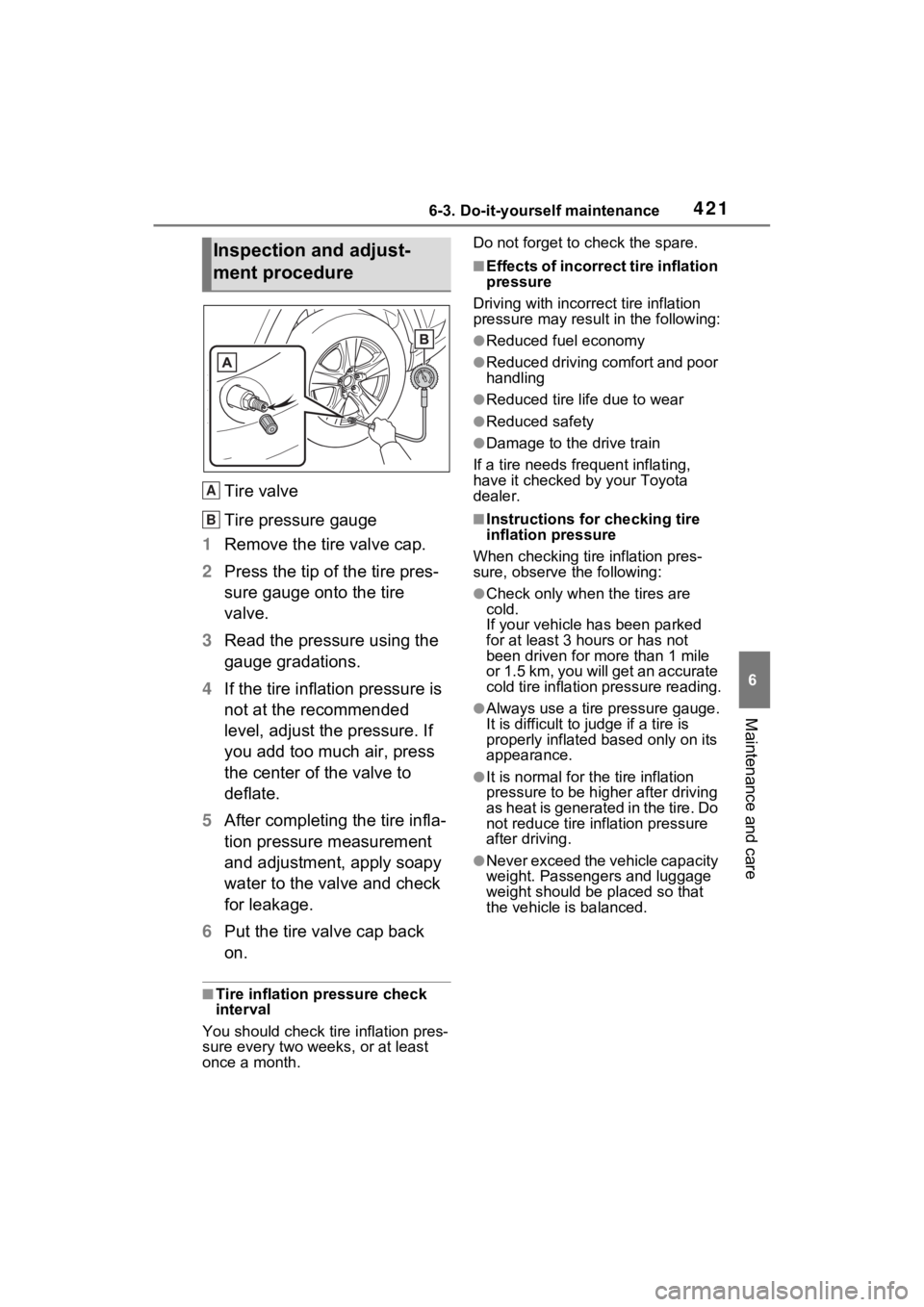
Tire valve
Tire pressure gauge
1 Remove the tire valve cap.
2 Press the tip of the tire pres-
sure gauge onto the tire
valve.
3 Read the pressure using the
gauge gradations.
4 If the tire inflation pressure is
not at the recommended
level, adjust the pressure. If
you add too much air, press
the center of the valve to
deflate.
5 After completing the tire infla-
tion pressure measurement
and adjustment, apply soapy
water to the valve and check
for leakage.
6 Put the tire valve cap back
on.
■Tire inflation pressure check
interval
You should check tire inflation pres-
sure every two weeks, or at least
once a month. Do not forget to
check the spare.
■Effects of incorrect tire inflation
pressure
Driving with incorrec t tire inflation
pressure may resul t in the following:
●Reduced fuel economy
●Reduced driving comfort and poor
handling
●Reduced tire life due to wear
●Reduced safety
●Damage to the drive train
If a tire needs frequent inflating,
have it checked by your Toyota
dealer.
■Instructions for checking tire
inflation pressure
When checking tire inflation pres-
sure, observe the following:
●Check only when the tires are
cold.
If your vehicle has been parked
for at least 3 hours or has not
been driven for more than 1 mile
or 1.5 km, you will get an accurate
cold tire inflation pressure reading.
●Always use a tire pressure gauge.
It is difficult to judge if a tire is
properly inflated based only on its
appearance.
●It is normal for the tire inflation
pressure to be higher after driving
as heat is generated in the tire. Do
not reduce tire inflation pressure
after driving.
●Never exceed the vehicle capacity
weight. Passengers and luggage
weight should be placed so that
the vehicle is balanced.
Inspection and adjust-
ment procedure
A
B
Page 464 of 586
4627-2. Steps to take in an emergency
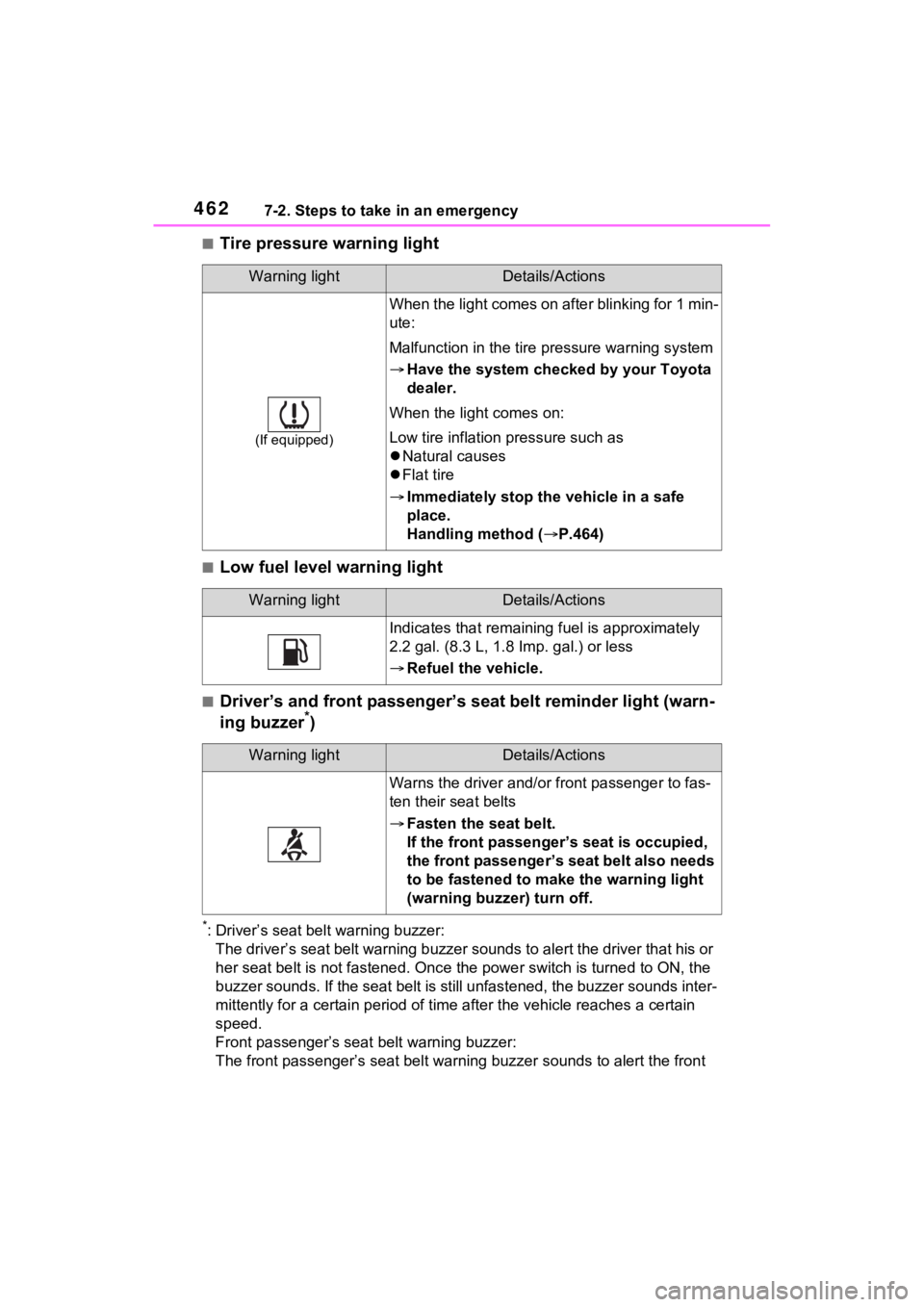
■Tire pressure warning light
■Low fuel level warning light
■Driver’s and front passenger’s seat belt reminder light (warn-
ing buzzer*)
*: Driver’s seat belt warning buzzer:
The driver’s seat belt warning buzzer sounds to alert the drive r that his or
her seat belt is not fastened. Onc e the power switch is turned to ON, the
buzzer sounds. If the seat belt is still unfastened, the buzzer sounds inter-
mittently for a certain period o f time after the vehicle reaches a certain
speed.
Front passenger’s seat belt warning buzzer:
The front passenger’s seat belt warning buzzer sounds to alert the front
Warning lightDetails/Actions
(If equipped)
When the light comes on after blinking for 1 min-
ute:
Malfunction in the tire pressure warning system
Have the system checked by your Toyota
dealer.
When the light comes on:
Low tire inflation pressure such as
Natural causes
Flat tire
Immediately stop the vehicle in a safe
place.
Handling method ( P.464)
Warning lightDetails/Actions
Indicates that remaining fuel is approximately
2.2 gal. (8.3 L, 1.8 Imp. gal.) or less
Refuel the vehicle.
Warning lightDetails/Actions
Warns the driver and/or front passenger to fas-
ten their seat belts
Fasten the seat belt.
If the front passenger’s seat is occupied,
the front passenger’s seat belt also needs
to be fastened to m ake the warning light
(warning buzzer) turn off.
Page 467 of 586
4657-2. Steps to take in an emergency
7
When trouble arises
WARNING
■When the electric power
steering system warning light
comes on
When the light comes on yellow,
the assist to the power steering is
restricted. When the light comes
on red, the assist to the power
steering is lost and handling oper-
ations of the steering wheel
become extremely heavy.
If the steering wheel becomes
heavier than usual when operat-
ing, hold firmly and operate using
more force than usual.
■If the tire pressure warning
light comes on (vehicles with
tire pressure warning system)
Be sure to observe the following
precautions. Failure to do so
could cause a loss of vehicle con-
trol and result in death or serious
injury.
●Stop your vehicle in a safe
place as soon as possible.
Adjust the tire inflation pressure
immediately.
●If the tire pressure warning light
comes on even after tire infla-
tion pressure adjustment, it is
probable that y ou have a flat
tire. Check the tires. If a tire is
flat, change it with the spare tire
and have the flat tire repaired by
the nearest Toyota dealer.
●Avoid abrupt maneuvering and
braking. If the vehicle tires dete-
riorate, you could lose control of
the steering wheel or the
brakes.
■If a blowout or sudden air
leakage should occur (vehi-
cles with tire pressure warn-
ing system)
The tire pressure warning system
may not activate immediately.
■Maintenance of the tires
(vehicles with tire pressure
warning system)
Each tire, includi ng the spare (if
provided), should be checked
monthly when cold and inflated to
the inflation pressure recom-
mended by the vehicle manufac-
turer on the vehicle placard or tire
inflation pressure label (tire and
load information label). (If your
vehicle has tires of a different size
than the size indicated on the
vehicle placard or tire inflation
pressure label [tire and load infor-
mation label], you should deter-
mine the proper tire inflation
pressure for those tires.)
As an added safety feature, your
vehicle has been equipped with a
tire pressure monitoring system
(TPMS-tire pressure warning sys-
tem) that illuminates a low tire
pressure telltale (tire pressure
warning light) w hen one or more
of your tires is s ignificantly under-
inflated. Accord ingly, when the
low tire pressure te lltale (tire pres-
sure warning light) illuminates,
you should stop and check your
tires as soon as possible, and
inflate them to the proper pres-
sure. Driving on a significantly
under-inflated tire causes the tire
to overheat and can lead to tire
failure. Under-inflation also
reduces fuel efficiency and tire
tread life, and may affect the vehi-
cle’s handling and stopping abil-
ity.
Please note that the TPMS (tire
pressure warning system) is not a
substitute for proper tire mainte-
nance, and it is the driver’s
responsibility to m aintain correct
tire pressure, even if under-infla-
tion has not reached the level to
trigger illumination of the TPMS
low tire pressure te lltale (tire pres-
sure warning light).
Page 484 of 586
4827-2. Steps to take in an emergency
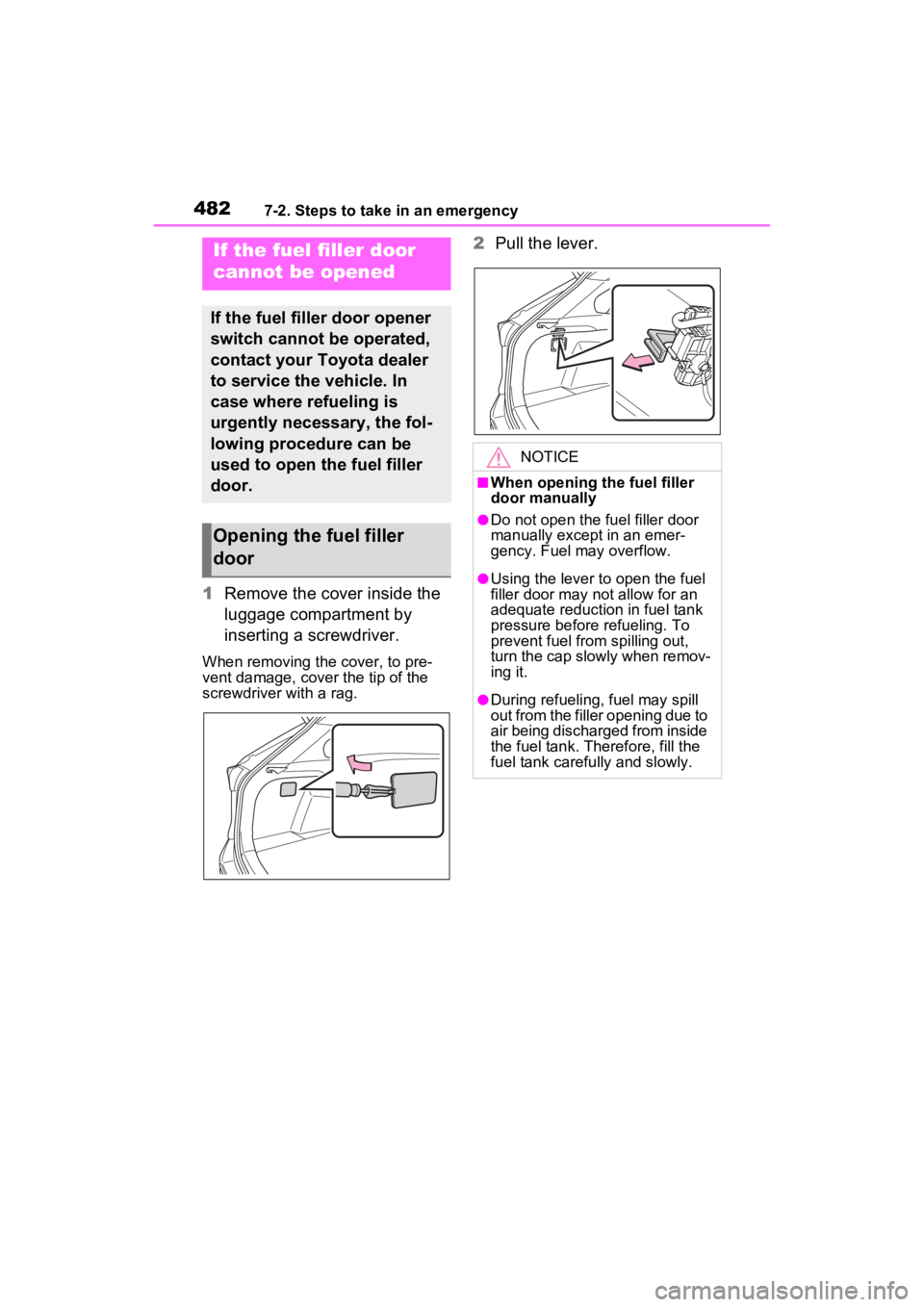
1Remove the cover inside the
luggage compartment by
inserting a screwdriver.
When removing the cover, to pre-
vent damage, cover the tip of the
screwdriver with a rag.
2 Pull the lever.If the fuel filler door
cannot be opened
If the fuel filler door opener
switch cannot be operated,
contact your Toyota dealer
to service the vehicle. In
case where refueling is
urgently necessary, the fol-
lowing procedure can be
used to open the fuel filler
door.
Opening the fuel filler
door
NOTICE
■When opening the fuel filler
door manually
●Do not open the fuel filler door
manually except in an emer-
gency. Fuel may overflow.
●Using the lever to open the fuel
filler door may not allow for an
adequate reduction in fuel tank
pressure before refueling. To
prevent fuel from spilling out,
turn the cap slowly when remov-
ing it.
●During refueling, fuel may spill
out from the filler opening due to
air being discharged from inside
the fuel tank. Therefore, fill the
fuel tank carefully and slowly.
Page 513 of 586
5118-1. Specifications
8
Vehicle specifications
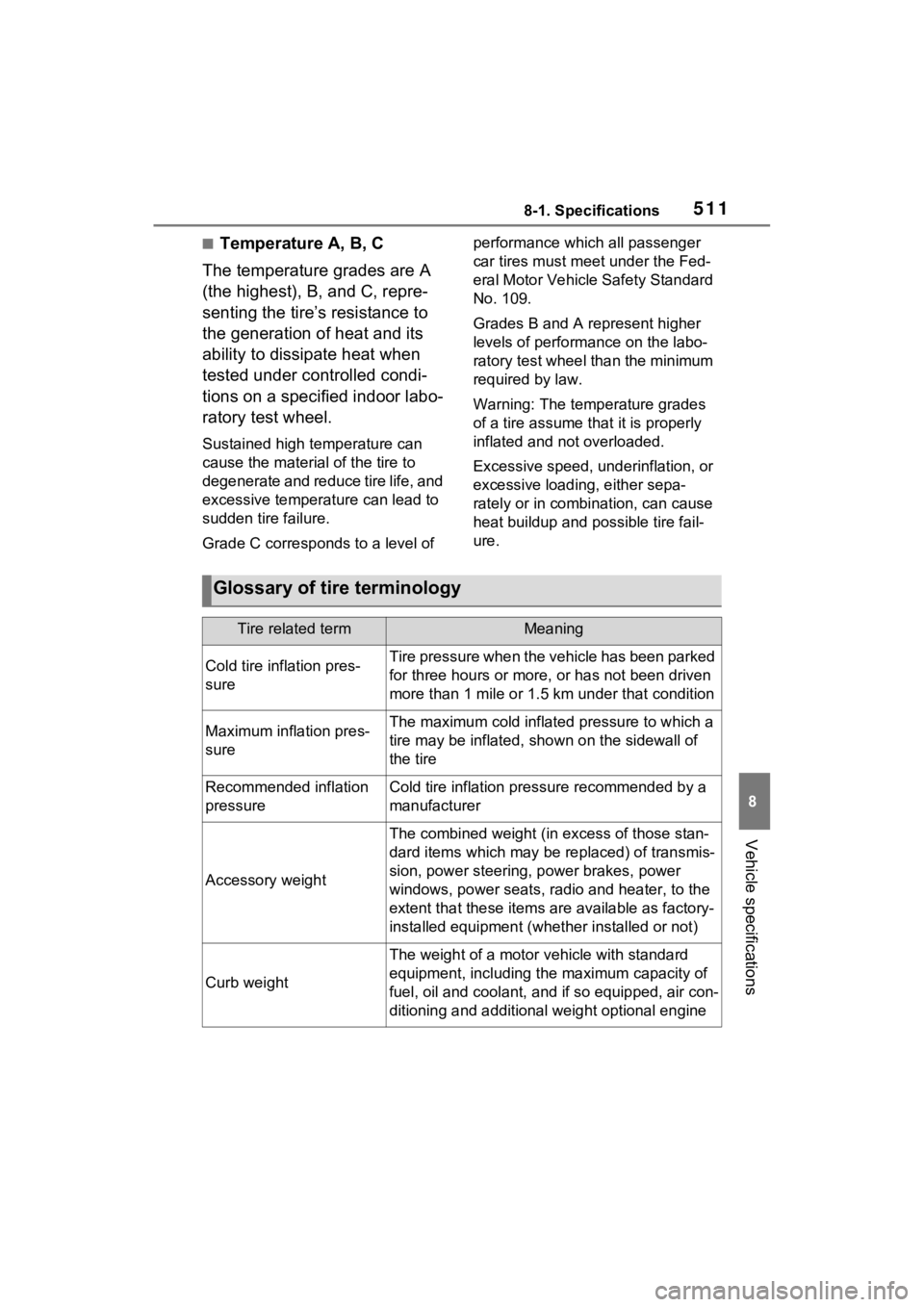
■Temperature A, B, C
The temperature grades are A
(the highest), B, and C, repre-
senting the tire’s resistance to
the generation of heat and its
ability to dissipate heat when
tested under controlled condi-
tions on a specified indoor labo-
ratory test wheel.
Sustained high temperature can
cause the material of the tire to
degenerate and reduce tire life, and
excessive temperature can lead to
sudden tire failure.
Grade C corresponds to a level of performance which all passenger
car tires must meet under the Fed-
eral Motor Vehicle Safety Standard
No. 109.
Grades B and A represent higher
levels of performance on the labo-
ratory test wheel than the minimum
required by law.
Warning: The temperature grades
of a tire assume tha
t it is properly
inflated and not overloaded.
Excessive speed, underinflation, or
excessive loading, either sepa-
rately or in combination, can cause
heat buildup and possible tire fail-
ure.
Glossary of tire terminology
Tire related termMeaning
Cold tire inflation pres-
sureTire pressure when the vehicle has been parked
for three hours or more, or has not been driven
more than 1 mile or 1.5 km under that condition
Maximum inflation pres-
sureThe maximum cold inflated pressure to which a
tire may be inflated, shown on the sidewall of
the tire
Recommended inflation
pressureCold tire inflation pressure recommended by a
manufacturer
Accessory weight
The combined weight (in excess of those stan-
dard items which may be replaced) of transmis-
sion, power steering, power brakes, power
windows, power seats, radio and heater, to the
extent that these items are available as factory-
installed equipment (whether installed or not)
Curb weight
The weight of a motor vehicle with standard
equipment, including th e maximum capacity of
fuel, oil and coolant, and if so equipped, air con-
ditioning and additional weight optional engine
Page 557 of 586

Alphabetical Index555
EV indicator .............................. 71
Exhaust gas precautions ......... 48
F
Flat tire .................................... 471Tire pressure warning system........................................... 412
Floor mats ................................. 26
Fluid Brake ............................ 405, 501
Hybrid transmission.............. 501
Rear differential .................... 501
Washer ................................. 406
Fog lights Replacing light bulbs ............ 439
Switch................................... 244
Footwell lights ..... ................... 352
Front passenger’s seat belt reminder light ....................... 462
Front passenger occupant clas- sification system .................... 43
Front position lights Light switch .......................... 237
Front seat heaters .................. 349
Front seats .............................. 160 Adjustment ........................... 160
Cleaning ............................... 387
Correct driving posture ........... 27
Driving position memory....... 163
Head restraints ..................... 166
Memory recall function ......... 165
Seat heaters ......................... 349
Seat position memory .......... 163
Seat ventilators .................... 349
Front side marker lights ........ 237 Light switch .......................... 237
Replacing light bulbs ............ 439
Wattage ................................ 504
Front turn signal lights Replacing light bulbs ............ 439
Turn signal lever................... 230
Wattage ................................ 504 Fuel
Capacity ...............................497
Fuel gauge .......................93, 99
Gas station information ........584
Information ......... ..................505
Refueling ..............................249
Type .............................497, 505
Warning light ........................462
Fuel filler door.........................250 If the fuel filler door cannot be opened ...............................482
Refueling ..............................249
Fuel gauge...........................93, 99
Fuses .......................................436
G
Garage door opene r ...............375
Gas station information .........584
Gauges ................................93, 99
Glove box ................................356
H
Headlight aim ..........................438 Headlight aim instructions for Canadian owners ...............544
Headlights ...............................237 Automatic High Beam system...........................................240
Light switch...........................237
Replacing light bulbs ............439
Head restraints .......................166
Heated steering wheel............349
Heaters Automatic air conditioning sys-tem .....................................342
Heated steering wheel..........349
Outside rear view mirrors .....344
Seat heaters ....... ..................349
High mounted stoplight Replacing light bulbs ............439
Hill-start assist control...........326
Page 566 of 586

564Alphabetical Index
Inappropriate pedal operation........................................... 461
Intuitive parking assist OFF indi- cator ................................... 459
Low engine oil pressure ....... 457
Low fuel level ....................... 462
LTA indicator ........................ 459
Malfunction indicator lamp ... 457
Parking brake indicator ........ 461
PCS warning light................. 459
PKSB (Parking Support Brake) ........................................... 460
PKSB OFF indicato r ............. 460
RCTA OFF indicator............. 460
Seat belt reminder light 462, 463
Slip indicator......................... 460
SRS ...................................... 458
Tire pressure ........................ 462
Warning messages ................ 466
Washer Checking .............................. 406
Low washer fluid warning mes-sage ........................... 406, 466
Preparing and c hecking before
winter.................................. 334
Switch........................... 244, 247
Washing and waxing .............. 384
Weight Cargo capacity ............. 202, 205
Load limits ............................ 205
Weight .................................. 496
Wheels ..................................... 422 Replacing wheels ................. 422
Size ...................................... 502
Window glasses Power windows .................... 183
Window lock switch ............... 185
Windows Power windows .................... 183
Rear window defogger ......... 344
Washer ......................... 244, 247
Windshield defogger .............. 344 Windshield wiper d
e-icer .......347
Windshield wipers Intermittent windshield wipers...........................................244
Position.........................244, 247
Rain-sensing windshield wipers ...........................................244
Replacing the wiper insert ....429
Winter driving tips ..................334
Wiper insert .............................429
Wireless charger.....................366
Wireless remote control.........132 Battery-saving function .........156
Locking/Unlocking ................132
Panic mode ..........................133
Replacing the battery ...........433
For information regarding the equipment listed
below, refer to the “MUL-
TIMEDIA OWNER’S MAN-
UAL”.
· Navigation system
· Audio system
Page 586 of 586
584
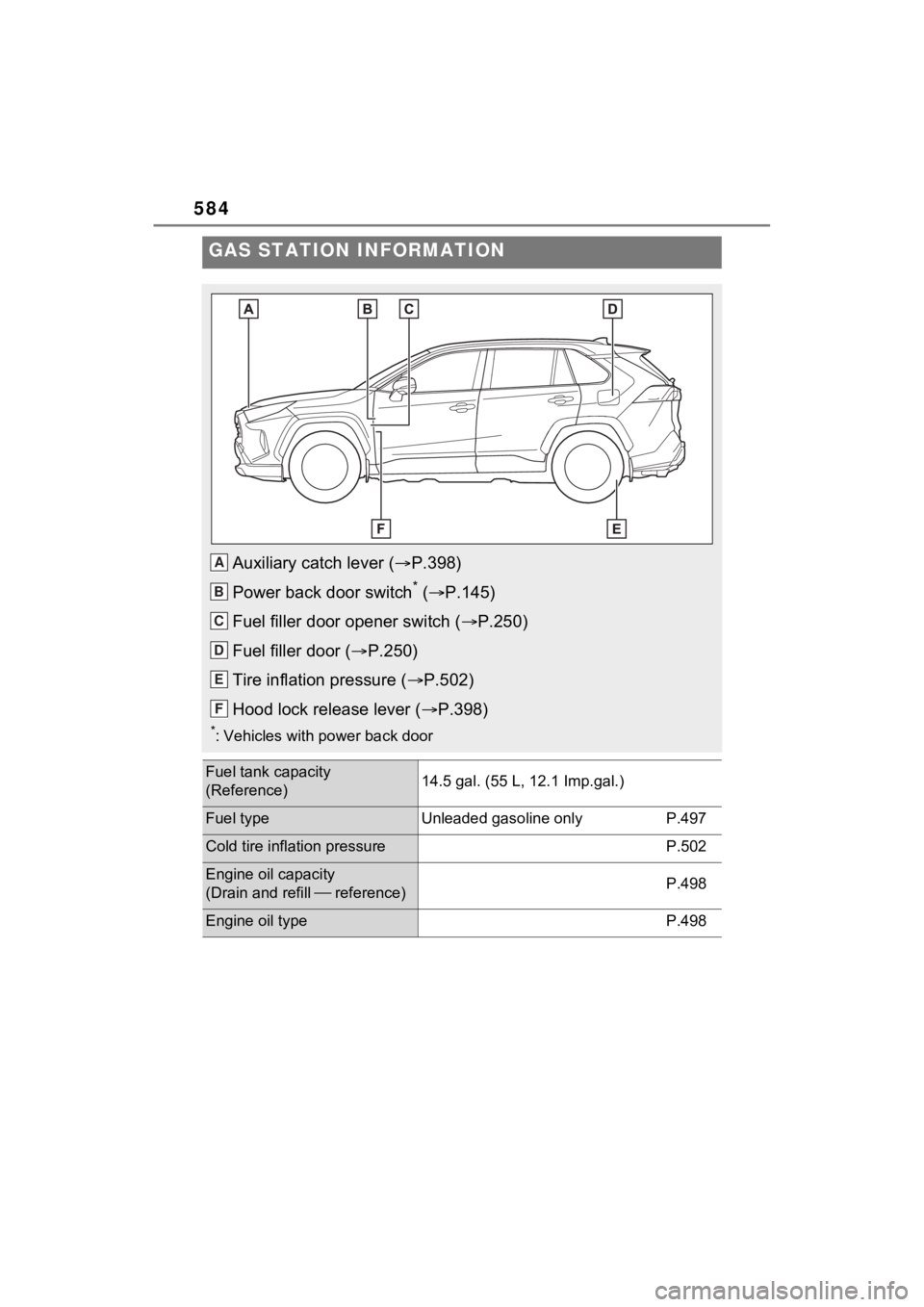
GAS STATION INFORMATION
Auxiliary catch lever (P.398)
Power back door switch
* ( P.145)
Fuel filler door opener switch ( P.250)
Fuel filler door ( P.250)
Tire inflation pressure ( P.502)
Hood lock release lever ( P.398)
*: Vehicles with power back door
Fuel tank capacity
(Reference)14.5 gal. (55 L, 12.1 Imp.gal.)
Fuel typeUnleaded gasoline onlyP.497
Cold tire infl ation pressureP.502
Engine oil capacity
(Drain and refill reference)P.498
Engine oil typeP.498
A
B
C
D
E
F