Page 458 of 608
4586-3. Do-it-yourself maintenance
4RUNNER (U)■
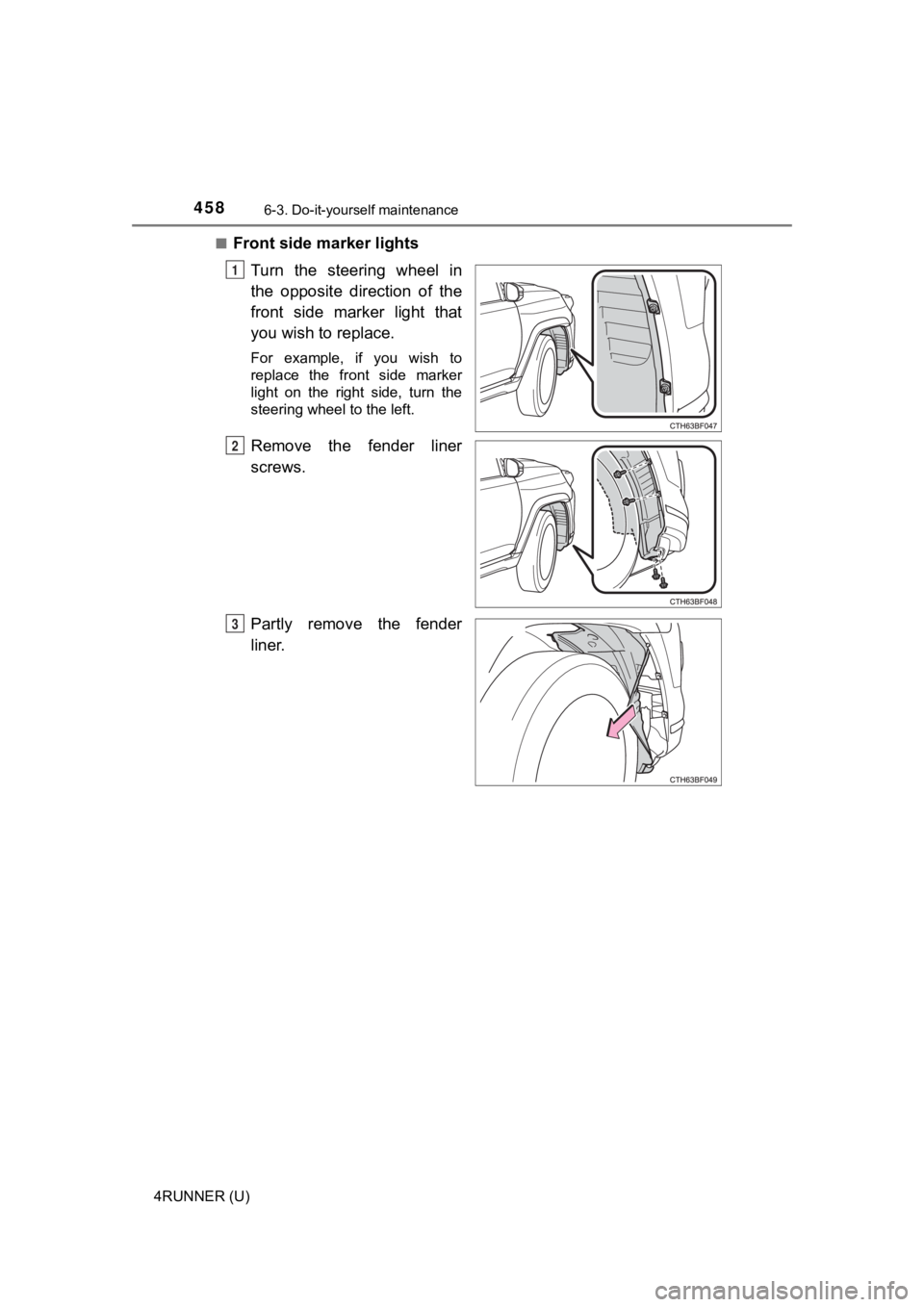
Front side marker lights
Turn the steering wheel in
the opposite direction of the
front side marker light that
you wish to replace.
For example, if you wish to
replace the front side marker
light on the right side, turn the
steering wheel to the left.
Remove the fender liner
screws.
Partly remove the fender
liner.
1
2
3
Page 467 of 608
4677-1. Essential information
7
When trouble arises
4RUNNER (U)
Steadily step on the brake pedal with both feet and firmly depress it.
Do not pump the brake pedal repeatedly as this will increase th e effort
required to slow the vehicle.
Shift the shift lever to N.
If the shift lever is shifted to N
After slowing down, stop the vehi cle in a safe place by the road.
Stop the engine.
If the shift lever cann ot be shifted to N
Keep depressing the brake pedal with both feet to reduce vehicl e
speed as much as possible.
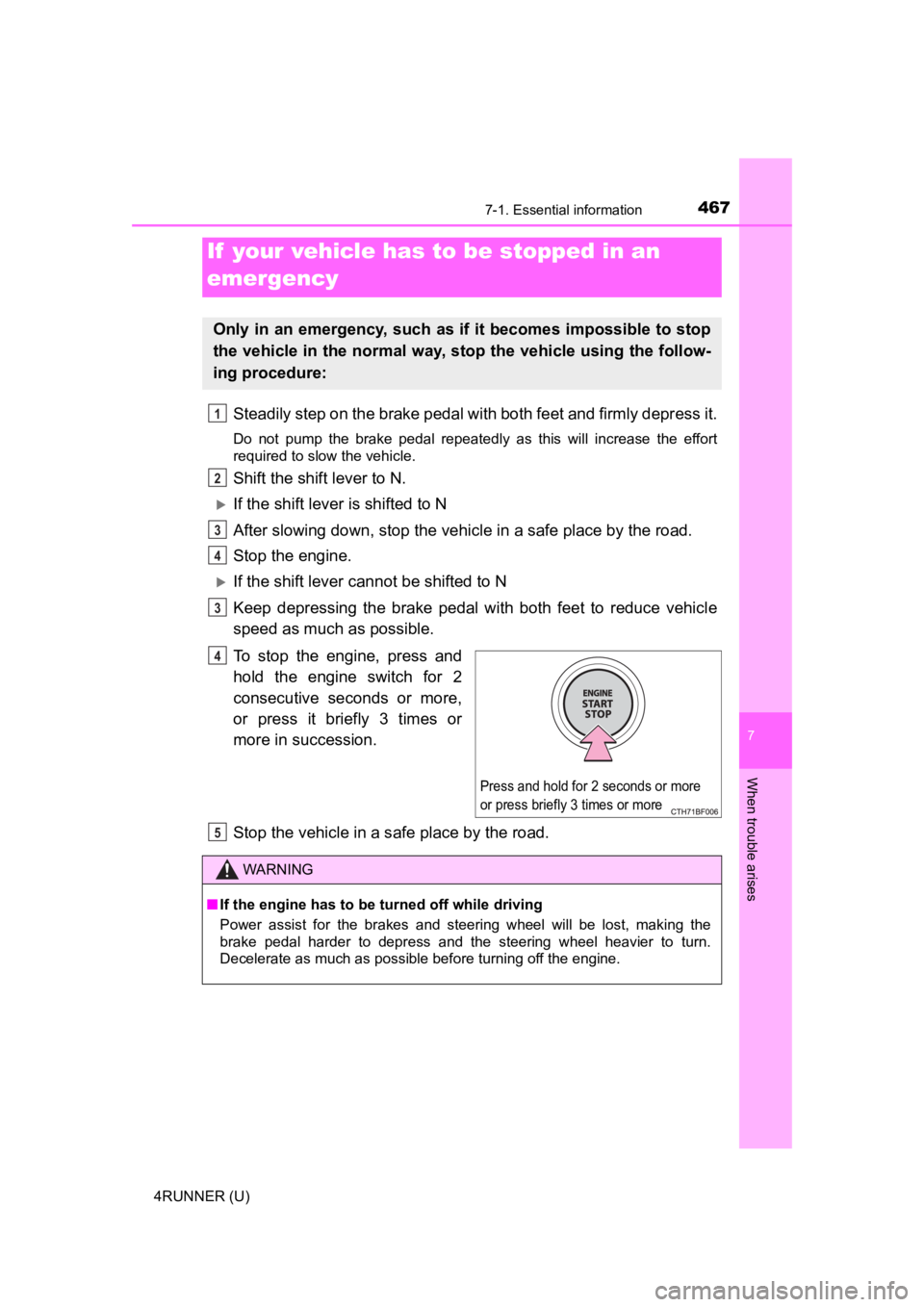
To stop the engine, press and
hold the engine switch for 2
consecutive seconds or more,
or press it briefly 3 times or
more in succession.
Stop the vehicle in a s afe place by the road.
If your vehicle has to be stopped in an
emergency
Only in an emergency, such as if it becomes impossible to stop
the vehicle in the normal way, st op the vehicle using the follow-
ing procedure:
1
2
3
4
3
Press and hold for 2 seconds or more
or press briefly 3 times or more
4
WARNING
■ If the engine has to be turned off while driving
Power assist for the brakes and steering wheel will be lost, making the
brake pedal harder to depress and the steering wheel heavier to turn.
Decelerate as much as possible before turning off the engine.
5
Page 472 of 608
4727-2. Steps to take in an emergency
4RUNNER (U)
When using a flat-bed truck to transport the vehicle, use tire strapping
belts. Refer to the owner's manual of the flat-bed truck for th e tire
strapping method.
In order to suppress vehicle movement during transportation, se t the
parking brake and turn the engine switch off.
If a tow truck is not available in an emergency, your vehicle m ay be
temporarily towed using cables or chains secured to the emergen cy
towing hooks. This should only be attempted on hard surfaced roads
for at most 50 miles (80 km) at under 18 mph (30 km/h).
A driver must be in the vehicle to steer and operate the brakes . The
vehicle’s wheels, drive train, a xles, steering and brakes must be in
good condition.
Using a flatbed truck
Emergency towing
Page 474 of 608
4747-2. Steps to take in an emergency
4RUNNER (U)
Part-time 4WD models:
Ty p e A
Shift the front-wheel drive control lever to H2.
Ty p e B
Push the “UNLOCK” button and turn the front-wheel drive control
switch to H2.
Full-time 4WD models: Push the “UNLOCK” button and turn the
four-wheel drive control switch to H4F. (The center differentia l is
unlocked.)
Shift the shift lever to N and release the parking brake.
When the shift lever cannot be shifted: P. 2 0 8
■While towing
If the engine is not running, the power assist for the brakes a nd steering will
not function, making steering and braking more difficult.
4
5
Page 479 of 608
4797-2. Steps to take in an emergency
7
When trouble arises
4RUNNER (U)
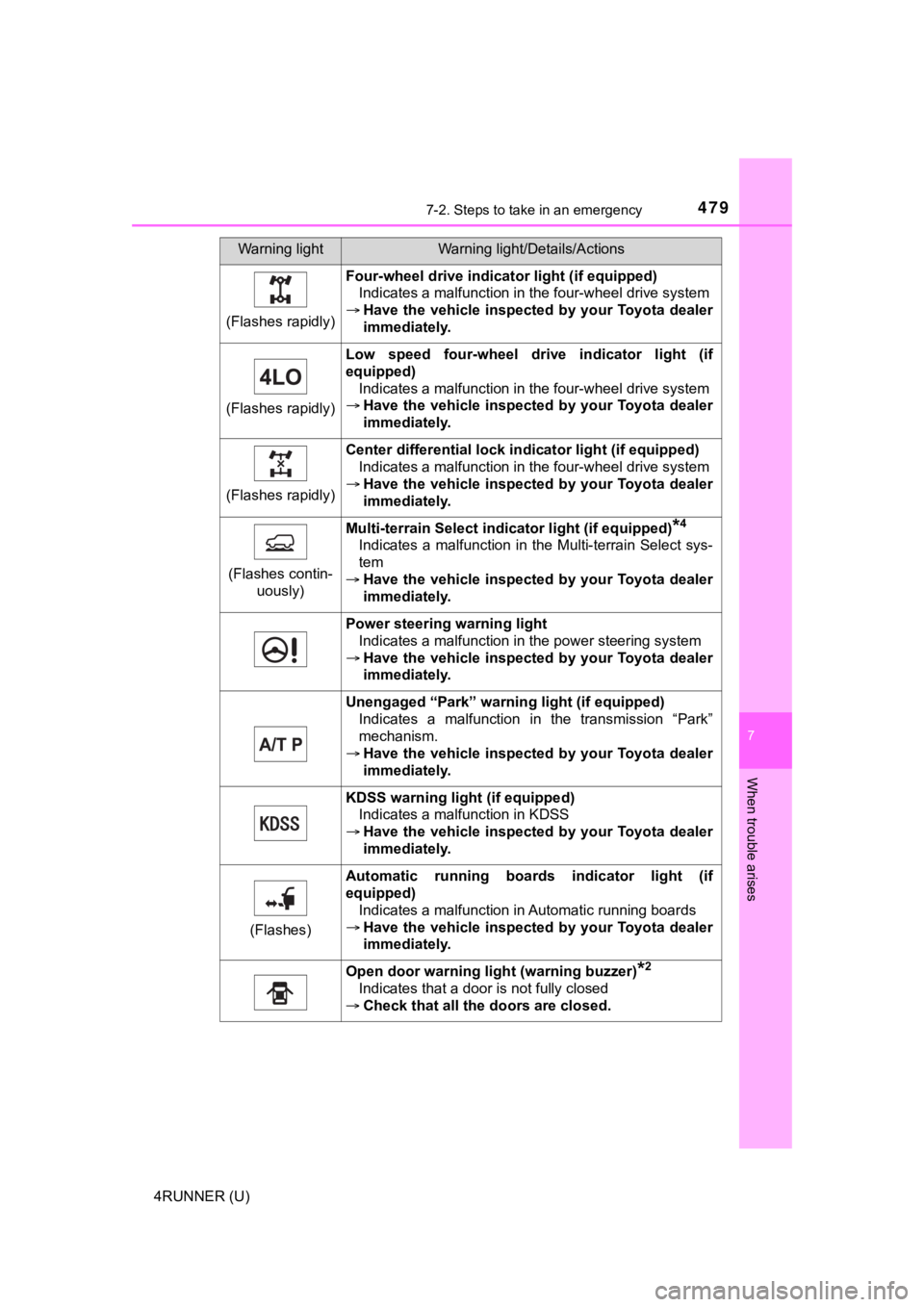
(Flashes rapidly)
Four-wheel drive indicator light (if equipped)
Indicates a malfunction in the four-wheel drive system
Have the vehicle inspected by your Toyota dealer
immediately.
(Flashes rapidly)
Low speed four-wheel dri ve indicator light (if
equipped) Indicates a malfunction in the four-wheel drive system
Have the vehicle inspected by your Toyota dealer
immediately.
(Flashes rapidly)
Center differential lock indicator light (if equipped)
Indicates a malfunction in the four-wheel drive system
Have the vehicle inspected by your Toyota dealer
immediately.
(Flashes contin-
uously)
Multi-terrain Select ind icator light (if equipped)*4
Indicates a malfunction in the Multi-terrain Select sys-
tem
Have the vehicle inspected by your Toyota dealer
immediately.
Power steering warning light
Indicates a malfunction in the power steering system
Have the vehicle inspected by your Toyota dealer
immediately.
Unengaged “Park” warning light (if equipped)
Indicates a malfunction in the transmission “Park”
mechanism.
Have the vehicle inspected by your Toyota dealer
immediately.
KDSS warning light (if equipped)
Indicates a malfunction in KDSS
Have the vehicle inspected by your Toyota dealer
immediately.
(Flashes)
Automatic running boards indicator light (if
equipped)
Indicates a malfunction in Automatic running boards
Have the vehicle inspected by your Toyota dealer
immediately.
Open door warning light (warning buzzer)*2
Indicates that a door is not fully closed
Check that all the doors are closed.
Warning lightWarning light/Details/Actions
Page 486 of 608

4867-2. Steps to take in an emergency
4RUNNER (U)
WARNING
■If the tire pressure warning light comes on
Be sure to observe the following precautions. Failure to do so could
cause a loss of vehicle control and result in death or serious injury.
●Stop your vehicle in a safe place as soon as possible. Adjust the tire
inflation pressure immediately.
●If the tire pressure warning light comes on even after tire inf lation pres-
sure adjustment, it is probable that you have a flat tire. Chec k the tires.
If a tire is flat, change it with the spare tire and have the flat tire
repaired by the nearest Toyota dealer.
●Avoid abrupt maneuvering and braking. If the vehicle tires dete riorate,
you could lose control of the steering wheel or the brakes.
■If a blowout or sudden air leakage should occur
The tire pressure warning system may not activate immediately.
■Maintenance of the tires
Each tire, including the spare (if provided), should be checked monthly
when cold and inflated to the inflation pressure recommended by the
vehicle manufacturer on the vehicle placard or tire inflation p ressure
label (tire and load information label). (If your vehicle has t ires of a dif-
ferent size than the size indicated on the vehicle placard or t ire inflation
pressure label [tire and load information label], you should de termine
the proper tire inflation p ressure for those tires.)
As an added safety feature, your vehicle has been equipped with a tire
pressure monitoring system (TPMS -tire pressure warning system) that
illuminates a low tire pressure telltale (tire pressure warning light) when
one or more of your tires is significantly under-inflated. Acco rdingly,
when the low tire pressure telltale (tire pressure warning ligh t) illumi-
nates, you should stop and check your tires as soon as possible , and
inflate them to the proper pressure. Driving on a significantly under-
inflated tire causes the tire to overheat and can lead to tire failure.
Under-inflation also reduces fuel efficiency and tire tread lif e, and may
affect the vehicle’s handling and stopping ability.
Please note that the TPMS (tire pressure warning system) is not a sub-
stitute for proper tire maintenance, and it is the driver’s res ponsibility to
maintain correct tire pressure, even if under-inflation has not reached
the level to trigger illumination of the TPMS low tire pressure telltale (tire pressure warning light).
Page 532 of 608
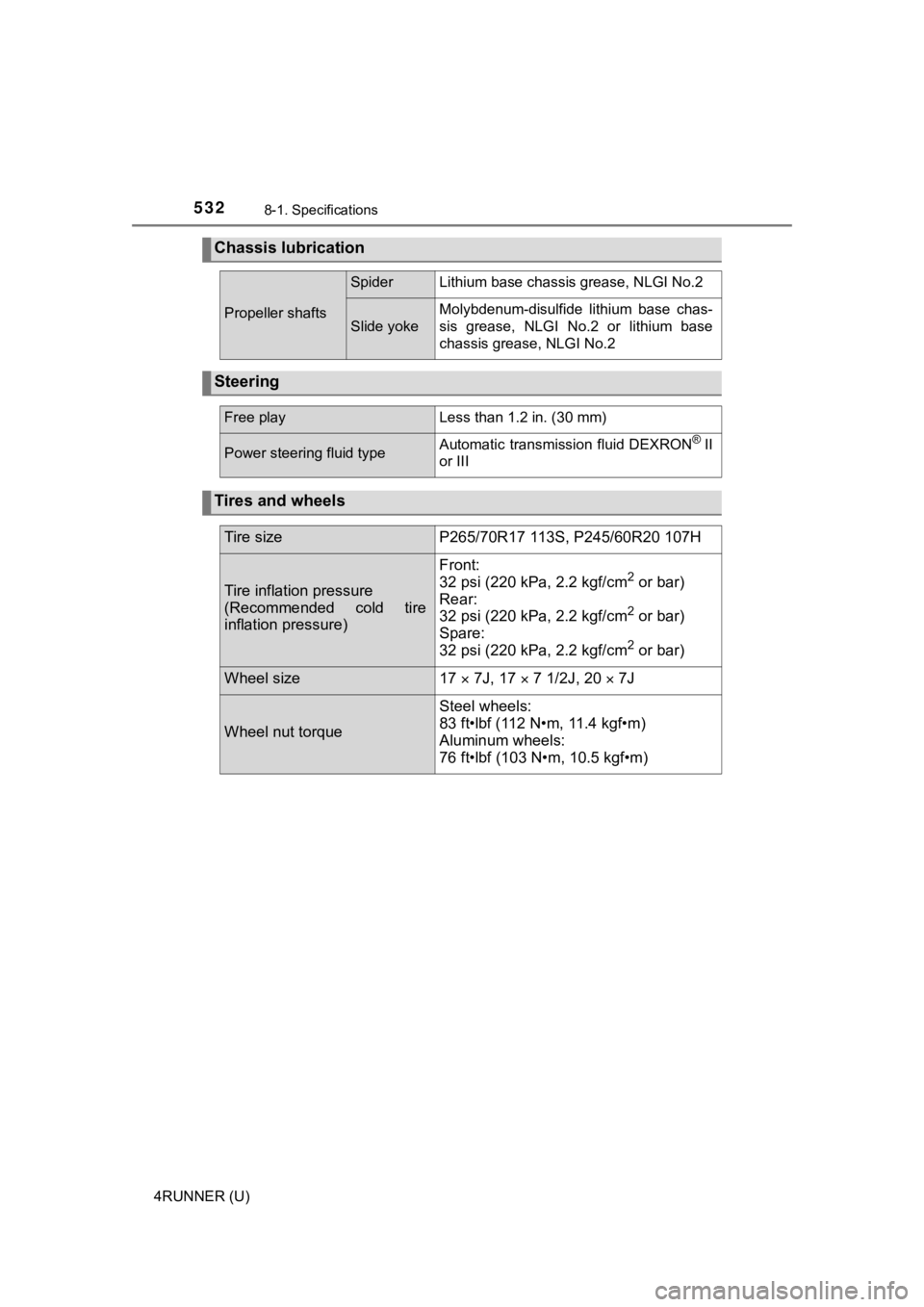
5328-1. Specifications
4RUNNER (U)
Chassis lubrication
Propeller shafts
SpiderLithium base chassis grease, NLGI No.2
Slide yoke
Molybdenum-disulfide lithium base chas-
sis grease, NLGI No.2 or lithium base
chassis grease, NLGI No.2
Steering
Free playLess than 1.2 in. (30 mm)
Power steering fluid typeAutomatic transmission fluid DEXRON® II
or III
Tires and wheels
Tire sizeP265/70R17 113S, P245/60R20 107H
Tire inflation pressure
(Recommended cold tire
inflation pressure)
Front:
32 psi (220 kPa, 2.2 kgf/cm2 or bar)
Rear:
32 psi (220 kPa, 2.2 kgf/cm
2 or bar)
Spare:
32 psi (220 kPa, 2.2 kgf/cm
2 or bar)
Wheel size17 7J, 17 7 1/2J, 20 7J
Wheel nut torque
Steel wheels:
83 ft•lbf (112 N•m, 11.4 kgf•m)
Aluminum wheels:
76 ft•lbf (103 N•m, 10.5 kgf•m)
Page 543 of 608
5438-1. Specifications
8
Vehicle specifications
4RUNNER (U)
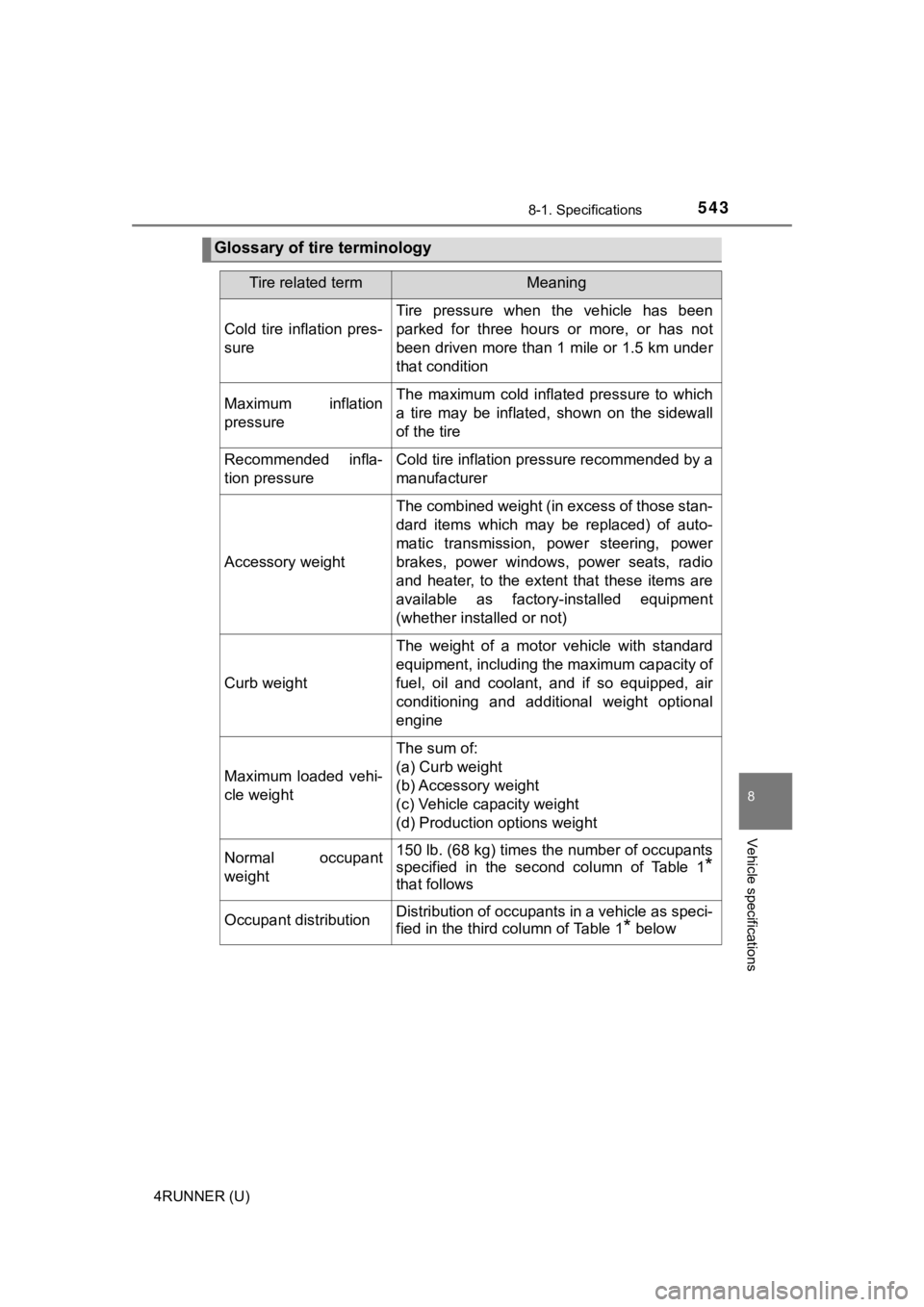
Glossary of tire terminology
Tire related termMeaning
Cold tire inflation pres-
sure
Tire pressure when the vehicle has been
parked for three hours or more, or has not
been driven more than 1 mile or 1.5 km under
that condition
Maximum inflation
pressureThe maximum cold inflated pressure to which
a tire may be inflated, shown on the sidewall
of the tire
Recommended infla-
tion pressureCold tire inflation pressure recommended by a
manufacturer
Accessory weight
The combined weight (in excess of those stan-
dard items which may be replaced) of auto-
matic transmission, power steering, power
brakes, power windows, power seats, radio
and heater, to the extent that these items are
available as factory-installed equipment
(whether installed or not)
Curb weight
The weight of a motor vehicle with standard
equipment, including the maximum capacity of
fuel, oil and coolant, and if so equipped, air
conditioning and additional weight optional
engine
Maximum loaded vehi-
cle weight
The sum of:
(a) Curb weight
(b) Accessory weight
(c) Vehicle capacity weight
(d) Production options weight
Normal occupant
weight150 lb. (68 kg) times the number of occupants
specified in the second column of Table 1
*
that follows
Occupant distributionDistribution of occupants in a vehicle as speci-
fied in the third column of Table 1
* below