2023 RAM PROMASTER air filter
[x] Cancel search: air filterPage 7 of 296

5
SAFETY TIPS ........................................................ 189 Transporting Passengers .............................. 189Transporting Pets ......................................... 190
Connected Vehicles....................................... 190
Safety Checks You Should Make Inside The
Vehicle ........................................................... 190Periodic Safety Checks You Should Make
Outside The Vehicle ...................................... 191Exhaust Gas ................................................... 192Carbon Monoxide Warnings ......................... 192
IN CASE OF EMERGENCY
HAZARD WARNING FLASHERS ......................... 193
SOS AND ASSIST SYSTEM ................................. 193
JACKING AND TIRE CHANGING.......................... 196
Preparations For Jacking .............................. 197Jack And Tools Location................................ 197
Spare Tire Removal ....................................... 198
Jacking Instructions ...................................... 200Wheel Covers ................................................. 203
TIRE SERVICE KIT — IF EQUIPPED ..................... 203
Alternate Tire Service Kit —
If Equipped..................................................... 209
Tire Service Kit Components And
Operation ....................................................... 209
Tire Service Kit Usage Precautions .............. 210
Sealing A Tire With Tire Service Kit .............. 211 JUMP STARTING .................................................. 214
Preparations For Jump Start ........................ 214
Jump Starting Procedure .............................. 215Battery Location ............................................ 216
IF YOUR ENGINE OVERHEATS .......................... 216
GEAR SELECTOR OVERRIDE ............................. 217
FREEING A STUCK VEHICLE .............................. 218
TOWING A DISABLED VEHICLE ......................... 219 Automatic Transmission ............................... 220
ENHANCED ACCIDENT RESPONSE
SYSTEM (EARS) ................................................... 220
EVENT DATA RECORDER (EDR) ........................ 220SERVICING AND MAINTENANCE
SCHEDULED SERVICING ................................... 221
Maintenance Plan ......................................... 222
ENGINE COMPARTMENT .................................... 225
3.6L Engine .................................................. 225
Checking Oil Level ......................................... 226
Adding Washer Fluid ..................................... 226
Maintenance-Free Battery ........................... 227Pressure Washing ......................................... 227
VEHICLE MAINTENANCE..................................... 227
Engine Oil ....................................................... 228
Engine Oil Filter ............................................ 228
Engine Air Cleaner Filter .............................. 228Air Conditioner Maintenance ....................... 229 Body Lubrication ........................................... 231
Windshield Wiper Blades ............................. 231
Exhaust System ............................................ 232
Cooling System.............................................. 233
Brake System ............................................... 235Automatic Transmission ............................... 236
Fuses.............................................................. 236
Bulb Replacement ....................................... 244
TIRES .................................................................... 249
Tire Safety Information ................................ 249Tires — General Information ......................... 256
Tire Types....................................................... 259Spare Tires — If Equipped ............................ 260
Wheel And Wheel Trim Care ........................ 262Snow Traction Devices ................................. 263
Tire Rotation Recommendations ................. 264
DEPARTMENT OF TRANSPORTATION UNIFORM
TIRE QUALITY GRADES ...................................... 264
Treadwear...................................................... 264
Traction Grades ............................................. 264Temperature Grades..................................... 265
STORING THE VEHICLE ...................................... 265
BODYWORK .......................................................... 265
Protection From Atmospheric Agents .......... 265
Body And Underbody Maintenance ............. 266
Preserving The Bodywork ............................. 266
23_VF_OM_EN_USC_t.book Page 5
Page 45 of 296
GETTING TO KNOW YOUR VEHICLE43
Climate Control OFF Button
Press and release this button to turn the
Climate Control ON/OFF.
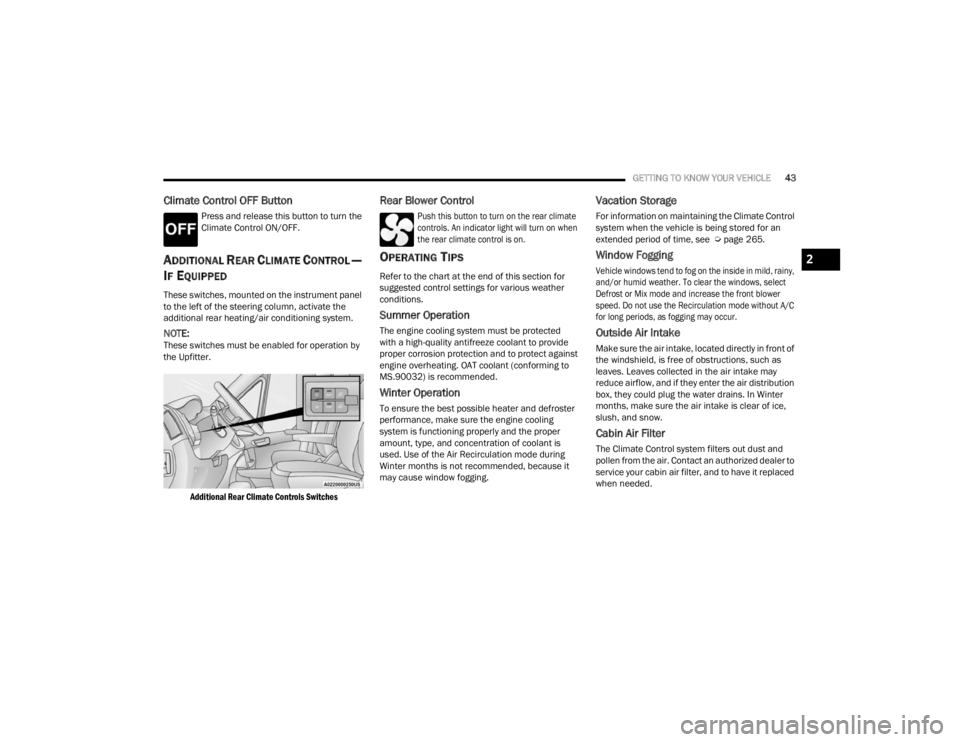
ADDITIONAL REAR CLIMATE CONTROL —
I
F EQUIPPED
These switches, mounted on the instrument panel
to the left of the steering column, activate the
additional rear heating/air conditioning system.
NOTE:These switches must be enabled for operation by
the Upfitter.
Additional Rear Climate Controls Switches
Rear Blower Control
Push this button to turn on the rear climate
controls. An indicator light will turn on when
the rear climate control is on.
OPERATING TIPS
Refer to the chart at the end of this section for
suggested control settings for various weather
conditions.
Summer Operation
The engine cooling system must be protected
with a high-quality antifreeze coolant to provide
proper corrosion protection and to protect against
engine overheating. OAT coolant (conforming to
MS.90032) is recommended.
Winter Operation
To ensure the best possible heater and defroster
performance, make sure the engine cooling
system is functioning properly and the proper
amount, type, and concentration of coolant is
used. Use of the Air Recirculation mode during
Winter months is not recommended, because it
may cause window fogging.
Vacation Storage
For information on maintaining the Climate Control
system when the vehicle is being stored for an
extended period of time, see Ú page 265.
Window Fogging
Vehicle windows tend to fog on the inside in mild, rainy,
and/or humid weather. To clear the windows, select
Defrost or Mix mode and increase the front blower
speed. Do not use the Recirculation mode without A/C
for long periods, as fogging may occur.
Outside Air Intake
Make sure the air intake, located directly in front of
the windshield, is free of obstructions, such as
leaves. Leaves collected in the air intake may
reduce airflow, and if they enter the air distribution
box, they could plug the water drains. In Winter
months, make sure the air intake is clear of ice,
slush, and snow.
Cabin Air Filter
The Climate Control system filters out dust and
pollen from the air. Contact an authorized dealer to
service your cabin air filter, and to have it replaced
when needed.
2
23_VF_OM_EN_USC_t.book Page 43
Page 224 of 296

222SERVICING AND MAINTENANCE
MAINTENANCE PLAN
Refer to the maintenance plan for the required maintenance intervals. More frequent maintenance may be needed in severe conditions, such as dusty areas
and very short trip driving. In some extreme conditions, additional maintenance not specified in the maintenance schedule may be required.
At Every Oil Change Interval As Indicated By Oil Change Indicator System:
Change oil and filter.
Rotate the tires at the first sign of irregular wear, even if it occurs before the oil indicator system turns on.
Inspect battery and clean and tighten terminals as required.
Inspect the CV/Universal joints.
Inspect brake pads, shoes, rotors, drums, hoses and parking brake.
Inspect engine cooling system protection and hoses.
Inspect exhaust system.
Inspect engine air cleaner filter if using in dusty or off-road conditions.
Inspect and replace the Evaporative System Fresh Air Filter as necessary, replacement may be more frequent if vehicle is operated in extreme dusty conditions.
23_VF_OM_EN_USC_t.book Page 222
Page 225 of 296

SERVICING AND MAINTENANCE223
Mileage Or Time Passed (Whichever Comes First)
20,000
30,000
40,000
50,000
60,000
70,000
80,000
90,000
100,000
110,000
120,000
130,000
140,000
150,000
Or Years: 2 3 4 5 6 7 8 9 10 11 12 13 14 15
Or Kilometers:
32,000
48,000
64,000
80,000
96,000
112,000
128,000
144,000
160,000
176,000
192,000
208,000
224,000
240,000
Additional Inspections
Inspect the CV/Universal joints. X X X X X X X X X X X X X X
Inspect front suspension, tie rod ends, boot seals, and replace if
necessary. X X X X X X X
Inspect the brake pads, replace as necessary. X X X X X X X
Inspect the rear door net block gap, adjust/replace as necessary. XXXXX
Additional Maintenance
Replace the engine air cleaner filter. XXXXX
Inspect the cabin air filter, replace as necessary. X X X X X X X
Replace the Brake Fluid every two years.
1X X X X X X X
Replace the spark plugs.
1X
8
23_VF_OM_EN_USC_t.book Page 223
Page 227 of 296

SERVICING AND MAINTENANCE225
ENGINE COMPARTMENT
3.6L ENGINE
1 — Washer Fluid Reservoir Cap 5 — Engine Oil Dipstick
2 — Brake Fluid Reservoir Cap 6 — Coolant Reservoir Cap
3 — Engine Air Cleaner Filter 7 — Power Distribution Center (Fuses)
4 — Engine Oil Fill
8
23_VF_OM_EN_USC_t.book Page 225
Page 230 of 296

228SERVICING AND MAINTENANCE
ENGINE OIL
Engine Oil Selection
Use only the manufacturer's recommended fluids
Úpage 273.
American Petroleum Institute (API)
Approved Engine Oil
These symbols mean that the oil has been certified
by the API. The manufacturer only recommends API
trademark oils.
The API Starburst trademark certifies
0W-20, 0W-30 and 5W-30 engine oils.
The API Donut trademark certifies 0W-40
and 5W-40 engine oil.
Synthetic Engine Oils
Your engine was designed for synthetic engine oils,
only use synthetic API approved engine oils.
Synthetic engine oils which do not have both the
engine oil certification mark and the correct SAE
viscosity grade number should not be used.
Materials Added To Engine Oil
The manufacturer strongly recommends against
the addition of any additives (other than leak
detection dyes) to the engine oil. Engine oil is an
engineered product and its performance may be
impaired by supplemental additives.
Disposing Of Used Engine Oil And Oil
Filters
Care should be taken in disposing of used engine oil
and oil filters from your vehicle. Used oil and oil filters,
indiscriminately discarded, can present a problem to
the environment. Contact an authorized dealer, service
station or governmental agency for advice on how and
where used oil and oil filters can be safely discarded in
your area.
ENGINE OIL FILTER
The engine oil filter should be replaced with a new
filter at every engine oil change. Engine Oil Filter Selection
A full-flow type disposable oil filter should be used
for replacement. The quality of replacement filters
varies considerably. Only high quality Mopar®
certified filters should be used. If a Mopar® Engine
Oil Filter is unavailable, only use filters that meet
or exceed SAE/USCAR-36 Filter Performance
Requirements.
ENGINE AIR CLEANER FILTER
For the proper maintenance intervals
Úpage 222.
NOTE:Be sure to follow the “Severe Duty Conditions”
maintenance interval if applicable.
CAUTION!
Do not use chemical flushes in your engine oil as
the chemicals can damage your engine. Such
damage is not covered by the New Vehicle
Limited Warranty.
WARNING!
The air induction system (air cleaner, hoses,
etc.) can provide a measure of protection in
the case of engine backfire. Do not remove the
air induction system (air cleaner, hoses, etc.)
unless such removal is necessary for repair or
maintenance. Make sure that no one is near the
engine compartment before starting the vehicle
with the air induction system (air cleaner, hoses,
etc.) removed. Failure to do so can result in
serious personal injury.
23_VF_OM_EN_USC_t.book Page 228
Page 231 of 296

SERVICING AND MAINTENANCE229
Engine Air Cleaner Filter Selection
The quality of replacement filters varies
considerably. Only high quality Mopar® certified
filters should be used.
Engine Air Cleaner Filter Inspection and
Replacement
Engine Air Cleaner Filter Removal
1. With a suitable tool, loosen the clamps and remove the engine air duct supply hose.
Engine Air Duct Supply Hose
2. With a suitable tool, fully loosen fasteners on the engine air cleaner filter cover and remove
the cover.
Engine Air Cleaner Filter Cover
3. Remove the engine air cleaner filter from the housing assembly.
Engine Air Cleaner Filter
Engine Air Cleaner Filter Installation
NOTE:Inspect and clean the housing assembly if signif
-
icant dirt or debris is present before replacing the
engine air cleaner filter.
1. Install the engine air cleaner filter into the housing assembly.
2. Install the engine air cleaner filter cover onto the housing assembly.
3. Tighten the fasteners on the engine air cleaner filter assembly.
4. Install the engine air duct supply hose and tighten the clamps
AIR CONDITIONER MAINTENANCE
For best possible performance, your air conditioner
should be checked and serviced by an authorized
dealer at the start of each warm season. This
service should include cleaning of the condenser
fins and a performance test. Drive belt tension
should also be checked at this time.
1 — Clamps
2 — Engine Air Duct Supply Hose
1 — Fasteners
2 — Engine Air Cleaner Filter Cover
1 — Engine Air Cleaner Filter
8
23_VF_OM_EN_USC_t.book Page 229
Page 232 of 296

230SERVICING AND MAINTENANCE
Refrigerant Recovery And Recycling
R-134a Air Conditioning Refrigerant is a Hydrofluo -
rocarbon (HFC) that is an ozone-saving product.
However, the manufacturer recommends that air
conditioning service be performed by authorized
dealer or other service facilities using recovery and
recycling equipment.
NOTE:Use only the manufacturer approved A/C system
PAG compressor oil and refrigerants.
Cabin Air Filter
Refer to the Maintenance Plan in this chapter for
the proper maintenance intervals Ú page 222.The cabin air filter is located in the fresh air inlet in
the engine compartment. Perform the following
procedure to replace the filter:
1. Remove the two screws that secure the filter
retainer to the fresh air inlet, and remove the
filter retainer.
Accessing Air Filter
WARNING!
Use only refrigerants and compressor lubricants
approved by the manufacturer for your air condi -
tioning system. Some unapproved refrigerants are
flammable and can explode, injuring you. Other
unapproved refrigerants or lubricants can cause
the system to fail, requiring costly repairs. Refer to
Warranty Information Book, for further warranty
information.
The air conditioning system contains refrig -
erant under high pressure. To avoid risk of
personal injury or damage to the system,
adding refrigerant or any repair requiring lines
to be disconnected should be done by an
experienced technician.
CAUTION!
Do not use chemical flushes in your air
conditioning system as the chemicals can
damage your air conditioning components.
Such damage is not covered by the New Vehicle
Limited Warranty.
WARNING!
Do not remove the cabin air filter while the
vehicle is running, or while the ignition is in the
ACC or ON/RUN position. With the cabin air filter
removed and the blower operating, the blower
can contact hands and may propel dirt and
debris into your eyes, resulting in personal injury.
1 — Screw Locations
2 — Fresh Air Inlet
23_VF_OM_EN_USC_t.book Page 230