2023 PEUGEOT EXPERT ESP
[x] Cancel search: ESPPage 46 of 348
44
Access
(the right-hand door is not detected). For more
information on the List of warning lamps and,
in particular, the door open warning, refer to the
corresponding section.
Opening to approximately
180°
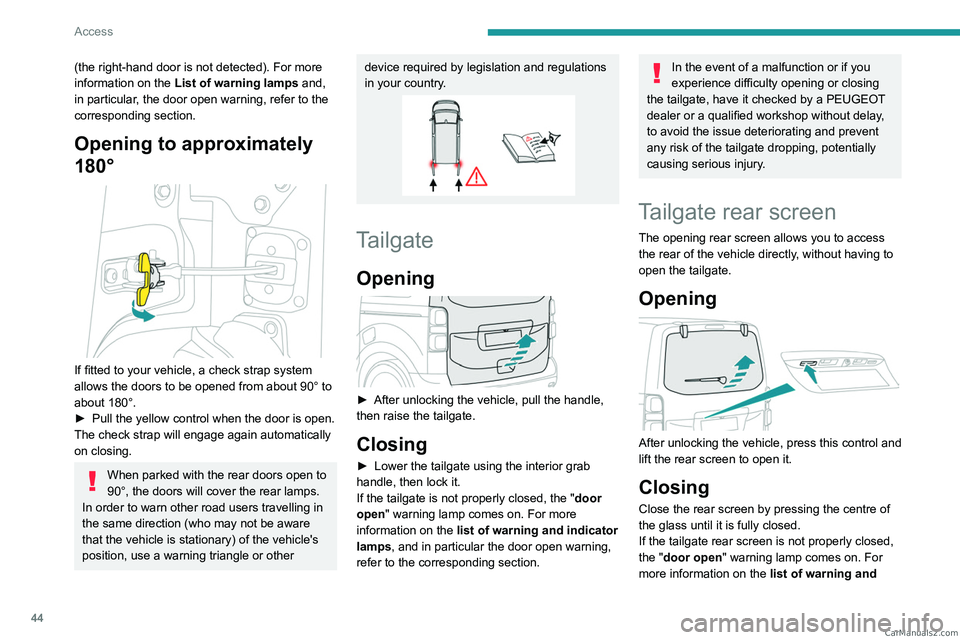
If fitted to your vehicle, a check strap system
allows the doors to be opened from about 90° to
about 180°.
►
Pull the yellow control when the door is open.
The check strap will engage again automatically
on closing.
When parked with the rear doors open to
90°, the doors will cover the rear lamps.
In order to warn other road users travelling in
the same direction (who may not be aware
that the vehicle is stationary) of the vehicle's
position, use a warning triangle or other
device required by legislation and regulations
in your country.
Tailgate
Opening
► After unlocking the vehicle, pull the handle,
then raise the tailgate.
Closing
► Lower the tailgate using the interior grab
handle, then lock it.
If the tailgate is not properly closed, the " door
open
" warning lamp comes on. For more
information on the list of warning and indicator
lamps, and in particular the door open warning,
refer to the corresponding section.
In the event of a malfunction or if you
experience difficulty opening or closing
the tailgate, have it checked by a PEUGEOT
dealer or a qualified workshop without delay,
to avoid the issue deteriorating and prevent
any risk of the tailgate dropping, potentially
causing serious injury.
Tailgate rear screen
The opening rear screen allows you to access
the rear of the vehicle directly, without having to
open the tailgate.
Opening
After unlocking the vehicle, press this control and
lift the rear screen to open it.
Closing
Close the rear screen by pressing the centre of
the glass until it is fully closed.
If the tailgate rear screen is not properly closed,
the "door open " warning lamp comes on. For
more information on the list of warning and CarM an uals 2 .c o m
Page 47 of 348

45
Access
2indicator lamps and in particular the door open
warning, refer to the corresponding section.
The tailgate and rear screen cannot both be open at the same time, to avoid
damaging them.
Alarm
(Depending on version)
System which protects and provides a deterrent
against theft and break-ins.
Exterior perimeter monitoring
The system checks for opening of the vehicle.
The alarm is triggered if anyone tries to open a
door, the boot or the bonnet, for example.
Interior volumetric monitoring
The system only checks for any
variation in volume in the cab.
The alarm is triggered if anyone
breaks a window or enters the
vehicle’s cab; however it is not
triggered if someone enters the
loading area.
The system checks for any
variation in volume in the
passenger compartment.
The alarm is triggered if anyone
breaks a window, enters the
passenger compartment or
moves inside the vehicle.
Self-protection function
The system checks whether any of its
components are out of service.
The alarm is triggered if the battery, the central
control or the siren wiring is put out of service or
damaged.
Work on the alarm system
Consult a PEUGEOT dealer or a
qualified workshop.
If your vehicle is fitted with Additional
Heating / Ventilation, volumetric
monitoring is not compatible with this system.
For more information on Additional Heating
/ Ventilation , refer to the corresponding
section.
Locking the vehicle with full
alarm system
Activation
► Switch off the ignition and exit the vehicle.
► Lock or deadlock the vehicle using the
remote control or with the Keyless Entry and
Start system.
When the monitoring system is active, the red
indicator lamp in the button flashes once per
second and the direction indicators come on for
about 2 seconds.
The exterior perimeter monitoring is activated
after 5 seconds and the interior volumetric
monitoring after 45 seconds.
Door, tailgate/side-hinged doors or
bonnet
If an opening is not properly closed, the
vehicle is not locked, but the exterior
perimeter monitoring will be activated after
45 seconds, at the same time as the interior
volumetric monitoring. CarM an uals 2 .c o m
Page 50 of 348

48
Ease of use and comfort
Correct driving position
Before taking to the road and to make the most
of the ergonomic layout of the instruments and
controls, carry out these adjustments in the
following order:
–
the height of the head restraint,
–
the seat backrest angle,
–
the seat cushion height,
–
the longitudinal position of the seat,
–
the height and reach of the steering wheel,
–
the rear view mirror and door mirrors.
Once these adjustments have been
made, check the instrument panel can be
viewed correctly from your driving position.
Manually-adjusted front
seats
For more information on the Seat belts,
refer to the corresponding section.
Longitudinal
► Raise the control bar and slide the seat
forwards or backwards.
►
Release the control bar to lock the seat in
position on one of the notches.
Before moving the seat backwards,
ensure that there is nothing that might
prevent the full travel of the seat.
There is a risk of trapping or pinching
passengers if present in the rear seats or
jamming the seat if large objects are placed
on the floor behind the seat.
Height
► Pull the control upwards to raise or push it
downwards to lower , until you obtain the position
required.
Backrest angle
► Depending on equipment, turn the knob
or pull the control all the way up and tilt the
backrest forwards or backwards to obtain the
desired angle.
Lumbar
► Turn the knob to obtain the desired level of
lumbar support.
Table position of the driver's
The table position of the driver's allows rear
passengers to be helped out of the vehicle (by
the emergency services). CarM an uals 2 .c o m
Page 51 of 348

49
Ease of use and comfort
3Check that there is no object that could
interfere with the movement of a seat,
both above and below.
►
Place the head restraint in the low position,
and if fitted to your vehicle, raise the armrest and
fold the table fitted to the back of the seat.
► Pull the control fully up and tip the backrest
forward.
T
o return to the normal position, pull the control
up to release the backrest, then pull the backrest
up to its raised position.
Electric front seat
To avoid discharging the battery, carry out these adjustments with the engine
running.
For more information on the Seat belts,
refer to the corresponding section.
Longitudinal
► Push the control forwards or rearwards to
slide the seat.
Before moving the seat backwards,
ensure that there is nothing that might
prevent the full travel of the seat.
There is a risk of trapping or pinching
passengers if present in the rear seats or
jamming the seat if large objects are placed
on the floor behind the seat.
Seat cushion height
► Tilt the control upwards or downwards to
obtain the desired height.
Backrest angle
► Tilt the control forwards or rearwards to
adjust the angle of the backrest.
Head restraint height
adjustment
If fitted to your vehicle.
► T o raise it, pull it upwards as far as possible
(notch).
►
T
o remove it, press the lug A and pull it
upwards. CarM an uals 2 .c o m
Page 52 of 348
50
Ease of use and comfort
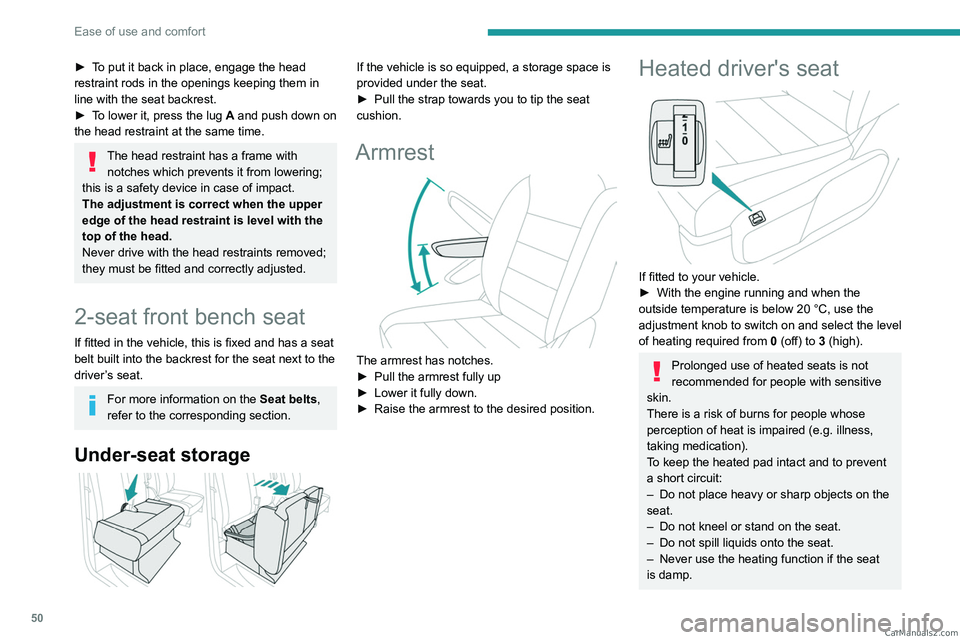
► To put it back in place, engage the head
restraint rods in the openings keeping them in
line with the seat backrest.
►
T
o lower it, press the lug A and push down on
the head restraint at the same time.
The head restraint has a frame with notches which prevents it from lowering;
this is a safety device in case of impact.
The adjustment is correct when the upper
edge of the head restraint is level with the
top of the head.
Never drive with the head restraints removed;
they must be fitted and correctly adjusted.
2-seat front bench seat
If fitted in the vehicle, this is fixed and has a seat
belt built into the backrest for the seat next to the
driver’s seat.
For more information on the Seat belts,
refer to the corresponding section.
Under-seat storage
If the vehicle is so equipped, a storage space is
provided under the seat.
►
Pull the strap towards you to tip the seat
cushion.
Armrest
The armrest has notches.
► Pull the armrest fully up
►
Lower it fully down.
►
Raise the armrest to the desired position.
Heated driver's seat
If fitted to your vehicle.
► With the engine running and when the
outside temperature is below 20
°C, use the
adjustment knob to switch on and select the level
of heating required from
0
(off) to 3 (high).
Prolonged use of heated seats is not
recommended for people with sensitive
skin.
There is a risk of burns for people whose
perception of heat is impaired (e.g.
illness,
taking medication).
To keep the heated pad intact and to prevent
a short circuit:
–
Do not place heavy or sharp objects on the
seat.
–
Do not kneel or stand on the seat.
–
Do not spill liquids onto the seat.
–
Never use the heating function if the seat
is damp. CarM an uals 2 .c o m
Page 54 of 348

52
Ease of use and comfort
► When stationary, lower the control lever to
release the steering wheel.
►
Adjust the height and reach.
►
Pull the control lever to lock the steering
wheel.
As a safety precaution, these operations must only be carried out while the vehicle
is stationary.
Mirrors
Door mirrors
As a safety measure, the mirrors should be adjusted to reduce the "blind spots".
The objects that you see in the mirrors are
in fact closer than they appear. Take this
into account in order to correctly judge the
distance of vehicles approaching from behind.
► Move control A to the right or to the left to
select the corresponding mirror.
►
Move control
B in any of the four directions
to adjust.
►
Return control A
to its central position.
Manual folding
The mirrors can be folded manually (parking
obstruction, narrow garage, etc.).
►
T
urn the mirror towards the vehicle.
Electric folding
Depending on equipment, the door mirrors can
be folded electrically.
► From the inside, with the
ignition on, place control A
in the
central position.
►
Pull control A
backwards.
►
Lock the vehicle from the outside.
If the mirrors are folded using control A,
they will not unfold when the vehicle is
unlocked.
Electric unfolding
The door mirrors are unfolded electrically when
the vehicle is unlocked using the remote control
or key. Unless folding was selected with control
A, pull the control in the central position towards
the rear again.
Folding/unfolding when locking/unlocking
the vehicle can be deactivated. Contact a
PEUGEOT dealer or a qualified workshop.
If necessary, the mirrors can be folded
manually.
Heated mirrors
► Press one of these buttons.
For more information on Rear screen
demisting/de-icing , refer to the
corresponding section.
Rear view mirror
Equipped with an anti-dazzle system, which
darkens the mirror glass and reduces the
nuisance to the driver caused by the sun,
headlamps of other vehicles, etc. CarM an uals 2 .c o m
Page 59 of 348
57
Ease of use and comfort
3introducing any foreign bodies into the
mechanisms.
The seats and bench seats are not designed for any other use than in the
vehicle. They are equipped with mechanisms
and features that may be damaged if used
improperly or if dropped.
Loading luggage or objects
behind the row 3 seat and
bench seat
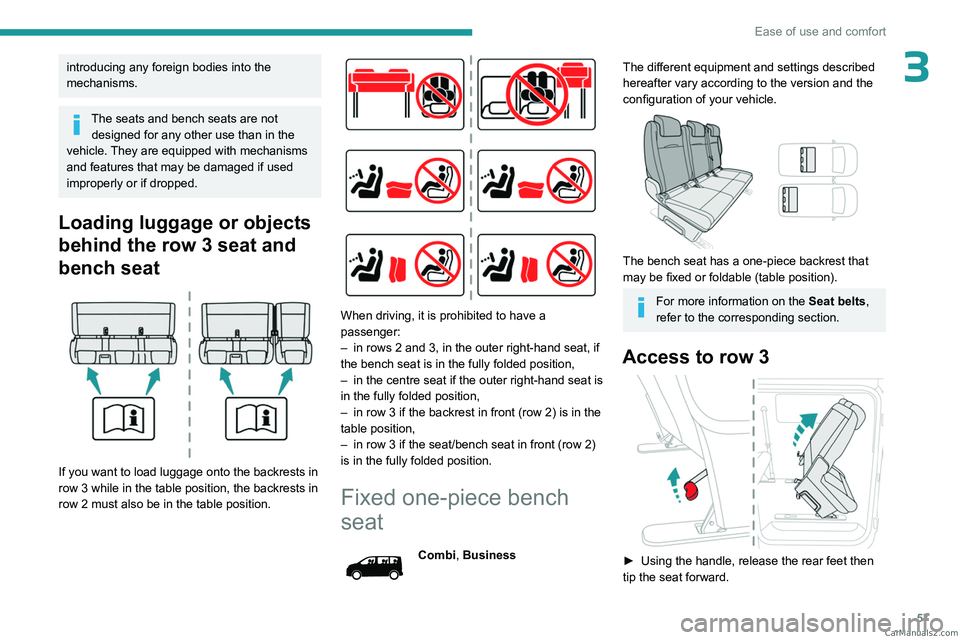
If you want to load luggage onto the backrests in
row
3 while in the table position, the backrests in
row
2 must also be in the table position.
When driving, it is prohibited to have a
passenger:
–
in rows 2 and 3, in the outer right-hand seat, if
the bench seat is in the fully folded position,
–
in the centre seat if the outer right-hand seat is
in the fully folded position,
–
in row 3 if the backrest in front (row 2) is in the
table position,
–
in row 3 if the seat/bench seat in front (row 2)
is in the fully folded position.
Fixed one-piece bench
seat
Combi, Business
The different equipment and settings described
hereafter vary according to the version and the
configuration of your vehicle.
The bench seat has a one-piece backrest that
may be fixed or foldable (table position).
For more information on the Seat belts,
refer to the corresponding section.
Access to row 3
► Using the handle, release the rear feet then
tip the seat forward. CarM an uals 2 .c o m
Page 61 of 348
59
Ease of use and comfort
3
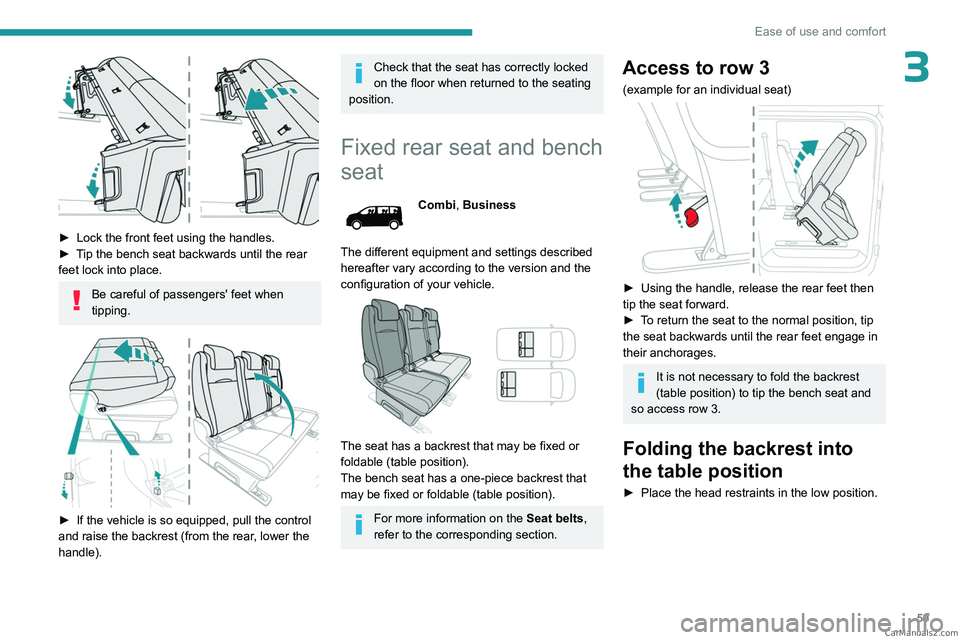
► Lock the front feet using the handles.
► T ip the bench seat backwards until the rear
feet lock into place.
Be careful of passengers' feet when
tipping.
► If the vehicle is so equipped, pull the control
and raise the backrest (from the rear , lower the
handle).
Check that the seat has correctly locked
on the floor when returned to the seating
position.
Fixed rear seat and bench
seat
Combi, Business
The different equipment and settings described
hereafter vary according to the version and the
configuration of your vehicle.
The seat has a backrest that may be fixed or
foldable (table position).
The bench seat has a one-piece backrest that
may be fixed or foldable (table position).
For more information on the Seat belts,
refer to the corresponding section.
Access to row 3
(example for an individual seat)
► Using the handle, release the rear feet then
tip the seat forward.
►
T
o return the seat to the normal position, tip
the seat backwards until the rear feet engage in
their anchorages.
It is not necessary to fold the backrest
(table position) to tip the bench seat and
so access row 3.
Folding the backrest into
the table position
► Place the head restraints in the low position. CarM an uals 2 .c o m