2023 HYUNDAI TUCSON HYBRID cooling
[x] Cancel search: coolingPage 6 of 699
1
Vehicle Data Collection and Event Data Recorders ........................................ 1-8
HEV (Hybrid Electric Vehicle) System .............................................................. 1-9
PHEV (Plug-in Hybrid Electric Vehicle) System ............................................. 1-10
Charging the Plug-in Hybrid Vehicle ............................................................... 1-11
Charging Information ........................................................................\
........................... 1-11
Charging Time ........................................................................\
...................................... 1-11
Charging Types ........................................................................\
.................................... 1-12
Charging Status ........................................................................\
................................... 1-13
Scheduled Charging........................................................................\
............................ 1-14
Charging Connector Lock ........................................................................\
................... 1-15
Charging Precautions ..............................................................\
................................... 1-16
Electric Charging Label ........................................................................\
....................... 1-18
AC Charge ........................................................................\
............................................ 1-19
Trickle Charge (Type A) ........................................................................\
.......................1-24
Trickle Charge (Type B) ........................................................................\
...................... 1-36
Action to be Taken when Charging Stops Abruptly ................................................. 1-49
Driving the Hybrid Vehicle ........................................................................\
......1-50Starting the Vehicle ........................................................................\
............................ 1-50
Special Features ........................................................................\
................................. 1-50
Hybrid System Gauge ........................................................................\
........................ 1-52
Plug-in Hybrid Mode (Plug-in hybrid vehicle) .......................................................... 1-53
Aux. Battery Saver+ (Plug-in hybrid vehicle) ............................................................ 1-54
Warning and Indicator Lights ........................................................................\
............ 1-56
LCD Display Messages ........................................................................\
........................1-57
Energy Flow ........................................................................\
........................................ 1-65
Hybrid Driving System ........................................................................\
.............1-68e-Handling (Electrically Assisted Handling Performance)/e-EHA (Electrically
Evasive Handling Assist) ........................................................................\
.................... 1-68
Safety Precautions for Hybrid System ............................................................1-69Hybrid Vehicle Components ........................................................................\
............. 1-69
Service Interlock Connector ........................................................................\
............... 1-71
Hybrid Battery Cooling Duct ........................................................................\
.............. 1-71
If an accident occurs ........................................................................\
........................... 1-72
When the Hybrid Vehicle Shuts Off ........................................................................\
... 1-73
1. Foreword/Starting your Hybrid/Plug-in hybrid vehicle
Page 22 of 699
01
1-17
CAUTION
• Always keep the charging connector
and charging plug in clean and
dry condition. Be sure to keep the
charging cable in a condition where
there is no water or moisture.
• Make sure to use the designated
charger for charging the electric
vehicle. Using any other charger may
cause failure.
• Before charging the battery, turn the
vehicle OFF
• When the vehicle is switched OFF
while charging, the cooling fan
inside the motor compartment may
automatically operate. Do not touch
the cooling fan while charging.
• Be careful not to drop the charging
connector. The charging connector
can be damaged.
WARNING
• Immediately stop charging when
you find abnormal symptoms (odor,
smoke).
• Replace the charging cable if the
cable coating is damaged to prevent
electrical shock.
• When connecting or removing the
charging cable, make sure to hold
the charging connector handle and
charging plug.
If you pull the cable itself (without
using the handle), the internal wires
may disconnect or get damaged. This
may lead to electric shock or fire.
CAUTION
• Always keep the charging connector
and charging plug in clean and
dry condition. Be sure to keep the
charging cable in a condition where
there is no water or moisture.
• Before charging the battery, turn the
vehicle OFF.
• When the vehicle is switched OFF
while charging, the cooling fan
inside the motor compartment may
automatically operate. Do not touch
the cooling fan while charging.
• Be careful not to drop the charging
connector. The charging connector
can be damaged.
Page 26 of 699

01
1-21
OAEPHQ049818LOAEPHQ049818L
8. After charging has started, the estimated charging time is displayed
on the instrument cluster for about 1
minute.
If you open the driver seat door while
charging, the estimated charging time
is also displayed on the instrument
cluster for about 1 minute.
When scheduled charging is set, the
estimated charging time is displayed
as “--” .
Information
Depending on the condition and durability
of the high voltage battery, charger
specifications, and ambient temperature,
the time required for charging the battery
may vary.
Information
To control the temperature of the high
voltage battery while charging or when
the battery temperature is high, the air
conditioner is used to cool down the
battery. It may generate noise or vibration
from operation of the air conditioner
compressor and cooling fan, but it is a
normal condition when charging the high
voltage battery. Also, the air conditioner’s
performance may be degraded due to
operation of the cooling system to charge
the high voltage battery. This is a normal
condition.
Checking Charging Status
ONX4EPHQ011020LONX4EPHQ011020L
When charging the high voltage battery,
the charge level can be checked from
outside the vehicle.
Page 34 of 699

01
1-29
Information
To control the temperature of the high
voltage battery while charging or when
the battery temperature is high, the air
conditioner is used to cool down the
battery. It may generate noise or vibration
from operation of the air conditioner
compressor and cooling fan, but it is a
normal condition when charging the high
voltage battery. Also, the air conditioner’s
performance may be degraded due to
operation of the cooling system to charge
the high voltage battery. This is a normal
condition.
Information
Even though charging is possible with
the Start/Stop button in the ON/START
position, for you safety, start charging
when the Start/Stop button is in the
OFF position and the vehicle shifted to P
(Park). After charging has started, you
can use electrical components such as the
radio by pressing the Start/Stop button to
the START or ON position.
During charging, the gear cannot be
shifted from P (Park) to any other gear.
OAEPHQ049818LOAEPHQ049818L
10. After charging has started, the estimated charging time is displayed
on the instrument cluster for about 1
minute.
If you open the driver seat door while
charging, the estimated charging time
is also displayed on the instrument
cluster for about 1 minute.
When scheduled charging is set, the
estimated charging time is displayed
as “--” .
Information
Depending on the condition and durability
of the high voltage battery, charger
specifications, and ambient temperature,
the time required for charging the battery
may vary.
Page 68 of 699
01
1-63
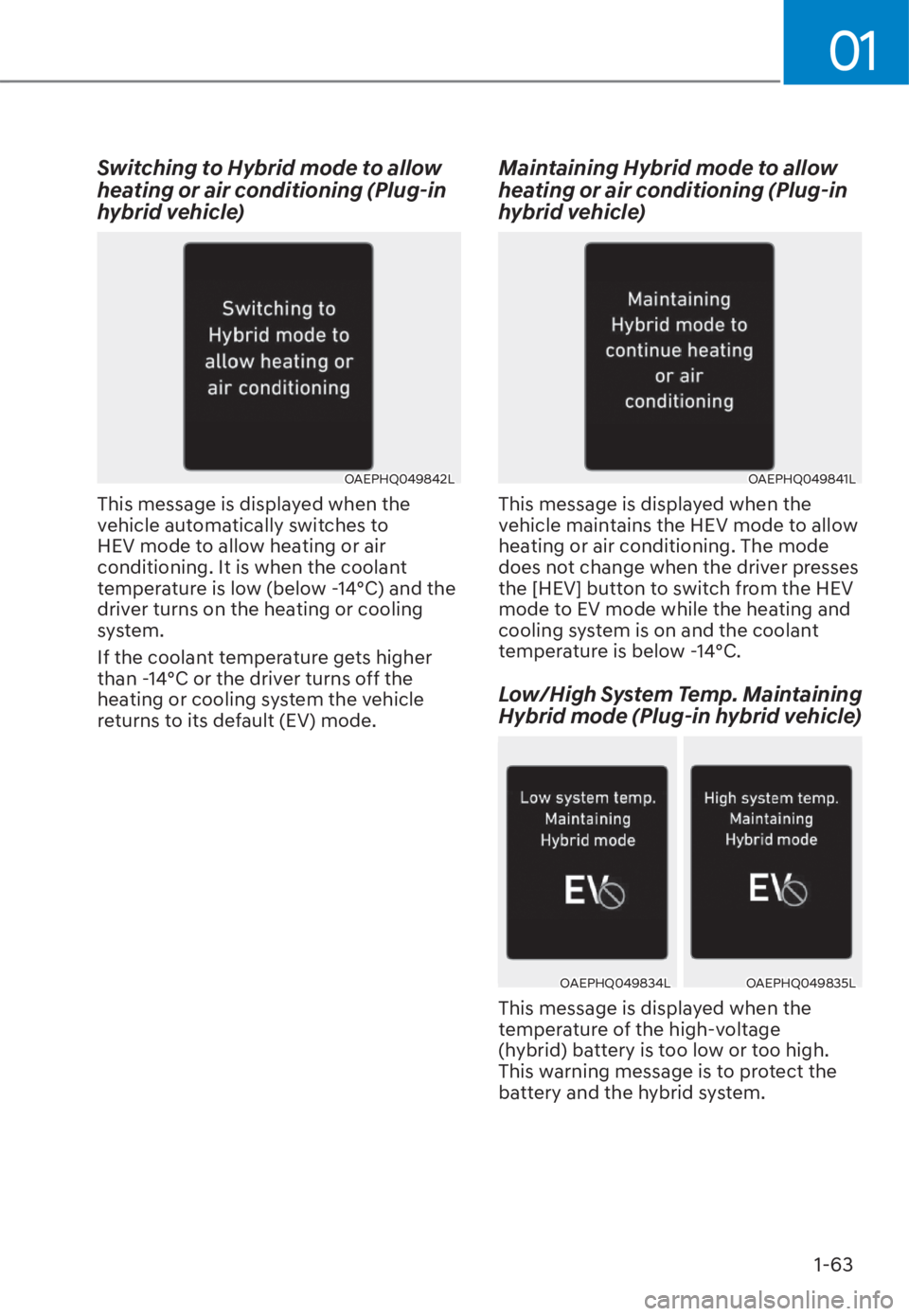
Switching to Hybrid mode to allow
heating or air conditioning (Plug-in
hybrid vehicle)
OAEPHQ049842LOAEPHQ049842L
This message is displayed when the
vehicle automatically switches to
HEV mode to allow heating or air
conditioning. It is when the coolant
temperature is low (below -14°C) and the
driver turns on the heating or cooling
system.
If the coolant temperature gets higher
than -14°C or the driver turns off the
heating or cooling system the vehicle
returns to its default (EV) mode.
Maintaining Hybrid mode to allow
heating or air conditioning (Plug-in
hybrid vehicle)
OAEPHQ049841LOAEPHQ049841L
This message is displayed when the
vehicle maintains the HEV mode to allow
heating or air conditioning. The mode
does not change when the driver presses
the [HEV] button to switch from the HEV
mode to EV mode while the heating and
cooling system is on and the coolant
temperature is below -14°C.
Low/High System Temp. Maintaining
Hybrid mode (Plug-in hybrid vehicle)
OAEPHQ049834LOAEPHQ049834LOAEPHQ049835LOAEPHQ049835L
This message is displayed when the
temperature of the high-voltage
(hybrid) battery is too low or too high.
This warning message is to protect the
battery and the hybrid system.
Page 76 of 699
01
1-71
NOTICE
• When the vehicle is paint baked, do
not bake over 30 minutes in 158°F
(70°C) or 20 minutes in 176°F (80°C)
degree.
• Do not wash the engine
compartment, using water. Water
may cause an electric shock and
damage the electronic components.
WARNING
This hybrid vehicle uses the hybrid
battery system inverter and converter
to generate high voltage. High voltage
in the hybrid battery system is very
dangerous and may cause severe burns
and electric shock. This may result in
serious injury or death.
• For your safety, never touch,
replace, disassemble or remove the
hybrid battery system including
components, cables and connectors.
Severe burns or electric shock may
result in serious injury or death when
you fail to follow this warning.
• When the hybrid battery system
operates, the hybrid battery system
can be hot. Always be careful
because burns or electric shock may
be caused by high voltage.
• Do not spill liquid on the HPCU, HSG,
motor and fuses. If the hybrid system
components come in contact with
liquid, it may result in electric shock.
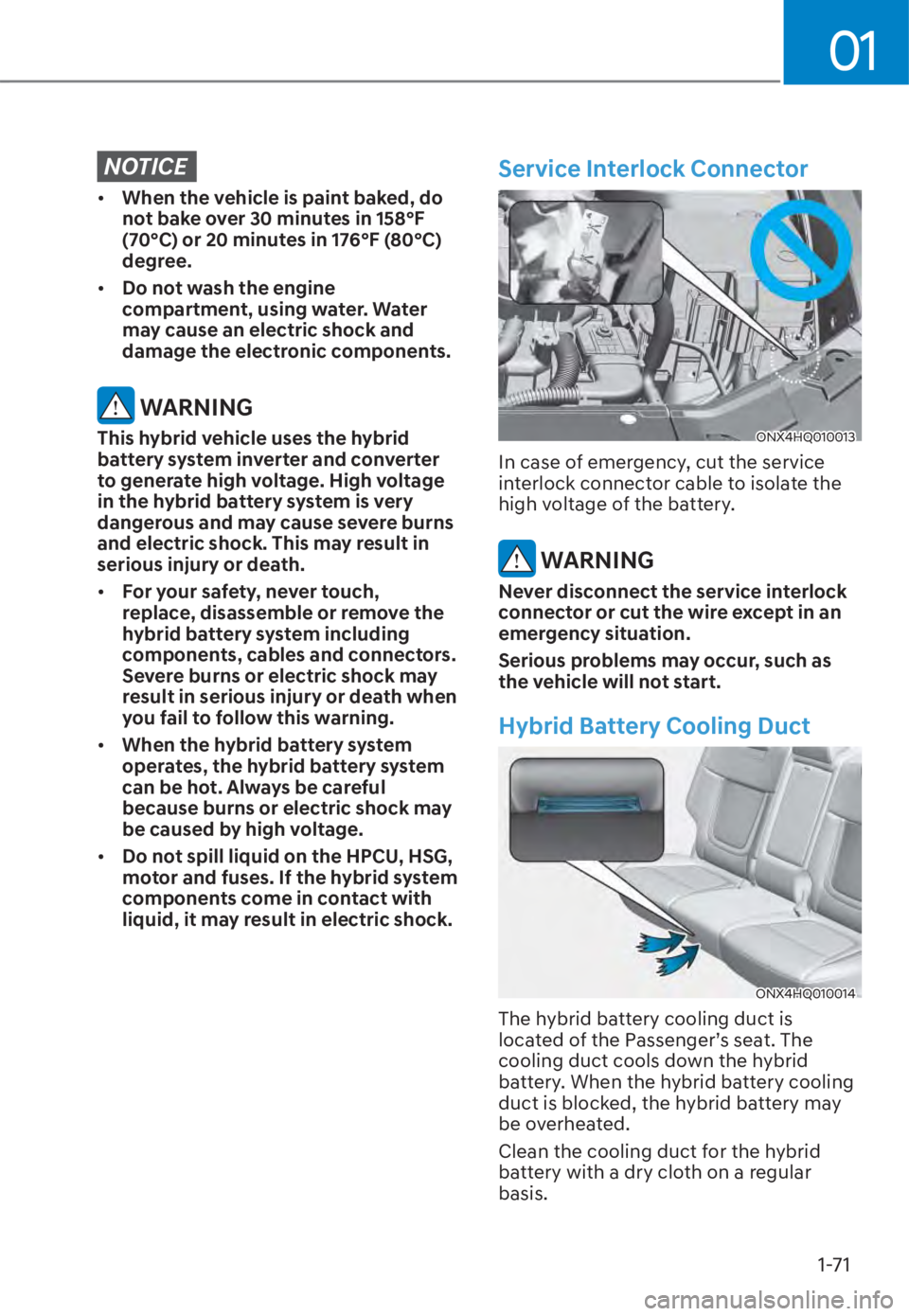
Service Interlock Connector
ONX4HQ010013ONX4HQ010013
In case of emergency, cut the service
interlock connector cable to isolate the
high voltage of the battery.
WARNING
Never disconnect the service interlock
connector or cut the wire except in an
emergency situation.
Serious problems may occur, such as
the vehicle will not start.
Hybrid Battery Cooling Duct
ONX4HQ010014ONX4HQ010014
The hybrid battery cooling duct is
located of the Passenger’s seat. The
cooling duct cools down the hybrid
battery. When the hybrid battery cooling
duct is blocked, the hybrid battery may
be overheated.
Clean the cooling duct for the hybrid
battery with a dry cloth on a regular
basis.
Page 77 of 699
Foreword/Starting your Hybrid/Plug-in hybrid vehicle1-72
WARNING
• Never clean the cooling duct of the
hybrid battery with a wet cloth. If
any water enters the cooling duct
of the hybrid battery, the hybrid
battery may cause an electric shock,
resulting in a serious damage, an
injury or a death.
• The hybrid battery is composed of
lithium-ion polymer. If the hybrid
battery is improperly handled, it is
dangerous to the environment. Also
it may cause electrical shock and
severe burns, resulting in a serious
injury or a death.
• Do not spill liquid over the cooling
duct of the hybrid battery. Doing
so is very dangerous. It may cause
electric shock or serious injury.
• Do not cover the cooling duct with
objects.
• Do not put any objects into the
cooling duct of the hybrid battery.
Doing so may cause loss of cooling
duct volume to the hybrid battery.
When the cooling duct is blocked
with any objects, immediately
contact your HYUNDAI dealer.
• Never place a container of liquid on
or near the cooling duct. If the liquid
spills, the hybrid battery located in
the under floor may be damaged.
• Do not obstruct the cooling duct
with any other objects.
If an accident occurs
WARNING
• For your safety, do not touch the
high voltage cables, connectors
and package modules. High voltage
components are orange in color.
• Exposed cables or wires may be
visible inside or outside of the
vehicle. Never touch the wires or
cables, because an electrical shock,
an injury, or a death may occur.
• Any gas or electrolyte leakage from
your vehicle is not only poisonous
but also flammable. Upon witnessing
one of those, open the windows,
and remain a safe distance from the
vehicle out of the road.
Immediately call an emergency
services or contact an authorized
HYUNDAI dealer and advise them
that a hybrid vehicle is involved.
• When the vehicle is severely
damaged, remain a safe distance of
49 feet or more between your vehicle
and other vehicles/flammables.
Page 198 of 699
04
4-31
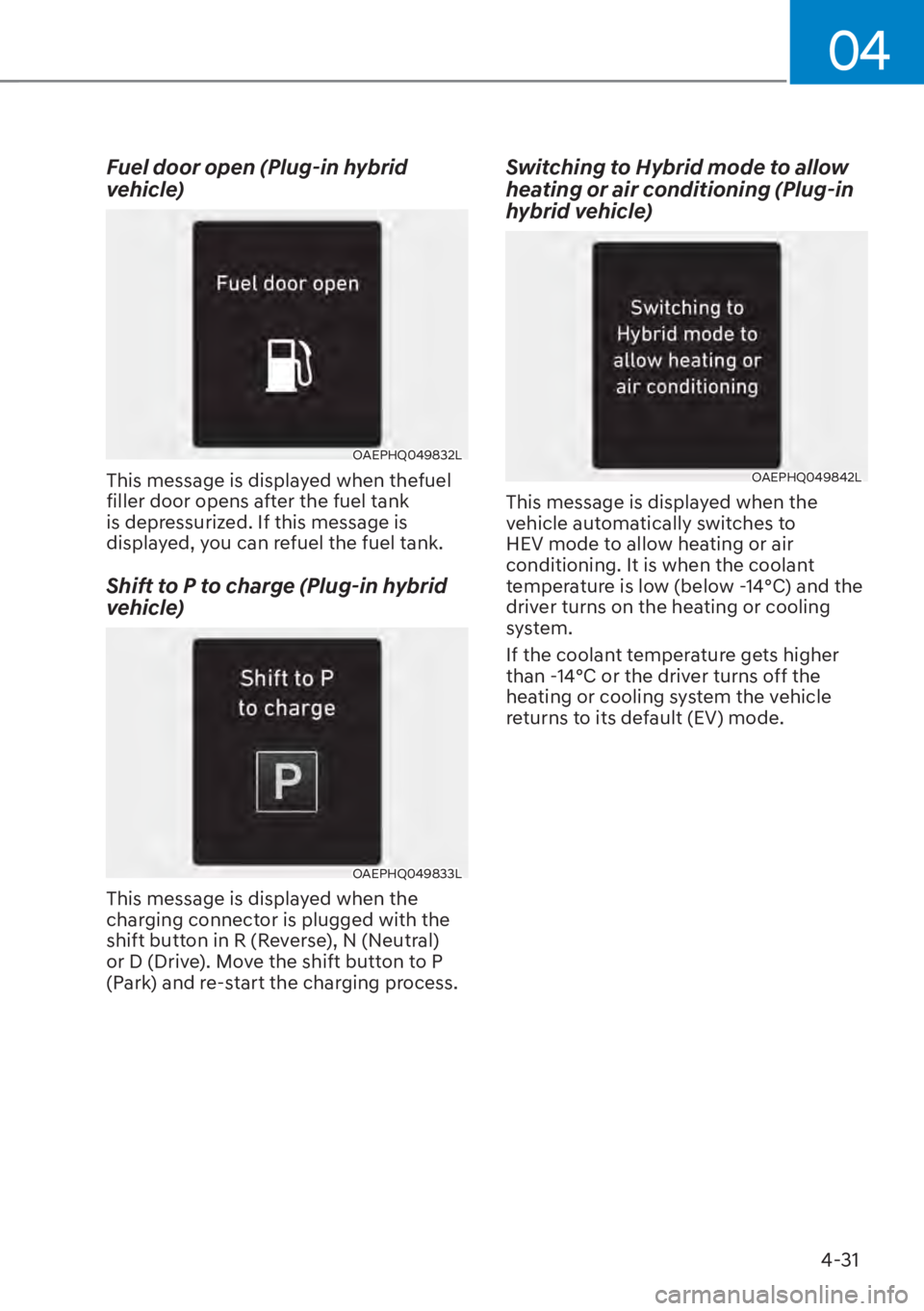
Fuel door open (Plug-in hybrid
vehicle)
OAEPHQ049832L
This message is displayed when thefuel
filler door opens after the fuel tank
is depressurized. If this message is
displayed, you can refuel the fuel tank.
Shift to P to charge (Plug-in hybrid
vehicle)
OAEPHQ049833L
This message is displayed when the
charging connector is plugged with the
shift button in R (Reverse), N (Neutral)
or D (Drive). Move the shift button to P
(Park) and re-start the charging process.
Switching to Hybrid mode to allow
heating or air conditioning (Plug-in
hybrid vehicle)
OAEPHQ049842L
This message is displayed when the
vehicle automatically switches to
HEV mode to allow heating or air
conditioning. It is when the coolant
temperature is low (below -14°C) and the
driver turns on the heating or cooling
system.
If the coolant temperature gets higher
than -14°C or the driver turns off the
heating or cooling system the vehicle
returns to its default (EV) mode.