Page 25 of 555
Vehicle Information and Reporting Safety Defects
2-14
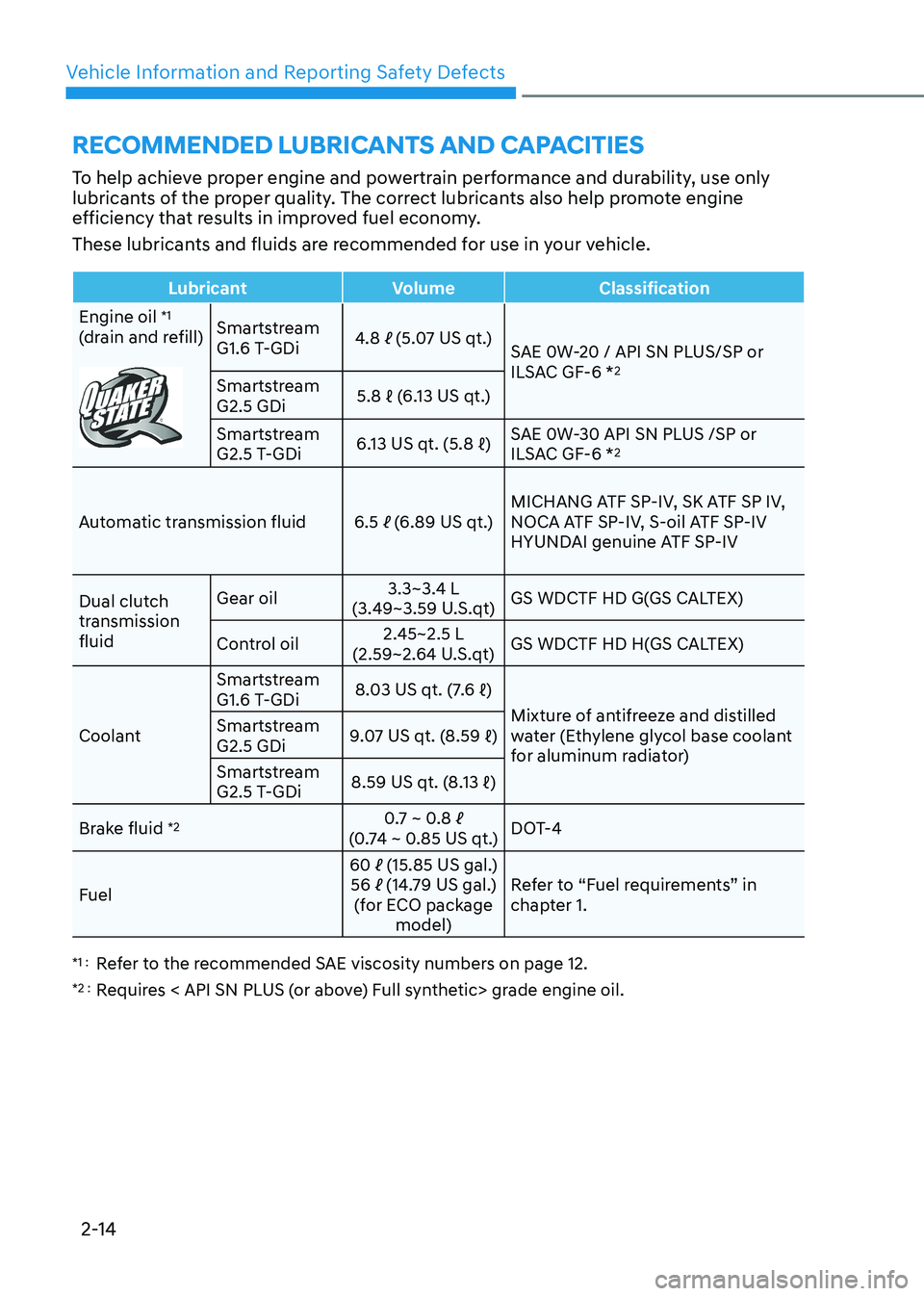
rECommEnDED luBriCants anD CaPaCitiEs
To help achieve proper engine and powertrain performance and durability, use only
lubricants of the proper quality. The correct lubricants also help promote engine
efficiency that results in improved fuel economy.
These lubricants and fluids are recommended for use in your vehicle.
Lubricant Volume Classification
Engine oil *1
(drain and refill) Smartstream
G1.6 T-GDi 4.8
ℓ (5.07 US qt.)
SAE 0W-20 / API SN PLUS/SP or
ILSAC GF-6 *2
Smartstream G2.5 GDi 5.8 ℓ (6.13 US qt.)
Smartstream
G2.5 T-GDi 6.13 US qt. (5.8 ℓ)
SAE 0W-30 API SN PLUS /SP or
ILSAC GF-6 *
2
Automatic transmission fluid 6.5 ℓ (6.89 US qt.) MICHANG ATF SP-IV, SK ATF SP IV,
NOCA ATF SP-IV, S-oil ATF SP-IV
HYUNDAI genuine ATF SP-IV
Dual clutch
transmission fluid Gear oil
3.3~3.4 L
(3.49~3.59 U.S.qt) GS WDCTF HD G(GS CALTEX)
Control oil 2.45~2.5 L
(2.59~2.64 U.S.qt) GS WDCTF HD H(GS CALTEX)
Coolant Smartstream
G1.6 T-GDi
8.03 US qt. (7.6 ℓ)
Mixture of antifreeze and distilled
water (Ethylene glycol base coolant
for aluminum radiator)
Smartstream G2.5 GDi
9.07 US qt. (8.59 ℓ)
Smartstream
G2.5 T-GDi 8.59 US qt. (8.13 ℓ)
Brake fluid *2
0.7 ~ 0.8
ℓ
(0.74 ~ 0.85 US qt.) DOT-4
Fuel 60
ℓ (15.85 US gal.)
56 ℓ (14.79 US gal.)
(for ECO package model) Refer to “Fuel requirements” in
chapter 1.
*1 : Refer to the recommended SAE viscosity numbers on page 12.
*2 : Requires < API SN PLUS (or above) Full synthetic> grade engine oil.
Page 26 of 555
02
2-15
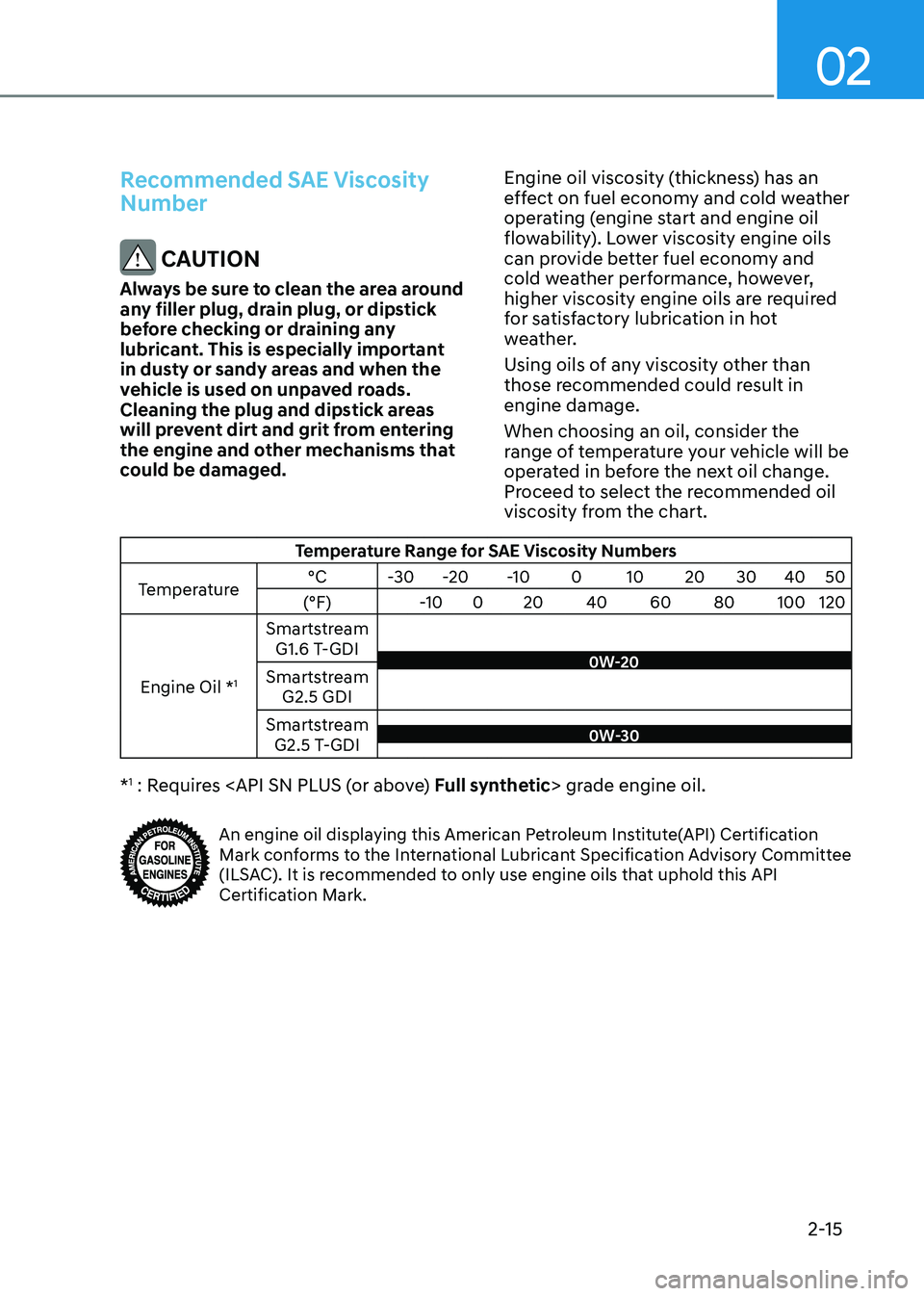
Recommended SAE Viscosity Number
CAUTION
Always be sure to clean the area around
any filler plug, drain plug, or dipstick
before checking or draining any
lubricant. This is especially important
in dusty or sandy areas and when the
vehicle is used on unpaved roads.
Cleaning the plug and dipstick areas
will prevent dirt and grit from entering
the engine and other mechanisms that
could be damaged. Engine oil viscosity (thickness) has an
effect on fuel economy and cold weather
operating (engine start and engine oil
flowability). Lower viscosity engine oils
can provide better fuel economy and
cold weather performance, however,
higher viscosity engine oils are required
for satisfactory lubrication in hot
weather.
Using oils of any viscosity other than
those recommended could result in engine damage. When choosing an oil, consider the
range of temperature your vehicle will be
operated in before the next oil change.
Proceed to select the recommended oil
viscosity from the chart.
Temperature Range for SAE Viscosity Numbers
Temperature °C
-30-20 -10 0 10 20 30 40 50
(°F) -100 20 40 60 80 100 120
Engine Oil * 1Smartstream
G1.6 T-GDI
Smartstream G2.5 GDI
Smartstream G2.5 T-GDI
0W-30
0W-20
* 1
: Requires grade engine oil.
An engine oil displaying this American Petroleum Institute(API) Certification
Mark conforms to the International Lubricant Specification Advisory Committee
(ILSAC). It is recommended to only use engine oils that uphold this API
Certification Mark.
Page 88 of 555
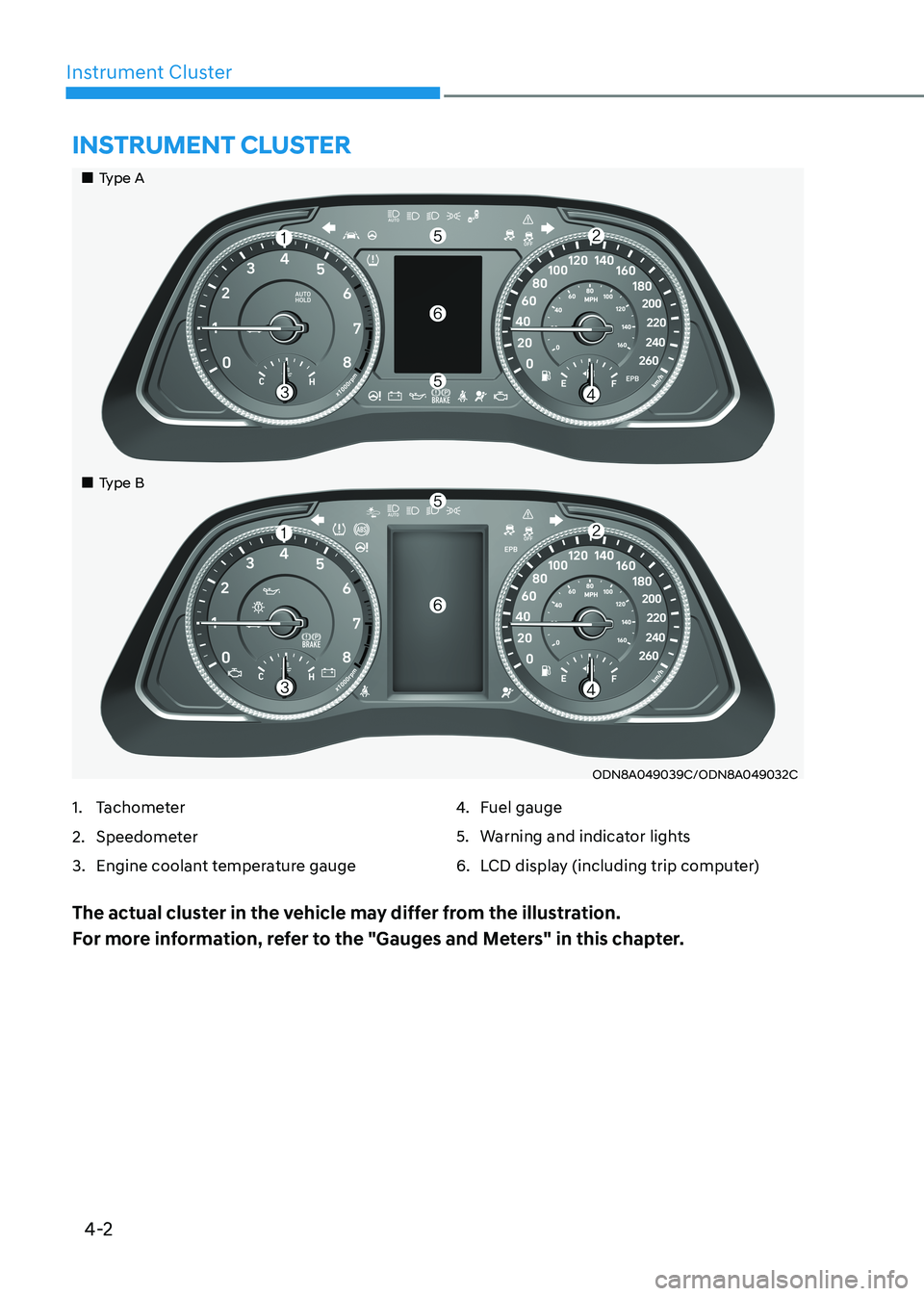
4-2
Instrument Cluster
ODN8A049039C/ODN8A049032C
Instrument Cluster
1. Tachometer
2. Speedometer
3. Engine coolant temperature gauge4.
Fuel gauge
5. Warning and indicator lights
6. LCD display (including trip computer)
The actual cluster in the vehicle may differ from the illustration.
For more information, refer to the "Gauges and Meters" in this chapter.
„„Type A
„
„Type B
Page 89 of 555
4-3
04
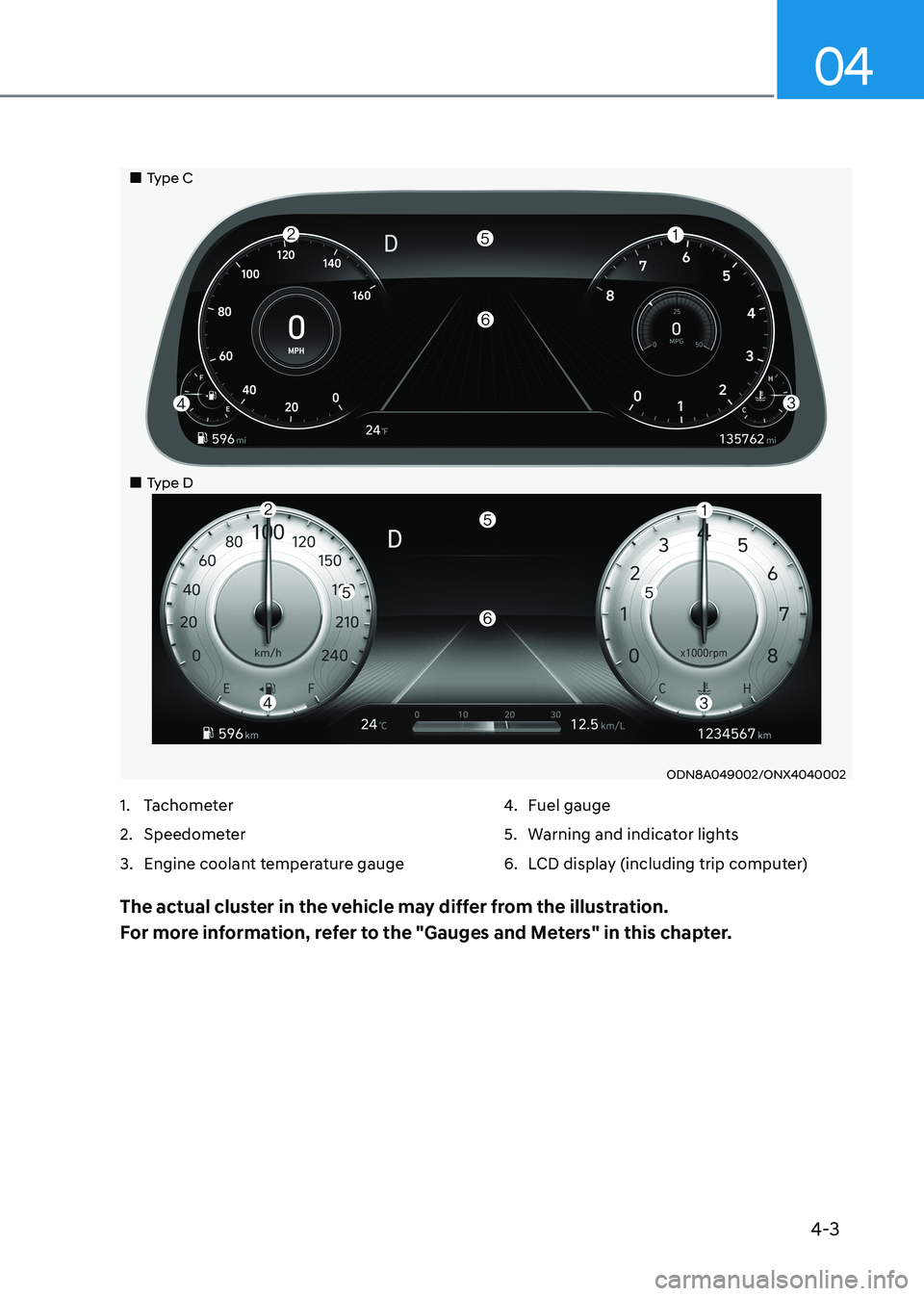
ODN8A049002/ONX4040002
1. Tachometer
2. Speedometer
3. Engine coolant temperature gauge 4.
Fuel gauge
5. Warning and indicator lights
6. LCD display (including trip computer)
The actual cluster in the vehicle may differ from the illustration.
For more information, refer to the "Gauges and Meters" in this chapter.
„„Type C
„
„Type D
Page 92 of 555
Instrument Cluster
4-6
NOTICE
If the gauge pointer moves beyond
the normal range area toward the "H"
position, it indicates overheating that
may damage the engine.
Do not continue driving with an
overheated engine. If your engine
overheats, refer to "If the Engine
Overheats" in chapter 7.
WARNING
Never remove the radiator cap or
reservoir cap when the engine is hot.
The engine coolant is under pressure
and could severely burn. Wait until the
engine is cool before adding coolant to
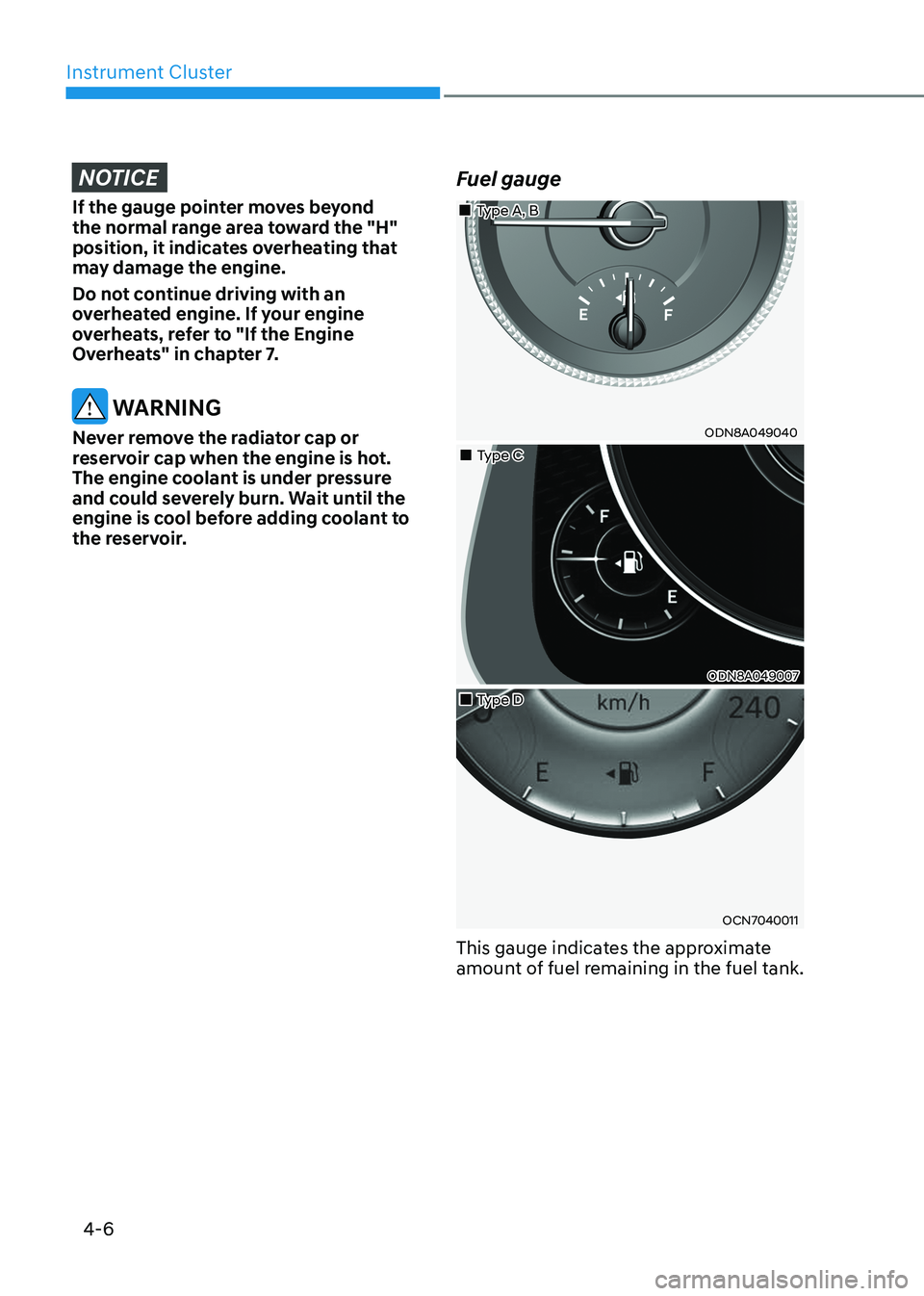
the reservoir. Fuel gauge
„„Type A, B
ODN8A049040
„„Type C
ODN8A049007
„„Type D
OCN7040011
This gauge indicates the approximate
amount of fuel remaining in the fuel tank.
Page 93 of 555
04
4 -7
Information
• The fuel tank capacity is given in
chapter 2.
• The fuel gauge is supplemented by a low fuel warning light, which will illuminate when the fuel tank is nearly
empty.
• On inclines or curves, the fuel gauge
pointer may fluctuate or the low fuel
warning light may come on earlier than usual due to the movement of fuel in the tank.
WARNING
Running out of fuel can expose vehicle
occupants to danger.
You must stop and obtain additional
fuel as soon as possible after the
warning light comes on or when the
gauge indicator comes close to the "E
(Empty)" level.
NOTICE
Avoid driving with an extremely low
fuel level. Running out of fuel could
cause the engine to misfire and damage
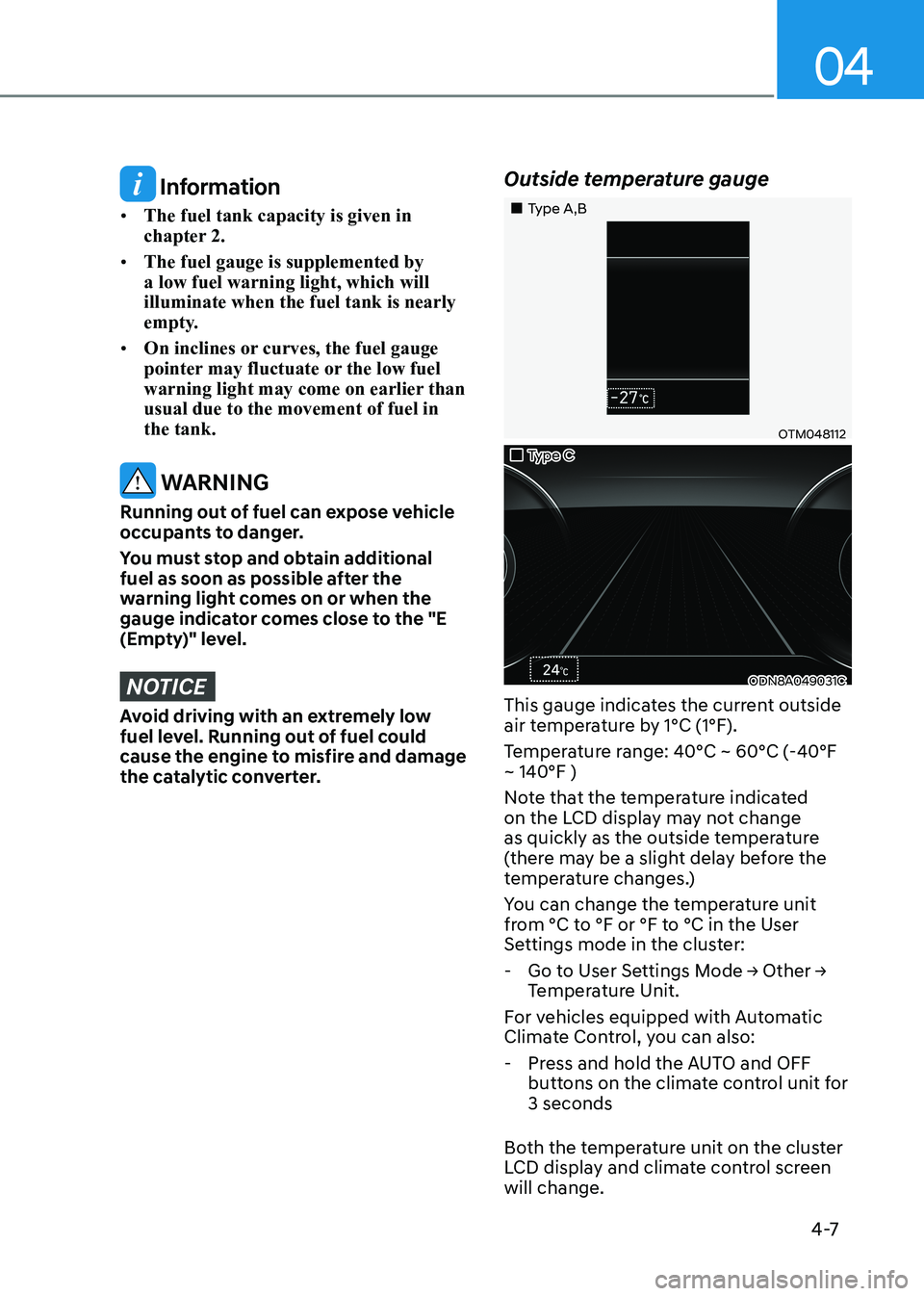
the catalytic converter. Outside temperature gauge
„„Type A,B
OTM048112
„„Type C
ODN8A049031C
This gauge indicates the current outside
air temperature by 1°C (1°F).
Temperature range: 40°C ~ 60°C (-40°F ~ 140°F )
Note that the temperature indicated
on the LCD display may not change
as quickly as the outside temperature
(there may be a slight delay before the
temperature changes.)
You can change the temperature unit
from °C to °F or °F to °C in the User
Settings mode in the cluster:
- Go to User Settings Mode → Other →
Temperature Unit.
For vehicles equipped with Automatic
Climate Control, you can also: - Press and hold the AUTO and OFF buttons on the climate control unit for 3 seconds
Both the temperature unit on the cluster
LCD display and climate control screen will change.
Page 94 of 555
Instrument Cluster
4-8
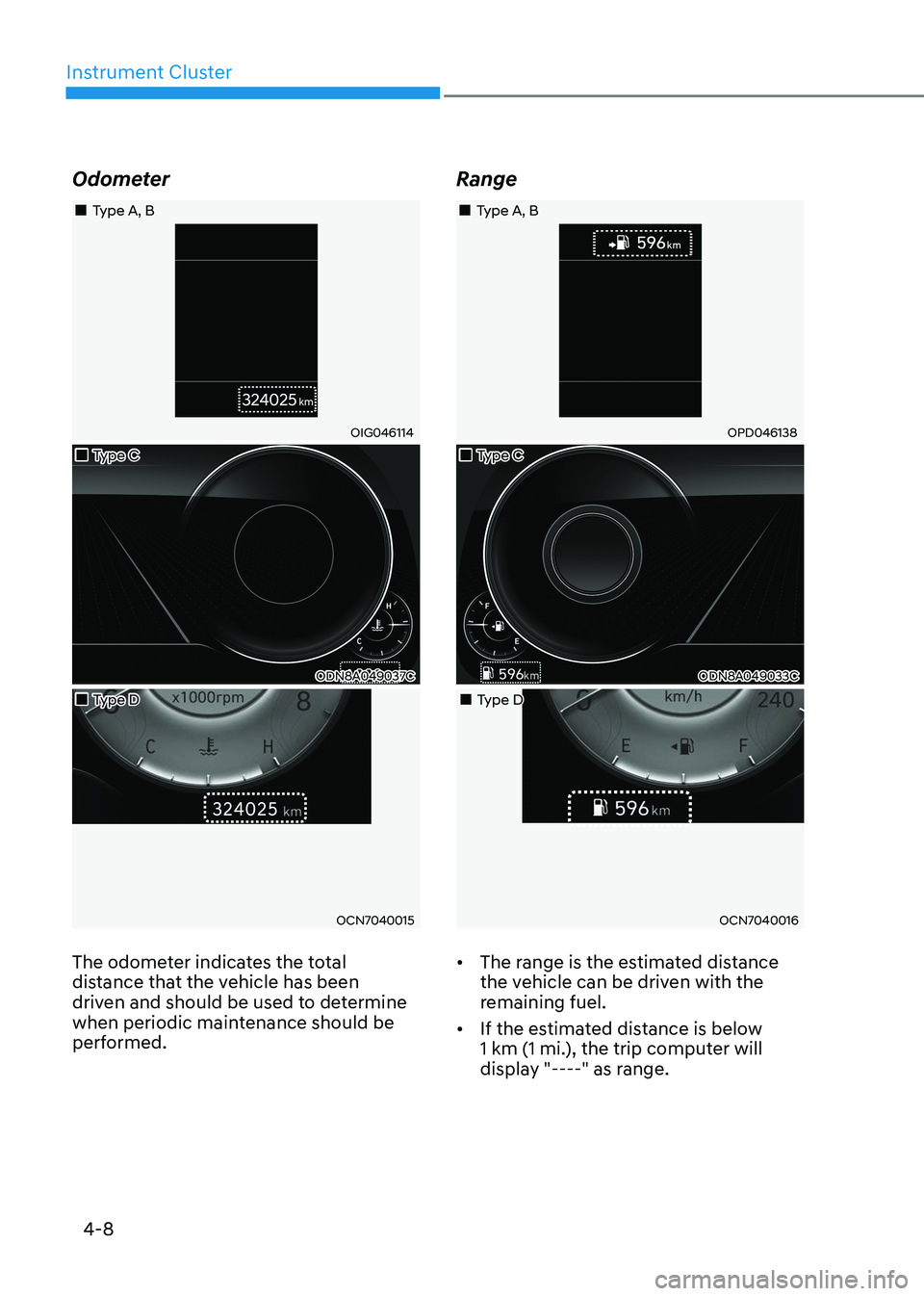
Odometer
„„Type A, B
OIG046114
„„Type C
ODN8A049037C
„„Type D
OCN7040015
The odometer indicates the total
distance that the vehicle has been
driven and should be used to determine
when periodic maintenance should be
performed. Range
„„Type A, B
OPD046138
„„Type C
ODN8A049033C
„„Type D
OCN7040016
• The range is the estimated distance
the vehicle can be driven with the
remaining fuel.
• If the estimated distance is below
1 km (1 mi.), the trip computer will
display "----" as range.
Page 95 of 555
04
4-9
Information
• If the vehicle is not on level ground or
the battery power has been interrupted, the range function may not operate
correctly.
• The range may differ from the actual driving distance as it is only an estimate
of the available driving range for the vehicle and driving conditions.
• The trip computer may not register additional fuel if less than 6 liters (1.6
gallon) of fuel are added to the vehicle.
• The range may vary significantly based on driving conditions, driving habits, and condition of the vehicle.
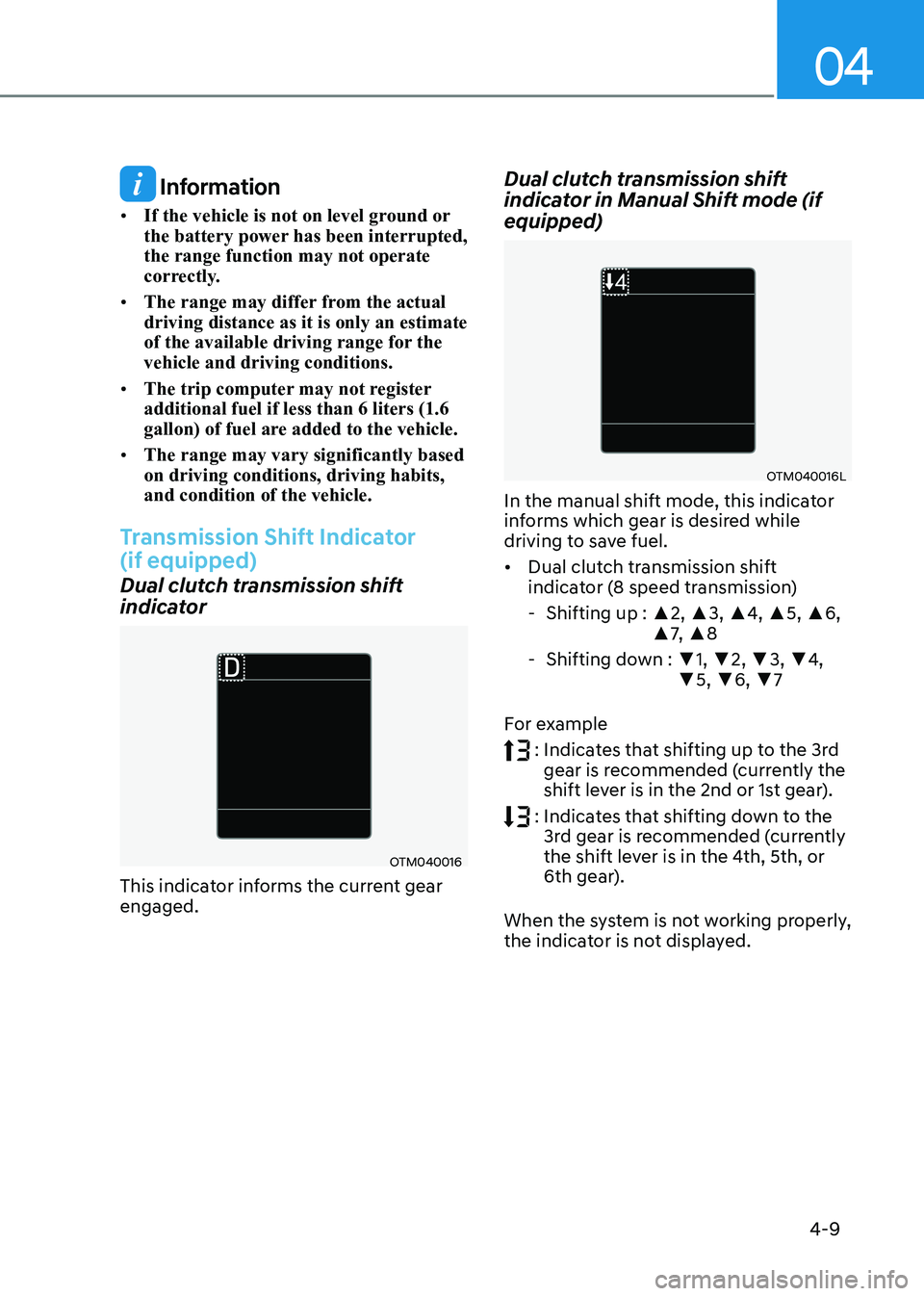
Transmission Shift Indicator (if equipped)
Dual clutch transmission shift
indicator
OTM040016
This indicator informs the current gear engaged. Dual clutch transmission shift
indicator in Manual Shift mode (if equipped)
OTM040016L
In the manual shift mode, this indicator
informs which gear is desired while
driving to save fuel. • Dual clutch transmission shift
indicator (8 speed transmission)
- Shifting up : ▲2, ▲3, ▲4, ▲5, ▲6,
▲ 7, ▲ 8
- Shifting down : ▼1, ▼ 2, ▼3, ▼4,
▼ 5, ▼6, ▼7
For example
: Indicates that shifting up to the 3rd
gear is recommended (currently the
shift lever is in the 2nd or 1st gear).
: Indicates that shifting down to the
3rd gear is recommended (currently
the shift lever is in the 4th, 5th, or
6th gear).
When the system is not working properly,
the indicator is not displayed.