Page 612 of 676

9-14
Maintenance
Engine Coolant/Liquid-Cooled
Intercooler Coolant
The coolant should be changed at the
intervals specified in the maintenance
schedule.
Automatic Transmission Fluid
Automatic transmission fluid should
not be checked under normal usage
conditions, the Automatic transmission
fluid should be changed by an authorized
retailer of Genesis Branded products
according to the maintenance schedule.
Information
Automatic transmission fluid color is red
when new.
As the vehicle is driven, the automatic
transmission fluid will begin to look
darker.
This is a normal condition. It does not
need to be replaced based on the color
change.
NOTICE
The use of a non-specified fluid could
result in transmission malfunction and
failure.
Use only specified automatic
transmission fluid. (Refer to
“Recommended Lubricants and
Capacities” section in chapter 2.)
Brake Hoses and Lines
Visually check for proper installation,
chafing, cracks, deterioration and any
leakage. Replace any deteriorated or
damaged parts immediately.
Brake Fluid
Check the brake fluid level in the brake
fluid reservoir. The level should be
between the MIN and the MAX marks
on the side of the reservoir. Use only
hydraulic brake fluid conforming to DOT
4 specification.
Brake Discs, Pads, Calipers and
Rotors
Check the pads, the disc, and the rotor
for any excessive wear-out. Inspect
calipers for any fluid leakage
Exhaust Pipe and Muffler
Visually inspect the exhaust pipes,
muffler and hangers for cracks,
deterioration, or damage. Start
the engine and listen carefully for
any exhaust gas leakage. Tighten
connections or replace parts as
necessary.
Propeller Shaft
Check the propeller shaft, boots, clamps,
rubber couplings and center-bearing
rubber for cracks, deterioration, or
damage. Replace any damaged parts
and if necessary, repack the grease.
Page 617 of 676
9-19
09
Information
The coolant level is influenced by the
engine temperature. Before checking or
refilling the coolant, turn the engine off.
WARNING
The electric motor for the
cooling fan may continue to
operate or start up when the
engine is not running and can
cause serious injury. Keep
hands, clothing and tools away
from the rotating fan blades of
the cooling fan.
Always turn off the vehicle unless the
vehicle has to be inspected with the
engine on. Be cautious as the cooling
fan may operate if the negative (-)
battery terminal is not disconnected.
WARNING
Make sure the coolant cap is properly
closed after refilling coolant. Otherwise
the engine could be overheated while
driving.
�„Engine compartment front view
ORG3EV091045
1. Check if the coolant cap label is
straight in front.
ORG3EV091043
2. Make sure that the tiny protrusions
inside the coolant cap are securely
interlocked.
Page 619 of 676

9-21
09
Checking the Brake Fluid Level
ORS091006
Check the fluid level in the reservoir
periodically. The fluid level should be
between MAX and MIN marks on the side
of the reservoir.
Before removing the reservoir cap and
adding brake fluid, clean the area around
the reservoir cap thoroughly to prevent
brake fluid contamination.
If the level is low, add the specified brake
fluid to the MAX level. The level will fall
with accumulated mileage. This is a
normal condition associated with the
wear of the brake linings. If the fluid level
is excessively low, have the brake system
checked by an authorized retailer of
Genesis Branded products.
WARNING
If the brake system requires frequent
additions of fluid this could indicate
a leak in the brake system. Have the
vehicle inspected by an authorized
retailer of Genesis Branded products.
WARNING
Do not let brake fluid enter into your
eyes. If brake fluid gets in your eyes,
flush your eyes with clean water for
at least 15 minutes and get immediate
medical attention.
NOTICE
�[�Do not allow brake fluid to contact
the vehicle’s body paint, as it will
result in paint damage.
�[�NEVER use brake fluid which has
been exposed to open air for an
extended time, as its quality cannot
be guaranteed. It should be disposed
of properly.
�[�Do not use the wrong type of brake
fluid. A few drops of mineral based
oil such as engine oil in your brake
system can damage brake system
parts.
Information
Use only the specified brake fluid (refer
to “Recommended Lubricants and
Capacities” section in chapter 2).
BRAKE FLUID
Page 622 of 676
9-24
Maintenance
Filter Inspection
The cabin air filter should be replaced
according to the Maintenance Schedule.
If the vehicle is operated in severely air-
polluted cities or on dusty rough roads
for a long period, it should be inspected
more frequently and replaced sooner.
Replace the cabin air filter by following
the procedure below and be careful to
avoid damaging other components.
Filter Replacement
ORS091009
1. Open the glove box and remove the
support rod M.
ORS091010
2. Remove the stoppers on both sides to
allow the glove box to hang freely on
the hinges.
ORS092011N
3. Press and hold the lock M on the left
side of the cover.
4. Pull out N the cover
5. Replace the cabin air filter.
6. Reassemble in the reverse order of
disassembly.
CABIN AIR FILTER
Page 623 of 676
9-25
09
Engine Compartment
ORS091012
ORS092054N
1. Open the engine hood and remove
the cover of the air conditioning
assembly to locate the air filter.
2. Open the engine hood and remove
the cover of air conditioning unit.
3. Press and hold the lock M on the left
side of the cover.
4. Pull out N the cover
5. Replace the cabin air filter.
6. Reassemble in the reverse order of
disassembly.
NOTICE
ORS091061
A : Glove box,
B : Engine compartment
Install a new cabin air filter in the
correct direction to prevent noise and
reduce effectiveness.
�[�Glove box: Install with the arrow
V\PERO�IDFLQJ�GRZQZDUG����
Page 631 of 676
9-33
09
WARNING
Tire failure may cause loss of
vehicle control resulting in an
accident. To reduce risk of SERIOUS
INJURY or DEATH, take the
following precautions:
�[�Inspect your tires monthly for
proper inflation as well as wear
and damage.
�[�The recommended cold tire
pressure for your vehicle can be
found in this manual and on the
tire label located on the driver’s
side center pillar. Always use a
tire pressure gauge to measure
tire pressure. Tires with too
much or too little pressure wear
unevenly causing poor handling.
�[�Check the pressure of the
spare every time you check the
pressure of the other tires on
your vehicle.
�[�Replace tires that are worn, show
uneven wear, or are damaged.
Worn tires can cause loss of
braking effectiveness, steering
control, or traction.
�[�ALWAYS replace tires with the
same size, type, construction and
tread pattern as each tire that
was originally supplied with this
vehicle. Using tires and wheels
other than the recommended
sizes could cause unusual
handling characteristics, poor
vehicle control, or negatively
affect your vehicle’s Anti-Lock
Brake System (ABS) resulting in a
serious accident.
Tire Care
For proper maintenance, safety, and
maximum fuel economy, you must
always maintain recommended
tire inflation pressures and stay
within the load limits and weight
distribution recommended for your
vehicle.
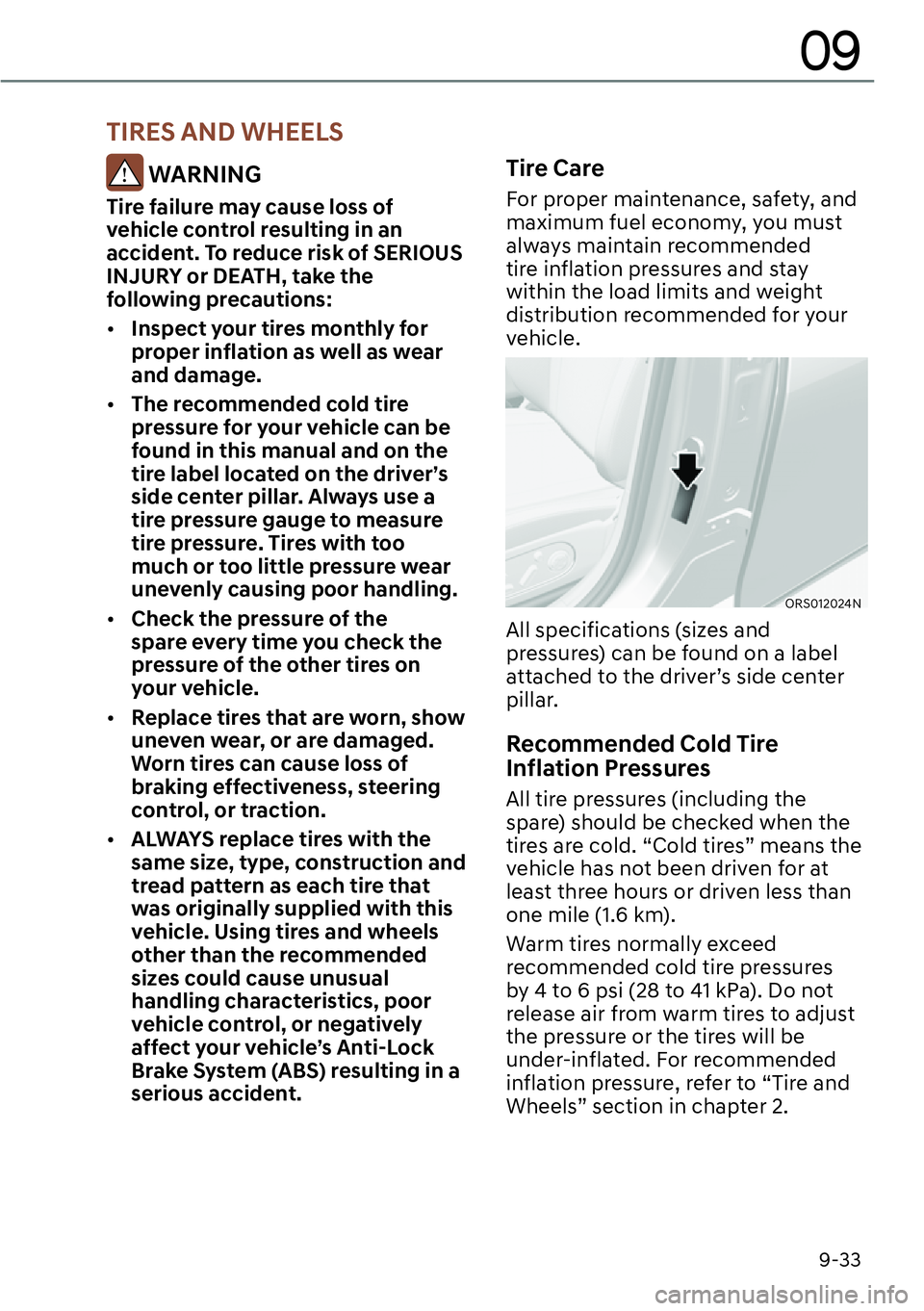
ORS012024N
All specifications (sizes and
pressures) can be found on a label
attached to the driver’s side center
pillar.
Recommended Cold Tire
Inflation Pressures
All tire pressures (including the
spare) should be checked when the
tires are cold. “Cold tires” means the
vehicle has not been driven for at
least three hours or driven less than
one mile (1.6 km).
Warm tires normally exceed
recommended cold tire pressures
by 4 to 6 psi (28 to 41 kPa). Do not
release air from warm tires to adjust
the pressure or the tires will be
under-inflated. For recommended
inflation pressure, refer to “Tire and
Wheels” section in chapter 2.
TIRES AND WHEELS
Page 633 of 676

9-35
09
Tire Rotation
To equalize tread wear, Genesis
Branded Vehicle recommends that
the tires be rotated according to the
maintenance schedule or sooner if
irregular wear develops.
During rotation, check the tires for
correct balance.
When rotating tires, check for uneven
wear and damage. Abnormal wear
is usually caused by incorrect tire
pressure, improper wheel alignment,
out-of-balance wheels, severe braking
or severe cornering. Look for bumps or
bulges in the tread or side of the tire.
Replace the tire if you find any of these
conditions. Replace the tire if fabric or
cord is visible. After rotation, be sure to
bring the front and rear tire pressures
to specification and check wheel bolt
tightness (proper torque is 101~116
lbf·ft [14-16 kgf·m].
ORS091056L
Disc brake pads should be inspected
for wear whenever tires are rotated.
Information
The outside and inside of the
unsymmetrical tire is distinguishable.
When installing an unsymmetrical
tire, be sure to install the side marked
“outside” face the outside. If the side
marked “inside” is installed on the
outside, it will have a negative effect
on vehicle performance.
WARNING
�[�Do not use the compact spare
tire for tire rotation.
�[�Do not mix bias ply and radial ply
tires under any circumstances.
This may cause unusual handling
characteristics that may cause
loss of vehicle control resulting in
an accident.
Page 636 of 676

9-38
Maintenance
Tire Sidewall Labeling
This information identifies and
describes the fundamental
characteristics of the tire and also
provides the tire identification
number (TIN) for safety standard
certification. The TIN can be used to
identify the tire in case of a recall.
ORS091058
1. Manufacturer or brand name
Manufacturer or brand name is
shown.
2. Tire size designation
A tire’s sidewall is marked with a
tire size designation. You will need
this information when selecting
replacement tires for your car.
The following explains what the
letters and numbers in the tire size
designation mean.Example tire size designation:
(These numbers are provided as
an example only; your tire size
designator could vary depending on
your vehicle.)
245/45R20 103V
245 - Tire width in millimeters.
45 - Aspect ratio. The tire’s section
height as a percentage of its
width.
R - Tire construction code (Radial).
20 - Rim diameter in inches.
103 - Load Index, a numerical code
associated with the maximum
load the tire can carry.
V - Speed Rating Symbol. See
the speed rating chart in
this section for additional
information.
Wheel size designation
Wheels are also marked with
important information that you need
if you ever have to replace one. The
following explains what the letters
and numbers in the wheel size
designation mean.
Example wheel size designation:
8.5J X 20
8.5 - Rim width in inches.
J - Rim contour designation.
20 - Rim diameter in inches.


