2023 FORD SUPER DUTY catalytic
[x] Cancel search: catalyticPage 11 of 738
Glasses Holder.............................................201
Starting and Stopping theEngine
Starting and Stopping the Engine –Precautions...............................................202
Ignition Switch.............................................202
Push Button Ignition Switch...................203
Starting the Engine....................................203
Engine Block Heater..................................205
Stopping the Engine.................................206
Idle Timer.......................................................207
Automatic Engine Stop...........................208
Accessing the Passive Key BackupPosition......................................................209
Starting and Stopping the Engine –Troubleshooting.....................................209
Starting and Stopping the Engine Videos.........................................................................213
Fuel and Refueling
Fuel and Refueling Precautions.............214
Fuel Quality....................................................214
Running Out of Fuel....................................217
Refueling.........................................................218
Fuel Tank Capacity....................................220
Fuel and Refueling – Troubleshooting........................................................................220
Diesel Particulate Filter
What Is the Diesel Particulate Filter......221
How Does the Diesel Particulate FilterWork..............................................................221
Diesel Particulate Filter Precautions.........................................................................221
Diesel Particulate Filter Requirements........................................................................222
Diesel Particulate Filter ManualRegeneration............................................222
Diesel Particulate Filter –Troubleshooting......................................224
Selective Catalytic ReductionSystem
What Is the Selective CatalyticReduction System..................................226
How Does the Selective CatalyticReduction System Work......................226
Selective Catalytic Reduction SystemPrecautions...............................................226
Selective Catalytic Reduction SystemRequirements..........................................228
Selective Catalytic Reduction SystemGuidelines..................................................228
Filling the Selective Catalytic ReductionSystem Tank.............................................228
Checking the Selective CatalyticReduction System Status...................230
Diesel Exhaust Fluid Capacity andSpecification............................................230
Selective Catalytic Reduction System –Troubleshooting......................................230
Catalytic Converter
What Is the Catalytic Converter............233
Catalytic Converter Precautions...........233
Catalytic Converter – Troubleshooting........................................................................233
Automatic Transmission
Automatic Transmission Precautions........................................................................234
Automatic Transmission Positions......234
Shifting Your Vehicle Into Gear..............235
Automatic Transmission PositionIndicators...................................................235
Manually Shifting Gears...........................235
Using Progressive Range Selection......236
Automatic Transmission AudibleWarnings....................................................236
Power Take-Off...........................................236
Four-Wheel Drive
How Does Four-Wheel Drive Work......238
7
2023 Super Duty (TFH) Canada/United States of America, enUSA, Edition date: 202211, DOMTable of Contents
Page 143 of 738

WHAT ARE THE INSTRUMENT
CLUSTER WARNING LAMPS
Warning lamps alert you to a vehiclecondition that could become serious.Some lamps illuminate when you startyour vehicle to make sure they work. If anylamps remain on after starting your vehicle,refer to the respective system warninglamp for further information.
INSTRUMENT CLUSTER
WARNING LAMPS
Depending on your vehicle options, somewarning lamps can appear different or notat all.
Anti-Lock Brake System
If it illuminates when you aredriving, this indicates amalfunction. Your vehiclecontinues to have normal braking withoutthe anti-lock brake system function. Haveyour vehicle checked as soon as possible.
Battery
It illuminates when you switchthe ignition on.
If it illuminates when the engineis running, this indicates your vehiclerequires service. Have your vehiclechecked as soon as possible.
Brake System
It illuminates when you apply theparking brake and the ignition ison. If it illuminates when yourvehicle is moving, make sure theparking brake is released. If theparking brake is released, thisindicates low brake fluid level or the brakesystem requires service. Have your vehiclechecked as soon as possible.
Note:Indicators may vary depending onregion.
Diesel Exhaust Fluid
Illuminates when the dieselexhaust fluid is low,contaminated or the systemrequires service. See Selective CatalyticReduction System (page 226).
Door Ajar
It illuminates when you switchthe ignition on and remains on ifany door is open.
Electric Parking Brake
It illuminates or flashes when theelectric parking brake requiresservice.
Note:Indicators may vary depending onregion.
Engine Coolant Temperature
If it illuminates, safely stop yourvehicle and switch the vehicleoff.
139
2023 Super Duty (TFH) Canada/United States of America, enUSA, Edition date: 202211, DOMInstrument ClusterE67020 E67021 E270480 E67024 E163176 E249859 E325775 E103308
Page 213 of 738
ACCESSING THE PASSIVE KEY
BACKUP POSITION
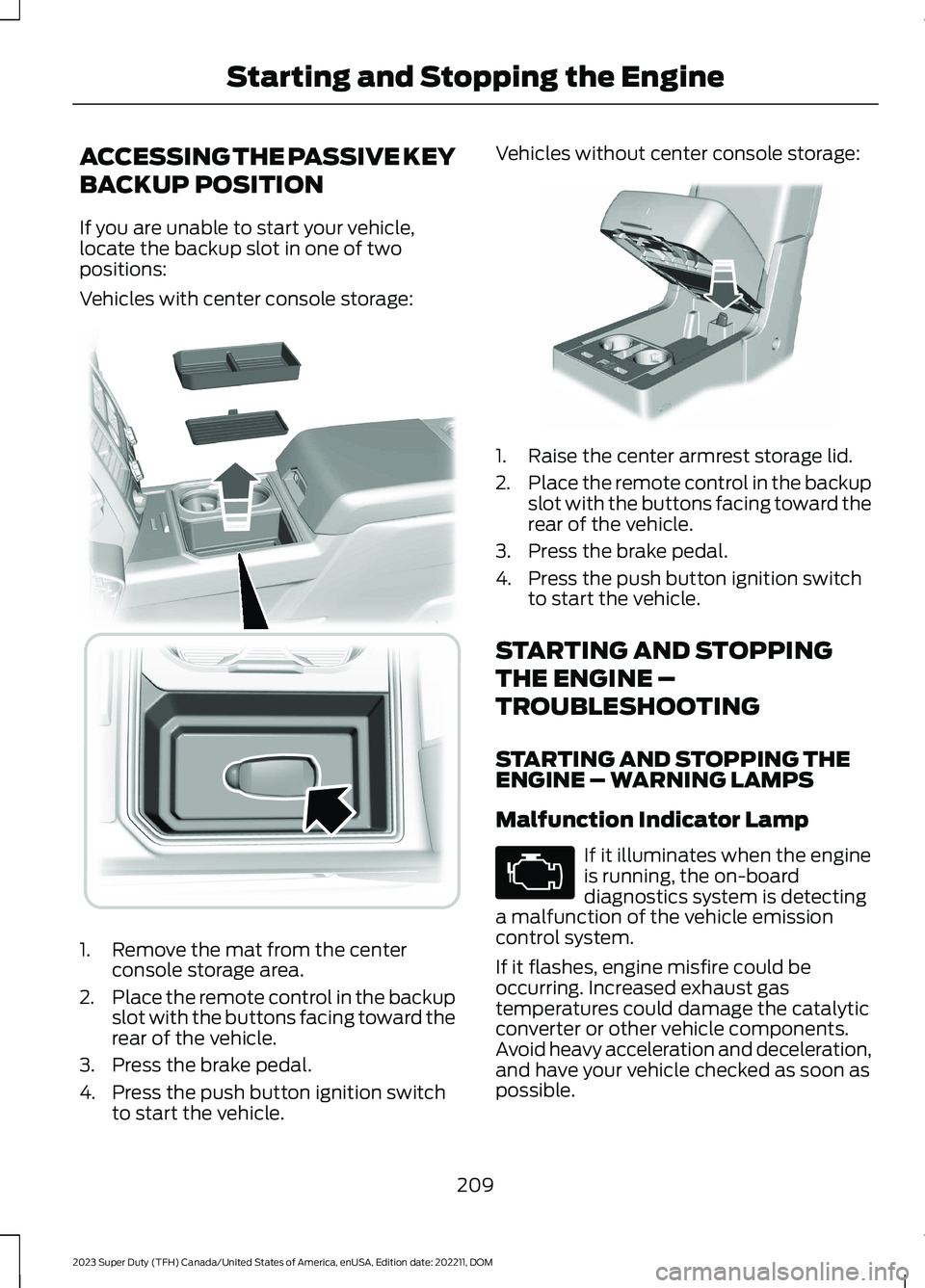
If you are unable to start your vehicle,locate the backup slot in one of twopositions:
Vehicles with center console storage:
1.Remove the mat from the centerconsole storage area.
2.Place the remote control in the backupslot with the buttons facing toward therear of the vehicle.
3.Press the brake pedal.
4.Press the push button ignition switchto start the vehicle.
Vehicles without center console storage:
1.Raise the center armrest storage lid.
2.Place the remote control in the backupslot with the buttons facing toward therear of the vehicle.
3.Press the brake pedal.
4.Press the push button ignition switchto start the vehicle.
STARTING AND STOPPING
THE ENGINE –
TROUBLESHOOTING
STARTING AND STOPPING THEENGINE – WARNING LAMPS
Malfunction Indicator Lamp
If it illuminates when the engineis running, the on-boarddiagnostics system is detectinga malfunction of the vehicle emissioncontrol system.
If it flashes, engine misfire could beoccurring. Increased exhaust gastemperatures could damage the catalyticconverter or other vehicle components.Avoid heavy acceleration and deceleration,and have your vehicle checked as soon aspossible.
209
2023 Super Duty (TFH) Canada/United States of America, enUSA, Edition date: 202211, DOMStarting and Stopping the Engine E226701 E269950 E67028
Page 225 of 738

WHAT IS THE DIESEL
PARTICULATE FILTER
The diesel particulate filter is part of yourvehicle's emissions system and filtersharmful diesel particulates from theexhaust gas.
HOW DOES THE DIESEL
PARTICULATE FILTER WORK
The diesel particulate filter reducesemissions by trapping exhaust particlesbefore they reach the tailpipe. The systemmust periodically clean the exhaustparticles that gather inside the filter. Thisis carried out in three ways, passiveregeneration, active regeneration andmanual regeneration.
Passive Regeneration
In passive regeneration, the normalexhaust system temperature cleans thefilter by oxidizing the soot. Cleaning occursduring normal vehicle operating conditionsdue to driving patterns.
Active Regeneration
Once the diesel particulate filter is full,active regeneration raises the exhausttemperature to eliminate the particles.
When the engine control module detectsthat the diesel particulate filter is nearlyfull of particulates, and you are notoperating your vehicle in a manner to alloweffective regeneration, messages appearin the information display as a reminderfor you to drive your vehicle in order toclean the diesel particulate filter. If youdrive your vehicle in a manner to alloweffective regeneration, the informationdisplay shows a cleaning exhaust filtermessage.
DIESEL PARTICULATE FILTER
PRECAUTIONS
WARNING: Do not park or idle yourvehicle over dry leaves, dry grass or othercombustible materials. The regenerationprocess creates very high exhaust gastemperatures and the exhaust willradiate a considerable amount of heatduring and after regeneration and afteryou have switched the engine off. This isa potential fire hazard.
WARNING: When the ExhaustFilter Cleaning message appears in theinformation display, do not park nearflammable materials, vapors orstructures until filter cleaning iscomplete.
WARNING: The normal operatingtemperature of the exhaust system isvery high. Never work around or attemptto repair any part of the exhaust systemuntil it has cooled. Use special care whenworking around the diesel oxidationcatalytic converter or the dieselparticulate filter. The diesel oxidationcatalytic converter and the dieselparticulate filter heat up to very hightemperatures after only a short periodof engine operation and remain hot afteryou switch the engine off.
Note:Avoid running out of fuel.
Note: During regeneration at low speed orengine idle, you may smell a hot metallicodor and could notice a clicking metallicsound. This is due to high temperaturesreached during regeneration and is normal.
Note:Changes in the engine or exhaustsound may be heard during the regenerationprocess.
221
2023 Super Duty (TFH) Canada/United States of America, enUSA, Edition date: 202211, DOMDiesel Particulate Filter (If Equipped)
Page 230 of 738
WHAT IS THE SELECTIVE
CATALYTIC REDUCTION
SYSTEM
The selective catalytic reduction systemhelps reduce tailpipe emissions andrequires Diesel Exhaust Fluid (DEF) toconvert nitrogen oxides into nitrogen andwater.
HOW DOES THE SELECTIVE
CATALYTIC REDUCTION
SYSTEM WORK
The selective catalytic reduction systeminjects diesel exhaust fluid into the exhaustsystem to enable correct selective catalyticreduction system function.
The usage of diesel exhaust fluid hasincreased from prior model years in orderto meet more stringent emissionsrequirements. The diesel exhaust fluidusage ranges from approximately 2-6%of fuel burned (100.00 gal (378.54 L) offuel requires approximately 2.00 gal(7.57 L)to 6.00 gal (22.71 L) of dieselexhaust fluid) depending on vehicle usage.Factors that influence diesel exhaust fluidusage may include:
•Payload/Towing
•Driving Style
•Altitude
•Humidity
•Temperature
SELECTIVE CATALYTIC
REDUCTION SYSTEM
PRECAUTIONS
WARNING: Keep diesel exhaustfluid out of reach of children. Avoidcontact with skin, eyes or clothing. Incase of contact with your eyes, flushimmediately with water and get promptmedical attention. In case of contactwith your skin, clean immediately withsoap and water. If you swallow anydiesel exhaust fluid, drink plenty ofwater, call a physician immediately.
WARNING: Only refill the dieselexhaust fluid tank in a well ventilatedarea. When you remove the dieselexhaust fluid tank filler cap or a dieselexhaust fluid container cap, ammoniavapors may escape. Ammonia vaporscan be irritating to skin, eyes and mucousmembranes. Inhaling ammonia vaporscan cause burning to the eyes, throat andnose and cause coughing and wateryeyes.
WARNING: Diesel exhaust fluidmust be refilled when low or replacedwhen contaminated or your vehiclespeed becomes limited to 50 mph(80 km/h). In these conditions, drive withcaution and refill diesel exhaust fluidimmediately. If the diesel exhaust fluidbecomes empty or contaminated andfluid is not replaced, your vehiclebecomes limited to engine idle only oncestopped. In these conditions, be cautiouswhere you stop your vehicle because youmay not be able to drive long distancesor maintain highway speeds until yourefill or replace the diesel exhaust fluid.
226
2023 Super Duty (TFH) Canada/United States of America, enUSA, Edition date: 202211, DOMSelective Catalytic Reduction System (If Equipped)
Page 231 of 738

WARNING: Tampering with ordisabling the selective catalyticreduction system results in severevehicle performance limitation includingeventual speed limiting to 5 mph(8 km/h).
Note: Do not put diesel exhaust fluid in thefuel tank. Do not start the engine if anyamount of diesel exhaust fluid was addedto the diesel fuel tank as it will likely lead tofailure of the fuel pump and injectors andmay result in severe engine damage whichyour vehicle Warranty may not cover. Thediesel fuel tank must be completely drainedand cleaned prior to being refilled with cleandiesel fuel and starting the engine.
Selective catalytic reduction systems aresensitive to contamination of the dieselexhaust fluid. Maintaining the purity of thefluid is important to avoid systemmalfunctions. If you remove or drain thediesel exhaust fluid tank, do not use thesame fluid to refill the tank. The systemhas a sensor to monitor fluid quality.
Driving without refilling, replacingcontaminated diesel exhaust fluid, orhaving the selective catalytic reductionsystem repaired results in the followingactions as required by the California AirResources Board (CARB) and the U.S.Environmental Protection Agency (EPA):
•Within a preset distance to empty,speed is limited upon vehicle restart.Prior to this occurring a messageappears in the information display.
•Further vehicle operation withoutrefilling or replacing contaminateddiesel exhaust fluid causes the engineto enter an idle-only condition. Thisonly occurs upon vehicle refueling,vehicle idling in park for 1 hour, orengine shutdown for 10 minutes ormore and is indicated by a message inthe information display indicatingrequired actions to resume normaloperation. It is required to add aminimum of 1.0 gal (3.8 L) of dieselexhaust fluid to the tank to exit theidle-only condition, but your vehicle isstill in the speed-limiting mode untilyou refill the tank completely.
Note:For vehicle speed limiting or idle-onlycondition, normal vehicle operation resumeswhen you refill the diesel exhaust fluid tankor repair the contaminated system. If thesystem is contaminated or inoperative, haveyour vehicle checked as soon as possible.
227
2023 Super Duty (TFH) Canada/United States of America, enUSA, Edition date: 202211, DOMSelective Catalytic Reduction System (If Equipped)
Page 232 of 738

SELECTIVE CATALYTIC
REDUCTION SYSTEM
REQUIREMENTS
Only use diesel exhaust fluid that iscertified by the American PetroleumInstitute (API).
You can purchase diesel exhaust fluid atan authorized dealer, or contact roadsideassistance for help in finding a retailer thatsells diesel exhaust fluid.
Note:Non-certified diesel exhaust fluid usecan cause damage that your Warranty maynot cover
SELECTIVE CATALYTIC
REDUCTION SYSTEM
GUIDELINES
•Diesel exhaust fluid is non-flammable,non-toxic, colorless and water-solubleliquid.
•In order for the system to operatecorrectly you must maintain the dieselexhaust fluid level.
•Do not overfill the diesel exhaust fluidtank.
•Diesel exhaust fluid is corrosive.
•Avoid spilling diesel exhaust fluid onpainted surfaces, carpeting or plasticcomponents. Immediately wipe awayany diesel exhaust fluid that has spilledwith a damp cloth and water. If it hasalready crystallized, use warm waterand a sponge.
•Do not store the diesel exhaust fluidbottle in your vehicle. If it leaks it couldcause damage to interior componentsor release an ammonia odor inside yourvehicle.
•Do not re-use the diesel exhaust fluidcontainer once it is emptied.
•Store diesel exhaust fluid out of directsunlight and in temperatures between23–68°F (-5–20°C).
•The system has a diesel exhaust fluidquality sensor. Dilution of dieselexhaust fluid or use of any other liquidin the selective catalytic reductionsystem leads to a diesel exhaust fluidsystem fault, eventually leading to thevehicle only operating in idle-onlymode.
•Do not dilute diesel exhaust fluid withwater or any other liquid.
FILLING THE SELECTIVE
CATALYTIC REDUCTION
SYSTEM TANK
FILLING THE SELECTIVECATALYTIC REDUCTION SYSTEMTANK IN COLD WEATHER
Diesel exhaust fluid may freeze if theambient temperature is below 12°F (-11°C).Your vehicle has a preheating systemwhich allows diesel exhaust fluid tooperate below 12°F (-11°C). If you do notuse your vehicle for an extended periodwhen the ambient temperature is below12°F (-11°C), the fluid in the tank mayfreeze.
228
2023 Super Duty (TFH) Canada/United States of America, enUSA, Edition date: 202211, DOMSelective Catalytic Reduction System (If Equipped)E163354
Page 233 of 738
If the DEF tank is frozen, it may notrecognize when the tank is refilled. The DEFlevel will update once the tank thaws out.It is best to fill the DEF tank prior to, or aftera drive cycle greater than 20 minutes toallow the remaining frozen DEF in the tankto liquefy. If the tank is overfilled and thefluid freezes it may cause damage thatyour Warranty will not cover.
FILLING THE SELECTIVECATALYTIC REDUCTION SYSTEMTANK USING A FUEL STATIONPUMP
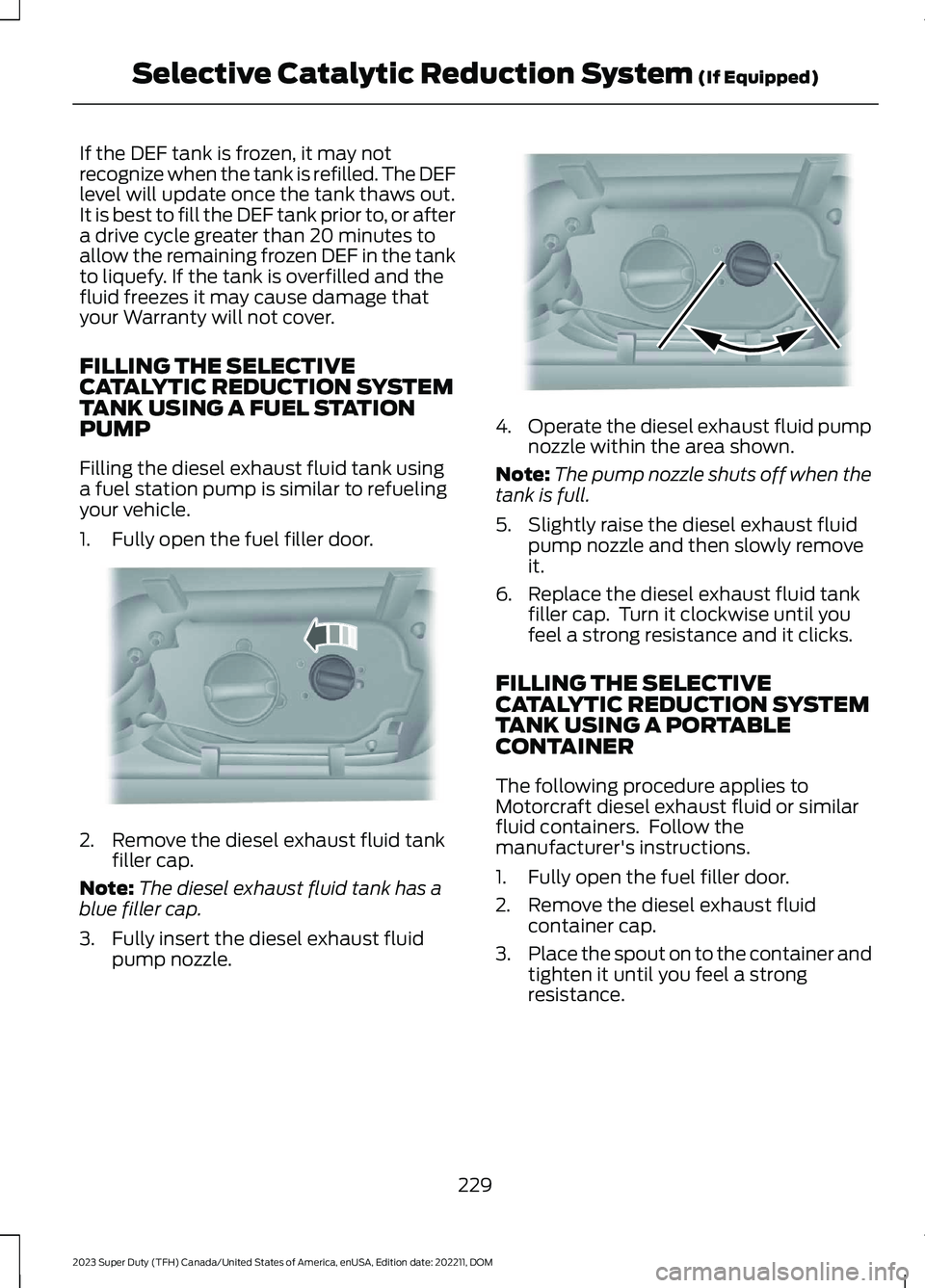
Filling the diesel exhaust fluid tank usinga fuel station pump is similar to refuelingyour vehicle.
1.Fully open the fuel filler door.
2.Remove the diesel exhaust fluid tankfiller cap.
Note:The diesel exhaust fluid tank has ablue filler cap.
3.Fully insert the diesel exhaust fluidpump nozzle.
4.Operate the diesel exhaust fluid pumpnozzle within the area shown.
Note:The pump nozzle shuts off when thetank is full.
5.Slightly raise the diesel exhaust fluidpump nozzle and then slowly removeit.
6.Replace the diesel exhaust fluid tankfiller cap. Turn it clockwise until youfeel a strong resistance and it clicks.
FILLING THE SELECTIVECATALYTIC REDUCTION SYSTEMTANK USING A PORTABLECONTAINER
The following procedure applies toMotorcraft diesel exhaust fluid or similarfluid containers. Follow themanufacturer's instructions.
1.Fully open the fuel filler door.
2.Remove the diesel exhaust fluidcontainer cap.
3.Place the spout on to the container andtighten it until you feel a strongresistance.
229
2023 Super Duty (TFH) Canada/United States of America, enUSA, Edition date: 202211, DOMSelective Catalytic Reduction System (If Equipped)E328788 E328783