2023 FORD SUPER DUTY warning light
[x] Cancel search: warning lightPage 183 of 738
GARAGE DOOR OPENER
INTRODUCTION
HomeLink Wireless ControlSystem
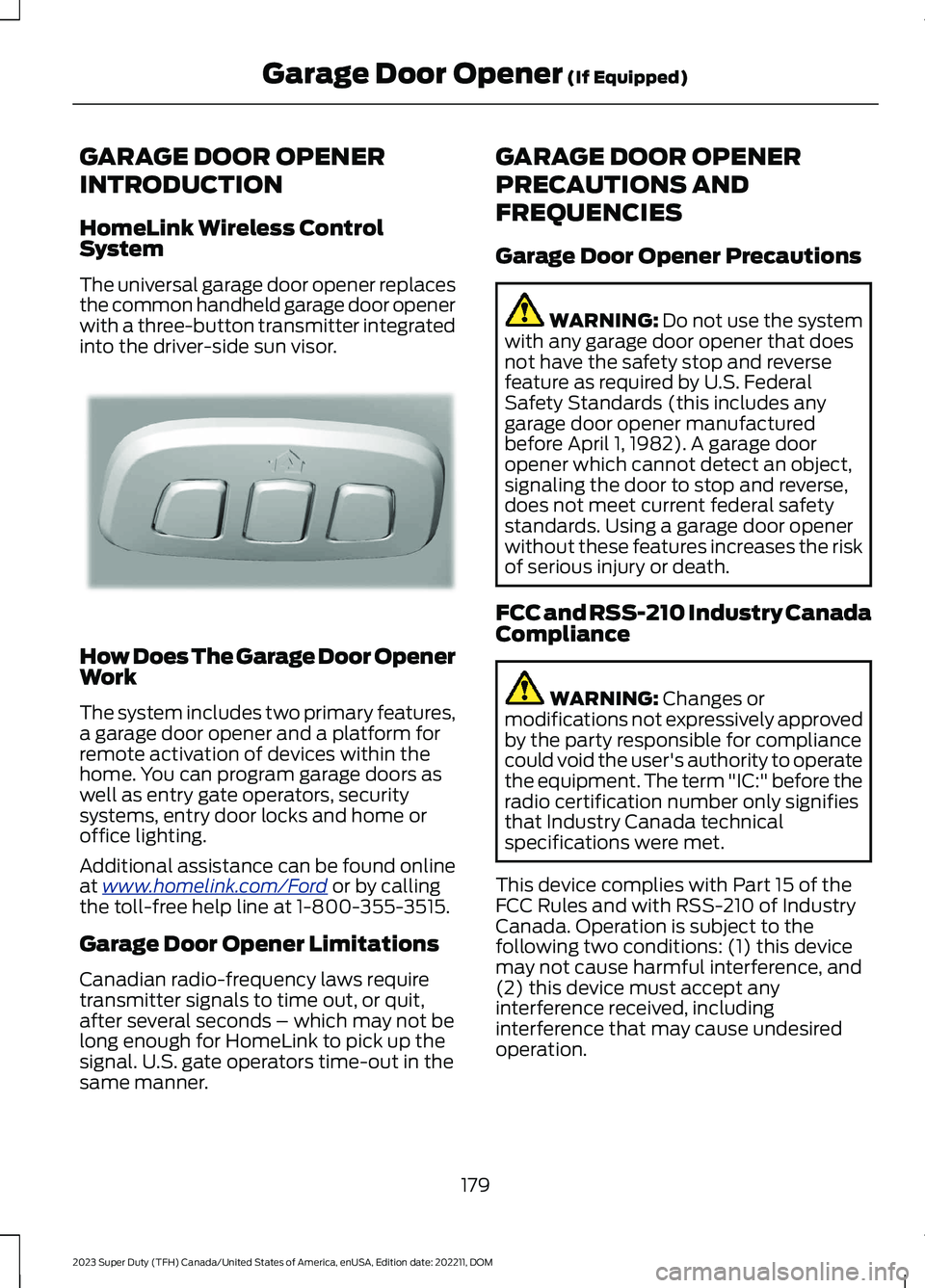
The universal garage door opener replacesthe common handheld garage door openerwith a three-button transmitter integratedinto the driver-side sun visor.
How Does The Garage Door OpenerWork
The system includes two primary features,a garage door opener and a platform forremote activation of devices within thehome. You can program garage doors aswell as entry gate operators, securitysystems, entry door locks and home oroffice lighting.
Additional assistance can be found onlineat www.homelink.com/Ford or by callingthe toll-free help line at 1-800-355-3515.
Garage Door Opener Limitations
Canadian radio-frequency laws requiretransmitter signals to time out, or quit,after several seconds – which may not belong enough for HomeLink to pick up thesignal. U.S. gate operators time-out in thesame manner.
GARAGE DOOR OPENER
PRECAUTIONS AND
FREQUENCIES
Garage Door Opener Precautions
WARNING: Do not use the systemwith any garage door opener that doesnot have the safety stop and reversefeature as required by U.S. FederalSafety Standards (this includes anygarage door opener manufacturedbefore April 1, 1982). A garage dooropener which cannot detect an object,signaling the door to stop and reverse,does not meet current federal safetystandards. Using a garage door openerwithout these features increases the riskof serious injury or death.
FCC and RSS-210 Industry CanadaCompliance
WARNING: Changes ormodifications not expressively approvedby the party responsible for compliancecould void the user's authority to operatethe equipment. The term "IC:" before theradio certification number only signifiesthat Industry Canada technicalspecifications were met.
This device complies with Part 15 of theFCC Rules and with RSS-210 of IndustryCanada. Operation is subject to thefollowing two conditions: (1) this devicemay not cause harmful interference, and(2) this device must accept anyinterference received, includinginterference that may cause undesiredoperation.
179
2023 Super Duty (TFH) Canada/United States of America, enUSA, Edition date: 202211, DOMGarage Door Opener (If Equipped)E188211
Page 220 of 738
Using low-sulfur diesel fuel(16-500 ppm) or high-sulfurdiesel fuel (greater than 500ppm) in your diesel engine will causecertain emission components tomalfunction which could also cause theservice engine soon light to illuminateindicating an emissions-related concern.
Diesel fuel is adjusted seasonally for coldtemperature. For best results attemperatures below 19°F (-7°C), werecommend using a diesel fuel which hasbeen seasonally adjusted for the ambientconditions.
Choosing the Right Fuel: VehiclesOperated Where Ultra Low SulfurDiesel Fuel Is Not Required
For the engine to operate reliably onlow-sulfur or high-sulfur diesel fuel, theengine must be a factory-built high-sulfurengine (available as a dealer order optionfor select markets) or an ultra-low sulfurdiesel fuel configured engine that has beenretrofitted for high-sulfur diesel fuel usingauthorized dealer service parts. Failure touse retrofit components other than thoseavailable through your authorized dealerresults in coolant system damage, engineoverheating, selective catalyst reductionsystem or diesel particulate filter damageand possible base engine damage.
Use only a diesel engine configured for usewith high-sulfur diesel fuel in markets withdiesel fuel that has sulfur content greaterthan 15 ppm. Using low-sulfur diesel fuel(16–500 ppm) or high-sulfur diesel fuel(greater than 500 ppm) in a diesel enginedesigned to use only ultra-low sulfur dieselfuel could result in damage to engineemission control devices and the aftertreatment system, potentially renderingthe vehicle inoperable.
Vehicles with engines configured for usewith high-sulfur diesel fuel are onlyavailable for sale in countries whereultra-low sulfur diesel fuel is generally notavailable or mandated by the government.Vehicles originally sold in an ultra-lowsulfur diesel fuel market that aresubsequently exported to non-ultra lowsulfur diesel fuel markets will need to beretrofitted at the customer’s expense usingFord authorized dealer service parts inorder to be reliably operated on non-ultralow sulfur diesel fuel.
Biodiesel
WARNING: Do not mix diesel withgasoline, gasohol or alcohol. This couldcause an explosion.
Note:Do not use home heating oil,agricultural fuel, raw fats and oils, wastecooking greases, biodiesel greater than 20%or any diesel not intended for highway use.Damage to the fuel injection system, engineand exhaust catalyst, and diesel particulatefilter can occur if you use an improper fuel.Red dye is used to identify fuels intendedfor agricultural and non-highway use.
You can operate your vehicle on dieselfuels containing up to 20% biodiesel, alsoknown as B20.
Biodiesel fuel is a chemically convertedproduct from renewable fuel sources, suchas vegetable oils, animal fats and wastecooking greases.
To help achieve acceptable engineperformance and durability when usingbiodiesel in your vehicle:
•Confirm the biodiesel content of thefuel to be B20 (20% biodiesel) or less.
•Only use biodiesel fuel of good qualitythat complies with industry standards.
216
2023 Super Duty (TFH) Canada/United States of America, enUSA, Edition date: 202211, DOMFuel and RefuelingE67028
Page 226 of 738
Failure to perform active or manualregeneration when instructed could resultin a clogged diesel particulate filter. If thediesel particulate filter fills beyond theregeneration threshold, your vehicledisables the ability for active and manualregeneration. This could result inirreversible damage your vehicle Warrantymay not cover.
DIESEL PARTICULATE FILTER
REQUIREMENTS
The diesel particulate filter on your vehiclerequires periodic regeneration to maintainits correct function.
If your journeys meet one of the followingconditions:
•You drive only short distances.
•You frequently switch the ignition onand off.
•Your journeys contain a high level ofacceleration and deceleration.
You must carry out occasional trips withthe following conditions to assist theregeneration process:
•Drive your vehicle in more favorableconditions, which you will find at highervehicle speeds in normal driving, on amain road or freeway for a minimumof 20 minutes. This drive may includeshort stops that will not affect theregeneration process.
•Avoid prolonged idling and observespeed limits and road conditions.
•Do not switch the ignition off.
•Select a suitable gear to ideallymaintain engine speed between 1500and 3000 RPM.
DIESEL PARTICULATE FILTER
MANUAL REGENERATION
WHAT IS DIESEL PARTICULATEFILTER MANUAL REGENERATION
Diesel particulate filter manualregeneration allows you to manually startregeneration of the diesel particulate filterat idle to clean the filter.
Note:If you are not sure whether yourvehicle has this feature, contact yourauthorized dealer.
DIESEL PARTICULATE FILTERMANUAL REGENERATIONPRECAUTIONS
WARNING: Stay clear of theexhaust tailpipe during regeneration. Hotexhaust gases can burn you badly.
You may not be able to use manualregeneration if the service engine soonwarning lamp appears in the informationdisplay.
Note:During the use of manualregeneration, you may observe a lightamount of white smoke. This is normal.
DIESEL PARTICULATE FILTERMANUAL REGENERATIONREQUIREMENTS
You can use the manual regenerationfeature when a message appears in theinformation display and you are not ableto drive in a manner that allows effectiveautomatic active regeneration or if youchoose to manually start the regenerationof the diesel particulate filter while thevehicle is idle.
222
2023 Super Duty (TFH) Canada/United States of America, enUSA, Edition date: 202211, DOMDiesel Particulate Filter (If Equipped)
Page 234 of 738
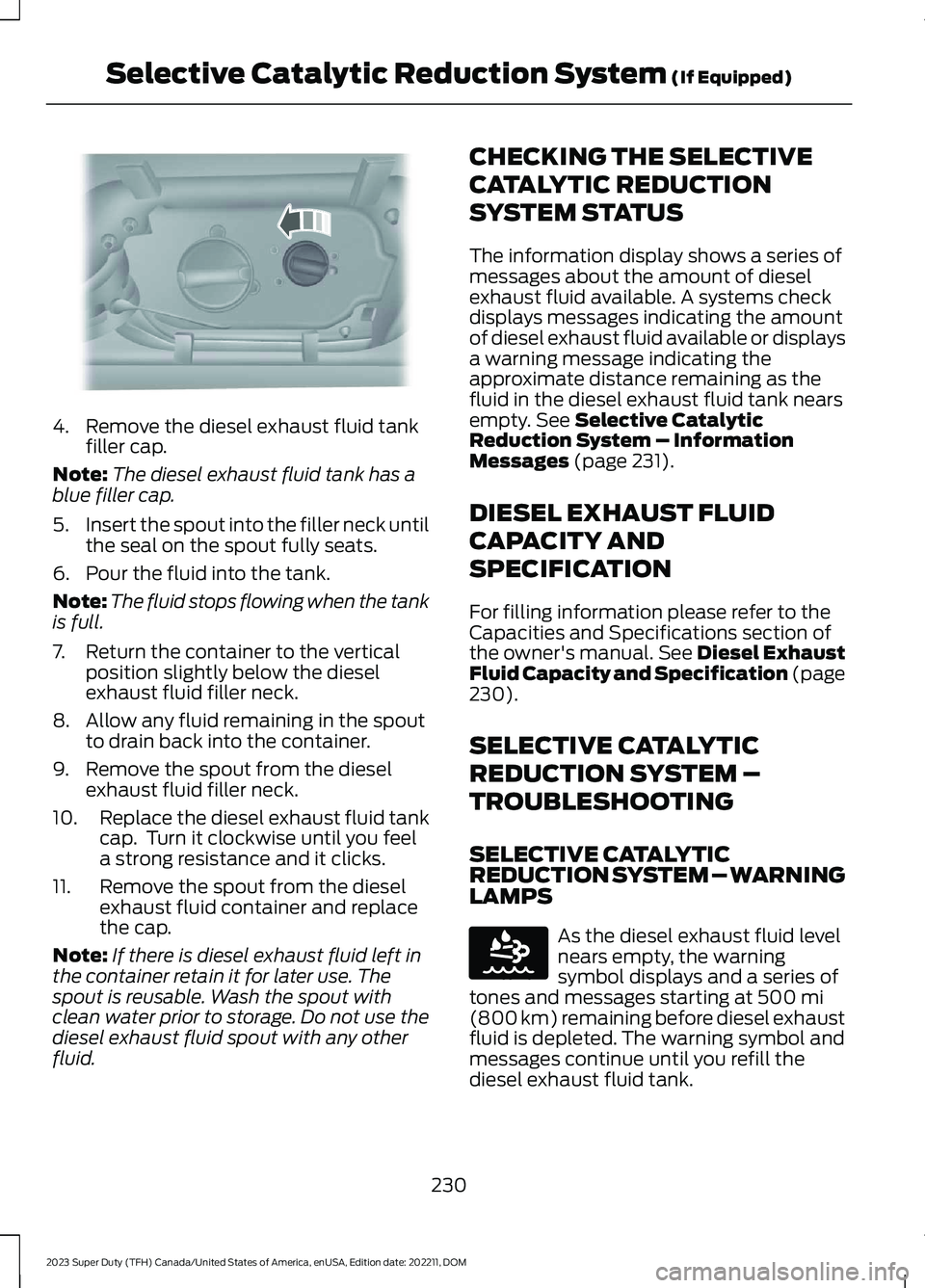
4.Remove the diesel exhaust fluid tankfiller cap.
Note:The diesel exhaust fluid tank has ablue filler cap.
5.Insert the spout into the filler neck untilthe seal on the spout fully seats.
6.Pour the fluid into the tank.
Note:The fluid stops flowing when the tankis full.
7.Return the container to the verticalposition slightly below the dieselexhaust fluid filler neck.
8.Allow any fluid remaining in the spoutto drain back into the container.
9.Remove the spout from the dieselexhaust fluid filler neck.
10.Replace the diesel exhaust fluid tankcap. Turn it clockwise until you feela strong resistance and it clicks.
11.Remove the spout from the dieselexhaust fluid container and replacethe cap.
Note:If there is diesel exhaust fluid left inthe container retain it for later use. Thespout is reusable. Wash the spout withclean water prior to storage. Do not use thediesel exhaust fluid spout with any otherfluid.
CHECKING THE SELECTIVE
CATALYTIC REDUCTION
SYSTEM STATUS
The information display shows a series ofmessages about the amount of dieselexhaust fluid available. A systems checkdisplays messages indicating the amountof diesel exhaust fluid available or displaysa warning message indicating theapproximate distance remaining as thefluid in the diesel exhaust fluid tank nearsempty. See Selective CatalyticReduction System – InformationMessages (page 231).
DIESEL EXHAUST FLUID
CAPACITY AND
SPECIFICATION
For filling information please refer to theCapacities and Specifications section ofthe owner's manual. See Diesel ExhaustFluid Capacity and Specification (page230).
SELECTIVE CATALYTIC
REDUCTION SYSTEM –
TROUBLESHOOTING
SELECTIVE CATALYTICREDUCTION SYSTEM – WARNINGLAMPS
As the diesel exhaust fluid levelnears empty, the warningsymbol displays and a series oftones and messages starting at 500 mi(800 km) remaining before diesel exhaustfluid is depleted. The warning symbol andmessages continue until you refill thediesel exhaust fluid tank.
230
2023 Super Duty (TFH) Canada/United States of America, enUSA, Edition date: 202211, DOMSelective Catalytic Reduction System (If Equipped)E328788 E163176
Page 245 of 738
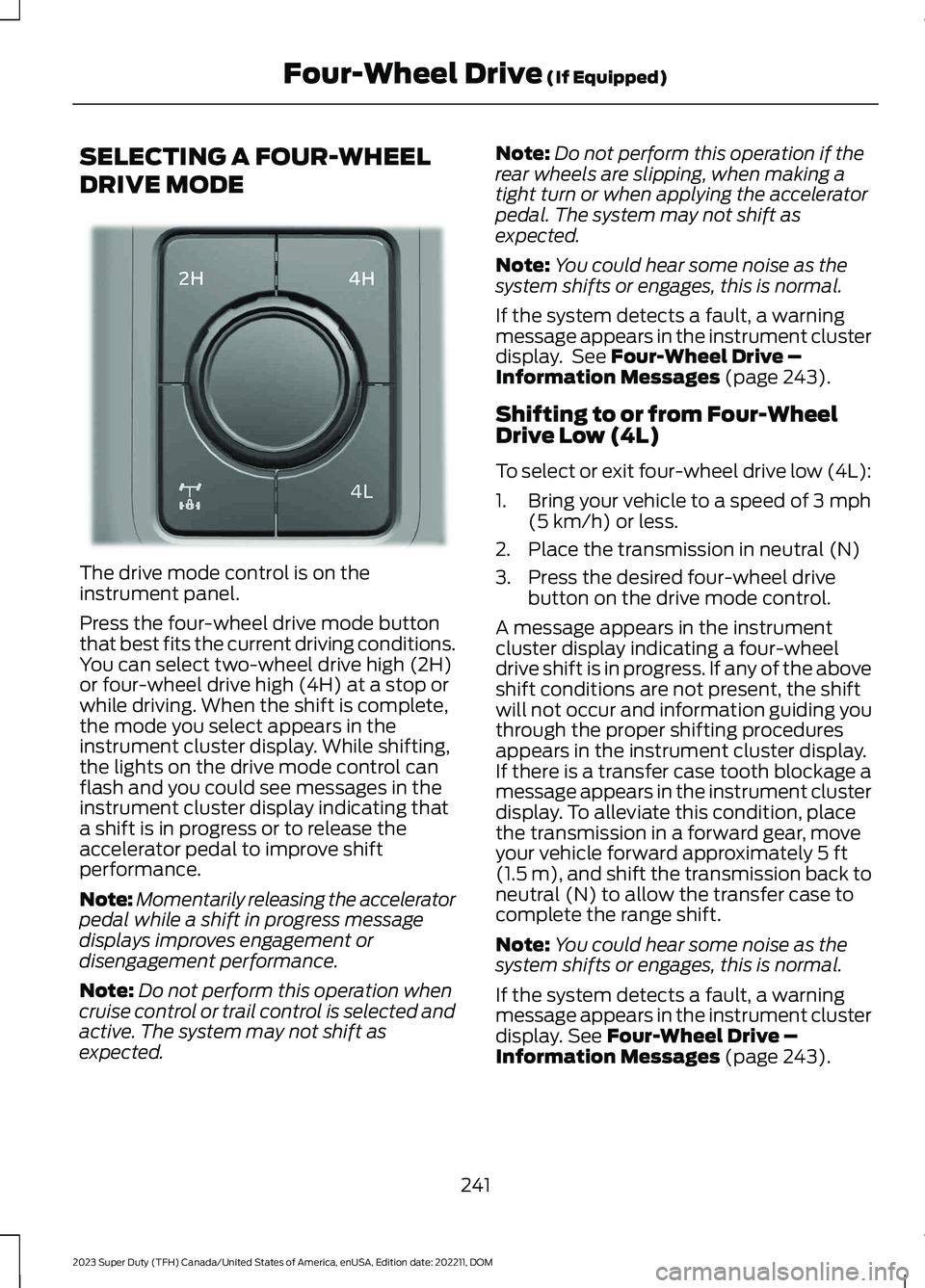
SELECTING A FOUR-WHEEL
DRIVE MODE
The drive mode control is on theinstrument panel.
Press the four-wheel drive mode buttonthat best fits the current driving conditions.You can select two-wheel drive high (2H)or four-wheel drive high (4H) at a stop orwhile driving. When the shift is complete,the mode you select appears in theinstrument cluster display. While shifting,the lights on the drive mode control canflash and you could see messages in theinstrument cluster display indicating thata shift is in progress or to release theaccelerator pedal to improve shiftperformance.
Note:Momentarily releasing the acceleratorpedal while a shift in progress messagedisplays improves engagement ordisengagement performance.
Note:Do not perform this operation whencruise control or trail control is selected andactive. The system may not shift asexpected.
Note:Do not perform this operation if therear wheels are slipping, when making atight turn or when applying the acceleratorpedal. The system may not shift asexpected.
Note:You could hear some noise as thesystem shifts or engages, this is normal.
If the system detects a fault, a warningmessage appears in the instrument clusterdisplay. See Four-Wheel Drive –Information Messages (page 243).
Shifting to or from Four-WheelDrive Low (4L)
To select or exit four-wheel drive low (4L):
1.Bring your vehicle to a speed of 3 mph(5 km/h) or less.
2.Place the transmission in neutral (N)
3.Press the desired four-wheel drivebutton on the drive mode control.
A message appears in the instrumentcluster display indicating a four-wheeldrive shift is in progress. If any of the aboveshift conditions are not present, the shiftwill not occur and information guiding youthrough the proper shifting proceduresappears in the instrument cluster display.If there is a transfer case tooth blockage amessage appears in the instrument clusterdisplay. To alleviate this condition, placethe transmission in a forward gear, moveyour vehicle forward approximately 5 ft(1.5 m), and shift the transmission back toneutral (N) to allow the transfer case tocomplete the range shift.
Note:You could hear some noise as thesystem shifts or engages, this is normal.
If the system detects a fault, a warningmessage appears in the instrument clusterdisplay. See Four-Wheel Drive –Information Messages (page 243).
241
2023 Super Duty (TFH) Canada/United States of America, enUSA, Edition date: 202211, DOMFour-Wheel Drive (If Equipped)E383456
Page 262 of 738

WHAT IS REVERSE BRAKE
ASSIST
Reverse brake assist is designed to reduceimpact damage or assist in avoiding acollision while in reverse (R). Using sensorson the rear of the vehicle, it can detect apossible collision and apply the brakes. Iffull braking occurs, the system attemptsto stop the vehicle a safe distance fromthe obstacle.
HOW DOES REVERSE BRAKE
ASSIST WORK
Reverse brake assist functions when inreverse (R) and traveling at a speed of1–7 mph (2–12 km/h).
If the system detects an obstacle behindyour vehicle, it provides a warning throughthe rear parking aid or cross traffic alertsystem.
REVERSE BRAKE ASSIST
PRECAUTIONS
WARNING: You are responsible forcontrolling your vehicle at all times. Thesystem is designed to be an aid and doesnot relieve you of your responsibility todrive with due care and attention. Failureto follow this instruction could result inthe loss of control of your vehicle,personal injury or death.
WARNING: To help avoid personalinjury, always use caution when inreverse (R) and when using the sensingsystem.
WARNING: The system may notoperate properly during severe weatherconditions, for example snow, ice, heavyrain and spray. Always drive with duecare and attention. Failure to take caremay result in a crash.
WARNING: Traffic control systems,fluorescent lamps, inclement weather,air brakes, external motors and fans mayaffect the correct operation of thesensing system. This may cause reducedperformance or false alerts.
WARNING: Some situations andobjects prevent hazard detection. Forexample low or direct sunlight, inclementweather, unconventional vehicle types,and pedestrians. Apply the brakes whennecessary. Failure to follow thisinstruction could result in the loss ofcontrol of your vehicle, personal injury ordeath.
WARNING: Do not use the systemwith accessories that extend beyond thefront or rear of your vehicle, for examplea trailer hitch or bike rack. The system isnot able to make corrections for theadditional length of the accessories.
The system only applies the brakes for ashort period of time when an event occurs.Act as soon as you notice the brakes applyto remain in control of the vehicle. If youdo not intervene the vehicle may start tomove again.
Note:Certain add-on devices around thebumper or fascia may create false alerts.For example, large trailer hitches, bicycle orsurfboard racks, license plate brackets,bumper covers or any other device that mayblock the normal detection zone of thesystem. Remove the add-on device toprevent false alerts.
258
2023 Super Duty (TFH) Canada/United States of America, enUSA, Edition date: 202211, DOMReverse Brake Assist (If Equipped)
Page 274 of 738
HOW DOES STABILITY
CONTROL WORK
WARNING: Vehicle modificationsinvolving braking system, aftermarketroof racks, suspension, steering system,tire construction and wheel and tire sizemay change the handling characteristicsof your vehicle and may adversely affectthe performance of the electronicstability control system. In addition,installing any stereo speakers mayinterfere with and adversely affect theelectronic stability control system.Reducing the effectiveness of theelectronic stability control system couldlead to an increased risk of loss of vehiclecontrol, vehicle rollover, personal injuryand death.
WARNING: Remember that evenadvanced technology cannot defy thelaws of physics. It's always possible tolose control of a vehicle due toinappropriate driver input for theconditions. Aggressive driving on anyroad condition can cause you to losecontrol of your vehicle increasing the riskof personal injury or property damage.Activation of the electronic stabilitycontrol system is an indication that atleast some of the tires have exceededtheir ability to grip the road; this couldreduce the operator's ability to controlthe vehicle potentially resulting in a lossof vehicle control, vehicle rollover,personal injury and death.
If a driving condition activates either thestability control or traction control you mayexperience the following conditions:
•The stability and traction control lightflashes.
•Your vehicle slows down.
•Reduced engine power.
The stability control system has severalfeatures built into it to help you maintaincontrol of your vehicle:
Electronic Stability Control
Electronic stability control enhances yourvehicle’s ability to prevent skids or lateralslides by applying brakes to one or moreof the wheels individually and, if necessary,reducing engine power.
Roll Stability Control
Roll stability control enhances yourvehicle’s ability to prevent rollovers bydetecting your vehicle’s roll motion andthe rate at which it changes by applyingthe brakes to one or more wheelsindividually.
Curve Control
Curve control enhances your vehicle’sability to follow the road when corneringseverely or avoiding objects in the roadway.Curve control operates by reducing enginepower and, if necessary, applying brakesto one or more of the wheels individually.
Side Wind Stabilization
Side wind stabilization is an advancedfeature that works by carefully applyingthe brakes on one side of the vehicle toreduce the effect of a side wind gust onthe vehicle's path.
Traction Control
Traction control enhances your vehicle’sability to maintain traction of the wheelsby detecting and controlling wheel spin.See What Is Traction Control (page 268).
270
2023 Super Duty (TFH) Canada/United States of America, enUSA, Edition date: 202211, DOMStability Control
Page 281 of 738
WHAT IS HILL DESCENT
CONTROL
Hill descent control allows the driver to setand maintain vehicle speed whiledescending steep slopes in various surfaceconditions.
HOW DOES HILL DESCENT
CONTROL WORK
Hill descent control can maintain vehiclespeeds on downhill slopes between2–20 mph (3–32 km/h). Above 20 mph(32 km/h), the system remains on but thedescent speed cannot be set ormaintained.
Note:The system does not function below2 mph (3 km/h).
The system requires a cool down intervalafter a period of sustained use. Hill descentcontrol provides a warning in the messagecenter when the system is about todisengage for cooling. At this time,manually apply the brakes as needed tomaintain descent speed.
Note:The amount of time that the systemcan remain active before cooling varies withconditions.
HILL DESCENT CONTROL
PRECAUTIONS
WARNING: The system does notcontrol speed in low traction conditionsor extremely steep slopes. The systemis designed to be an aid and does notrelieve you of your responsibility to drivewith due care and attention. Failure tofollow this instruction could result inpersonal injury.
WARNING: The system does notreplace the parking brake. When youleave your vehicle, always apply theparking brake.
SWITCHING HILL DESCENT
CONTROL ON AND OFF
Press the button on theinstrument panel. A lightilluminates and a tone soundswhen the system is active.
SETTING THE HILL DESCENT
SPEED
To increase or decrease the descent speed,press the accelerator or brake pedal, or usethe SET + and SET - buttons on thesteering wheel. Once you reach thepreferred speed remove your feet from thepedals.
HILL DESCENT CONTROL
INDICATOR
Illuminates when you switch hilldescent control on.
277
2023 Super Duty (TFH) Canada/United States of America, enUSA, Edition date: 202211, DOMHill Descent Control (If Equipped)E163171 E163171