2023 FORD SUPER DUTY ESP
[x] Cancel search: ESPPage 187 of 738
LOCATING THE USB PORTS
Data Transfer USB Ports
The USB ports could be in the followinglocations:
•On the lower instrument panel.
•Inside the center console.
Note: These USB ports can also chargedevices.
Note: Not all USB ports in your vehicle havedata transfer capabilities.
Note: We recommend using only USB-IFcertified cables and adapters. Non-certifiedcables and adapters may not work.
Charge Only USB Ports
The USB ports could be in the followinglocations:
•On the lower instrument panel.
•On the upper instrument panel.
•Inside the media bin.
•Inside the center console.
•On the rear of the center console.
•Behind the first row seats.
•In the cargo area.
PLAYING MEDIA USING THE
USB PORT
WARNING: Driving while distractedcan result in loss of vehicle control, crashand injury. We strongly recommend thatyou use extreme caution when using anydevice that may take your focus off theroad. Your primary responsibility is thesafe operation of your vehicle. Werecommend against the use of anyhand-held device while driving andencourage the use of voice-operatedsystems when possible. Make sure youare aware of all applicable local lawsthat may affect the use of electronicdevices while driving.
Connect your device to a data transfer USBport.
Press the audio button on thefeature bar.
Select Sources.
Select the USB option.
Press to play a track. Press againto pause the track.
Press to skip to the next track.
Press and hold to fast forwardthrough the track.
Press once to return to thebeginning of a track. Repeatedlypress to return to previoustracks.
Press and hold to fast rewind.
CHARGING A DEVICE
Connect your device to the USB port.
183
2023 Super Duty (TFH) Canada/United States of America, enUSA, Edition date: 202211, DOMUSB PortsE250655 E263583 E100027
Page 195 of 738
ONBOARD GENERATOR – TROUBLESHOOTING
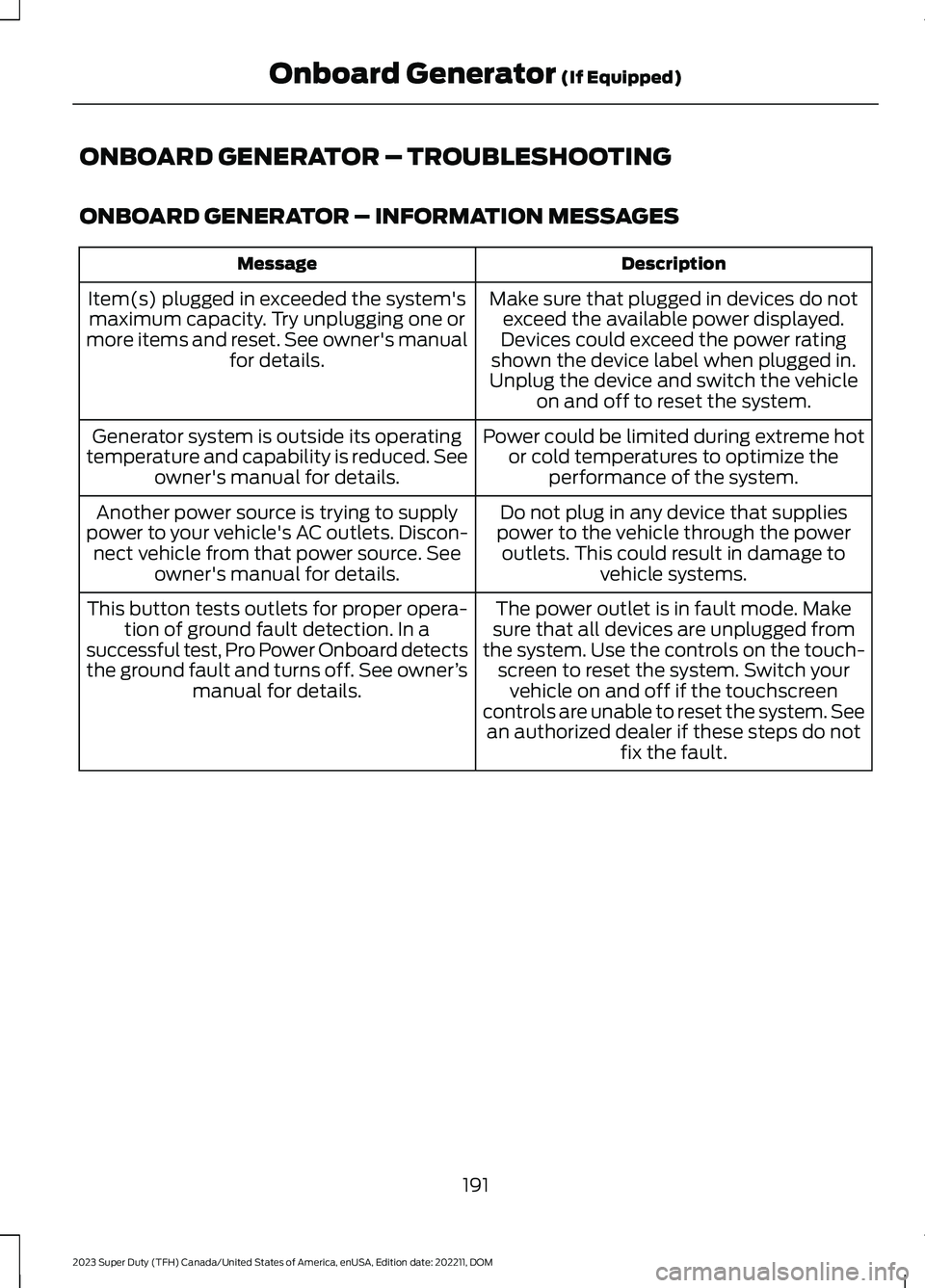
ONBOARD GENERATOR – INFORMATION MESSAGES
DescriptionMessage
Make sure that plugged in devices do notexceed the available power displayed.Devices could exceed the power ratingshown the device label when plugged in.Unplug the device and switch the vehicleon and off to reset the system.
Item(s) plugged in exceeded the system'smaximum capacity. Try unplugging one ormore items and reset. See owner's manualfor details.
Power could be limited during extreme hotor cold temperatures to optimize theperformance of the system.
Generator system is outside its operatingtemperature and capability is reduced. Seeowner's manual for details.
Do not plug in any device that suppliespower to the vehicle through the poweroutlets. This could result in damage tovehicle systems.
Another power source is trying to supplypower to your vehicle's AC outlets. Discon-nect vehicle from that power source. Seeowner's manual for details.
The power outlet is in fault mode. Makesure that all devices are unplugged fromthe system. Use the controls on the touch-screen to reset the system. Switch yourvehicle on and off if the touchscreencontrols are unable to reset the system. Seean authorized dealer if these steps do notfix the fault.
This button tests outlets for proper opera-tion of ground fault detection. In asuccessful test, Pro Power Onboard detectsthe ground fault and turns off. See owner’smanual for details.
191
2023 Super Duty (TFH) Canada/United States of America, enUSA, Edition date: 202211, DOMOnboard Generator (If Equipped)
Page 210 of 738
HOW DOES THE ENGINE BLOCKHEATER WORK
The engine block heater warms the enginecoolant. This allows the climate controlsystem to quickly respond. The equipmentincludes a heater element installed in theengine block and a wire harness. You canconnect the system to a grounded 110 voltAC electrical source.
Note:The engine block heater is mosteffective when outdoor temperatures arebelow 0°F (-18°C). We recommend the useof engine block heater to improve enginecold start performance.
USING THE ENGINE BLOCKHEATER
Make sure the receptacle terminals areclean and dry prior to use. Clean them witha dry cloth if necessary.
The heater uses 0.4 to 1.0 kilowatt-hoursof energy per hour of use. The system doesnot have a thermostat. It achievesmaximum temperature afterapproximately three hours of operation.Using the engine block heater longer thanthree hours does not improve systemperformance and unnecessarily useselectricity.
STOPPING THE ENGINE
STOPPING THE ENGINE WHENYOUR VEHICLE IS STATIONARY -VEHICLES WITHOUT: PUSHBUTTON START
1.Shift into park (P).
2.Apply the parking brake.
3.Wait until the engine reaches idlespeed.
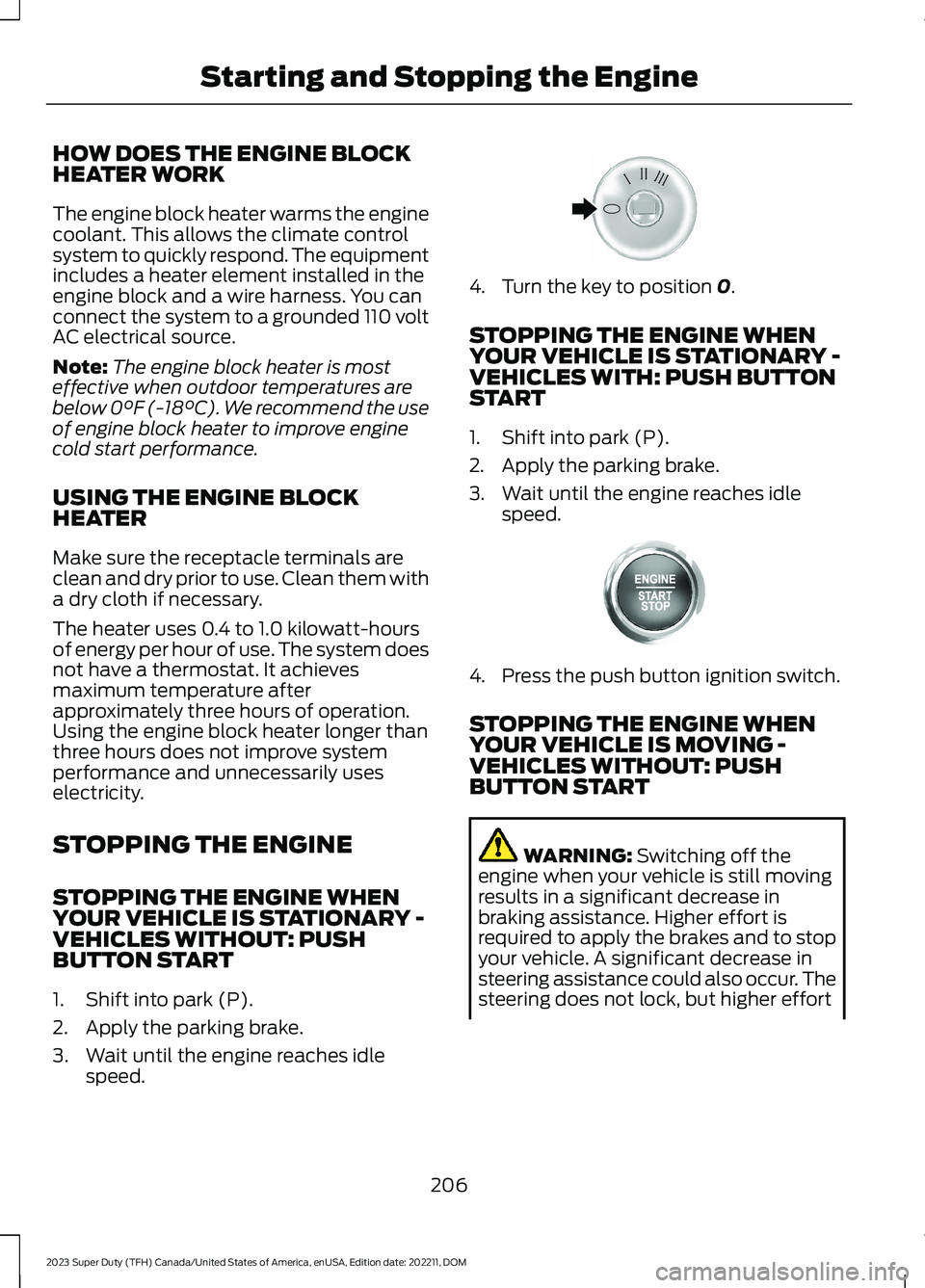
4.Turn the key to position 0.
STOPPING THE ENGINE WHENYOUR VEHICLE IS STATIONARY -VEHICLES WITH: PUSH BUTTONSTART
1.Shift into park (P).
2.Apply the parking brake.
3.Wait until the engine reaches idlespeed.
4.Press the push button ignition switch.
STOPPING THE ENGINE WHENYOUR VEHICLE IS MOVING -VEHICLES WITHOUT: PUSHBUTTON START
WARNING: Switching off theengine when your vehicle is still movingresults in a significant decrease inbraking assistance. Higher effort isrequired to apply the brakes and to stopyour vehicle. A significant decrease insteering assistance could also occur. Thesteering does not lock, but higher effort
206
2023 Super Duty (TFH) Canada/United States of America, enUSA, Edition date: 202211, DOMStarting and Stopping the EngineE322405 E357998
Page 218 of 738
FUEL AND REFUELING
PRECAUTIONS
WARNING: Fuels can cause seriousinjury or death if misused or mishandled.
WARNING: Fuel may containbenzene, which is a cancer-causingagent.
Follow these guidelines when refueling:
•Extinguish all smoking materials andany open flames before refueling yourvehicle.
•Switch the engine off before refueling.
•Automotive fuels can be harmful orfatal if swallowed. Fuel is highly toxicand if swallowed can cause death orpermanent injury. If fuel is swallowedimmediately call a physician, even if nosymptoms are immediately apparent.The toxic effects of fuel may not beapparent for hours.
•Avoid inhaling fuel vapors. Inhaling fuelvapor can lead to eye and respiratorytract irritation. In severe cases,excessive or prolonged breathing offuel vapor can cause serious illness andpermanent injury.
•Avoid getting fuel in your eyes. If yousplash fuel in your eyes, immediatelyremove contact lenses, if worn, flushwith water for 15 minutes and seekmedical attention. Failure to seekproper medical attention could lead topermanent injury.
•Fuels can be harmful if absorbedthrough the skin. If you splash fuel onyour skin, clothing or both, promptlyremove contaminated clothing andthoroughly wash your skin with soapand water. Repeated or prolonged skincontact causes skin irritation.
•Be particularly careful if you are takingAntabuse or other forms of Disulfiramfor the treatment of alcoholism.Breathing fuel vapors could cause anadverse reaction, serious personalinjury or sickness. Immediately call aphysician if you experience any adversereactions.
FUEL QUALITY
SELECTING THE CORRECT FUEL -GASOLINE
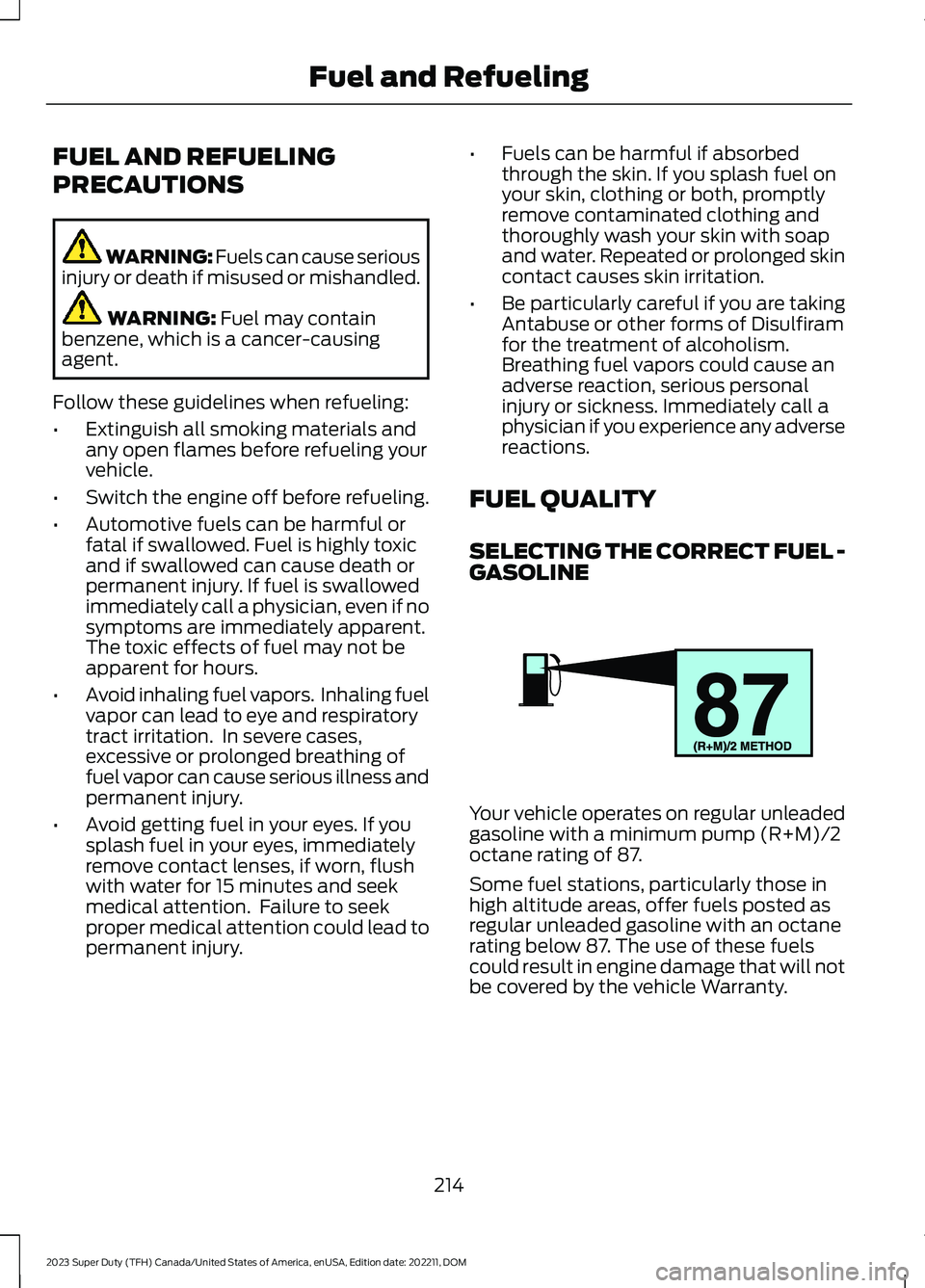
Your vehicle operates on regular unleadedgasoline with a minimum pump (R+M)/2octane rating of 87.
Some fuel stations, particularly those inhigh altitude areas, offer fuels posted asregular unleaded gasoline with an octanerating below 87. The use of these fuelscould result in engine damage that will notbe covered by the vehicle Warranty.
214
2023 Super Duty (TFH) Canada/United States of America, enUSA, Edition date: 202211, DOMFuel and RefuelingE161513
Page 226 of 738
Failure to perform active or manualregeneration when instructed could resultin a clogged diesel particulate filter. If thediesel particulate filter fills beyond theregeneration threshold, your vehicledisables the ability for active and manualregeneration. This could result inirreversible damage your vehicle Warrantymay not cover.
DIESEL PARTICULATE FILTER
REQUIREMENTS
The diesel particulate filter on your vehiclerequires periodic regeneration to maintainits correct function.
If your journeys meet one of the followingconditions:
•You drive only short distances.
•You frequently switch the ignition onand off.
•Your journeys contain a high level ofacceleration and deceleration.
You must carry out occasional trips withthe following conditions to assist theregeneration process:
•Drive your vehicle in more favorableconditions, which you will find at highervehicle speeds in normal driving, on amain road or freeway for a minimumof 20 minutes. This drive may includeshort stops that will not affect theregeneration process.
•Avoid prolonged idling and observespeed limits and road conditions.
•Do not switch the ignition off.
•Select a suitable gear to ideallymaintain engine speed between 1500and 3000 RPM.
DIESEL PARTICULATE FILTER
MANUAL REGENERATION
WHAT IS DIESEL PARTICULATEFILTER MANUAL REGENERATION
Diesel particulate filter manualregeneration allows you to manually startregeneration of the diesel particulate filterat idle to clean the filter.
Note:If you are not sure whether yourvehicle has this feature, contact yourauthorized dealer.
DIESEL PARTICULATE FILTERMANUAL REGENERATIONPRECAUTIONS
WARNING: Stay clear of theexhaust tailpipe during regeneration. Hotexhaust gases can burn you badly.
You may not be able to use manualregeneration if the service engine soonwarning lamp appears in the informationdisplay.
Note:During the use of manualregeneration, you may observe a lightamount of white smoke. This is normal.
DIESEL PARTICULATE FILTERMANUAL REGENERATIONREQUIREMENTS
You can use the manual regenerationfeature when a message appears in theinformation display and you are not ableto drive in a manner that allows effectiveautomatic active regeneration or if youchoose to manually start the regenerationof the diesel particulate filter while thevehicle is idle.
222
2023 Super Duty (TFH) Canada/United States of America, enUSA, Edition date: 202211, DOMDiesel Particulate Filter (If Equipped)
Page 227 of 738
Before you start manual regeneration, dothe following:
•Make sure the parking brake is on.
•Shift into park (P) on stable, levelground.
•Park your vehicle outside of anystructure.
•Park your vehicle 10–15 ft (3–5 m)away from any obstructions and awayfrom materials that can easily combustor melt, for example paper, leaves,petroleum products, fuels, plastics andother dry organic material.
•Make sure there is a minimum of 1/8tank of fuel.
•Make sure all fluids are at proper levels.
DIESEL PARTICULATE FILTERMANUAL REGENERATIONLIMITATIONS
You cannot use manual regeneration untilthe diesel particulate filter load percentagehas reached 100% or Full. The dieselparticulate filter load percentagefluctuates up and down when driving yourvehicle due to active and passiveregenerations.
If your vehicle is operated with significantstationary operation, low speed drivecycles less than 25 mph (40 km/h), shortdrive cycles, drive time less than 15 minutesor the vehicle does not fully warm up,passive and active regeneration may notsufficiently clean the diesel particulatefilter system.
Aftermarket devices or modifications tothe exhaust system may reduce theeffectiveness of the exhaust system aswell as cause damage to the exhaustsystem or engine. This may also degradevehicle performance and could lead toengine damage that may not be coveredby the vehicle Warranty.
STARTING DIESEL PARTICULATEFILTER MANUAL REGENERATION
Start with your vehicle engine and when ithas reached the normal operatingtemperature, press the information displaycontrol button on the steering wheel. SeeInstrument Cluster Display (page 143).
If the diesel particulate filter is near or atsaturation, a message requestingpermission to initiate filter cleaningappears in the information display. SeeDiesel Particulate Filter – InformationMessages (page 224). Answer yes to thisprompt and then follow the next promptsregarding exhaust position required toinitiate manual regeneration. Be sure tounderstand each prompt. If you are notsure what is being asked by each prompt,contact an authorized dealer. The displayconfirms the operation has started andwhen it has finished. You can also drive toclean the filter.
When the system is at the pointof oversaturation, themalfunction indicator lampilluminates and a message appears in theinformation display. You cannot initiatefilter cleaning. You must have your vehiclechecked as soon as possible.
Once manual regeneration starts, enginespeed increases and the cooling fan speedincreases. You will hear a change in audiblesound due to engine speed and cooling fanspeed increases.
It is not necessary to open the hood on theengine compartment. Once manualregeneration completes, the engine speedreturns to normal idling. The exhaustsystem remains very hot for severalminutes even after regeneration iscomplete. Do not reposition the vehicleover materials that could burn until the
223
2023 Super Duty (TFH) Canada/United States of America, enUSA, Edition date: 202211, DOMDiesel Particulate Filter (If Equipped)E67028
Page 230 of 738
WHAT IS THE SELECTIVE
CATALYTIC REDUCTION
SYSTEM
The selective catalytic reduction systemhelps reduce tailpipe emissions andrequires Diesel Exhaust Fluid (DEF) toconvert nitrogen oxides into nitrogen andwater.
HOW DOES THE SELECTIVE
CATALYTIC REDUCTION
SYSTEM WORK
The selective catalytic reduction systeminjects diesel exhaust fluid into the exhaustsystem to enable correct selective catalyticreduction system function.
The usage of diesel exhaust fluid hasincreased from prior model years in orderto meet more stringent emissionsrequirements. The diesel exhaust fluidusage ranges from approximately 2-6%of fuel burned (100.00 gal (378.54 L) offuel requires approximately 2.00 gal(7.57 L)to 6.00 gal (22.71 L) of dieselexhaust fluid) depending on vehicle usage.Factors that influence diesel exhaust fluidusage may include:
•Payload/Towing
•Driving Style
•Altitude
•Humidity
•Temperature
SELECTIVE CATALYTIC
REDUCTION SYSTEM
PRECAUTIONS
WARNING: Keep diesel exhaustfluid out of reach of children. Avoidcontact with skin, eyes or clothing. Incase of contact with your eyes, flushimmediately with water and get promptmedical attention. In case of contactwith your skin, clean immediately withsoap and water. If you swallow anydiesel exhaust fluid, drink plenty ofwater, call a physician immediately.
WARNING: Only refill the dieselexhaust fluid tank in a well ventilatedarea. When you remove the dieselexhaust fluid tank filler cap or a dieselexhaust fluid container cap, ammoniavapors may escape. Ammonia vaporscan be irritating to skin, eyes and mucousmembranes. Inhaling ammonia vaporscan cause burning to the eyes, throat andnose and cause coughing and wateryeyes.
WARNING: Diesel exhaust fluidmust be refilled when low or replacedwhen contaminated or your vehiclespeed becomes limited to 50 mph(80 km/h). In these conditions, drive withcaution and refill diesel exhaust fluidimmediately. If the diesel exhaust fluidbecomes empty or contaminated andfluid is not replaced, your vehiclebecomes limited to engine idle only oncestopped. In these conditions, be cautiouswhere you stop your vehicle because youmay not be able to drive long distancesor maintain highway speeds until yourefill or replace the diesel exhaust fluid.
226
2023 Super Duty (TFH) Canada/United States of America, enUSA, Edition date: 202211, DOMSelective Catalytic Reduction System (If Equipped)
Page 234 of 738
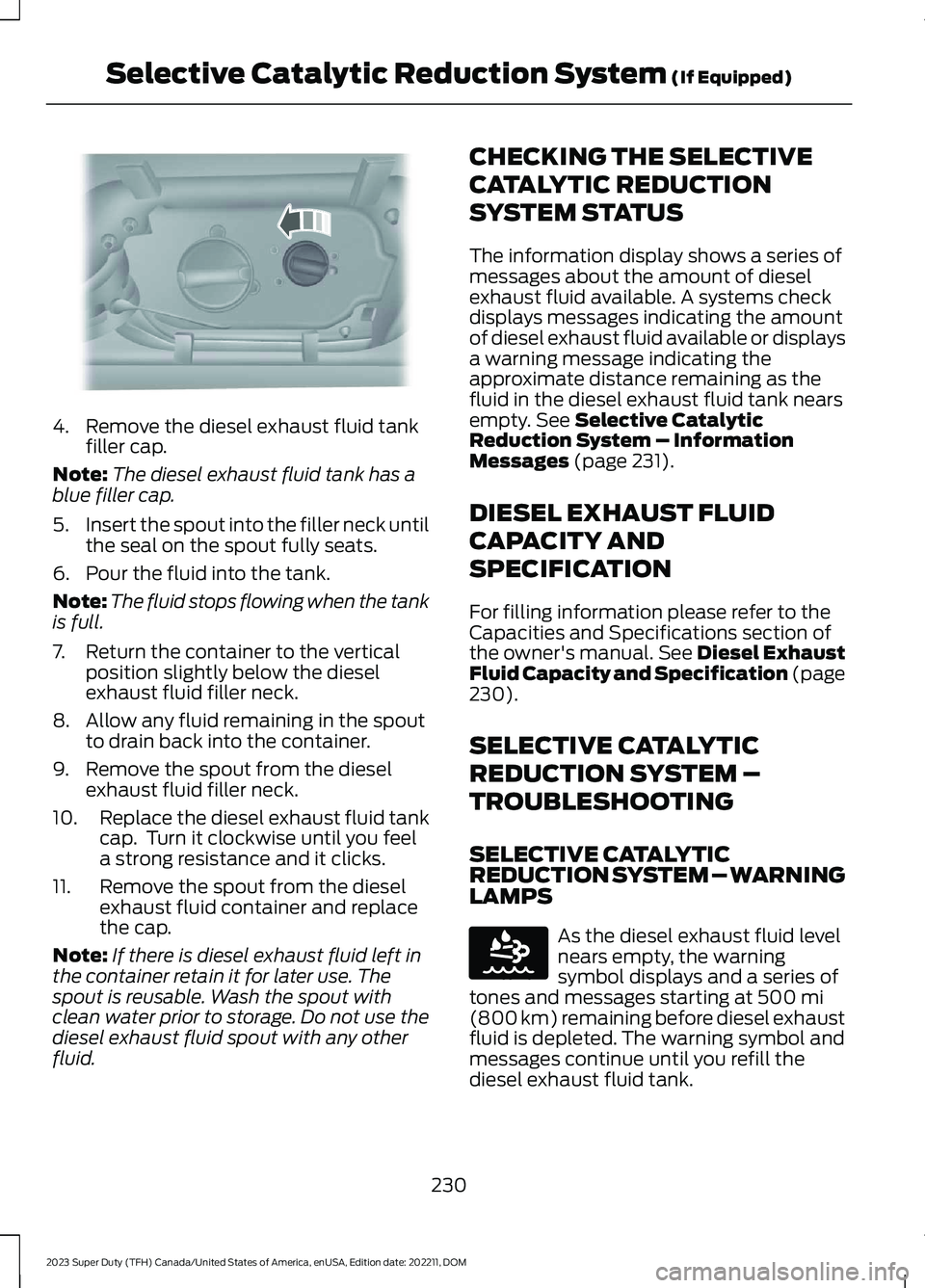
4.Remove the diesel exhaust fluid tankfiller cap.
Note:The diesel exhaust fluid tank has ablue filler cap.
5.Insert the spout into the filler neck untilthe seal on the spout fully seats.
6.Pour the fluid into the tank.
Note:The fluid stops flowing when the tankis full.
7.Return the container to the verticalposition slightly below the dieselexhaust fluid filler neck.
8.Allow any fluid remaining in the spoutto drain back into the container.
9.Remove the spout from the dieselexhaust fluid filler neck.
10.Replace the diesel exhaust fluid tankcap. Turn it clockwise until you feela strong resistance and it clicks.
11.Remove the spout from the dieselexhaust fluid container and replacethe cap.
Note:If there is diesel exhaust fluid left inthe container retain it for later use. Thespout is reusable. Wash the spout withclean water prior to storage. Do not use thediesel exhaust fluid spout with any otherfluid.
CHECKING THE SELECTIVE
CATALYTIC REDUCTION
SYSTEM STATUS
The information display shows a series ofmessages about the amount of dieselexhaust fluid available. A systems checkdisplays messages indicating the amountof diesel exhaust fluid available or displaysa warning message indicating theapproximate distance remaining as thefluid in the diesel exhaust fluid tank nearsempty. See Selective CatalyticReduction System – InformationMessages (page 231).
DIESEL EXHAUST FLUID
CAPACITY AND
SPECIFICATION
For filling information please refer to theCapacities and Specifications section ofthe owner's manual. See Diesel ExhaustFluid Capacity and Specification (page230).
SELECTIVE CATALYTIC
REDUCTION SYSTEM –
TROUBLESHOOTING
SELECTIVE CATALYTICREDUCTION SYSTEM – WARNINGLAMPS
As the diesel exhaust fluid levelnears empty, the warningsymbol displays and a series oftones and messages starting at 500 mi(800 km) remaining before diesel exhaustfluid is depleted. The warning symbol andmessages continue until you refill thediesel exhaust fluid tank.
230
2023 Super Duty (TFH) Canada/United States of America, enUSA, Edition date: 202211, DOMSelective Catalytic Reduction System (If Equipped)E328788 E163176