2023 FORD SUPER DUTY power steering
[x] Cancel search: power steeringPage 284 of 738
The electronic torque overlay steeringsystem adds supplemental steering assistto the hydraulic gear when needed,dependent on vehicle conditions such asvehicle speed, steering wheel angle, andsteering wheel torque. The hydraulicsteering system provides the majority ofsteering assistance. The electronic torqueoverlay enables features such as pro trailerbackup assistance and lane departurewarning.
If your vehicle loses electrical power whileyou are driving, your vehicle loses electricpower steering assistance. The steeringsystem still operates, and you can steeryour vehicle with hydraulic assist. Steeringyour vehicle with only hydraulic assistrequires more effort.
Extreme continuous steering may increasethe effort required for you to steer yourvehicle. This increased effort preventsoverheating and permanent damage tothe steering system. You do not lose theability to steer your vehicle manually.Typical steering and driving maneuversallow the system to cool and return tonormal operation.
LOCATING THE HYDRAULICPOWER STEERING FLUIDRESERVOIR
The hydraulic power steering fluid reservoiris found in the engine compartment. SeeUnder Hood Overview (page 441).
CHECKING THE HYDRAULICPOWER STEERING FLUID
Check the power steering fluid. SeeScheduled Maintenance (page 591). Ifadding fluid is necessary, use onlyMERCON LV ATF.
Check the fluid level when it is at ambienttemperature.
1.Check the fluid level in the reservoir. Itshould be between the MIN and MAXrange. Do not add fluid if the level iswithin this range.
2.If the fluid level is low, add fluid to bringthe fluid level up to between the MINand MAX range.
3.Switch the engine on.
4.While the engine idles, turn the steeringwheel left and right several times.
5.Switch the engine off.
6.Recheck the fluid level in the reservoir.Do not add fluid if the level is betweenthe MIN and MAX range.
7.If the fluid is low, add fluid in smallamounts, continuously checking thelevel until it is between the MIN andMAX range. For proper fluid type, SeeCapacities and Specifications (page520). Be sure to put the cap back on thereservoir.
STEERING –
TROUBLESHOOTING
STEERING – WARNINGINDICATORS
The electric power steeringsystem indicator illuminates ifthe system detects a fault duringthe continuous diagnostic checks.
Note:If a red warning message displays,stop your vehicle as soon as it is safe to doso.
280
2023 Super Duty (TFH) Canada/United States of America, enUSA, Edition date: 202211, DOMSteeringE223375
Page 285 of 738
STEERING – INFORMATION MESSAGES
ActionMessage
The power steering system has detected acondition that requires service. Have yourvehicle checked as soon as possible.
Steering Fault Service Now
The power steering system is not working.Stop your vehicle in a safe place. Have yourvehicle checked as soon as possible.
Steering Loss Stop Safely
The power steering system has detected acondition that requires service. Have yourvehicle checked as soon as possible.
Steering Assist Fault Service Required
The steering system has detected a condi-tion that could prevent you from startingyour vehicle. Have your vehicle checked assoon as possible.
Steering Lock Malfunction Service Now
281
2023 Super Duty (TFH) Canada/United States of America, enUSA, Edition date: 202211, DOMSteering
Page 315 of 738
WHAT IS DRIVE MODE
CONTROL
Your vehicle has various drive modes thatyou can select for different drivingconditions. Depending on the drive modethat you select, the system adjusts variousvehicle settings.
HOW DOES DRIVE MODE
CONTROL WORK
Drive mode control adjusts your vehicleconfiguration for each mode you select.
Changing the drive mode adjusts thesteering effort and feel of the steeringsystem.
The stability and traction control assistyour vehicle control in adverse conditionsor high-performance driving.
Throttle control enhances the powertrainresponse, transmission controls becomeoptimized with shift schedules, andfour-wheel drive settings are optimizedand tuned to each mode.
Changing the drive mode can engage ordisengage the electronic lockingdifferentials.
Changing the drive mode changes thefour-wheel drive mode to the defaultsetting for the selected drive mode.
Note:The system has diagnostic checksthat continuously monitor the system forproper operation. If a mode is unavailabledue to a system fault, the drive modesystem defaults to normal. When thesystem defaults to normal, the drivelinesettings remain the same as prior to thesystem fault.
Note:The system reverts to the normalmode each time you start your vehicle. Atstartup the system also displays a prompton the instrument cluster display that givesyou the option to return to the previouslyselected drive mode during the last ignitioncycle. If you select yes, the system returnsto the last selected drive mode and thedefault driveline settings associated withthat mode. If you select no, the systemremains in normal mode and the drivelinesettings remain the same as selected in theprior ignition cycle. If you do not select yesor no, the system stays in normal mode andthe driveline settings remain the same asselected in the prior ignition cycle.
SELECTING A DRIVE MODE
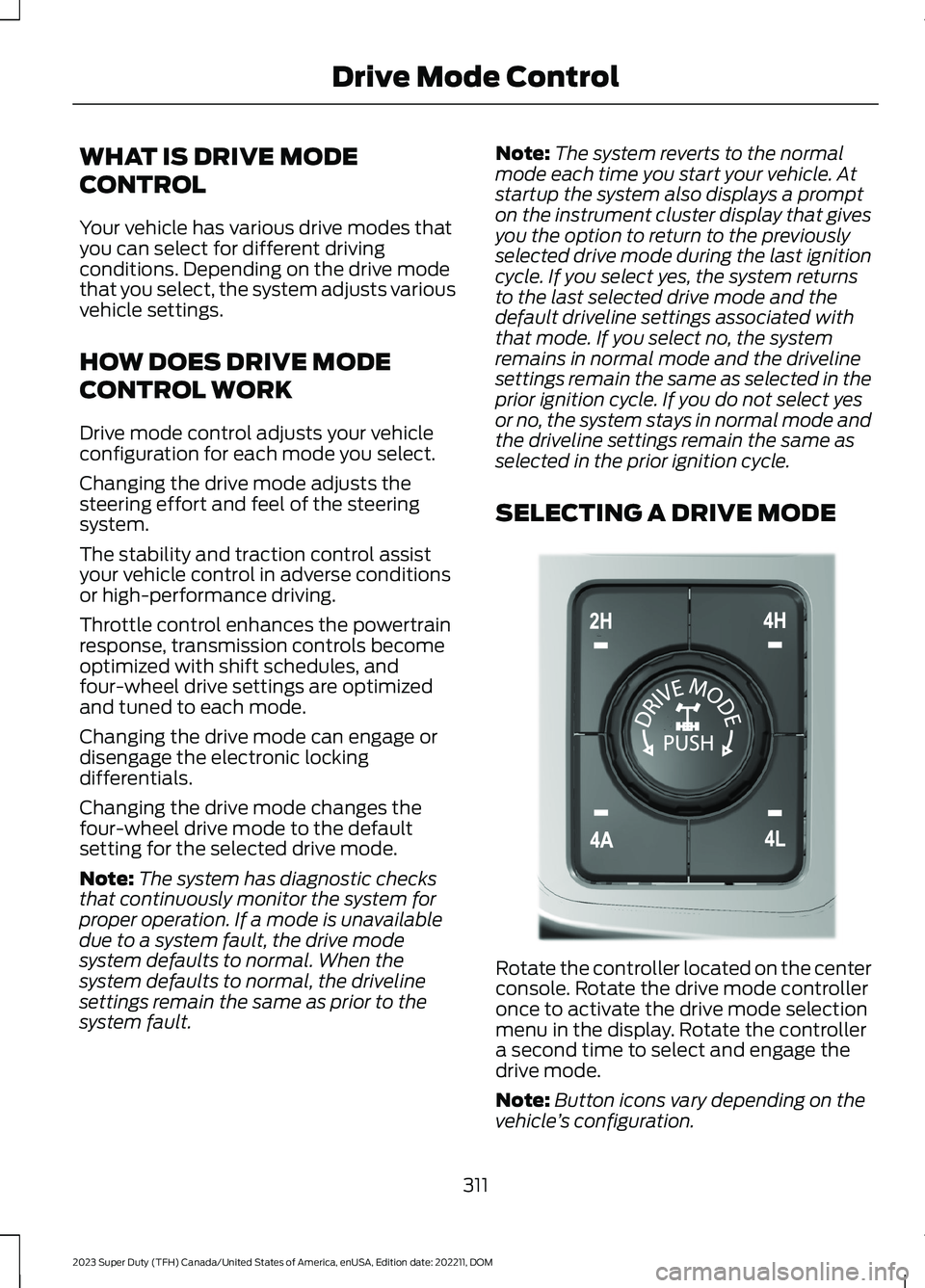
Rotate the controller located on the centerconsole. Rotate the drive mode controlleronce to activate the drive mode selectionmenu in the display. Rotate the controllera second time to select and engage thedrive mode.
Note:Button icons vary depending on thevehicle’s configuration.
311
2023 Super Duty (TFH) Canada/United States of America, enUSA, Edition date: 202211, DOMDrive Mode ControlE308146
Page 420 of 738
DRIVING ON SNOW AND ICE
WARNING: If you are driving inslippery conditions that require tirechains or cables, then it is critical thatyou drive cautiously. Keep speeds down,allow for longer stopping distances andavoid aggressive steering to reduce thechances of a loss of vehicle controlwhich can lead to serious injury or death.If the rear end of your vehicle slides whilecornering, steer in the direction of theslide until you regain control of yourvehicle.
On ice and snow, you should drive moreslowly than usual. Your vehicle has a fourwheel anti-lock brake system, do not pumpthe brake pedal. See Anti-Lock BrakingSystem Limitations (page 249).
BREAKING-IN
Your vehicle requires a break-in period. Forthe first 1,000 mi (1,600 km), avoid drivingat high speeds, heavy braking, aggressiveshifting or using your vehicle to tow. Duringthis time, your vehicle may exhibit someunusual driving characteristics.
DRIVING ECONOMICALLY
The following helps to improve fuelconsumption:
•Drive smoothly, accelerate gently andanticipate the road ahead to avoidheavy braking.
•Regularly check your tire pressures andmake sure that they are inflated to thecorrect pressure.
•Follow the recommended maintenanceschedule and carry out therecommended checks.
•Plan your journey and check the trafficbefore you set off. It is more efficientto combine errands into a single tripwhenever possible.
•Avoid idling the engine in cold weatheror for extended periods. Start theengine only when you are ready to setoff.
•Do not carry unnecessary weight in yourvehicle as extra weight wastes fuel.
•Do not add unnecessary accessoriesto the exterior of your vehicle, forexample running boards. If you use aroof rack, remember to fold it down orremove it when not in use.
•Do not shift into neutral when you arebraking or when your vehicle is slowingdown.
•Shut all windows when driving at highspeeds.
•Switch off all electric systems whennot in use, for example air conditioning.Make sure that you unplug anyaccessories from the auxiliary powerpoints when not in use.
DRIVING IN SPECIAL
CONDITIONS
DRIVING THROUGH MUD ANDWATER
WARNING: Do not spin the wheelsat over 34 mph (55 km/h). The tires mayfail and injure a passenger or bystander.
416
2023 Super Duty (TFH) Canada/United States of America, enUSA, Edition date: 202211, DOMDriving Hints
Page 429 of 738
We recommend the use of a wheel lift anddollies or flatbed equipment to tow yourvehicle. Vehicle damage could occur iftowed incorrectly, or by any other means.
Front-wheel and rear-wheel drive vehiclesmust have their designated drive wheelsoff the ground regardless of towingdirection. Use tow dollies to preventdamage to the transmission.
All-wheel or four-wheel drive vehiclesrequire that all wheels be off the groundusing a wheel lift and dollies or flatbedequipment. This prevents damage to thetransmission and drive system.
Note:You need to switch on the ignition tounlock the steering.
Note:Make sure you check the steeringcolumn before towing. It could lock if thebattery is dead.
FAIL-SAFE COOLING
WHAT IS FAIL-SAFE COOLING
Fail-safe cooling allows you to temporarilydrive your vehicle before any incrementalcomponent damage occurs due tooverheating.
The fail-safe distance depends on outsidetemperature, vehicle load and terrain.
HOW DOES FAIL-SAFE COOLINGWORK
If the engine reaches a presetover-temperature condition, the engineautomatically switches to alternatingcylinder operation. Each disabled cylinderacts as an air pump and cools the engine.
When this occurs, your vehicle stilloperates, however:
•Engine power is limited.
•The air conditioning system turns off.
Continued operation increases the enginetemperature, causing the engine tocompletely shut down. Your steering andbraking effort increases in this situation.
When the engine temperature cools, youcan re-start the engine.
Note:Have your vehicle checked as soonas possible to minimize engine damage.
DRIVING WHEN FAIL-SAFE MODEIS ACTIVATED
WARNING: Fail-safe mode is foruse during emergencies only. Operateyour vehicle in fail-safe mode only aslong as necessary to bring your vehicleto rest in a safe location and seekimmediate repairs. When in fail-safemode, your vehicle will have limitedpower, will not be able to maintainhigh-speed operation, and maycompletely shut down without warning,potentially losing engine power, powersteering assist, and power brake assist,which may increase the possibility of acrash resulting in serious injury.
WARNING: Do not remove thecoolant reservoir cap when the engine ison or the cooling system is hot. Wait 10minutes for the cooling system to cooldown. Cover the coolant reservoir capwith a thick cloth to prevent thepossibility of scalding and slowly removethe cap. Failure to follow this instructioncould result in personal injury.
Continued operation increases the enginetemperature, causing the engine tocompletely shut down. Your steering andbraking effort increases in this situation.
When the engine temperature cools, youcan re-start the engine. Have your vehiclechecked as soon as possible to minimizeengine damage.
425
2023 Super Duty (TFH) Canada/United States of America, enUSA, Edition date: 202211, DOMCrash and Breakdown Information
Page 436 of 738
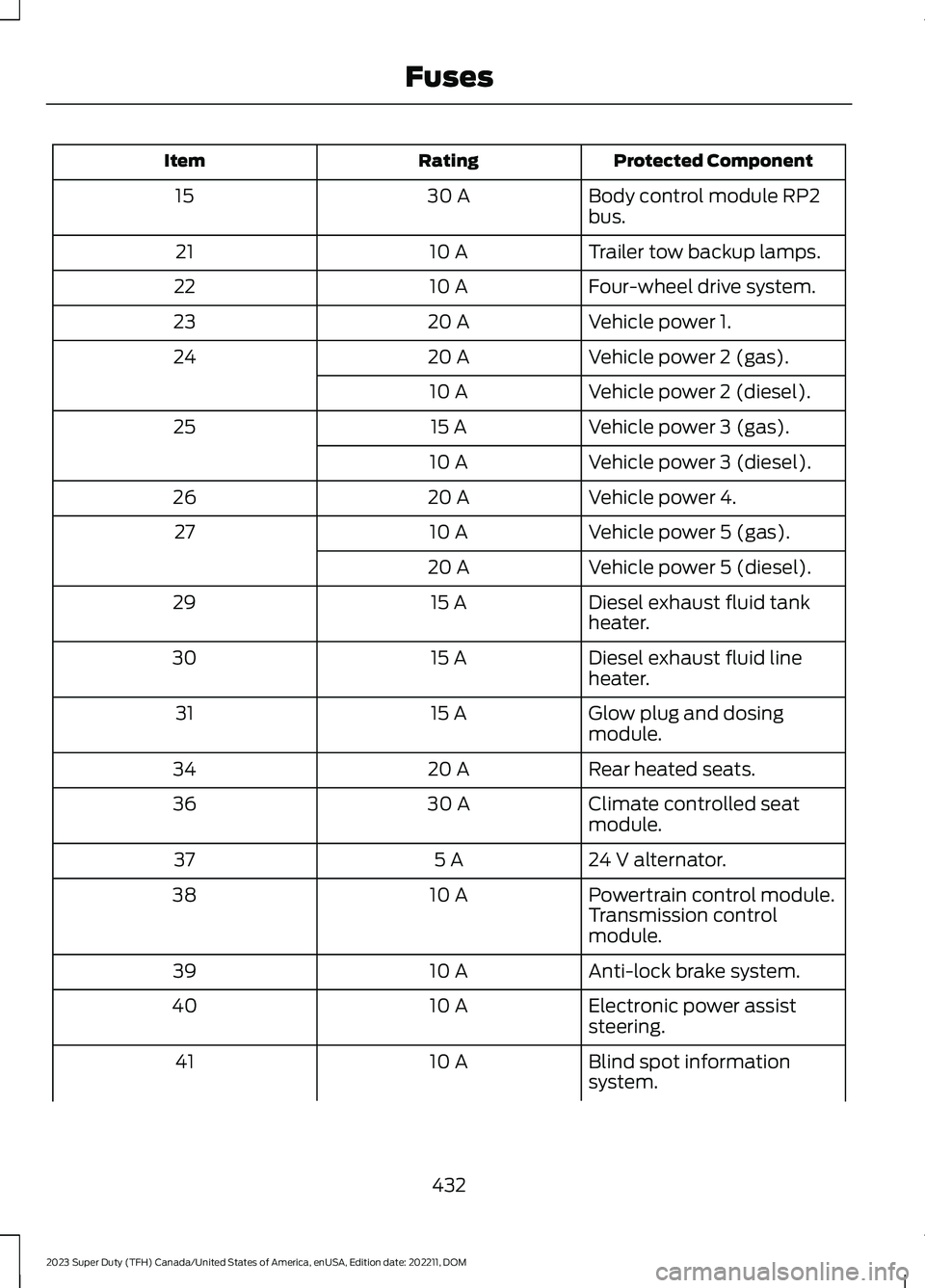
Protected ComponentRatingItem
Body control module RP2bus.30 A15
Trailer tow backup lamps.10 A21
Four-wheel drive system.10 A22
Vehicle power 1.20 A23
Vehicle power 2 (gas).20 A24
Vehicle power 2 (diesel).10 A
Vehicle power 3 (gas).15 A25
Vehicle power 3 (diesel).10 A
Vehicle power 4.20 A26
Vehicle power 5 (gas).10 A27
Vehicle power 5 (diesel).20 A
Diesel exhaust fluid tankheater.15 A29
Diesel exhaust fluid lineheater.15 A30
Glow plug and dosingmodule.15 A31
Rear heated seats.20 A34
Climate controlled seatmodule.30 A36
24 V alternator.5 A37
Powertrain control module.10 A38Transmission controlmodule.
Anti-lock brake system.10 A39
Electronic power assiststeering.10 A40
Blind spot informationsystem.10 A41
432
2023 Super Duty (TFH) Canada/United States of America, enUSA, Edition date: 202211, DOMFuses
Page 437 of 738

Protected ComponentRatingItem
Trailer tow tire pressuremonitoring system.Rear electronic modulecontroller area network.
Snowplow.10 A42
Interior power distributionbox run/start.15 A43
Heated steering wheel.15 A45
Not used (spare).20 A46
Not used (spare).5 A47
Amplifier.30 A48
Not used (spare).25 A49
Blower motor.40 A51
Not used.—52
Four-wheel drive - transfercase control module.10 A53
Not used (spare).10 A54
Not used (spare).10 A55
Electronic power assiststeering.40 A56
Trailer tow lighting module.20 A57
Customer interface module.50 A58
Inverter.60 A59
Interior power distributionbox B+.60 A60
Vehicle battery 2.30 A61
Smart trailer hitch.5 A62
Smart data link connector.10 A63Enhanced central gateway.
Glow plug relay coil (diesel).5 A64
433
2023 Super Duty (TFH) Canada/United States of America, enUSA, Edition date: 202211, DOMFuses
Page 445 of 738

UNDER HOOD OVERVIEW - 6.7L DIESEL
Battery. See Changing the 12V Battery (page 457).A
Under hood fuse box. See Accessing the Under Hood Fuse Box (page 430).B
Engine oil dipstick. See Engine Oil Dipstick Overview (page 444).C
Secondary fuel filter. See Changing the Fuel Filter (page 453).D
Engine oil filler cap. See Checking the Engine Oil Level (page 444).E
Engine cooling system coolant reservoir - primary high-temperature coolingsystem. See Checking the Coolant Level (page 450).F
Brake fluid reservoir. See Checking the Brake Fluid (page 249).G
Battery. See Changing the 12V Battery (page 457).H
Windshield washer fluid reservoir. See Adding Washer Fluid (page 115).I
Power steering fluid reservoir. See Checking the Hydraulic Power SteeringFluid (page 280).J
Secondary cooling system coolant reservoir. See Checking the Coolant Level(page 450).K
Air filter assembly. See Changing the Engine Air Filter (page 445).L
441
2023 Super Duty (TFH) Canada/United States of America, enUSA, Edition date: 202211, DOMMaintenanceE350655