2023 FORD SUPER DUTY engine oil
[x] Cancel search: engine oilPage 206 of 738
STARTING AND STOPPING
THE ENGINE – PRECAUTIONS
WARNING: Extended idling at highengine speeds can produce very hightemperatures in the engine and exhaustsystem, creating the risk of fire or otherdamage.
WARNING: Do not park, idle ordrive your vehicle on dry grass or otherdry ground cover. The emission systemheats up the engine compartment andexhaust system, creating the risk of fire.
WARNING: Do not start the enginein a closed garage or in other enclosedareas. Exhaust fumes are toxic. Alwaysopen the garage door before you startthe engine. Failure to follow thisinstruction could result in personal injuryor death.
WARNING: Do not use startingfluid, for example ether, in the air intakesystem. Such fluid could causeimmediate explosive damage to theengine and possible personal injury.
WARNING: Exhaust leaks mayresult in entry of harmful and potentiallylethal fumes into the passengercompartment. If you smell exhaustfumes inside your vehicle, have yourvehicle inspected immediately. Do notdrive if you smell exhaust fumes.
The powertrain control system meets allCanadian interference-causing equipmentstandard requirements regulating theimpulse electrical field or radio noise.
Note:If you use your vehicle regularly abovethe altitude of 5,000 ft (1,524 m) and underthe temperature of -4.0°F (-20°C), it isrecommended to use the alternative engineoil. See Capacities and Specifications(page 520).
If you stop your vehicle and leave theengine idling for long periods, werecommend that you do one of thefollowing:
•Open the windows at least 1 in(2.5 cm).
•Set your climate control to outside air.
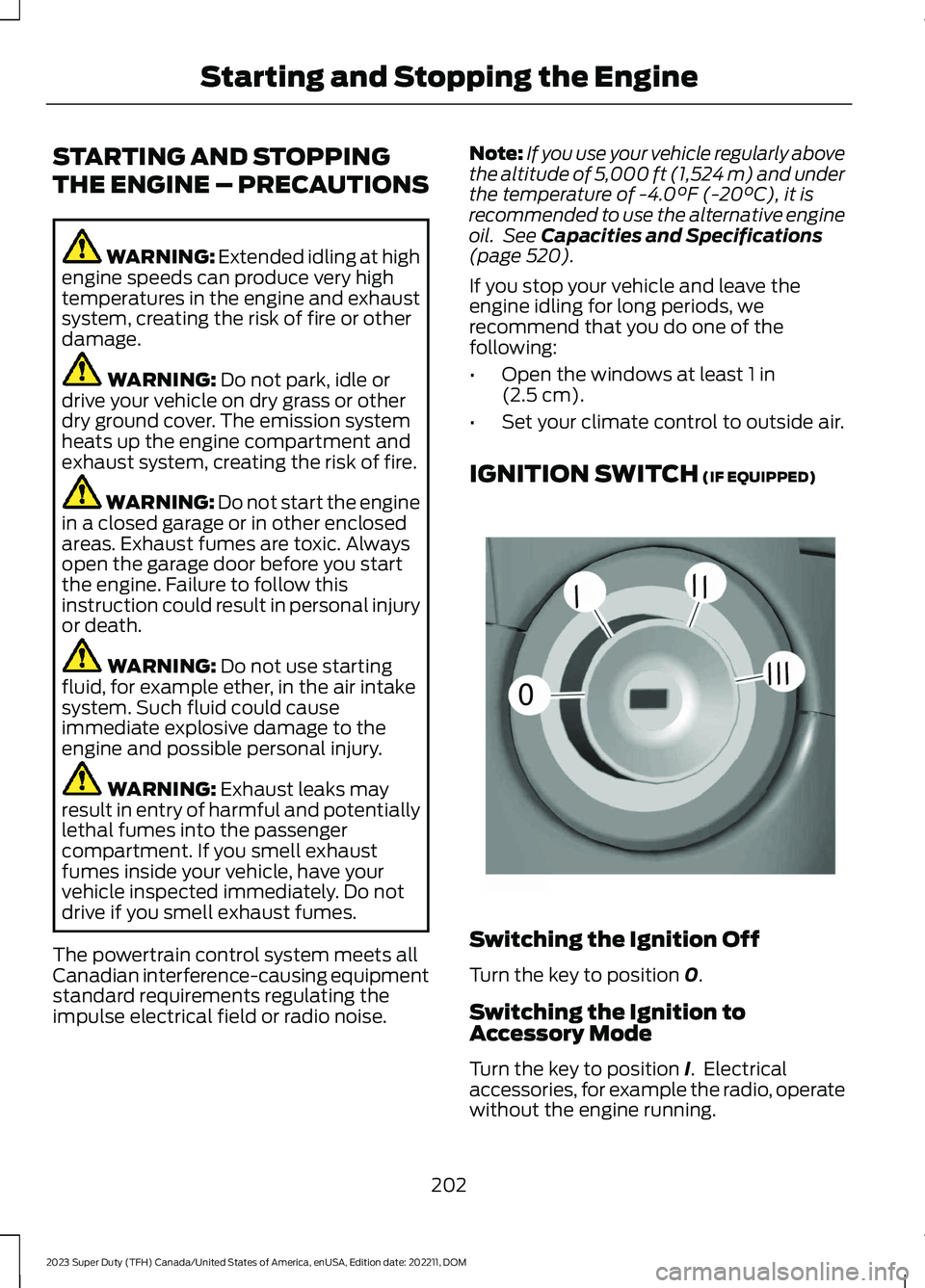
IGNITION SWITCH (IF EQUIPPED)
Switching the Ignition Off
Turn the key to position 0.
Switching the Ignition toAccessory Mode
Turn the key to position I. Electricalaccessories, for example the radio, operatewithout the engine running.
202
2023 Super Duty (TFH) Canada/United States of America, enUSA, Edition date: 202211, DOMStarting and Stopping the Engine0//////E252522
Page 219 of 738
For best overall vehicle and engineperformance, premium fuel with an octanerating of 91 or higher is recommended. Theperformance gained by using premium fuelis most noticeable in hot weather as wellas other conditions, for example whentowing a trailer. See Towing a Trailer(page 365).
Do not be concerned if the enginesometimes knocks lightly. However, if theengine knocks heavily while using fuel withthe recommended octane rating, contactan authorized dealer to prevent any enginedamage.
We recommend Top Tier detergentgasolines, where available to help minimizeengine deposits and maintain optimalvehicle and engine performance.
For additional information, visitwww.toptiergas.com.
Note:Use of any fuel for which the vehiclewas not designed can impair the emissioncontrol system, cause loss of vehicleperformance, and cause damage to theengine which may not be covered by thevehicle Warranty.
Do not use:
•Diesel fuel.
•Fuels containing kerosene or paraffin.
•Fuel containing more than 15% ethanolor E85 fuel.
•Fuels containing methanol.
•Fuels containing metallic-basedadditives, including manganese-basedcompounds.
•Fuels containing the octane boosteradditive, methylcyclopentadienylmanganese tricarbonyl (MMT).
•Leaded fuel, using leaded fuel isprohibited by law.
The use of fuels with metallic compoundssuch as methylcyclopentadienylmanganese tricarbonyl, which is amanganese-based fuel additive, will impairengine performance and affect theemission control system.
SELECTING THE CORRECT FUELFOR COLD WEATHER
Choosing the Right Fuel: VehiclesOperated Where Ultra Low SulfurDiesel Fuel Is Required (UnitedStates/Canada/Puerto Rico/U.S.Virgin Islands And Other Locales)
Note:Your Warranty will not cover damagecaused by using an improper type of fuel orfuel additive.
Note:Do not blend used engine oil withdiesel fuel under any circumstances.Blending used oil with the fuel significantlyincreases your vehicle’s exhaust emissionsand reduce engine life due to increasedinternal wear.
We recommend Top Tier diesel fuel whereavailable to help minimize engine depositsand maintain optimal vehicle and engineperformance.
For additional information, visitwww.toptiergas.com.
You should use ultra-low sulfur diesel fueldesignated as number 1-D or 2-D with amaximum of 15-ppm sulfur in your dieselvehicle. You can operate your vehicle ondiesel fuels containing up to 20%biodiesel, also known as B20. These fuelsshould meet the ASTM D975 diesel or theASTM D7467 B6-B20 biodiesel industryspecifications. Outside of North America,use fuels meeting EN590 or equivalentlocal market standard.
215
2023 Super Duty (TFH) Canada/United States of America, enUSA, Edition date: 202211, DOMFuel and Refueling
Page 220 of 738
Using low-sulfur diesel fuel(16-500 ppm) or high-sulfurdiesel fuel (greater than 500ppm) in your diesel engine will causecertain emission components tomalfunction which could also cause theservice engine soon light to illuminateindicating an emissions-related concern.
Diesel fuel is adjusted seasonally for coldtemperature. For best results attemperatures below 19°F (-7°C), werecommend using a diesel fuel which hasbeen seasonally adjusted for the ambientconditions.
Choosing the Right Fuel: VehiclesOperated Where Ultra Low SulfurDiesel Fuel Is Not Required
For the engine to operate reliably onlow-sulfur or high-sulfur diesel fuel, theengine must be a factory-built high-sulfurengine (available as a dealer order optionfor select markets) or an ultra-low sulfurdiesel fuel configured engine that has beenretrofitted for high-sulfur diesel fuel usingauthorized dealer service parts. Failure touse retrofit components other than thoseavailable through your authorized dealerresults in coolant system damage, engineoverheating, selective catalyst reductionsystem or diesel particulate filter damageand possible base engine damage.
Use only a diesel engine configured for usewith high-sulfur diesel fuel in markets withdiesel fuel that has sulfur content greaterthan 15 ppm. Using low-sulfur diesel fuel(16–500 ppm) or high-sulfur diesel fuel(greater than 500 ppm) in a diesel enginedesigned to use only ultra-low sulfur dieselfuel could result in damage to engineemission control devices and the aftertreatment system, potentially renderingthe vehicle inoperable.
Vehicles with engines configured for usewith high-sulfur diesel fuel are onlyavailable for sale in countries whereultra-low sulfur diesel fuel is generally notavailable or mandated by the government.Vehicles originally sold in an ultra-lowsulfur diesel fuel market that aresubsequently exported to non-ultra lowsulfur diesel fuel markets will need to beretrofitted at the customer’s expense usingFord authorized dealer service parts inorder to be reliably operated on non-ultralow sulfur diesel fuel.
Biodiesel
WARNING: Do not mix diesel withgasoline, gasohol or alcohol. This couldcause an explosion.
Note:Do not use home heating oil,agricultural fuel, raw fats and oils, wastecooking greases, biodiesel greater than 20%or any diesel not intended for highway use.Damage to the fuel injection system, engineand exhaust catalyst, and diesel particulatefilter can occur if you use an improper fuel.Red dye is used to identify fuels intendedfor agricultural and non-highway use.
You can operate your vehicle on dieselfuels containing up to 20% biodiesel, alsoknown as B20.
Biodiesel fuel is a chemically convertedproduct from renewable fuel sources, suchas vegetable oils, animal fats and wastecooking greases.
To help achieve acceptable engineperformance and durability when usingbiodiesel in your vehicle:
•Confirm the biodiesel content of thefuel to be B20 (20% biodiesel) or less.
•Only use biodiesel fuel of good qualitythat complies with industry standards.
216
2023 Super Duty (TFH) Canada/United States of America, enUSA, Edition date: 202211, DOMFuel and RefuelingE67028
Page 221 of 738
•Follow the recommended servicemaintenance intervals. See GeneralMaintenance Information (page 594).
•Do not store biodiesel fuel in the fueltank for more than 1 month.
•Consider changing brands or reducingbiodiesel content if you have coldtemperature fuel gelling issues or afrequently appearing LOW FUELPRESSURE message.
Use of biodiesel in concentrations greaterthan 20% can cause damage to yourvehicle, including engine and/or exhaustafter-treatment hardware (exhaustcatalyst and particulate filter) failures.Concentrations greater than 20% can alsocause fuel filter restrictions that couldresult in a lack of power or damage to fuelsystem components, including fuel pumpand fuel injector failures.
We recommend SAE 5W-40 oil for fuelswith greater than 5% biodiesel (B5). Formore information about oil changeintervals and other maintenance whenoperating on biodiesel. See SpecialOperating Conditions ScheduledMaintenance (page 603).
Look for a label on the fuel pump toconfirm the amount of biodiesel containedin diesel fuel. Ask the service stationattendant to confirm the biodiesel contentof diesel fuel, if you do not see a label onthe fuel pump.
If you plan to park or store your vehicle formore than 1 month, then you should emptyyour vehicle fuel tank of biodiesel fuel. Youshould fill the tank with a purepetroleum-based diesel fuel and run yourvehicle for a minimum of 30 minutes.
Note:Degraded or oxidized biodiesel candamage fuel system seals and plastics andcorrode steel parts.
During cold weather, if you have problemsoperating on biodiesel, you may need touse diesel fuel with lower biodieselcontent, try another brand or discontinuethe use of biodiesel.
Diesel Fuel Additives
It should not be necessary to add anyaftermarket additives to your fuel if youuse a high-quality diesel fuel that conformsto ASTM industry specifications.Aftermarket additives can damage the fuelinjector system or engine.
Use Motorcraft® cetane booster or anequivalent cetane booster additive if yoususpect fuel has low cetane. UseMotorcraft® anti-gel and performanceimprover or an equivalent additive if thereis fuel gelling.
Do not use alcohol-based additives toimprove cetane quality, to prevent fuelgelling or any other use. The use of alcoholadditives could result in damage to the fuelinjectors and system.
Your Warranty may not cover repairsneeded to correct the effects of using anaftermarket product that does not meetour specifications in your fuel.
RUNNING OUT OF FUEL
FILLING A PORTABLE FUELCONTAINER
WARNING: Flow of fuel through afuel pump nozzle can produce staticelectricity. This can cause a fire if you arefilling an ungrounded fuel container.
217
2023 Super Duty (TFH) Canada/United States of America, enUSA, Edition date: 202211, DOMFuel and Refueling
Page 423 of 738
When operating your vehicle with asnowplow:
•Do not exceed 45 mph (72 km/h).
•Your engine could run at a highertemperature than normal.
•If you are driving more than 15 mi(24 km) at temperatures abovefreezing, angle the plow bladeeither full left or full right to providemaximum airflow to the radiator.
•If you are driving less than 15 mi(24 km) at speeds up to 45 mph(72 km/h) in cold weather, you donot need to worry about bladeposition to provide maximumairflow.
•Shift to 4L when plowing in small areasat speeds below 5 mph (8 km/h).
•Shift to 4H when plowing larger areasor light snow at higher speeds above5 mph (8 km/h). Do not exceed15 mph (24 km/h).
•Do not shift the transmission from aforward gear to reverse (R) until theengine is at idle and the wheels havestopped.
Note:Careless or high-speed driving whensnowplowing, which results in significantvehicle decelerations, can deploy the airbag.Such driving also increases the risk ofaccidents.
Note:Drive your vehicle at least 500 mi(800 km) before using your vehicle forsnowplowing.
Note:Follow the severe duty schedule forengine oil and transmission fluid changeintervals. See Special OperatingConditions Scheduled Maintenance (page608).
419
2023 Super Duty (TFH) Canada/United States of America, enUSA, Edition date: 202211, DOMSnow Plowing - Vehicles With: Snow Plow Mode (If Equipped)
Page 445 of 738

UNDER HOOD OVERVIEW - 6.7L DIESEL
Battery. See Changing the 12V Battery (page 457).A
Under hood fuse box. See Accessing the Under Hood Fuse Box (page 430).B
Engine oil dipstick. See Engine Oil Dipstick Overview (page 444).C
Secondary fuel filter. See Changing the Fuel Filter (page 453).D
Engine oil filler cap. See Checking the Engine Oil Level (page 444).E
Engine cooling system coolant reservoir - primary high-temperature coolingsystem. See Checking the Coolant Level (page 450).F
Brake fluid reservoir. See Checking the Brake Fluid (page 249).G
Battery. See Changing the 12V Battery (page 457).H
Windshield washer fluid reservoir. See Adding Washer Fluid (page 115).I
Power steering fluid reservoir. See Checking the Hydraulic Power SteeringFluid (page 280).J
Secondary cooling system coolant reservoir. See Checking the Coolant Level(page 450).K
Air filter assembly. See Changing the Engine Air Filter (page 445).L
441
2023 Super Duty (TFH) Canada/United States of America, enUSA, Edition date: 202211, DOMMaintenanceE350655
Page 446 of 738

UNDER HOOD OVERVIEW - 6.8L, GASOLINE
Engine compartment fuse box. See Locating the Under Hood Fuse Box (page430).A
Battery. See Changing the 12V Battery (page 457).B
Engine oil dipstick. See Engine Oil Dipstick Overview (page 444).C
Engine oil filler cap. See Checking the Engine Oil Level (page 444).D
Brake fluid reservoir. See Checking the Brake Fluid (page 249).E
Windshield washer fluid reservoir. See Adding Washer Fluid (page 115).F
Engine coolant reservoir. See Checking the Coolant Level (page 450).G
Power steering fluid reservoir. See Checking the Hydraulic Power SteeringFluid (page 280).H
Air cleaner assembly. See Changing the Engine Air Filter (page 445).I
442
2023 Super Duty (TFH) Canada/United States of America, enUSA, Edition date: 202211, DOMMaintenanceE398419
Page 447 of 738
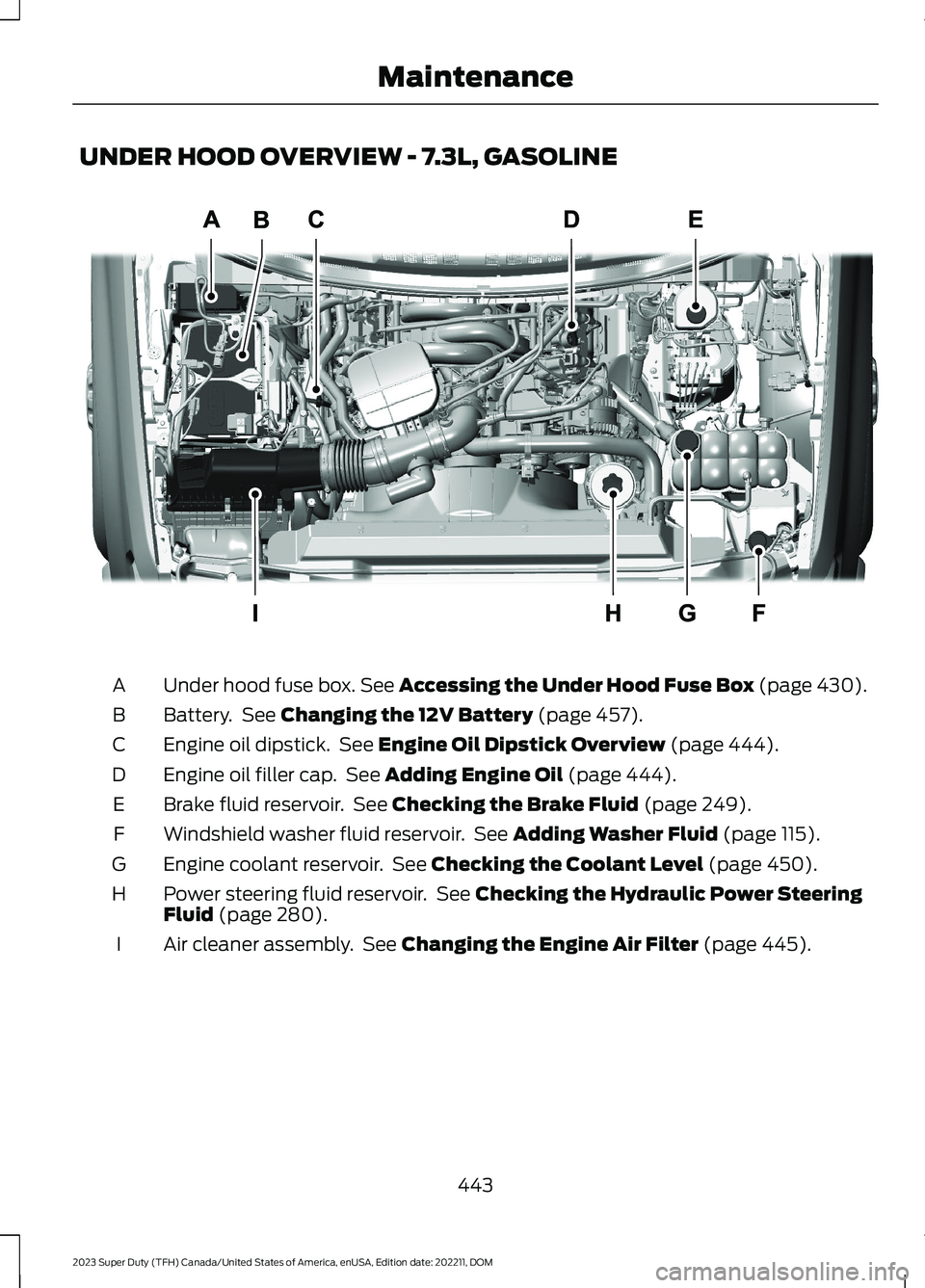
UNDER HOOD OVERVIEW - 7.3L, GASOLINE
Under hood fuse box. See Accessing the Under Hood Fuse Box (page 430).A
Battery. See Changing the 12V Battery (page 457).B
Engine oil dipstick. See Engine Oil Dipstick Overview (page 444).C
Engine oil filler cap. See Adding Engine Oil (page 444).D
Brake fluid reservoir. See Checking the Brake Fluid (page 249).E
Windshield washer fluid reservoir. See Adding Washer Fluid (page 115).F
Engine coolant reservoir. See Checking the Coolant Level (page 450).G
Power steering fluid reservoir. See Checking the Hydraulic Power SteeringFluid (page 280).H
Air cleaner assembly. See Changing the Engine Air Filter (page 445).I
443
2023 Super Duty (TFH) Canada/United States of America, enUSA, Edition date: 202211, DOMMaintenanceE351057