2023 DODGE HORNET Power
[x] Cancel search: PowerPage 243 of 288

SERVICING AND MAINTENANCE241
Relays
Cavity Maxi Fuse Mini FuseDescription
T02 ––Not Used
T03 –30 AmpHorn
T05 –30 AmpA/C Compressor
T06 –30 AmpRad Fan Enable
T07 50 Amp –Aux.1 / DTCM
T08 –30 AmpHVAC Fan
T09 –30 AmpEngine Main Relay
T10 ––Not Used
T14 –30 AmpRear Cargo Power Outlet
T17 –30 AmpRear Window Defrost/Heated Mirrors
T19 ––Not Used
T20 –30 AmpStarter Relay R1
T31 –30 AmpFuel Pump
T89 ––Not Used
T90 –30 AmpBrake Booster Vacuum Pump
8
23_GG_OM_EN_USC_t.book Page 241
Page 244 of 288

242SERVICING AND MAINTENANCE
Interior Fuses
The interior fuse panel is located under the driver’s side
lower instrument panel.
Interior Fuse Box Location
Cavity Mini Fuse Description
*If Equipped
F31 7.5 Amp BrownHVAC Relay Coil & Power Outlet / Seat Relay Coil
F33 20 Amp YellowFront Passenger Window Lifter
F34 20 Amp YellowFront Driver Window Lifter
F36 15 Amp BlueHVAC / VTA / External Mirror /Ceiling Light / CVPM / Radio Mod / USB /
AUX/ DCSD / Electric Steering Lock
23_GG_OM_EN_USC_t.book Page 242
Page 245 of 288

SERVICING AND MAINTENANCE243
F37 10 Amp RedBrake Switch / DASM / IPC
F38 20 Amp YellowDoor Lock & Unlock / Liftgate Release
F42 7.5 Amp BrownBrake System Module, Electric Power Steering
F43 20 Amp YellowBi-Directional Washer Pump
F47 20 Amp YellowRear Left Window Lifter
F48 20 Amp YellowRear Right Window Lifter
F49 7.5 Amp BrownPark Assist, Blind Spot, Voltage Stabilizer, Humidity Sensor, Electronic Steering Lock,
Temp Sense, Mirror, Heated Seats, Light And Rain Sensor, Start Stop Switch
F50 7.5 Amp BrownOccupant Restraint Controller
F51 7.5 Amp BrownElectronic Climate Control, Occupant Classification, Rear View Camera, Climate Control,
Headlamp Leveling, Terrain Select, Heated Rear Window, Trailer Tow, Haptic Lane Mod
F53 7.5 Amp BrownHCP / Reverse Gear / ISNSR / A/C Compressor / HVAC / Defrosting / Right & Left
Headlamp Leveling / LDW / Alarm Mod / Psg Airbag / Trailer Tow Mod / AFLM /
Air Quality Sensor / ASBM
F94 15 Amp BluePower Outlet
Cavity
Mini Fuse Description
*If Equipped
8
23_GG_OM_EN_USC_t.book Page 243
Page 247 of 288

SERVICING AND MAINTENANCE245
Fuse Holder No. 1
Fuse Holder No. 2
On the Rear Cargo Fuse/Relay Distribution Unit bracket, there is a Maxi Fuse holder for the Amplifier (if equipped).
Cavity Mini Fuse Description
* If Equipped
F1 20 Amp YellowSunroof*
F2 ––
F3 30 Amp GreenPower Liftgate Module (PLGM)
F4 5 Amp TanDriver And Passenger Ventilated Seats (HMSM*)
F5 25 Amp ClearHeating And Memory Drive Seat Module 1
F6 10 Amp RedHeating And Memory Drive Seat Module 2
F7 7.5 Amp BrownDriver And Passenger Lumbar Regulator (Without HMSM)
F8 20 Amp YellowPassenger Seat SW (HMSM*)
Cavity Mini Fuse Description
F3 5 Amp TanHands-Free Power Liftgate (HFRM)
F4 7.5 Amp BrownDamping Control Module
F5 5 Amp TanChangeover Valve Feed (ELCM)
F8 7.5 Amp BrownDamping Control Module
Cavity Maxi Fuse Description
* If Equipped
F01 30 Amp GreenAmplifier*
8
23_GG_OM_EN_USC_t.book Page 245
Page 262 of 288
260SERVICING AND MAINTENANCE
TIRE ROTATION RECOMMENDATIONS
The tires on the front and rear of your vehicle operate at
different loads and perform different steering, handling,
and braking functions. For these reasons, they wear at
unequal rates.
These effects can be reduced by timely rotation of tires.
The benefits of rotation are especially worthwhile with
aggressive tread designs such as those on On/Off Road
type tires. Rotation will increase tread life, help to
maintain mud, snow, and wet traction levels, and
contribute to a smooth, quiet ride.
For the proper maintenance intervals
Úpage 224. The
reasons for any rapid or unusual wear should be corrected
prior to rotation being performed.
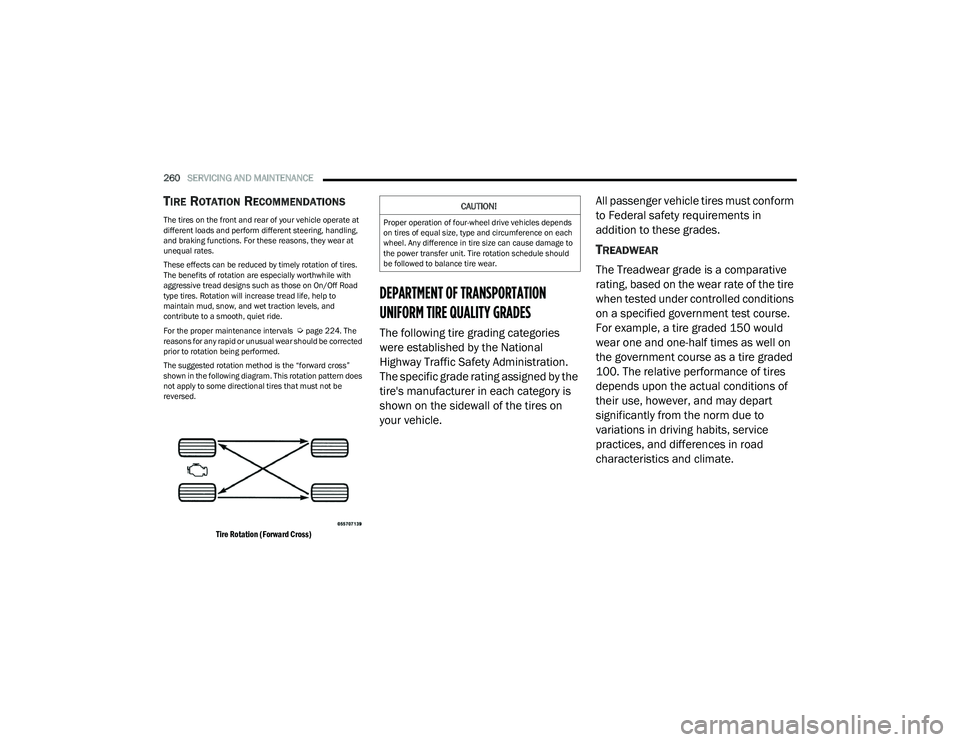
The suggested rotation method is the “forward cross”
shown in the following diagram. This rotation pattern does
not apply to some directional tires that must not be
reversed.
Tire Rotation (Forward Cross)
DEPARTMENT OF TRANSPORTATION
UNIFORM TIRE QUALITY GRADES
The following tire grading categories
were established by the National
Highway Traffic Safety Administration.
The specific grade rating assigned by the
tire's manufacturer in each category is
shown on the sidewall of the tires on
your vehicle. All passenger vehicle tires must conform
to Federal safety requirements in
addition to these grades.
TREADWEAR
The Treadwear grade is a comparative
rating, based on the wear rate of the tire
when tested under controlled conditions
on a specified government test course.
For example, a tire graded 150 would
wear one and one-half times as well on
the government course as a tire graded
100. The relative performance of tires
depends upon the actual conditions of
their use, however, and may depart
significantly from the norm due to
variations in driving habits, service
practices, and differences in road
characteristics and climate.
CAUTION!
Proper operation of four-wheel drive vehicles depends
on tires of equal size, type and circumference on each
wheel. Any difference in tire size can cause damage to
the power transfer unit. Tire rotation schedule should
be followed to balance tire wear.
23_GG_OM_EN_USC_t.book Page 260
Page 265 of 288

SERVICING AND MAINTENANCE263
Cleaning Headlights
Your vehicle is equipped with plastic headlights and fog
lights that are lighter and less susceptible to stone
breakage than glass headlights.
Plastic is not as scratch resistant as glass and therefore
different lens cleaning procedures must be followed.
To minimize the possibility of scratching the lenses and
reducing light output, avoid wiping with a dry cloth. To
remove road dirt, wash with a mild soap solution followed
by rinsing.
Do not use abrasive cleaning components, solvents, steel
wool or other aggressive material to clean the lenses.
PRESERVING THE BODYWORK
Washing
Wash your vehicle regularly. Always wash your vehicle
in the shade using Mopar® Car Wash, or a mild car
wash soap, and rinse the panels completely with water.
If insects, tar, or other similar deposits have accumu -
lated on your vehicle, use Mopar® Super Kleen Bug
and Tar Remover to remove.
Use a high quality cleaner wax, such as Mopar®
Cleaner Wax to remove road film, stains and to protect
your paint finish. Use precautions to not scratch the
paint.
Avoid using abrasive compounds and power buffing
that may diminish the gloss or thin out the paint finish.
Special Care
If you drive on salted or dusty roads or if you drive near
the ocean, hose off the undercarriage at least once a
month.
It is important that the drain holes in the lower edges of
the doors, rocker panels, and trunk be kept clear and
open.
If you detect any stone chips or scratches in the paint,
touch them up immediately.
If your vehicle is damaged due to a collision or similar
cause that destroys the paint and protective coating,
have your vehicle repaired as soon as possible.
If you carry special cargo such as chemicals, fertilizers,
de-icer salt, etc., be sure that such materials are well
packaged and sealed.
If a lot of driving is done on gravel roads, consider mud
or stone shields behind each wheel.
Use Mopar® Touch Up Paint on scratches as soon as
possible. An authorized dealer has touch up paint to
match the color of your vehicle.
INTERIORS
SEATS AND FABRIC PARTS
Use Mopar® Total Clean to clean fabric upholstery and
carpeting.
Stain Repel Fabric Cleaning Procedure —
If Equipped
Stain Repel seats may be cleaned in the following manner:
Remove as much of the stain as possible by blotting
with a clean, dry towel.
Blot any remaining stain with a clean, damp towel.
For tough stains, apply Mopar® Total Clean, or a mild
soap solution to a clean, damp cloth and remove stain.
Use a fresh, damp towel to remove soap residue.
For grease stains, apply Mopar® Multi-Purpose
Cleaner to a clean, damp cloth and remove stain. Use
a fresh, damp towel to remove soap residue.
Do not use any harsh solvents or any other form of
protectants on Stain Repel products.
CAUTION!
Do not use abrasive or strong cleaning materials
such as steel wool or scouring powder that will
scratch metal and painted surfaces.
Use of power washers exceeding 1,200 psi
(8,274 kPa) can result in damage or removal of
paint and decals.
WARNING!
Do not use volatile solvents for cleaning purposes.
Many are potentially flammable, and if used in closed
areas they may cause respiratory harm.
8
23_GG_OM_EN_USC_t.book Page 263
Page 267 of 288

265
TECHNICAL SPECIFICATIONS
VEHICLE IDENTIFICATION NUMBER (VIN)
The VIN is found on the left front corner of the windshield
and is visible from outside of the vehicle.
Vehicle Identification Number
NOTE:
It is illegal to remove or alter the VIN.
BRAKE SYSTEM
Your vehicle is equipped with power assisted brakes as
standard equipment. In the event power assist is lost for
any reason (for example, repeated brake applications with
the engine off), the brakes will still function. However, the
effort required to brake the vehicle will be much greater
than that required with the power system operating. If either of the two hydraulic systems lose normal
capability, the remaining system will still function with
some loss of overall braking effectiveness. This will be
evident by increased pedal travel during application and
greater pedal force required to slow or stop. In addition, if
the malfunction is caused by an internal leak, as the brake
fluid in the master cylinder drops, the Brake Warning Light
will illuminate.
WHEEL AND TIRE TORQUE SPECIFICATIONS
Proper lug nut/bolt torque is very important to ensure that
the wheel is properly mounted to the vehicle. Any time a
wheel has been removed and reinstalled on the vehicle,
the lug nuts/bolts should be torqued using a properly
calibrated torque wrench using a six-sided (hex) deep wall
socket.
TORQUE SPECIFICATIONS
**Use only authorized dealer recommended lug nuts/
bolts and clean or remove any dirt or oil before tightening.
Inspect the wheel mounting surface prior to mounting the
tire and remove any corrosion or loose particles.
Wheel Mounting Surface
WARNING!
Driving a vehicle with the Brake Warning Light on is
dangerous. A significant decrease in braking
performance or vehicle stability during braking may
occur. It will take you longer to stop the vehicle or will
make your vehicle harder to control. You could have a
collision. Have the vehicle checked immediately.
Lug Nut/Bolt
Torque
**Lug Nut/Bolt
SizeLug Nut/Bolt
Socket Size
88.5 ft-lb
(120 N·m) M12 x 1.25 17 mm
9
23_GG_OM_EN_USC_t.book Page 265
Page 271 of 288

TECHNICAL SPECIFICATIONS269
ENGINE FLUIDS AND LUBRICANTS
CHASSIS FLUIDS AND LUBRICANTS
Component Fluid, Lubricant, or Genuine Part
Engine Coolant We recommend using Mopar® Antifreeze/Coolant 10 Year/150,000 Miles
(240,000 Kilometers) Formula OAT (Organic Additive Technology) meeting the
requirements of the manufacturer Material Standard MS.90032.
Engine Oil - 2.0L Engine We recommend using Mopar® API SP/GF-6A Certified SAE 5W-30 Full Synthetic Engine
Oil which meets the requirements of the manufacturer Material Standard MS-13340.
Equivalent full synthetic 5W-30 API SP engine oil can be used but must have the API
Donut trademark
Úpage 228.
CAUTION!
Failure to use the recommended API SP/GF-6A or equivalent oil can cause engine
damage not covered by the vehicle warranty.
Fuel Selection - 2.0L Engine 87 Octane (R+M)/2 Method, 0-15% ethanol.
ComponentFluid, Lubricant, or Genuine Part
9-Speed Automatic Transmission – If Equipped Use only Mopar® ZF 8 & 9 Speed ATF Automatic Transmission Fluid, or equivalent.
Failure to use the correct fluid may affect the function or performance of your
transmission.
Power Transfer Unit (PTU) – If Equipped
We recommend using Mopar® Front Axle/PTU Synthetic Axle Lubricant SAE 75W-90 (API GL-5).
Rear Differential (RDM) – If Equipped
We recommend using Mopar® Rear Axle/RDM Synthetic Axle Lubricant SAE 75W-90 (API GL-5).
Brake Master Cylinder We recommend using Mopar® DOT 4 (TUTELA TOP EVO).
9
23_GG_OM_EN_USC_t.book Page 269