2023 DODGE HORNET esc
[x] Cancel search: escPage 221 of 288

IN CASE OF EMERGENCY219
5. Locate the gear selector override access (at the right
rear corner of the gear selector assembly). Using a
small screwdriver or similar tool, push and hold the
override release lever down.
Gear Selector Override Access Location
6. Move the gear selector to the NEUTRAL (N) position.
7. The vehicle may then be started in NEUTRAL.
8. Reinstall the gear selector boot.
FREEING A STUCK VEHICLE
If your vehicle becomes stuck in mud, sand or snow, it can
often be moved using a rocking motion. Turn the steering
wheel right and left to clear the area around the front
wheels. Push and hold the button on the gear selector.
Then shift back and forth between DRIVE (D) and
REVERSE (R) while gently pressing the accelerator.
NOTE:Shifts between DRIVE (D) and REVERSE (R) can only be
achieved at wheel speeds of 5 mph (8 km/h) or less.
Whenever the transmission remains in NEUTRAL (N) for
more than two seconds, you must press the brake pedal
to engage DRIVE (D) or REVERSE (R).
Use the least amount of accelerator pedal pressure that
will maintain the rocking motion without spinning the
wheels or racing the engine.
NOTE:Push the ESC OFF button (if necessary), to place the Elec -
tronic Stability Control (ESC) system in the “Off” mode,
before rocking the vehicle
Úpage 156. Once the vehicle
has been freed, push the ESC OFF button again to restore
“ESC On” mode.
WARNING!
Fast spinning tires can be dangerous. Forces generated
by excessive wheel speeds may cause damage, or even
failure, of the axle and tires. A tire could explode and
injure someone. Do not spin your vehicle's wheels
faster than 30 mph (48 km/h) or for longer than
30 seconds continuously without stopping when you
are stuck and do not let anyone near a spinning wheel,
no matter what the speed.
CAUTION!
Racing the engine or spinning the wheels may lead to
transmission overheating and failure. Allow the
engine to idle with the transmission in NEUTRAL for
at least one minute after every five rocking-motion
cycles. This will minimize overheating and reduce the
risk of clutch or transmission failure during
prolonged efforts to free a stuck vehicle.
When “rocking” a stuck vehicle by shifting between
DRIVE gear and REVERSE, do not spin the wheels
faster than 15 mph (24 km/h), or drivetrain damage
may result.
Revving the engine or spinning the wheels too fast
may lead to transmission overheating and failure. It
can also damage the tires. Do not spin the wheels
above 30 mph (48 km/h) while in gear (no transmis -
sion shifting occurring).
7
23_GG_OM_EN_USC_t.book Page 219
Page 222 of 288
220IN CASE OF EMERGENCY
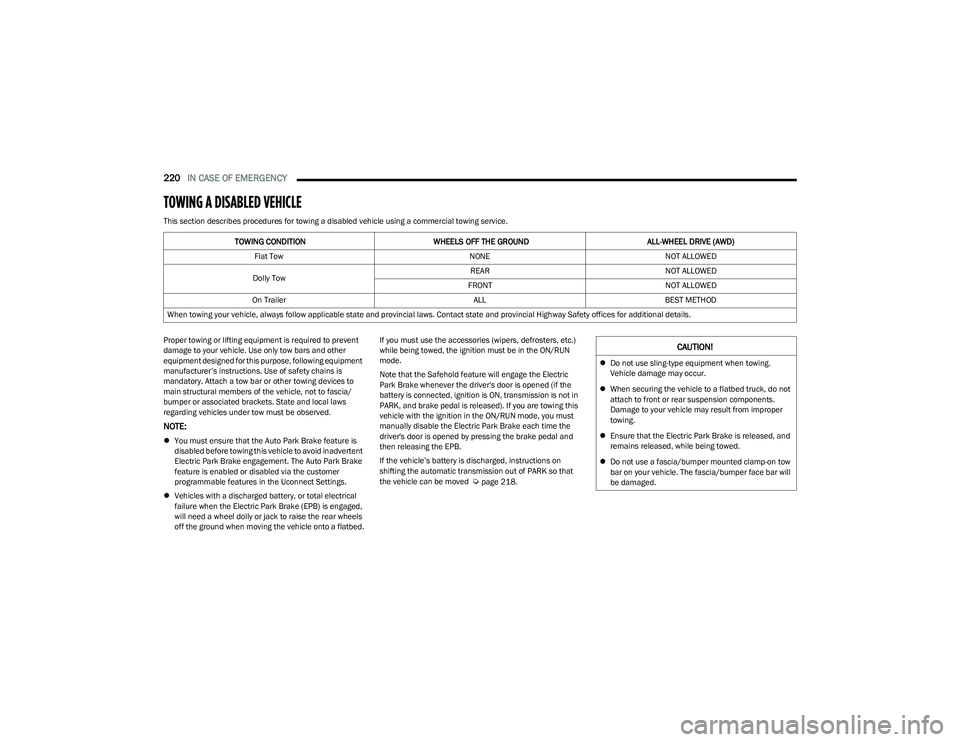
TOWING A DISABLED VEHICLE
This section describes procedures for towing a disabled vehicle using a commercial towing service.
Proper towing or lifting equipment is required to prevent
damage to your vehicle. Use only tow bars and other
equipment designed for this purpose, following equipment
manufacturer’s instructions. Use of safety chains is
mandatory. Attach a tow bar or other towing devices to
main structural members of the vehicle, not to fascia/
bumper or associated brackets. State and local laws
regarding vehicles under tow must be observed.
NOTE:
You must ensure that the Auto Park Brake feature is
disabled before towing this vehicle to avoid inadvertent
Electric Park Brake engagement. The Auto Park Brake
feature is enabled or disabled via the customer
programmable features in the Uconnect Settings.
Vehicles with a discharged battery, or total electrical
failure when the Electric Park Brake (EPB) is engaged,
will need a wheel dolly or jack to raise the rear wheels
off the ground when moving the vehicle onto a flatbed. If you must use the accessories (wipers, defrosters, etc.)
while being towed, the ignition must be in the ON/RUN
mode.
Note that the Safehold feature will engage the Electric
Park Brake whenever the driver's door is opened (if the
battery is connected, ignition is ON, transmission is not in
PARK, and brake pedal is released). If you are towing this
vehicle with the ignition in the ON/RUN mode, you must
manually disable the Electric Park Brake each time the
driver's door is opened by pressing the brake pedal and
then releasing the EPB.
If the vehicle’s battery is discharged, instructions on
shifting the automatic transmission out of PARK so that
the vehicle can be moved
Úpage 218.
TOWING CONDITION WHEELS OFF THE GROUND
ALL-WHEEL DRIVE (AWD)
Flat Tow NONENOT ALLOWED
Dolly Tow REAR
NOT ALLOWED
FRONT NOT ALLOWED
On Trailer ALLBEST METHOD
When towing your vehicle, always follow applicable state and provincial laws. Contact state and provincial Highway Safety offices for additional details.
CAUTION!
Do not use sling-type equipment when towing.
Vehicle damage may occur.
When securing the vehicle to a flatbed truck, do not
attach to front or rear suspension components.
Damage to your vehicle may result from improper
towing.
Ensure that the Electric Park Brake is released, and
remains released, while being towed.
Do not use a fascia/bumper mounted clamp-on tow
bar on your vehicle. The fascia/bumper face bar will
be damaged.
23_GG_OM_EN_USC_t.book Page 220
Page 225 of 288

223
SERVICING AND MAINTENANCE
SCHEDULED SERVICING
Your vehicle is equipped with an automatic oil change
indicator system. The oil change indicator system will
remind you that it is time to take your vehicle in for
scheduled maintenance.
Based on engine operation conditions, the oil change
indicator message will illuminate in the instrument cluster.
This means that service is required for your vehicle.
Operating conditions such as frequent short-trips, trailer
towing, and extremely hot or cold ambient temperatures
will influence when the “Change Oil” or “Oil Change
Required” message is displayed. Have your vehicle
serviced as soon as possible, within the next 500 miles
(805 km).An authorized dealer will reset the oil change indicator
message after completing the scheduled oil change. If a
scheduled oil change is performed by someone other than
an authorized dealer, the message can be reset by
referring to the steps described under Instrument Cluster
Display
Úpage 66.
NOTE:Under no circumstances should oil change intervals
exceed 10,000 miles (16,000 km), one year or 350 hours
of engine run time, whichever comes first. The 350 hours
of engine run or idle time is generally only a concern for
fleet customers.
Once A Month Or Before A Long Trip:
Check engine oil level.
Check windshield washer fluid level.
Check the tire inflation pressures and look for unusual
wear or damage. Rotate tires at the first sign of irreg -
ular wear, even if it occurs before the oil indicator
system turns on.
Check the fluid levels of the coolant reservoir, and
brake master cylinder reservoir, and fill as needed.
Check function of all interior and exterior lights.
8
23_GG_OM_EN_USC_t.book Page 223
Page 238 of 288

236SERVICING AND MAINTENANCE
BRAKE SYSTEM
In order to ensure brake system performance, all brake
system components should be inspected periodically.
For the proper maintenance intervals
Úpage 224.
Brake Master Cylinder
The fluid in the master cylinder should be checked when
performing under hood services or immediately if the
Brake Warning Light is illuminated.
Be sure to clean the top of the master cylinder area before
removing the cap. If necessary, add fluid to bring the fluid
level up to the requirements described on the brake fluid
reservoir. With disc brakes, fluid level can be expected to
fall as the brake pads wear. Brake fluid level should be
checked when pads are replaced. However, low fluid level
may be caused by a leak and a checkup may be needed.
Use only the manufacturer recommended brake fluid
Úpage 269.
AUTOMATIC TRANSMISSION —
I
F EQUIPPED
Special Additives
It is strongly recommended against using any special
additives in the transmission. Automatic Transmission
Fluid (ATF) is an engineered product and its performance
may be impaired by supplemental additives. Therefore, do
not add any fluid additives to the transmission. Avoid
using transmission sealers as they may adversely affect
seals.
Fluid Level Check
The fluid level is preset at the factory and does not require
adjustment under normal operating conditions. Routine
fluid level checks are not required; therefore the
transmission has no dipstick. An authorized dealer can
check your transmission fluid level using special service
tools. If you notice fluid leakage or transmission
malfunction, visit an authorized dealer immediately to
have the transmission fluid level checked. Operating the
vehicle with an improper fluid level can cause severe
transmission damage.
WARNING!
Riding the brakes can lead to brake failure and possibly
a collision. Driving with your foot resting or riding on the
brake pedal can result in abnormally high brake
temperatures, excessive lining wear, and possible brake
damage. You would not have your full braking capacity
in an emergency.
WARNING!
Use only the manufacturer recommended brake fluid Úpage 269. Using the wrong type of brake fluid can
severely damage your brake system and/or impair its
performance. The proper type of brake fluid for your
vehicle is also identified on the original factory
installed hydraulic master cylinder reservoir.
To avoid contamination from foreign matter or
moisture, use only new brake fluid or fluid that has
been in a tightly closed container. Keep the master
cylinder reservoir cap secured at all times. Brake
fluid in an open container absorbs moisture from the
air resulting in a lower boiling point. This may cause
it to boil unexpectedly during hard or prolonged
braking, resulting in sudden brake failure.
This could result in a collision.
Overfilling the brake fluid reservoir can result in
spilling brake fluid on hot engine parts, causing the
brake fluid to catch fire. Brake fluid can also damage
painted and vinyl surfaces, care should be taken to
avoid its contact with these surfaces.
Do not allow petroleum-based fluid to contaminate
the brake fluid. Brake seal components could be
damaged, causing partial or complete brake failure.
This could result in a collision.
CAUTION!
Do not use chemical flushes in your transmission as the
chemicals can damage your transmission components.
Such damage is not covered by the New Vehicle Limited
Warranty.
23_GG_OM_EN_USC_t.book Page 236
Page 241 of 288

SERVICING AND MAINTENANCE239
The fuse box screw and cover must be removed to gain
access to the fuses.
Fuse Box Cover And Locking Screw Removal
For fuse box access, proceed as follows:
1. Turn the locking screw counterclockwise.
2. Slowly release the screw.
3. Remove the fuse box cover by sliding it upward.
4. Reverse the procedure to reinstall.
1 — Fuse Cover
2 — Locking Screw
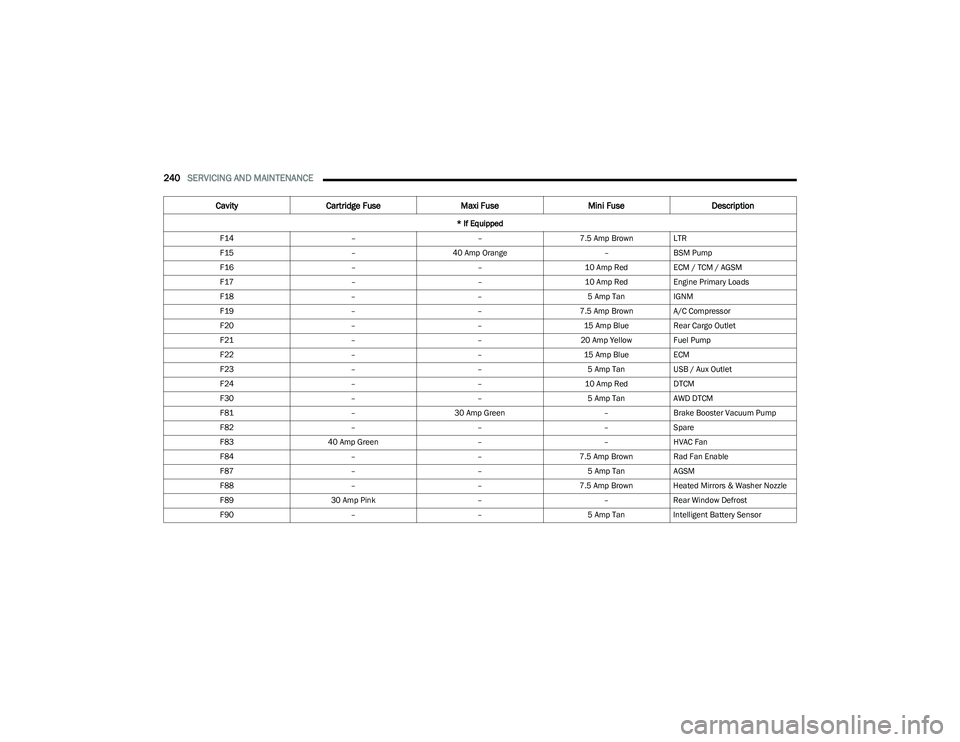
CavityCartridge Fuse Maxi FuseMini FuseDescription
* If Equipped
F01 –70 Amp Tan –BCM1
F02 –70 Amp Tan –BCM2 / RDU
F03 20 Amp Blue ––BCM3
F04 40 Amp Green ––BCM Valves
F05 –40 Amp Orange –PTC 1
F06 –20 Amp Yellow –Front Wiper Motor
F07 –20 Amp Yellow –DTCM
F08 30 Amp Pink ––Power Supply F24 - F87 - Fxx
F09 ––7.5 Amp Brown ECM T09
F10 ––15 Amp BlueHorn
F11 ––5 Amp TanEngine Secondary Loads
8
23_GG_OM_EN_USC_t.book Page 239
Page 242 of 288
240SERVICING AND MAINTENANCE
F14 ––7.5 Amp Brown LTR
F15 –40 Amp Orange –BSM Pump
F16 ––10 Amp RedECM / TCM / AGSM
F17 ––10 Amp RedEngine Primary Loads
F18 ––5 Amp TanIGNM
F19 ––7.5 Amp Brown A/C Compressor
F20 ––15 Amp BlueRear Cargo Outlet
F21 ––20 Amp Yellow Fuel Pump
F22 ––15 Amp BlueECM
F23 ––5 Amp TanUSB / Aux Outlet
F24 ––10 Amp RedDTCM
F30 ––5 Amp TanAWD DTCM
F81 –30 Amp Green –Brake Booster Vacuum Pump
F82 –––Spare
F83 40 Amp Green ––HVAC Fan
F84 ––7.5 Amp Brown Rad Fan Enable
F87 ––5 Amp TanAGSM
F88 ––7.5 Amp Brown Heated Mirrors & Washer Nozzle
F89 30 Amp Pink ––Rear Window Defrost
F90 ––5 Amp TanIntelligent Battery Sensor
Cavity Cartridge Fuse Maxi FuseMini FuseDescription
* If Equipped
23_GG_OM_EN_USC_t.book Page 240
Page 243 of 288

SERVICING AND MAINTENANCE241
Relays
Cavity Maxi Fuse Mini FuseDescription
T02 ––Not Used
T03 –30 AmpHorn
T05 –30 AmpA/C Compressor
T06 –30 AmpRad Fan Enable
T07 50 Amp –Aux.1 / DTCM
T08 –30 AmpHVAC Fan
T09 –30 AmpEngine Main Relay
T10 ––Not Used
T14 –30 AmpRear Cargo Power Outlet
T17 –30 AmpRear Window Defrost/Heated Mirrors
T19 ––Not Used
T20 –30 AmpStarter Relay R1
T31 –30 AmpFuel Pump
T89 ––Not Used
T90 –30 AmpBrake Booster Vacuum Pump
8
23_GG_OM_EN_USC_t.book Page 241
Page 244 of 288

242SERVICING AND MAINTENANCE
Interior Fuses
The interior fuse panel is located under the driver’s side
lower instrument panel.
Interior Fuse Box Location
Cavity Mini Fuse Description
*If Equipped
F31 7.5 Amp BrownHVAC Relay Coil & Power Outlet / Seat Relay Coil
F33 20 Amp YellowFront Passenger Window Lifter
F34 20 Amp YellowFront Driver Window Lifter
F36 15 Amp BlueHVAC / VTA / External Mirror /Ceiling Light / CVPM / Radio Mod / USB /
AUX/ DCSD / Electric Steering Lock
23_GG_OM_EN_USC_t.book Page 242