2023 DODGE HORNET uconnect
[x] Cancel search: uconnectPage 167 of 288
SAFETY165
Turning PEB On Or Off
NOTE:The default status of PEB is “On.” This allows the system
to warn you of a possible frontal collision with the pedes -
trian/cyclist.
The PEB button is located in the Uconnect Settings
Úpage 130.
To turn the PEB system off, push the Pedestrian
Emergency Braking OFF button.
To turn the PEB system back on, push the Warning Active
Braking button.
Changing the PEB status to “Only Warning” prevents the
system from providing autonomous braking, or additional
brake support if the driver is not braking adequately in the
event of a potential frontal collision with a pedestrian/cyclist.
Changing the PEB status to “Off” deactivates the system,
so no warning or active braking will be available in case of
a possible frontal collision with a pedestrian/cyclist.
NOTE:The PEB system will retain the last setting selected by the
driver after ignition shut down. The system will not reset to
the default setting when the vehicle is restarted.
TIRE PRESSURE MONITORING SYSTEM
(TPMS)
The TPMS will warn the driver of a low tire pressure based
on the vehicle recommended cold placard pressure.
The tire pressure will vary with temperature by
approximately 1 psi (7 kPa) for every 12°F (6.5°C). This
means that when the outside temperature decreases, the
tire pressure will decrease. Tire pressure should always be
set based on cold inflation tire pressure. This is defined as
the tire pressure after the vehicle has not been driven for
at least three hours, or driven less than 1 mile (1.6 km)
after a three hour period. The cold tire inflation pressure
must not exceed the maximum inflation pressure molded
into the tire sidewall. The tire pressure will also increase
as the vehicle is driven. This is normal and there should be
no adjustment for this increased pressure.
For more information on how to properly inflate the
vehicle’s tires, see
Úpage 246.
The TPMS will warn the driver of a low tire pressure if the
tire pressure falls below the low-pressure warning limit for
any reason, including low temperature effects and natural
pressure loss through the tire. The TPMS will continue to
warn the driver of low tire pressure as long as the
condition exists, and will not turn off until the tire pressure
is at or above the recommended cold placard pressure.
NOTE:Once the low tire pressure warning (Tire Pressure
Monitoring System Warning Light) illuminates, you must
increase the tire pressure to the recommended cold
placard pressure in order for the Tire Pressure Monitoring
System Warning Light to turn off.
The system will automatically update and the Tire
Pressure Monitoring System Warning Light will turn off
once the system receives the updated tire pressures. The
vehicle may need to be driven for up to 20 minutes above
15 mph (24 km/h) in order for the TPMS to receive this information.
For example, your vehicle may have a recommended cold
(parked for more than three hours) placard pressure of
33 psi (227 kPa). If the ambient temperature is 68°F
(20°C) and the measured tire pressure is 28 psi
(193 kPa), a temperature drop to 20°F (-7°C) will
decrease the tire pressure to approximately 24 psi
(165 kPa). This tire pressure is low enough to turn on
the Tire Pressure Monitoring System Warning Light.
Driving the vehicle may cause the tire pressure to rise to
approximately 28 psi (193 kPa), but the Tire Pressure
Monitoring System Warning Light will still be on. In this
situation, the Tire Pressure Monitoring System Warning
Light will turn off only after the tires are inflated to the
vehicle’s recommended cold placard pressure value
Úpage 275.
NOTE:When filling warm tires, the tire pressure may need to be
increased up to an additional 4 psi (28 kPa) above the
recommended cold placard pressure in order to turn the
Tire Pressure Monitoring System Warning Light off.
6
23_GG_OM_EN_USC_t.book Page 165
Page 201 of 288
SAFETY199
(Continued)
1. Look behind the seating position where you plan to
install the child restraint to find the tether
anchorage. You may need to move the seat forward
to provide better access to the tether anchorage. If
there is no top tether anchorage for that seating
position, move the child restraint to another position
in the vehicle if one is available.
2. Route the tether strap to provide the most direct path for the strap between the anchor and the child seat.
If your vehicle is equipped with adjustable rear head
restraints, raise the head restraint, and where
possible, route the tether strap under the head
restraint and between the two posts. If not possible,
lower the head restraint and pass the tether strap
around the outboard side of the head restraint.
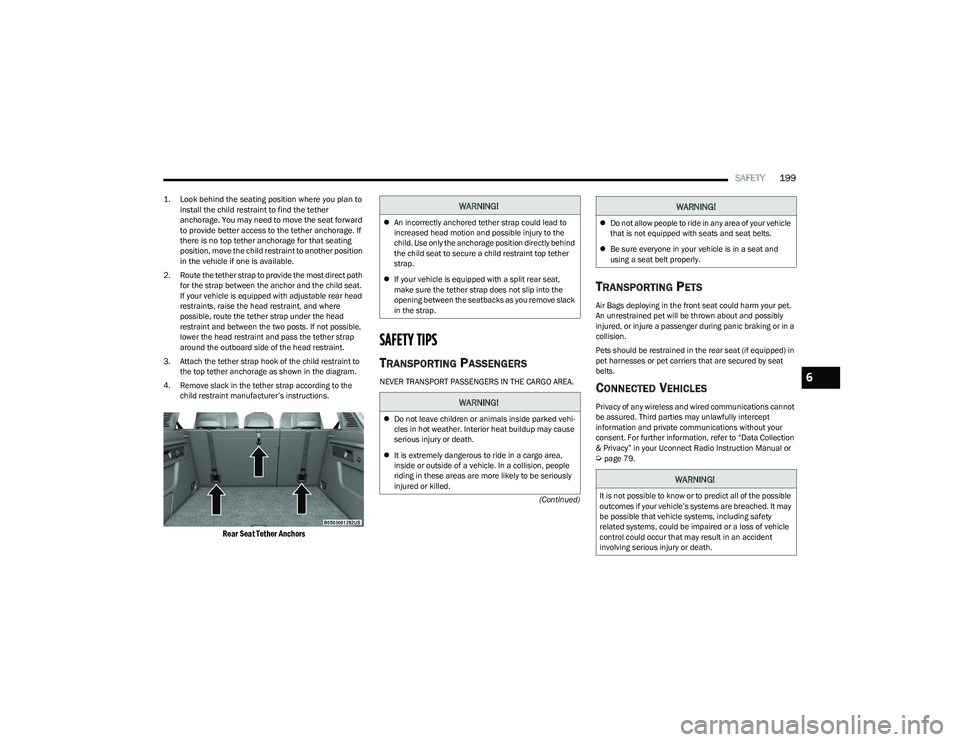
3. Attach the tether strap hook of the child restraint to the top tether anchorage as shown in the diagram.
4. Remove slack in the tether strap according to the child restraint manufacturer’s instructions.
Rear Seat Tether Anchors
SAFETY TIPS
TRANSPORTING PASSENGERS
NEVER TRANSPORT PASSENGERS IN THE CARGO AREA.
TRANSPORTING PETS
Air Bags deploying in the front seat could harm your pet.
An unrestrained pet will be thrown about and possibly
injured, or injure a passenger during panic braking or in a
collision.
Pets should be restrained in the rear seat (if equipped) in
pet harnesses or pet carriers that are secured by seat
belts.
CONNECTED VEHICLES
Privacy of any wireless and wired communications cannot
be assured. Third parties may unlawfully intercept
information and private communications without your
consent. For further information, refer to “Data Collection
& Privacy” in your Uconnect Radio Instruction Manual or
Úpage 79.
WARNING!
An incorrectly anchored tether strap could lead to
increased head motion and possible injury to the
child. Use only the anchorage position directly behind
the child seat to secure a child restraint top tether
strap.
If your vehicle is equipped with a split rear seat,
make sure the tether strap does not slip into the
opening between the seatbacks as you remove slack
in the strap.
WARNING!
Do not leave children or animals inside parked vehi -
cles in hot weather. Interior heat buildup may cause
serious injury or death.
It is extremely dangerous to ride in a cargo area,
inside or outside of a vehicle. In a collision, people
riding in these areas are more likely to be seriously
injured or killed.
Do not allow people to ride in any area of your vehicle
that is not equipped with seats and seat belts.
Be sure everyone in your vehicle is in a seat and
using a seat belt properly.
WARNING!
It is not possible to know or to predict all of the possible
outcomes if your vehicle’s systems are breached. It may
be possible that vehicle systems, including safety
related systems, could be impaired or a loss of vehicle
control could occur that may result in an accident
involving serious injury or death.
WARNING!
6
23_GG_OM_EN_USC_t.book Page 199
Page 208 of 288
206IN CASE OF EMERGENCY
(Continued)
Automatic SOS — If Equipped
Automatic SOS is a hands-free safety service that can
immediately connect you with help in the event that your
vehicle’s airbags deploy. Please refer to your provided
radio supplement for complete information.
ASSIST Call
The vehicle is equipped with an on-board assist, which is
located within the Uconnect system. The ASSIST feature is
used to automatically connect you to any one of the
following support centers:
Roadside Assistance – If you get a flat tire, or need a
tow, just push the ASSIST button to connect to
someone who can help. Roadside Assistance will know
what vehicle you’re driving and its location. Additional
fees may apply for roadside assistance.
Vehicle Customer Care – Total support for all other
vehicle issues.
Dodge Connect Customer Care – Total support for
Radio, Phone and NAV issues.
For further information, refer to the vehicles radio
supplement.
JACKING AND TIRE CHANGING —
IF EQUIPPED
Use this QR code to access your digital
experience.
PREPARATIONS FOR JACKING
1. Park the vehicle on a firm level surface as far from the edge of the roadway as possible. Avoid icy or
slippery areas.
2. Turn on the Hazard Warning Flashers.
3. Apply the parking brake.
4. Place the ignition in the OFF position.
WARNING!
Do not attempt to change a tire on the side of the
vehicle close to moving traffic. Pull far enough off the
road to avoid the danger of being hit when operating
the jack or changing the wheel.
Being under a jacked-up vehicle is dangerous. The
vehicle could slip off the jack and fall on you. You
could be crushed. Never put any part of your body
under a vehicle that is on a jack. If you need to get
under a raised vehicle, take it to a service center
where it can be raised on a lift.
Never start or run the engine while the vehicle is on
a jack.
The jack is designed to be used as a tool for changing
tires only. The jack should not be used to lift the
vehicle for service purposes. The vehicle should be
jacked on a firm level surface only. Avoid ice or slip -
pery areas.
WARNING!
Do not attempt to change a tire on the side of the
vehicle close to moving traffic. Pull far enough off the
road to avoid being hit when operating the jack or
changing the wheel.
WARNING!
23_GG_OM_EN_USC_t.book Page 206
Page 222 of 288
220IN CASE OF EMERGENCY
TOWING A DISABLED VEHICLE
This section describes procedures for towing a disabled vehicle using a commercial towing service.
Proper towing or lifting equipment is required to prevent
damage to your vehicle. Use only tow bars and other
equipment designed for this purpose, following equipment
manufacturer’s instructions. Use of safety chains is
mandatory. Attach a tow bar or other towing devices to
main structural members of the vehicle, not to fascia/
bumper or associated brackets. State and local laws
regarding vehicles under tow must be observed.
NOTE:
You must ensure that the Auto Park Brake feature is
disabled before towing this vehicle to avoid inadvertent
Electric Park Brake engagement. The Auto Park Brake
feature is enabled or disabled via the customer
programmable features in the Uconnect Settings.
Vehicles with a discharged battery, or total electrical
failure when the Electric Park Brake (EPB) is engaged,
will need a wheel dolly or jack to raise the rear wheels
off the ground when moving the vehicle onto a flatbed. If you must use the accessories (wipers, defrosters, etc.)
while being towed, the ignition must be in the ON/RUN
mode.
Note that the Safehold feature will engage the Electric
Park Brake whenever the driver's door is opened (if the
battery is connected, ignition is ON, transmission is not in
PARK, and brake pedal is released). If you are towing this
vehicle with the ignition in the ON/RUN mode, you must
manually disable the Electric Park Brake each time the
driver's door is opened by pressing the brake pedal and
then releasing the EPB.
If the vehicle’s battery is discharged, instructions on
shifting the automatic transmission out of PARK so that
the vehicle can be moved
Úpage 218.
TOWING CONDITION WHEELS OFF THE GROUND
ALL-WHEEL DRIVE (AWD)
Flat Tow NONENOT ALLOWED
Dolly Tow REAR
NOT ALLOWED
FRONT NOT ALLOWED
On Trailer ALLBEST METHOD
When towing your vehicle, always follow applicable state and provincial laws. Contact state and provincial Highway Safety offices for additional details.
CAUTION!
Do not use sling-type equipment when towing.
Vehicle damage may occur.
When securing the vehicle to a flatbed truck, do not
attach to front or rear suspension components.
Damage to your vehicle may result from improper
towing.
Ensure that the Electric Park Brake is released, and
remains released, while being towed.
Do not use a fascia/bumper mounted clamp-on tow
bar on your vehicle. The fascia/bumper face bar will
be damaged.
23_GG_OM_EN_USC_t.book Page 220
Page 284 of 288

282
Pets ............................................................................... 199
Placard, Tire And Loading Information ....................... 251
PowerDoor Locks .................................................................22
Liftgate ....................................................................... 60
Outlet (Auxiliary Electrical Outlet) ............................. 52
Outside Mirrors ..........................................................35
Seats...........................................................................29
Sunroof ....................................................................... 56
Windows .....................................................................55
Pregnant Women And Seat Belts................................ 174
Premium Instrument Cluster
b
...................................66
Preparation For Jacking ............................................... 206
Pretensioners Seat Belts ................................................................ 174
Profile Settings ............................................................. 132
Programmable Features .............................................. 130
RRadial Ply Tires ............................................................. 255
Radiator Cap (Coolant Pressure Cap) ......................... 234
Radio Settings ................................................................... 130
Sound Setting ......................................................... 145
Radio Operation ........................................................... 153
Radio Remote Controls................................................ 150
Rain Sensitive Wiper System .........................................45
Rear Camera ................................................................ 116
Rear Cross Path ........................................................... 161
Rear Seats, Folding .........................................................28 Rear Wiper/Washer ........................................................46
Recreational Towing .................................................... 126
Reformulated Gasoline................................................ 266
Refrigerant.................................................................... 230 Release, Hood................................................................. 58
Reminder, Lights On ....................................................... 41
Reminder, Seat Belt ..................................................... 169
Remote Control
Starting System ......................................................... 18
Remote Keyless Entry .................................................... 13 Arm The Alarm ........................................................... 20
Disarm The Alarm ...................................................... 21
Programming Additional Key Fobs ........................... 15
Remote Sound System (Radio) Control....................... 150
Remote Starting Exit Remote Start Mode ............................................ 19
Uconnect Customer Programmable Features ......... 19
Uconnect Settings ..................................................... 19
Remote Starting System ................................................ 18
Removable Rear Shelf.................................................... 63 Replacement Tires........................................................ 256
Reporting Safety Defects ............................................. 273
Restraints, Child ...........................................................188
Restraints, Head ............................................................. 31
Roll Over Warning ............................................................. 8
Rotation, Tires ............................................................... 260
SSafety Checks Inside Vehicle ....................................... 200
Safety Checks Outside Vehicle ....................................201
Safety Defects, Reporting ............................................273
Safety Information, Tire ................................................ 246
Safety Tips.....................................................................199
Safety, Exhaust Gas...................................................... 202
Schedule, Maintenance ............................................... 223
Seat Belt Reminder ........................................................ 73 Seat Belts............................................................. 169
, 200
Adjustable Shoulder Belt ........................................ 172 Adjustable Upper Shoulder Anchorage.................. 172
Adjustable Upper Shoulder Belt Anchorage .......... 172
Child Restraints ....................................................... 188Energy Management Feature................................. 174Extender................................................................... 174
Front Seat ............................................. 169
, 170, 171
Inspection ................................................................ 200
Lap/Shoulder Belt Operation ................................. 171 Lap/Shoulder Belt Untwisting ................................ 172
Lap/Shoulder Belts ................................................. 170Operating Instructions ............................................ 171
Pregnant Women .................................................... 174
Pretensioners .......................................................... 174
Rear Seat ................................................................. 170
Reminder ................................................................. 169
Seat Belt Extender .................................................. 174
Seat Belt Pretensioner............................................ 174
Untwisting Procedure.............................................. 172
Seat Belts Maintenance .............................................. 264
Seats ........................................................................ 28
, 29
Head Restraints ........................................................ 31
Heated ....................................................................... 30
Memory ...................................................................... 27
Power ......................................................................... 29
Rear Folding .............................................................. 28
Seatback Release ..................................................... 28
Tilting .................................................................. 28
, 29
Ventilated .................................................................. 31
Security Alarm ......................................................... 20
, 73
Arm The System ........................................................ 20
Disarm The System ................................................... 21
23_GG_OM_EN_USC_t.book Page 282
Page 286 of 288
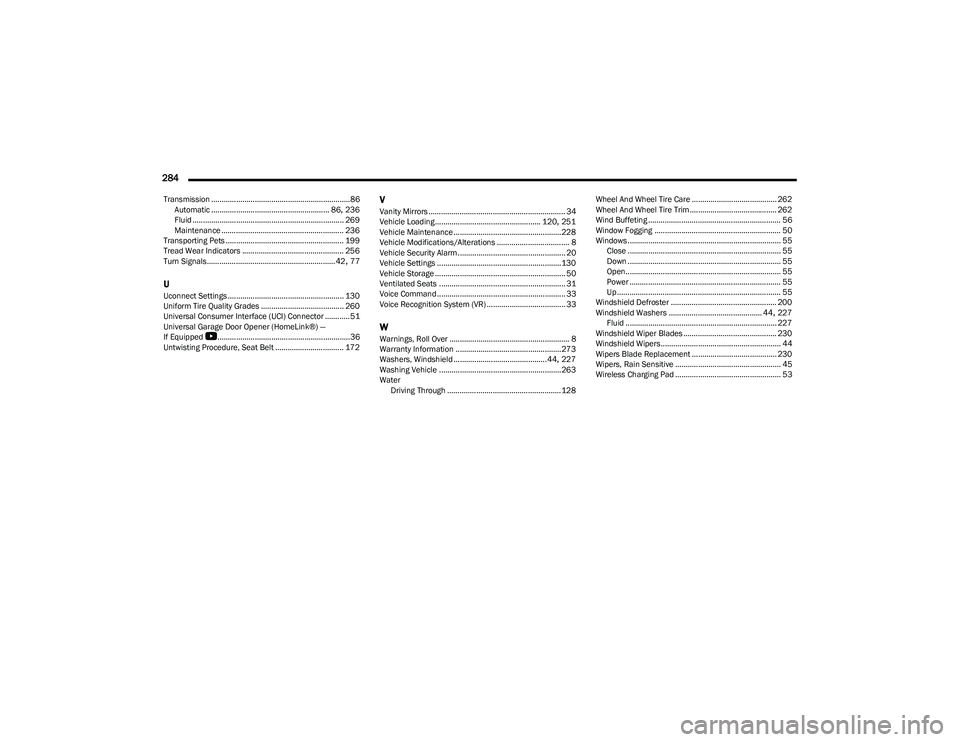
284
Transmission ...................................................................86Automatic ......................................................... 86, 236
Fluid ......................................................................... 269
Maintenance ........................................................... 236
Transporting Pets ......................................................... 199
Tread Wear Indicators ................................................. 256
Turn Signals.............................................................. 42
, 77
UUconnect Settings ........................................................ 130
Uniform Tire Quality Grades ........................................ 260
Universal Consumer Interface (UCI) Connector ............ 51
Universal Garage Door Opener (HomeLink®) —
If Equipped
b
................................................................36
Untwisting Procedure, Seat Belt ................................. 172
VVanity Mirrors .................................................................. 34
Vehicle Loading................................................... 120, 251
Vehicle Maintenance ....................................................228
Vehicle Modifications/Alterations ................................... 8
Vehicle Security Alarm .................................................... 20 Vehicle Settings ............................................................130
Vehicle Storage ............................................................... 50
Ventilated Seats ............................................................. 31
Voice Command.............................................................. 33
Voice Recognition System (VR) ...................................... 33
WWarnings, Roll Over .......................................................... 8
Warranty Information ...................................................273
Washers, Windshield .............................................44
, 227
Washing Vehicle ...........................................................263
Water Driving Through ....................................................... 128 Wheel And Wheel Tire Care ......................................... 262
Wheel And Wheel Tire Trim.......................................... 262
Wind Buffeting ................................................................ 56
Window Fogging ............................................................. 50
Windows.......................................................................... 55
Close .......................................................................... 55
Down .......................................................................... 55
Open........................................................................... 55
Power ......................................................................... 55
Up ............................................................................... 55
Windshield Defroster ................................................... 200
Windshield Washers ............................................. 44
, 227
Fluid ......................................................................... 227
Windshield Wiper Blades ............................................. 230
Windshield Wipers.......................................................... 44
Wipers Blade Replacement ......................................... 230
Wipers, Rain Sensitive ................................................... 45
Wireless Charging Pad ................................................... 53
23_GG_OM_EN_USC_t.book Page 284