2023 CADILLAC CT4 lock
[x] Cancel search: lockPage 232 of 524

Cadillac CT4 Owner Manual (GMNA-Localizing-U.S./Canada-16500442) -
2023 - CRC - 5/4/22
Climate Controls 231
Operation Tips
.Clear away any ice, snow,
or leaves from air inlets at
the base of the windshield
that could block the flow of
air into the vehicle.
.Clear snow off the hood to
improve visibility and help
decrease moisture drawn
into the vehicle.
.Keep the path under the
front seats clear of objects
to help circulate the air
inside of the vehicle more
effectively.
.Use of non-GM approved
hood deflectors can
adversely affect the
performance of the system.
Check with your dealer
before adding equipment to
the outside of the vehicle.
.Do not attach any devices to
the air vent slats. This
restricts airflow and may
cause damage to the air
vents.
Maintenance
Passenger
Compartment Air
Filter
The filter reduces dust, pollen,
and other airborne irritants
from outside air that is pulled
into the vehicle. The filter
should be replaced as part of
routine scheduled
maintenance. See
Maintenance Schedule0469.
See your dealer regarding
replacement of the filter.
Service
All vehicles have a label
underhood that identifies the
refrigerant used in the vehicle.
The refrigerant system should
only be serviced by trained
and certified technicians. The
air conditioning evaporator
should never be repaired or
replaced by one from a
salvage vehicle. It should only be replaced by a new
evaporator to ensure proper
and safe operation.
During service, all refrigerants
should be reclaimed with
proper equipment. Venting
refrigerants directly to the
atmosphere is harmful to the
environment and may also
create unsafe conditions
based on inhalation,
combustion, frostbite, or other
health-based concerns.
The air conditioning system
requires periodic maintenance.
See Maintenance Schedule
0
469.
Page 233 of 524
Cadillac CT4 Owner Manual (GMNA-Localizing-U.S./Canada-16500442) -
2023 - CRC - 5/10/22
232 Driving and Operating
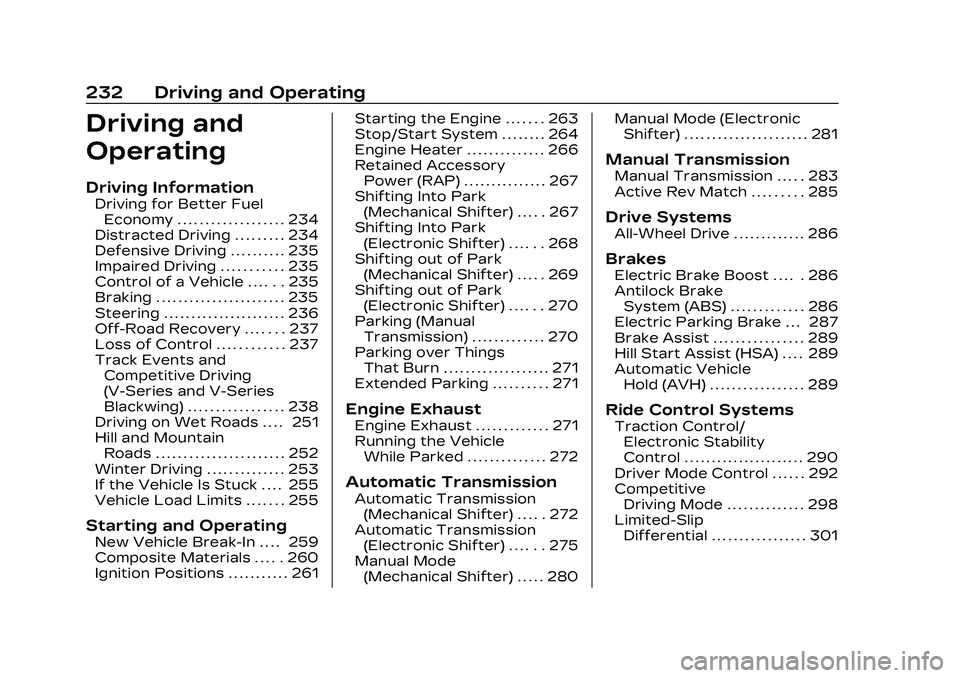
Driving and
Operating
Driving Information
Driving for Better FuelEconomy . . . . . . . . . . . . . . . . . . . 234
Distracted Driving . . . . . . . . . 234
Defensive Driving . . . . . . . . . . 235
Impaired Driving . . . . . . . . . . . 235
Control of a Vehicle . . . . . . 235
Braking . . . . . . . . . . . . . . . . . . . . . . . 235
Steering . . . . . . . . . . . . . . . . . . . . . . 236
Off-Road Recovery . . . . . . . 237
Loss of Control . . . . . . . . . . . . 237
Track Events and Competitive Driving
(V-Series and V-Series
Blackwing) . . . . . . . . . . . . . . . . . 238
Driving on Wet Roads . . . . 251
Hill and Mountain Roads . . . . . . . . . . . . . . . . . . . . . . . 252
Winter Driving . . . . . . . . . . . . . . 253
If the Vehicle Is Stuck . . . . 255
Vehicle Load Limits . . . . . . . 255
Starting and Operating
New Vehicle Break-In . . . . 259
Composite Materials . . . . . 260
Ignition Positions . . . . . . . . . . . 261 Starting the Engine . . . . . . . 263
Stop/Start System . . . . . . . . 264
Engine Heater . . . . . . . . . . . . . . 266
Retained Accessory
Power (RAP) . . . . . . . . . . . . . . . 267
Shifting Into Park (Mechanical Shifter) . . . . . 267
Shifting Into Park (Electronic Shifter) . . . . . . 268
Shifting out of Park (Mechanical Shifter) . . . . . 269
Shifting out of Park (Electronic Shifter) . . . . . . 270
Parking (Manual Transmission) . . . . . . . . . . . . . 270
Parking over Things That Burn . . . . . . . . . . . . . . . . . . . 271
Extended Parking . . . . . . . . . . 271
Engine Exhaust
Engine Exhaust . . . . . . . . . . . . . 271
Running the Vehicle While Parked . . . . . . . . . . . . . . 272
Automatic Transmission
Automatic Transmission(Mechanical Shifter) . . . . . 272
Automatic Transmission (Electronic Shifter) . . . . . . 275
Manual Mode (Mechanical Shifter) . . . . . 280 Manual Mode (Electronic
Shifter) . . . . . . . . . . . . . . . . . . . . . . 281
Manual Transmission
Manual Transmission . . . . . 283
Active Rev Match . . . . . . . . . 285
Drive Systems
All-Wheel Drive . . . . . . . . . . . . . 286
Brakes
Electric Brake Boost . . . . . 286
Antilock BrakeSystem (ABS) . . . . . . . . . . . . . 286
Electric Parking Brake . . . 287
Brake Assist . . . . . . . . . . . . . . . . 289
Hill Start Assist (HSA) . . . . 289
Automatic Vehicle Hold (AVH) . . . . . . . . . . . . . . . . . 289
Ride Control Systems
Traction Control/Electronic Stability
Control . . . . . . . . . . . . . . . . . . . . . . 290
Driver Mode Control . . . . . . 292
Competitive Driving Mode . . . . . . . . . . . . . . 298
Limited-Slip Differential . . . . . . . . . . . . . . . . . 301
Page 238 of 524

Cadillac CT4 Owner Manual (GMNA-Localizing-U.S./Canada-16500442) -
2023 - CRC - 5/10/22
Driving and Operating 237
.Maintain a reasonable
steady speed through the
curve.
.Wait until the vehicle is out
of the curve before
accelerating gently into the
straightaway.
Steering in Emergencies
.There are some situations
when steering around a
problem may be more
effective than braking.
.Holding both sides of the
steering wheel allows you to
turn 180 degrees without
removing a hand.
.The Antilock Brake System
(ABS) allows steering while
braking.
Off-Road Recovery
The vehicle's right wheels can
drop off the edge of a road
onto the shoulder while
driving. Follow these tips:1. Ease off the accelerator and then, if there is
nothing in the way, steer
the vehicle so that it
straddles the edge of the
pavement.
2. Turn the steering wheel about one-eighth of a turn,
until the right front tire
contacts the
pavement edge. 3. Turn the steering wheel to
go straight down the
roadway.
Loss of Control
Skidding
There are three types of skids
that correspond to the
vehicle's three control
systems:
.Braking Skid —wheels are
not rolling.
.Steering or Cornering Skid —
too much speed or steering
in a curve causes tires to slip
and lose cornering force.
.Acceleration Skid —too
much throttle causes the
driving wheels to spin.
Defensive drivers avoid most
skids by taking reasonable
care suited to existing
conditions, and by not
overdriving those conditions.
But skids are always possible.
Page 239 of 524

Cadillac CT4 Owner Manual (GMNA-Localizing-U.S./Canada-16500442) -
2023 - CRC - 5/10/22
238 Driving and Operating
If the vehicle starts to slide,
follow these suggestions:
.Ease your foot off the
accelerator pedal and steer
the way you want the vehicle
to go. The vehicle may
straighten out. Be ready for
a second skid if it occurs.
.Slow down and adjust your
driving according to weather
conditions. Stopping
distance can be longer and
vehicle control can be
affected when traction is
reduced by water, snow, ice,
gravel, or other material on
the road. Learn to recognize
warning clues—such as
enough water, ice, or packed
snow on the road to make a
mirrored surface —and slow
down when you have any
doubt.
.Try to avoid sudden
steering, acceleration,
or braking, including
reducing vehicle speed by
shifting to a lower gear. Any
sudden changes could cause
the tires to slide. Remember: Antilock brakes
help avoid only the
braking skid.
Track Events and
Competitive Driving
(V-Series and
V-Series Blackwing)
Before any track event, there
are three features that should
be turned off:
.Automatic Emergency
Braking (AEB). See
Automatic Emergency
Braking (AEB)
0345.
.Lane Keep Assist. See Lane
Keep Assist (LKA) 0351.
.Adaptive Cruise Control. See
Adaptive Cruise Control
(Advanced) 0304.
{Danger
High-performance features
are intended for use only on
closed tracks by
experienced and qualified
(Continued)
Danger (Continued)
drivers and should not be
used on public roads.
High-speed driving,
aggressive cornering, hard
braking, and other
high-performance driving
can be dangerous. Improper
driver inputs for the
conditions may result in loss
of control of the vehicle,
which could injure or kill you
or others. Always drive
safely.
Track events and competitive
driving may affect the vehicle
warranty. See the warranty
manual before using the
vehicle for competitive driving.
{Warning
Some of the adjustments
and procedures specified in
this section may require
specialized skill, training, and
equipment. Failure to (Continued)
Page 240 of 524

Cadillac CT4 Owner Manual (GMNA-Localizing-U.S./Canada-16500442) -
2023 - CRC - 5/10/22
Driving and Operating 239
Warning (Continued)
perform these procedures
properly could cause
malfunction, potentially
resulting in death, personal
injury, or damage to the
vehicle or property. Do not
attempt to perform these
adjustments or procedures
unless properly qualified.
{Warning
Prior to each track event
and again before returning
to public roads, tighten the
wheel nuts with a torque
wrench to the proper torque
specification. Wheel nuts
that are improperly or
incorrectly tightened can
cause the wheels to become
loose or come off, resulting
in a crash. See Capacities
and Specifications0480 for
wheel nut torque
specifications.
Caution
Low oil levels can damage
the engine. If using the
vehicle for competitive
driving, the engine may use
more oil than it would with
normal use. Check the oil
level often during
competitive driving.
Competitive Driving Mode can
be selected. See Driver Mode
Control 0292.
Seat Belts
Lap-Shoulder Belt
If equipped, the driver seat
belt has an Automatic Locking
Retractor (ALR). This feature
is useful in performance
driving scenarios where the
driver wants to be held in the
seat more tightly to take
advantage of the aggressive
bolstering of the seat.
1. Move the seat 8-10 cm (3-4 in) rearward from the
normal driving position. 2. Pull the driver shoulder
belt out as far as it will go,
until it stops, to set the
lock. While holding the
shoulder belt in this
position, buckle the belt.
When the shoulder belt is
released, the retractor will
make a ratchet sound
when it retracts. When the
retractor lock is set, the
belt can be tightened but
not pulled out of the
retractor.
3. Adjust the belt, and then move the seat forward
8-10 cm (3-4 in) to the
desired driving position.
This will secure the belt.
The belt fit should be tight,
but not uncomfortable.
To unlatch the belt, press
the button on the buckle.
The belt should return to
its stowed position.
Page 242 of 524

Cadillac CT4 Owner Manual (GMNA-Localizing-U.S./Canada-16500442) -
2023 - CRC - 5/10/22
Driving and Operating 241
the pads, or any other work.
The battery must be
disconnected to prevent the
brake master cylinder from
pressurizing the hydraulic
system during its automated
self diagnostic tests that may
occur when a door is opened
or the remote key is present.
{Warning
To avoid personal injury and/
or vehicle damage, always
disconnect the battery
before performing service
work on the hydraulic brake
system. Bleeding the brake
system with the battery
connected can lead to
excessive pressurization of
the system during automatic
diagnostic tests or diagnosis
of a leak or air in the braking
system. A Diagnostic
Trouble Code (DTC) may set
and vehicle speed may be
limited.Brake Cooling (V-Series
Blackwing)
Prior to any track event, high
speed driving event,
or competitive driving,
complete the following:
1. Ensure all the brake cooling parts are correctly
secured and installed.
2. Inspect and replace any deflectors that have
damage.
3. Inspect for blockage in the front brake cooling duct
prior to every event.
If improved brake cooling is
desired, install the ball joint
protector front shields,
remove both upper and lower
rear rotor shields, and install
the rear lower control arm
cooling deflectors, per the
instructions included with the
brake cooling kit. These parts
are for track use only. After
track events reinstall original
front and rear rotor shields,
and remove rear lower control
arm cooling deflectors.Right Side Front Shown, Left Side Front Similar
1. Front Lower Control Arm Deflector
Page 251 of 524

Cadillac CT4 Owner Manual (GMNA-Localizing-U.S./Canada-16500442) -
2023 - CRC - 5/10/22
250 Driving and Operating
6. Auto Trans Only - Quicklyapply full throttle. Release
the brake pedal to launch
the vehicle.
Line Lock (If Equipped)
{Warning
The vehicle may move
unexpectedly when using
Line Lock, which could cause
injury to persons or property
located nearby. Only use
Line Lock on a closed track
where there is a large clear
area around all sides of the
vehicle. Be ready to apply
the brakes immediately if the
vehicle begins to move. Do
(Continued)
Warning (Continued)
not use Line Lock in an area
that is accessible to the
public or where people or
property are located near
the vehicle.
Caution
Attempting to shift when
the drive wheels are
spinning and do not have
traction may cause damage
to the transmission. Damage
caused by misuse of the
vehicle is not covered by the
vehicle warranty. Do not
attempt to shift when the
drive wheels do not have
traction.
Line Lock allows for locking
the front brakes
independently of the rear
brakes. This allows the rear
tires to spin when the throttle
is applied. To enter Line Lock, all of
these conditions must be met:
.The vehicle must be in
Track Mode.
.Performance Traction
Management (PTM) Mode
must be enabled.
.The steering wheel must be
straight.
.The driver door must be
closed.
.The vehicle must be in D
(Drive) for an automatic
transmission or 1 (First) gear
for a manual transmission.
.The parking brake must not
be engaged.
.The vehicle must be stopped
on level ground. The
accelerator pedal must not
be applied.
Page 252 of 524

Cadillac CT4 Owner Manual (GMNA-Localizing-U.S./Canada-16500442) -
2023 - CRC - 5/10/22
Driving and Operating 251
1. Using the DriverInformation Center (DIC)
buttons on the right side
of the steering wheel,
navigate to the Line Lock
menu within Launch
Control. See Driver
Information Center (DIC)
(Base Level) 0129 or
Driver Information Center
(DIC) (Uplevel) 0132.
2. Press the brake pedal
firmly to move the bar
graph to 100%.
3. Release the brake pedal.
4. There are 15 seconds to complete the burnout
and exit.
5. To release the brakes and
roll out, press
*and SEL
at the same time. If the burnout is not
completed in 15 seconds,
torque will be reduced to idle,
the parking brake will be
applied, Line Lock releases,
and Custom Launch Control
will be disabled.
Ensure the parking brake is
disengaged to re-enter
Launch Control.
Driving on Wet Roads
Rain and wet roads can
reduce vehicle traction and
affect your ability to stop and
accelerate. Always drive
slower in these types of
driving conditions and avoid
driving through large puddles
and deep-standing or flowing
water.
{Warning
Wet brakes can cause
crashes. They might not
work as well in a quick stop
(Continued)