2022 TOYOTA SUPRA height
[x] Cancel search: heightPage 121 of 498
119
3
3-1. CONTROLS
CONTROLS
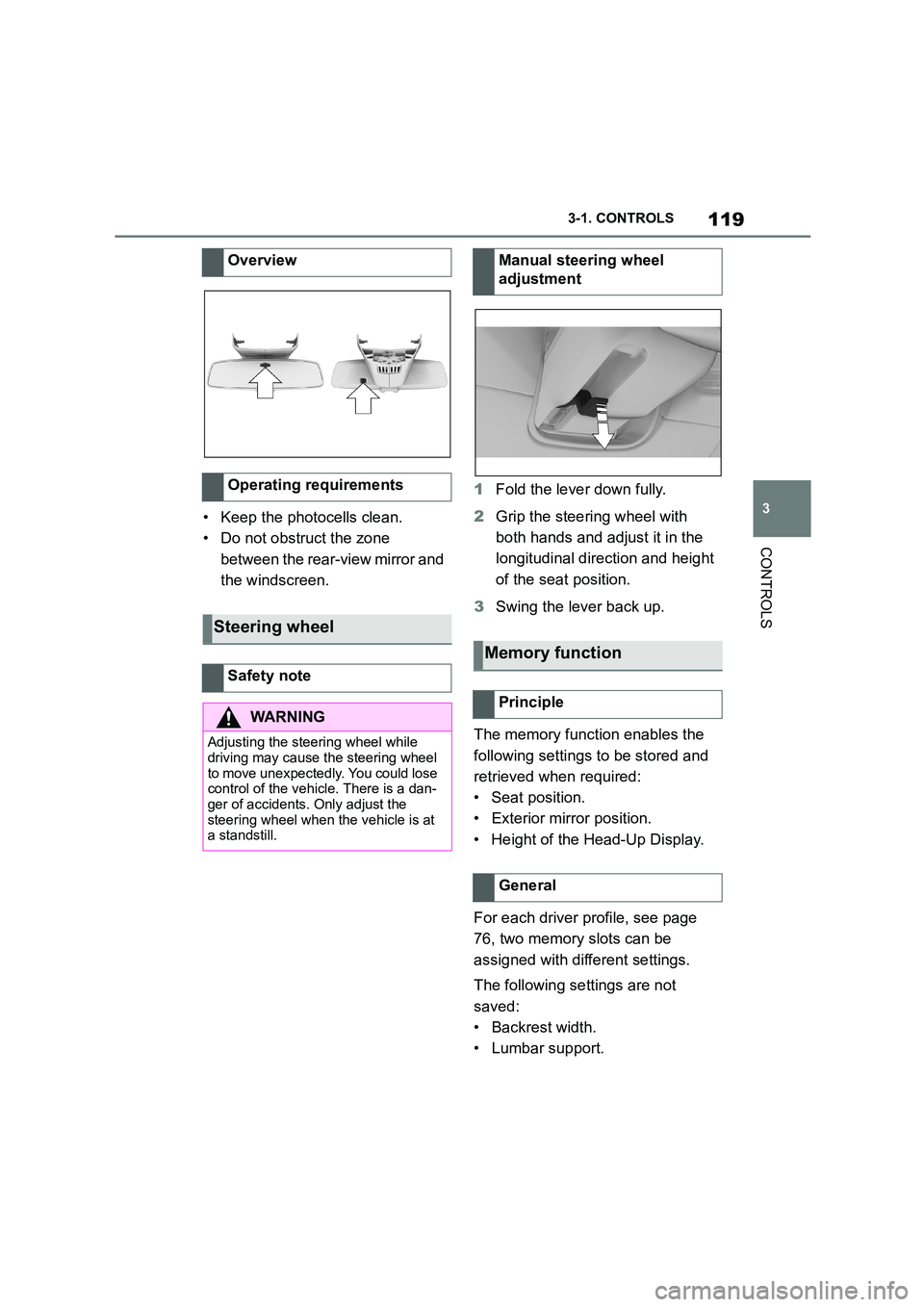
• Keep the photocells clean.
• Do not obstruct the zone
between the rear-view mirror and
the windscreen.
1 Fold the lever down fully.
2 Grip the steering wheel with
both hands and adjust it in the
longitudinal direction and height
of the seat position.
3 Swing the lever back up.
The memory function enables the
following settings to be stored and
retrieved when required:
• Seat position.
• Exterior mirror position.
• Height of the Head-Up Display.
For each driver profile, see page
76, two memory slots can be
assigned with different settings.
The following settings are not
saved:
• Backrest width.
• Lumbar support.
Overview
Operating requirements
Steering wheel
Safety note
WA R N I N G
Adjusting the steering wheel while
driving may cause the steering wheel
to move unexpectedly. You could lose control of the vehicle. There is a dan-
ger of accidents. Only adjust the
steering wheel when the vehicle is at a standstill.
Manual steering wheel
adjustment
Memory function
Principle
General
Page 124 of 498
1223-1. CONTROLS
WA R N I N G
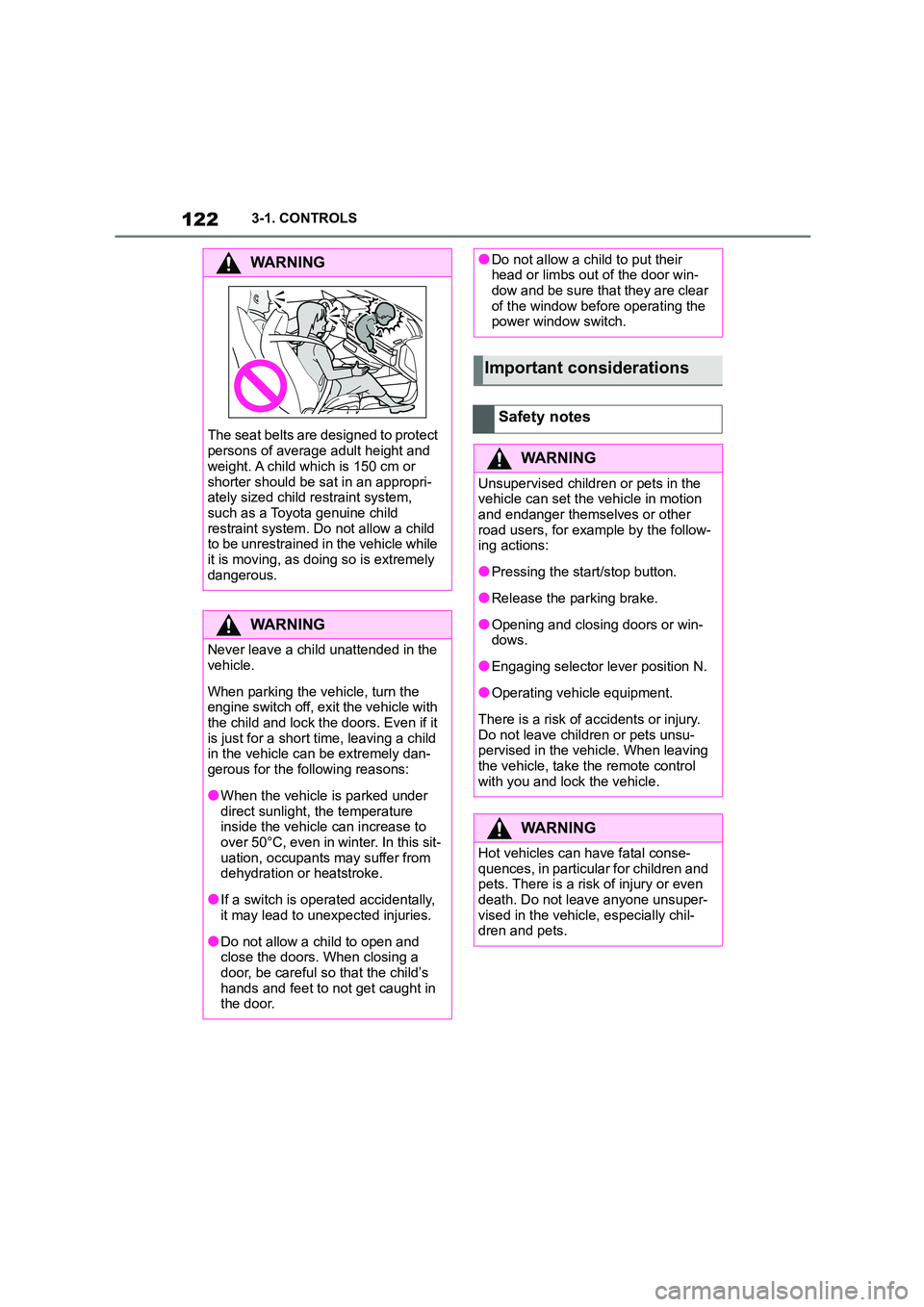
The seat belts are designed to protect
persons of average adult height and
weight. A child which is 150 cm or
shorter should be sat in an appropri- ately sized child restraint system,
such as a Toyota genuine child
restraint system. Do not allow a child to be unrestrained in the vehicle while
it is moving, as doing so is extremely
dangerous.
WA R N I N G
Never leave a child unattended in the
vehicle.
When parking the vehicle, turn the
engine switch off, exit the vehicle with
the child and lock the doors. Even if it
is just for a short time, leaving a child in the vehicle can be extremely dan-
gerous for the following reasons:
●When the vehicle is parked under
direct sunlight, the temperature
inside the vehicle can increase to over 50°C, even in winter. In this sit-
uation, occupants may suffer from
dehydration or heatstroke.
●If a switch is operated accidentally,
it may lead to unexpected injuries.
●Do not allow a child to open and
close the doors. When closing a door, be careful so that the child’s
hands and feet to not get caught in
the door.
●Do not allow a child to put their head or limbs out of the door win-
dow and be sure that they are clear
of the window before operating the power window switch.
Important considerations
Safety notes
WA R N I N G
Unsupervised children or pets in the vehicle can set the vehicle in motion
and endanger themselves or other
road users, for example by the follow- ing actions:
●Pressing the start/stop button.
●Release the parking brake.
●Opening and closing doors or win-
dows.
●Engaging selector lever position N.
●Operating vehicle equipment.
There is a risk of accidents or injury.
Do not leave children or pets unsu- pervised in the vehicle. When leaving
the vehicle, take the remote control
with you and lock the vehicle.
WA R N I N G
Hot vehicles can have fatal conse-
quences, in particular for children and
pets. There is a risk of injury or even death. Do not leave anyone unsuper-
vised in the vehicle, especially chil-
dren and pets.
Page 125 of 498
123
3
3-1. CONTROLS
CONTROLS
When using a child restraint system
on the front passenger seat, make
sure that the front and side airbags
on the passenger side are deacti-
vated. Front passenger airbags can
only be deactivated with the key
switch for front passenger airbags,
see page 202.
Appropriate child restraint systems
for every age and weight class are
available from any authorized
Toyota retailer or Toyota authorized
repairer, or any reliable repairer.
Please comply with the operating
and safety instructions provided by
the child restraint system manufac-
turer when selecting, attaching and
using child restraint systems.
WA R N I N G
Child restraint systems and their parts
can get very hot when exposed to
direct sunlight. Contact with hot parts can cause burns. There is a risk of
injury. Do not expose the child
restraint system to direct sunlight. Cover the child restraint system if
necessary. It may be necessary to
allow the child restraint system to cool
down before strapping a child in. Do not leave children unsupervised in the
vehicle.
WA R N I N G
Children under 150 cm, 5 ft tall cannot
wear the seat belt correctly without
using additional child restraint sys- tems. The protective function of the
seat belts may be limited or may even
fail completely if the seat belts are worn incorrectly. If a seat belt is not
worn correctly, additional injuries can
be caused, for example in the event of an accident or when braking or car-
rying out evasive manoeuvres. There
is a risk of injury or even death. Chil-
dren under 150 cm, 5 ft tall must be secured in suitable child restraint sys-
tems.
Not for Austra lia/New Zea-
land: Children on the front
passenger seat
General
Safety note
WA R N I N G
Active front passenger airbags can
injure a child in a child restraint sys- tem if they are deployed. There is a
risk of injury. Make sure that the front
passenger airbags are deactivated and the PASSENGER AIRBAG OFF
indicator lamp is illuminated.
WA R N I N G
Children less than 150 cm, 5 ft in height cannot wear the seat belt cor-
rectly without using additional child
restraint systems. The protective function of the seat belts may be lim-
ited or may even fail completely if the
seat belts are worn incorrectly. If a seat belt is not worn correctly, addi-
tional injuries can be caused, for
example in the event of an accident or braking and evasive manoeuvres.
There is a danger of injury or even
death. Children smaller than 150 cm,
5 ft in height must be secured in suita- ble child restraint systems.
Fitting child restraints
General
Page 126 of 498
1243-1. CONTROLS
Please note the following warning
because your vehicle has been
equipped with a front airbag for the
front passenger’s seat that cannot
be deactivated:
Before fitting a child restraint on the
front passenger seat, make sure
that the front and side airbags on
the passenger side are disabled. If
the airbag cannot be deactivated,
do not fit child restraint systems.
Deactivating the front passenger
airbags with key switch, see page
202.
Safety notes
WA R N I N G
If child restraint systems and their
attachment system s have been dam- aged or subjected to stresses in an
accident, their protective function may
be limited or may fail completely. A child might not be adequately
restrained, for example in the event of
an accident, braking or evasive
manoeuvres. There is a risk of injury or even death. Child restraint systems
that are damaged or have been sub-
jected to stresses in an accident must not be used further. If attachment sys-
tems have been damaged or sub-
jected to stresses in an accident, have them checked and replaced by
any authorized Toyota retailer or
Toyota authorized repairer, or any reli- able repairer and renewed if neces-
sary.
WA R N I N G
If the seat is not adjusted properly or the child seat has been installed
incorrectly, the chil d restraint system
may have limited stability or may not be stable at all. There is a risk of
injury or even death. Make sure that
the child restraint system rests firmly against the backrest. Wherever possi-
ble, adapt the backrest angle of all the
relevant seat backrests and adjust the seats correctly. Make sure that the
seats and their backrests are correctly
engaged or locked. If possible, adjust the height of the head restraints, or
remove them.
For Australia: In stallation of
child restraints
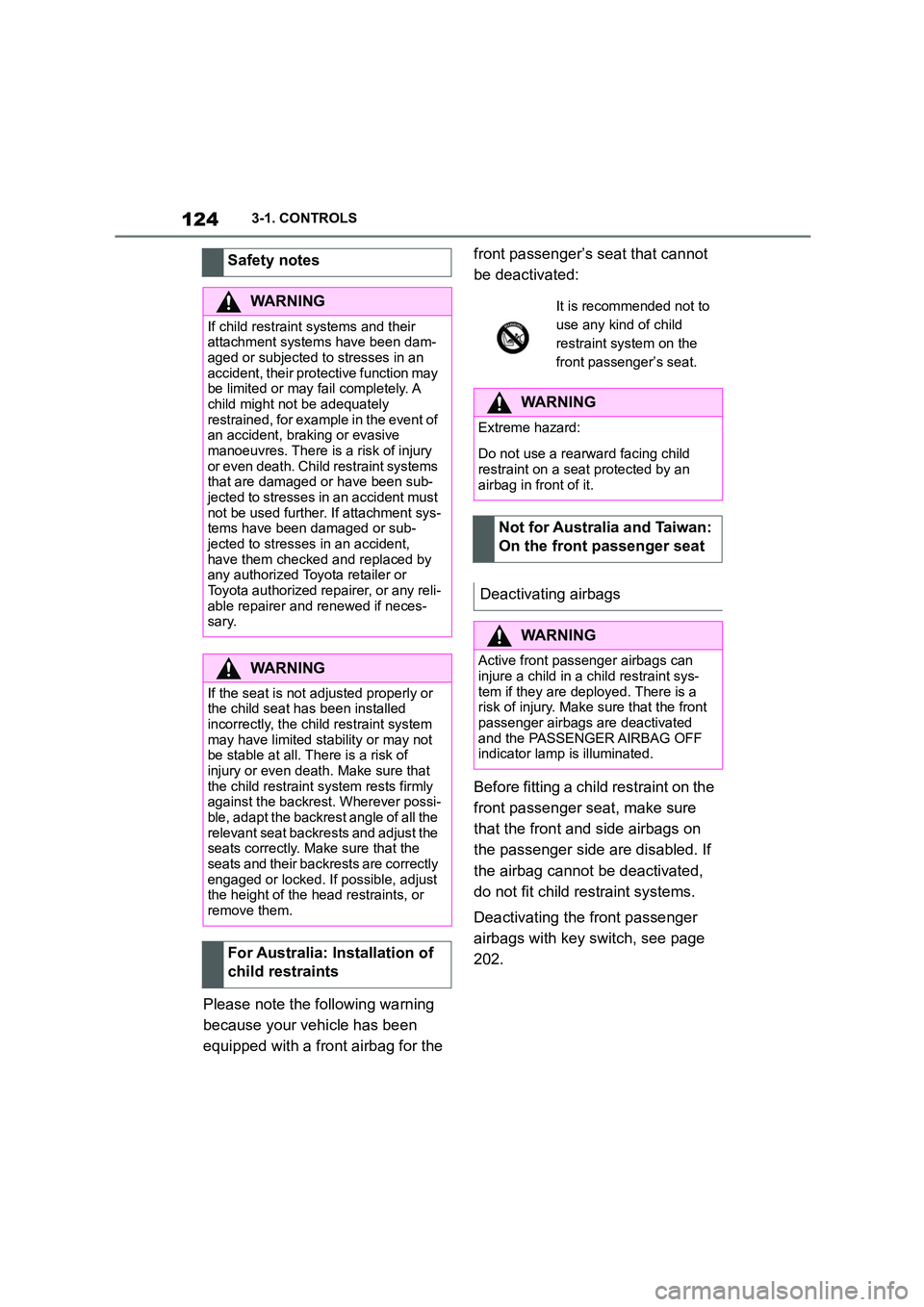
It is recommended not to
use any kind of child
restraint system on the
front passenger’s seat.
WA R N I N G
Extreme hazard:
Do not use a rearward facing child
restraint on a seat protected by an airbag in front of it.
Not for Australia and Taiwan:
On the front passenger seat
Deactivating airbags
WA R N I N G
Active front passenger airbags can
injure a child in a child restraint sys-
tem if they are deployed. There is a
risk of injury. Make sure that the front passenger airbags are deactivated
and the PASSENGER AIRBAG OFF
indicator lamp is illuminated.
Page 127 of 498
125
3
3-1. CONTROLS
CONTROLS
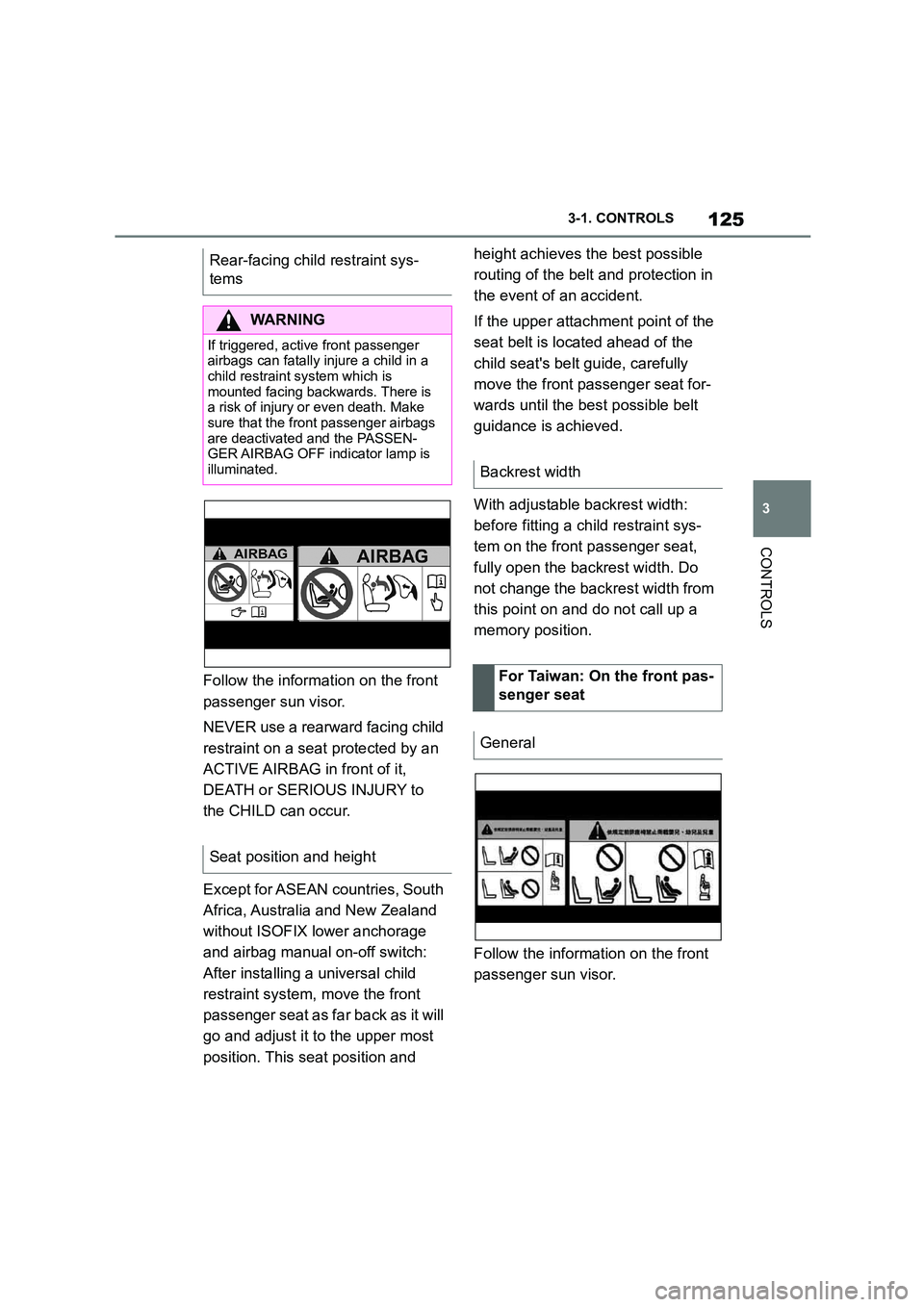
Follow the information on the front
passenger sun visor.
NEVER use a rearwa rd facing child
restraint on a seat protected by an
ACTIVE AIRBAG in front of it,
DEATH or SERIOUS INJURY to
the CHILD can occur.
Except for ASEAN countries, South
Africa, Australia and New Zealand
without ISOFIX lower anchorage
and airbag manual on-off switch:
After installing a universal child
restraint system, move the front
passenger seat as fa r back as it will
go and adjust it to the upper most
position. This seat position and
height achieves the best possible
routing of the belt and protection in
the event of an accident.
If the upper attachment point of the
seat belt is located ahead of the
child seat's belt guide, carefully
move the front passenger seat for-
wards until the best possible belt
guidance is achieved.
With adjustable backrest width:
before fitting a child restraint sys-
tem on the front passenger seat,
fully open the backrest width. Do
not change the backrest width from
this point on and do not call up a
memory position.
Follow the informat ion on the front
passenger sun visor.
Rear-facing child restraint sys-
tems
WA R N I N G
If triggered, active front passenger
airbags can fatally injure a child in a child restraint system which is
mounted facing backwards. There is
a risk of injury or even death. Make
sure that the front passenger airbags are deactivated and the PASSEN-
GER AIRBAG OFF indicator lamp is
illuminated.
Seat position and height
Backrest width
For Taiwan: On the front pas-
senger seat
General
Page 128 of 498
1263-1. CONTROLS
Before fitting a child restraint on the
front passenger seat, make sure
that the front and side airbags on
the passenger side are disabled.
Deactivating the front passenger
airbags with key switch, see page
202.
After installing a universal child
restraint system, move the front
passenger seat as far back as it will
go and adjust to a mid-height posi-
tion. This seat position and height
achieves the best possible routing
of the belt and protection in the
event of an accident.
If the upper attachment point of the
seat belt is located ahead of the
child seat's belt guide, carefully
move the front passenger seat for-
wards until the best possible belt
guidance is achieved.
With adjustable backrest width:
before fitting a child restraint sys-
tem on the front passenger seat,
fully open the backrest width. Do
not change the backrest width from
this point on and do not call up a
memory position.
Note for Australia: ISOFIX child
seats are not permitted for road use
in Australia at the time of printing.
However, also since a change of
the respective regulations is also
expected in the future, lower
ISOFIX anchorages are supplied in
line with applicable ADRs also for
WA R N I N G
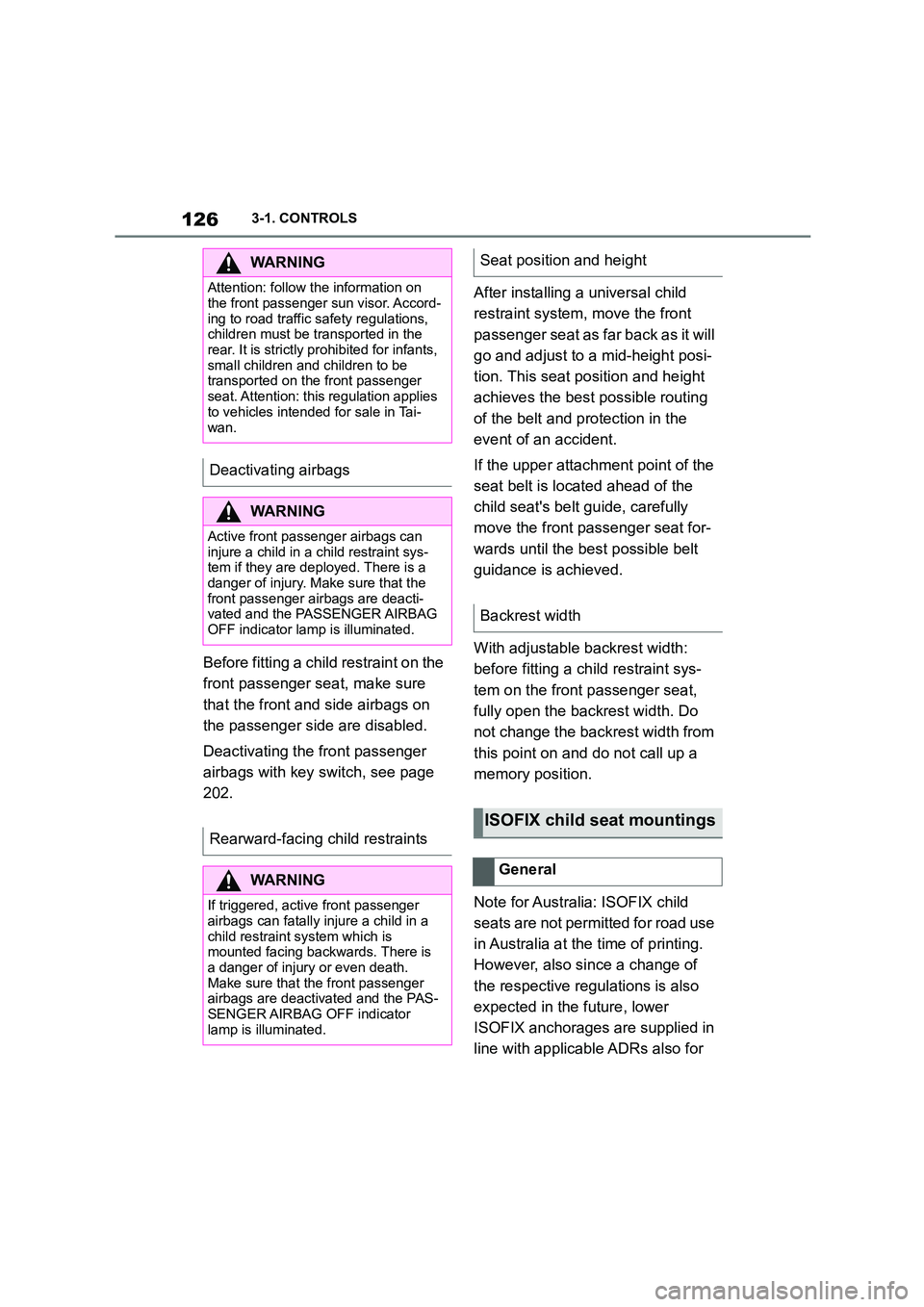
Attention: follow the information on
the front passenger sun visor. Accord-
ing to road traffic safety regulations, children must be transported in the
rear. It is strictly prohibited for infants,
small children and children to be transported on the front passenger
seat. Attention: this regulation applies
to vehicles intended for sale in Tai-
wan.
Deactivating airbags
WA R N I N G
Active front passenger airbags can
injure a child in a child restraint sys- tem if they are deployed. There is a
danger of injury. Make sure that the
front passenger airbags are deacti- vated and the PASSENGER AIRBAG
OFF indicator lamp is illuminated.
Rearward-facing child restraints
WA R N I N G
If triggered, active front passenger
airbags can fatally injure a child in a
child restraint system which is
mounted facing backwards. There is a danger of injury or even death.
Make sure that the front passenger
airbags are deactivated and the PAS- SENGER AIRBAG OFF indicator
lamp is illuminated.
Seat position and height
Backrest width
ISOFIX child seat mountings
General
Page 132 of 498
1303-1. CONTROLS
any reliable repairer.
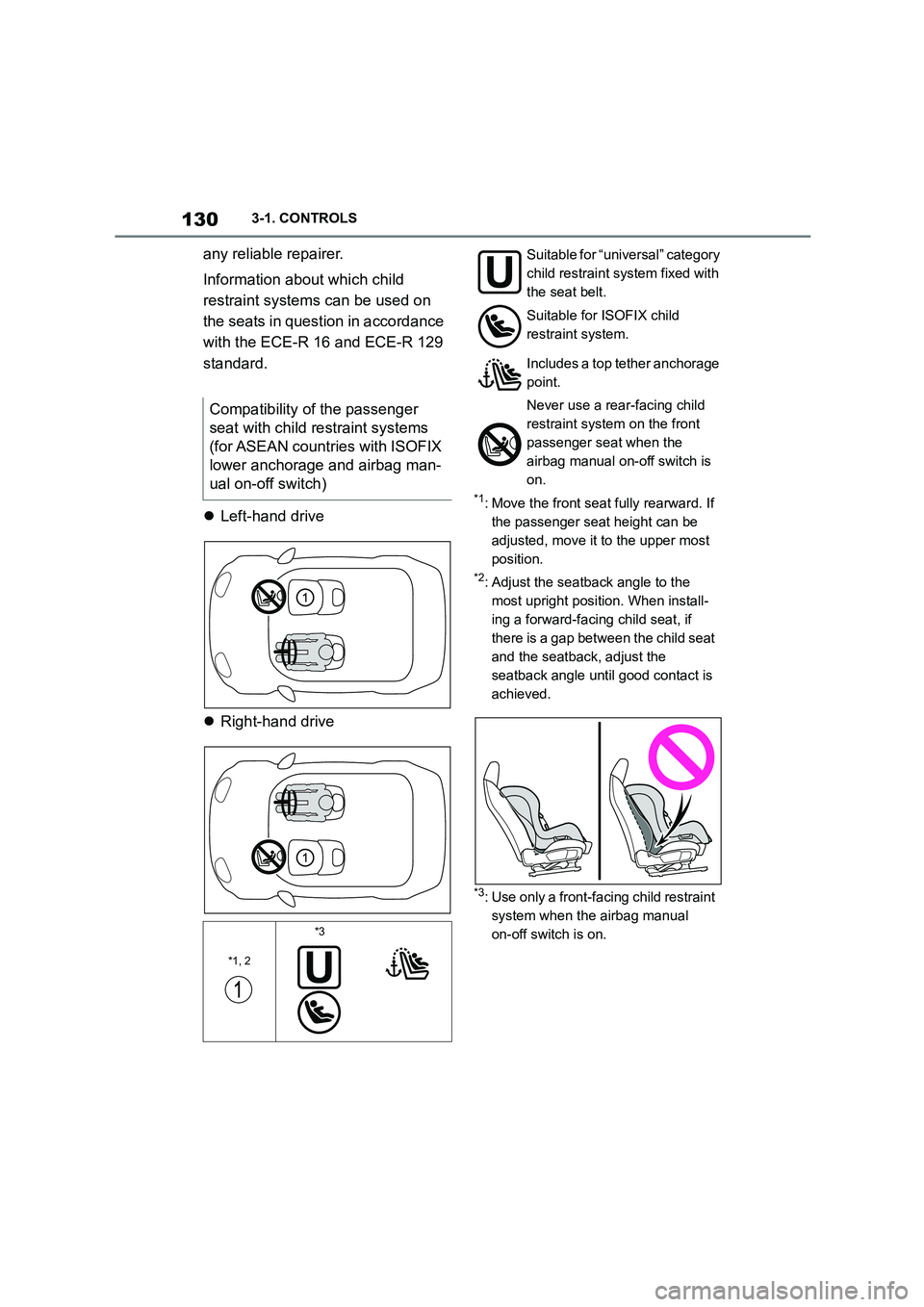
Information about which child
restraint systems can be used on
the seats in question in accordance
with the ECE-R 16 and ECE-R 129
standard.
Left-hand drive
Right-hand drive
*1: Move the front seat fully rearward. If
the passenger seat height can be
adjusted, move it to the upper most
position.
*2: Adjust the seatback angle to the
most upright position. When install-
ing a forward-facing child seat, if
there is a gap between the child seat
and the seatback, adjust the
seatback angle until good contact is
achieved.
*3: Use only a front-fa cing child restraint
system when the airbag manual
on-off switch is on.
Compatibility of the passenger
seat with child restraint systems
(for ASEAN countries with ISOFIX
lower anchorage and airbag man-
ual on-off switch)
*1, 2
*3
Suitable for “universal” category
child restraint system fixed with
the seat belt.
Suitable for ISOFIX child
restraint system.
Includes a top tether anchorage
point.
Never use a rear-facing child
restraint system on the front
passenger seat when the
airbag manual on-off switch is
on.
Page 133 of 498
131
3
3-1. CONTROLS
CONTROLS
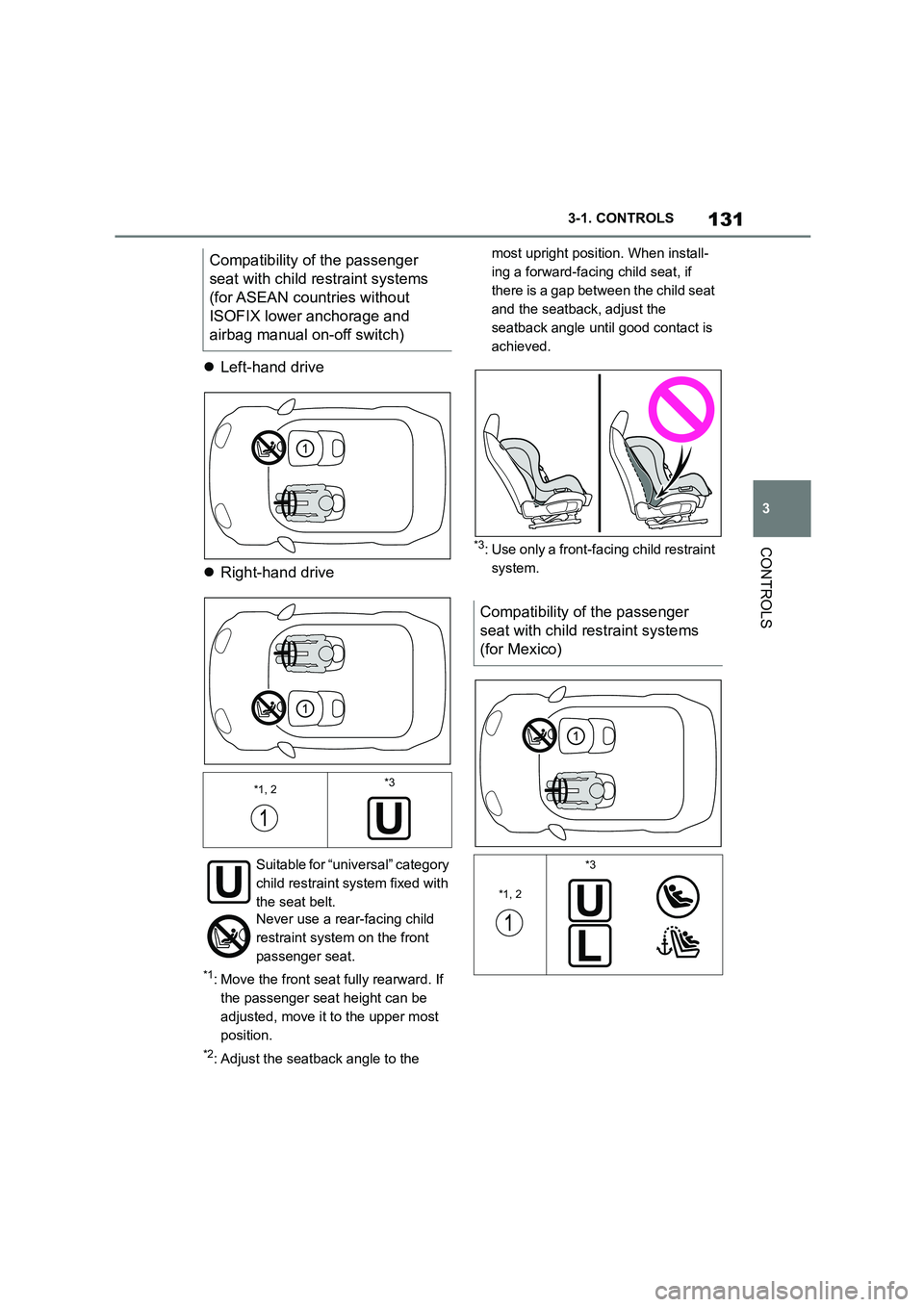
Left-hand drive
Right-hand drive
*1: Move the front seat fully rearward. If
the passenger seat height can be
adjusted, move it to the upper most
position.
*2: Adjust the seatback angle to the
most upright position. When install-
ing a forward-facing child seat, if
there is a gap between the child seat
and the seatback, adjust the
seatback angle until good contact is
achieved.
*3: Use only a front-fa cing child restraint
system.
Compatibility of the passenger
seat with child restraint systems
(for ASEAN countries without
ISOFIX lower anchorage and
airbag manual on-off switch)
*1, 2*3
Suitable for “universal” category
child restraint syst em fixed with
the seat belt.
Never use a rear-facing child
restraint system on the front
passenger seat.
Compatibility of the passenger
seat with child restraint systems
(for Mexico)
*1, 2
*3