2022 TOYOTA SUPRA light
[x] Cancel search: lightPage 353 of 498
351
5
5-1. MOBILITY
MOBILITY
WA R N I N G
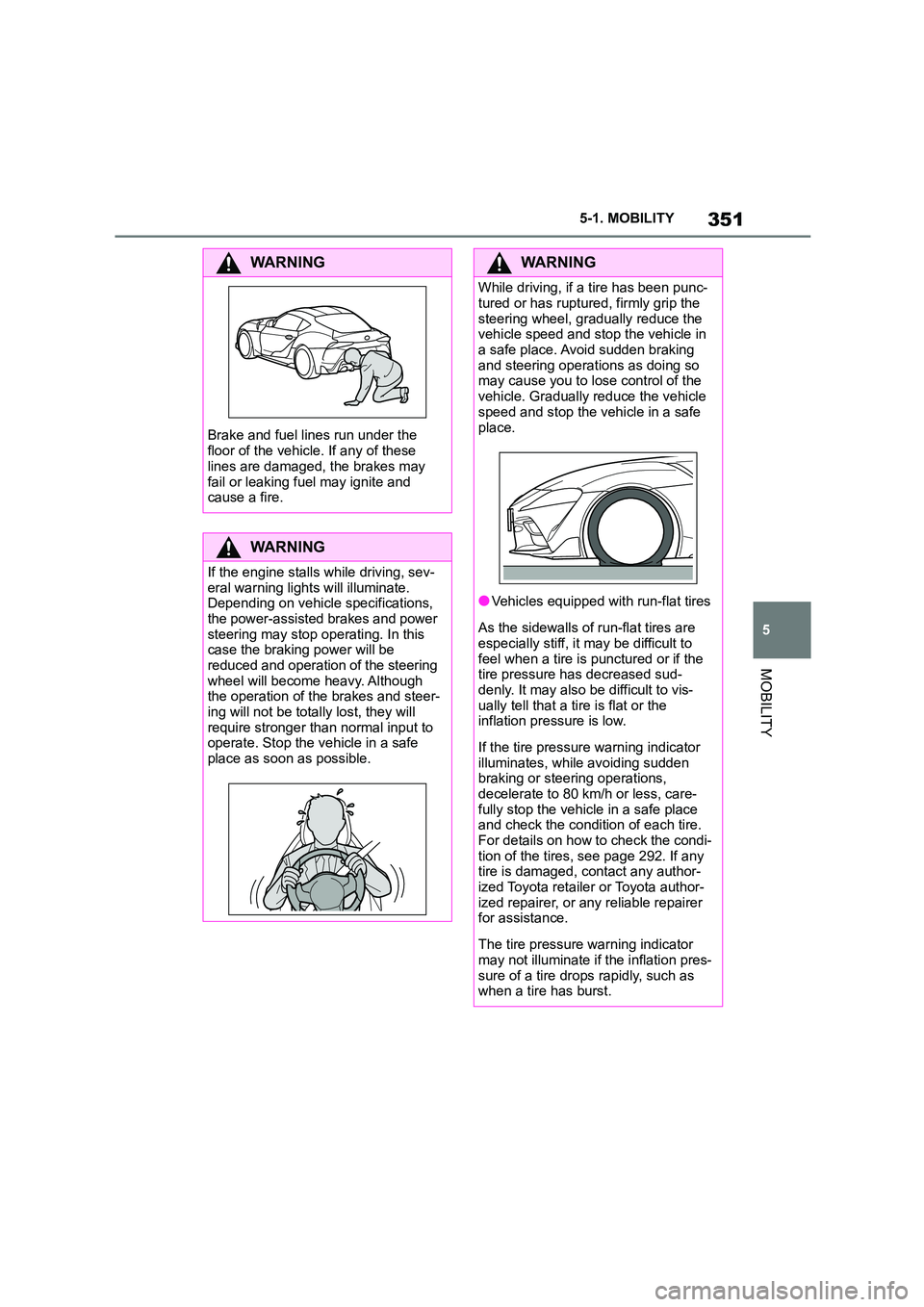
Brake and fuel lines run under the
floor of the vehicle. If any of these
lines are damaged, the brakes may
fail or leaking fuel may ignite and cause a fire.
WA R N I N G
If the engine stalls while driving, sev-
eral warning lights will illuminate. Depending on vehicle specifications,
the power-assisted brakes and power
steering may stop operating. In this case the braking power will be
reduced and operation of the steering
wheel will become heavy. Although the operation of the brakes and steer-
ing will not be totally lost, they will
require stronger than normal input to
operate. Stop the vehicle in a safe place as soon as possible.
WA R N I N G
While driving, if a tire has been punc-
tured or has ruptured, firmly grip the
steering wheel, gradually reduce the vehicle speed and stop the vehicle in
a safe place. Avoid sudden braking
and steering operations as doing so may cause you to lo se control of the
vehicle. Gradually reduce the vehicle
speed and stop the vehicle in a safe
place.
●Vehicles equipped with run-flat tires
As the sidewalls of run-flat tires are
especially stiff, it may be difficult to
feel when a tire is punctured or if the tire pressure has decreased sud-
denly. It may also be difficult to vis-
ually tell that a tire is flat or the inflation pressure is low.
If the tire pressure warning indicator illuminates, while avoiding sudden
braking or steering operations,
decelerate to 80 km /h or less, care- fully stop the vehicle in a safe place
and check the condition of each tire.
For details on how to check the condi- tion of the tires, see page 292. If any
tire is damaged, contact any author-
ized Toyota retailer or Toyota author- ized repairer, or any reliable repairer
for assistance.
The tire pressure warning indicator
may not illuminate if the inflation pres-
sure of a tire drops rapidly, such as when a tire has burst.
Page 354 of 498
3525-1. MOBILITY
If you have been involved in a colli-
sion, perform the following:
1 Immediately leave the vehicle
and move to a safe place in
order to avoid secondary colli-
sions. Make sure to turn the
engine switch off to help prevent
the vehicle from catching fire. If
the airbags have deployed
(inflated), the airbag related
parts will be extremely hot.
Avoid touching the parts with
your hands or any part of your
body.
2 If someone has been injured,
contact emergency services and
request assistance. If someone
has no obvious external injuries,
but they may have a head injury,
keep their airway open while
moving them as little as possi-
ble. If there is danger of the
vehicle being involved in a sec-
ondary collision, move the
injured person to a safe place
while keeping them as horizon-
tal as possible.
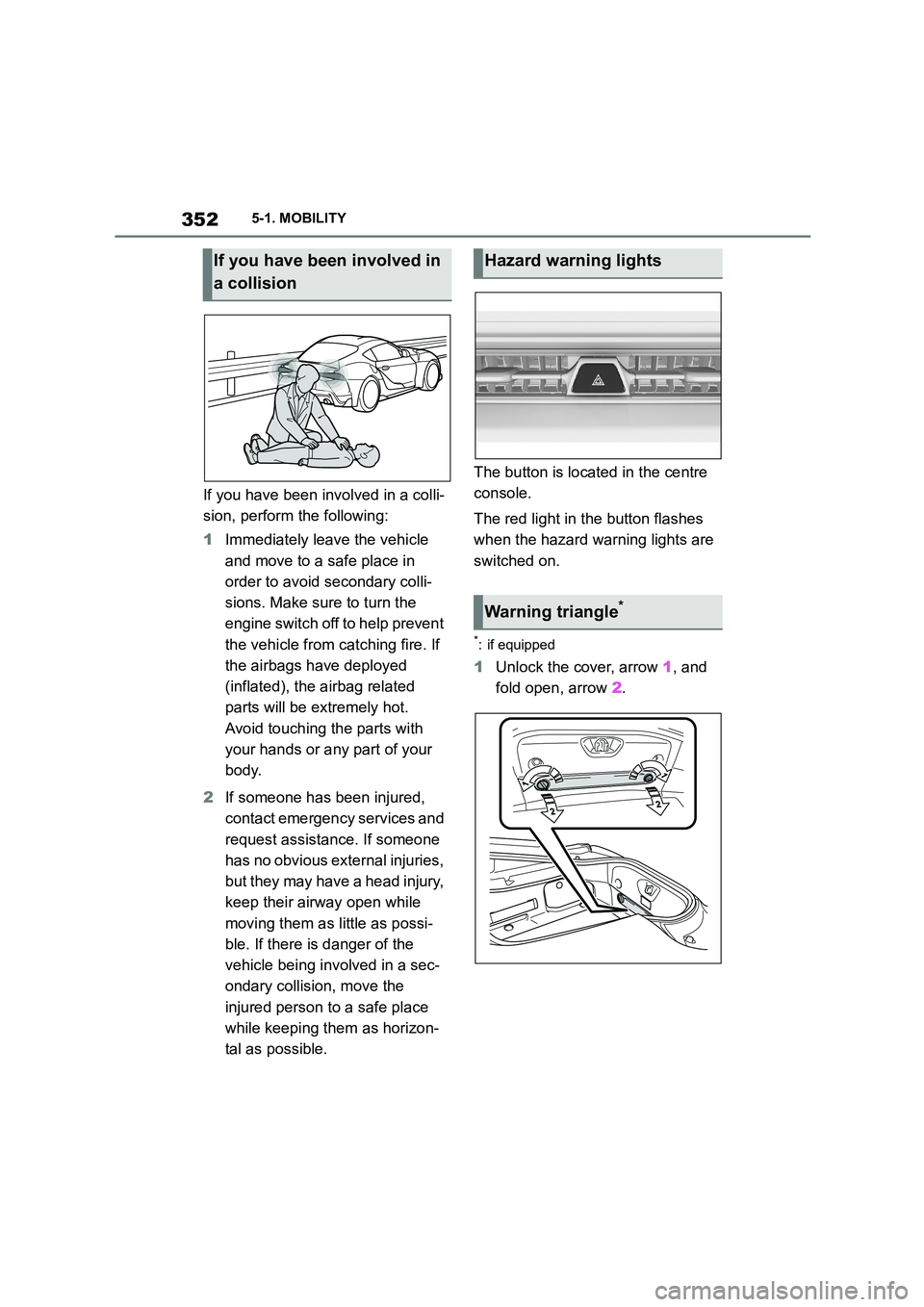
The button is located in the centre
console.
The red light in the button flashes
when the hazard warning lights are
switched on.
*: if equipped
1 Unlock the cover, arrow 1, and
fold open, arrow 2.
If you have been involved in
a collision
Hazard warning lights
Warning triangle*
Page 360 of 498
3585-1. MOBILITY
3Switch off any power consumers
in both vehicles.
The jump-starting connection in the
engine compartment serves as the
battery positive terminal.
A special connection on the body
serves as the negative battery ter-
minal in the engine compartment.
For further information:
Overview of the engine compart-
ment, see page 320.
Open the lid of the positive battery
terminal.
Before starting, switch off all unnec-
essary power consumers, for
example the radio, on both vehi-
cles.
1 Open the cover of the
jump-starting connection.
2 Connect a terminal clamp on the
positive/+ jump lead to the posi-
tive terminal of the battery or the
corresponding jump-starting
connection on the donor vehicle.
3 Connect the second terminal
clamp to the battery's positive
terminal or to the corresponding
jump-starting connection on the
vehicle to be started.
4 Connect a terminal clamp on the
negative/– jump lead to the neg-
ative terminal of the battery or
the corresponding engine or
body earth connection on the
donor vehicle.
5 Connect the second terminal
clamp to the negative terminal of
the battery or to a corresponding
engine or body earth connection
on the vehicle to be started.
Do not use spray products sold as
starting aids.
1 Start the engine of the donor
vehicle and allow it to run for a
few minutes at a slightly
increased idle speed.
2 Start the engine of the vehicle to
be started as normal.
If an initial attempt to start the engine
fails, wait several minutes until the dis-
charged battery has been recharged somewhat.
3 Allow both engines to run for a
few minutes.
4 Disconnect the jump leads in
reverse order to connection.
Check the battery and have it
recharged if necessary.
Jump-starting connections
Connecting the cables
Starting the engine
Page 361 of 498
359
5
5-1. MOBILITY
MOBILITY
Do not have the vehicle towed.
To remove a broken-down vehicle
from a dangerous area, it can be
pushed for a short distance.
To roll or push the vehicle, see
page 156.
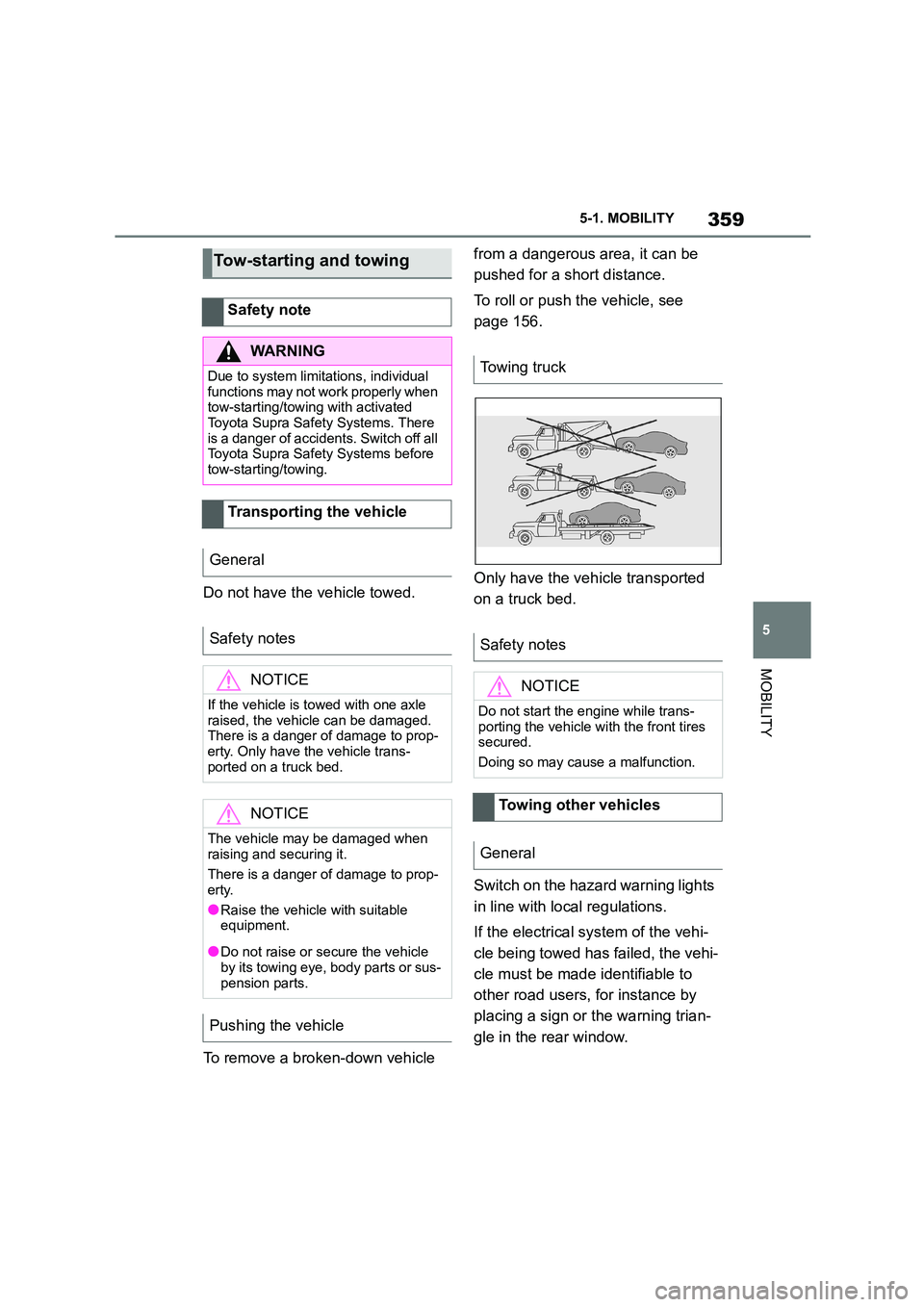
Only have the vehicle transported
on a truck bed.
Switch on the hazard warning lights
in line with local regulations.
If the electrical system of the vehi-
cle being towed has failed, the vehi-
cle must be made identifiable to
other road users, for instance by
placing a sign or the warning trian-
gle in the rear window.
Tow-starting and towing
Safety note
WA R N I N G
Due to system limitations, individual
functions may not work properly when
tow-starting/towing with activated
Toyota Supra Safety Systems. There is a danger of accidents. Switch off all
Toyota Supra Safety Systems before
tow-starting/towing.
Transporting the vehicle
General
Safety notes
NOTICE
If the vehicle is towed with one axle raised, the vehicle can be damaged.
There is a danger of damage to prop-
erty. Only have the vehicle trans- ported on a truck bed.
NOTICE
The vehicle may be damaged when raising and securing it.
There is a danger of damage to prop-
erty.
●Raise the vehicle with suitable
equipment.
●Do not raise or secure the vehicle by its towing eye, body parts or sus-
pension parts.
Pushing the vehicle
Towing truck
Safety notes
NOTICE
Do not start the engine while trans-
porting the vehicle with the front tires secured.
Doing so may cause a malfunction.
Towing other vehicles
General
Page 365 of 498

363
5
5-1. MOBILITY
MOBILITY
■Safety note
■General
In a car wash, the vehicle must be
able to roll freely.
To roll or push the vehicle, see
page 156.
Some car washes require you to
get out of the vehicle. It is not possi-
ble to lock the vehicle from the out-
side in selector lever position N. If
an attempt is made to lock the vehi-
cle, a signal sounds.
Ensure that the remote control is
located in the vehicle.
Switch on drive-ready state, see
page 55.
Do not rub wet headlights dry and
do not use abrasive or corrosive
cleaning agents.
Soak impurities such as insect resi-
dues with shampoo and wash off
with water.
Remove ice with a de-icer spray; do
not use an ice scraper.
After the vehicle has been washed,
briefly apply the brakes to dry them
otherwise braking effectiveness
may be temporarily reduced. The
heat generated by braking dries the
brake discs and br ake pads and
Automatic car washes
Safety notes
NOTICE
If high-pressure washers are used, water may penetrate the area around
the windows. There is a danger of
damage to property. Avoid high pres-
sure washers.
NOTICE
The vehicle can be damaged if auto-
matic washing bays or car washes are used incorrectly. There is a dan-
ger of damage to property. Observe
the following notes:
●Textile car washes or systems
using soft brushes are preferable,
to avoid damage to the paintwork.
●Avoid washing bays or car washes
with guide rails higher than 10 cm,
4 in, to avoid damage to the body.
●Note the maximum tyre width of the
guide rail to avoid damage to tyres and rims.
●Fold in the exterior mirrors to avoid damaging them.
●Deactivate the wipers and the rain sensor (if fitted) to avoid damage to
the wiper system.
Entering a car wash
NOTICE
Selector lever position P is automati-
cally engaged when standby state is
switched off. There is a danger of damage to property. Do not switch off
standby state in car washes.
Exiting from a car wash
Headlights
After washing the vehicle
Page 367 of 498
365
5
5-1. MOBILITY
MOBILITY
Remove dust from the leather at
regular intervals with a cloth or vac-
uum cleaner.
Dust and road dirt will otherwise
become worked into pores and
folds, resulting in considerable
abrasion and causing the leather
surface to become prematurely brit-
tle.
In order to protect against discol-
ouration, for example from clothing,
clean and care for the leather
approximately every two months.
Clean light-coloured leather more
frequently as it has the tendency to
soil faster.
Use leather cleaner, otherwise dirt
and grease will atta ck the protec-
tive coating of the leather.
Clean the synthetic leather regu-
larly with a damp microfibre cloth or
vacuum cleaner.
Dust and road dirt will otherwise
become worked into pores and
folds, resulting in considerable
abrasion and causing the surface to
become prematurely brittle.
In case of major contaminations,
use a moist soft sponge or microfi-
bre cloth with a suitable interior
cleaners.
Remove aggressive substances,
for example sunscreen, immedi-
NOTICE
■To prevent paint deterioration
and corrosion on the body and
components (aluminum wheels etc.)
Observe the following precautions:
●Wash the vehicle immediately in the
following cases:
• After driving near the sea coast
• After driving on salted roads
• If coal tar or tree sap is present on the paint surface
• If dead insects, insect droppings or bird droppings are present on the
paint surface
• After driving in an area contami-
nated with soot, oily smoke, mine
dust, iron powder or chemical sub- stances
• If the vehicle becomes heavily soiled with dust or mud
• If liquids such as benzene and gas- oline are spilled on the paint sur-
face
●If the paint is chipped or scratched,
have it repaired immediately.
●To prevent the wheels from corrod-
ing, remove any dirt and store in a
place with low humidity when stor- ing the wheels.
For the matte paintwork, pay attention to the following as well:
●If anything is spilled on a painted surface, wipe it off as soon as pos-
sible. If spilled washer fluid or alka-
line fluids are left as is, the paint in the affected area may deteriorate,
causing blemishing.
●Do not wax or apply coating to the
vehicle. Doing so may cause a
change in the body surface's tex- ture or irregularities in the paint.
Leather care
Synthetic leather care
Page 368 of 498
3665-1. MOBILITY
ately to prevent the synthetic
leather from being altered or dis-
coloured.
Regularly clean the upholstery with
a vacuum cleaner.
In the event of heavy soiling, for
example stains caused by drinks,
use a soft sponge or a lint-free
microfibre cloth with suitable inte-
rior cleaning agents.
Clean the upholstery up to the
seams using wide wiping actions.
Avoid rubbing vigorously.
When cleaning the wheels while
they are installed on the vehicle,
only use neutral rim cleaner with a
pH value of between 5 and 9. Do
not use abrasive cleaners or steam
cleaners above 60 °C/140 °F.
Observe the manufacturer's
instructions.
Corrosive, acidic or alkaline
cleaners may destroy the protective
layer of adjacent parts, for example
brake discs.
After cleaning, briefly apply the
brakes to dry them. The heat gen-
erated by braking dries the brake
discs and brake pads and protects
them against corrosion.
Carefully clean parts such as the
radiator grille and door handles with
plenty of water to which a shampoo
may be added, particularly if
exposed to road salt.
The surfaces of rubber parts can be
contaminated or lose their shine
due to environmental influences.
Only use water and suitable care
products for cleaning.
Rubber parts subjected to high
wear and tear should be treated
regularly with rubber care products.
Do not use silicone-based care
products for treating rubber seals,
otherwise these could be damaged
and become a source of noise.
The wiper blades are cleaned by
using the window washer system.
Avoid additional manual cleaning of
Care of upholstery fabrics
General
Safety note
NOTICE
Open hook-and-loop fasteners on articles of clothing can damage the
seat covers. There is a danger of
damage to property. Make sure that any hook-and-loop fasteners on your
clothing are closed.
Care of special parts
Light alloy wheels
Chrome-like surfaces
Rubber parts
Wiper blades
Page 369 of 498

367
5
5-1. MOBILITY
MOBILITY
the wiper blades to prevent a
reduction in wipe quality.
Clean with a microfibre cloth.
Lightly moisten the cloth with water,
if necessary.
Do not soak the roof lining.
Dirt on the belt straps can interfere
with the action of the reel and is a
safety hazard.
Only clean the belt straps with a
mild soap solution while still fitted to
the vehicle.
Do not allow seat belts to retract
unless they are dry.
Floor mats can be removed from
the vehicle to enable the interior to
be cleaned more thoroughly.
In the event of he avy soiling, clean
floor carpets using a microfibre
cloth and water or textile cleaner.
Rub back and forth in the direction
of travel to prevent matting.
Clean sensors or camera lenses
using a cloth moistened with a
small amount of glass cleaner.
Plastic parts
NOTICE
Cleaning agents containing alcohol or
solvents, such as ni tro thinners, cold
cleaners, fuel or similar can damage plastic parts. There is a danger of
damage to property. Clean with a
microfibre cloth. Lightly moisten the cloth with water, if necessary.
Seat belts
WA R N I N G
Chemical cleaners can cause irrepa-rable damage to the fabric of the seat
belts. The protective function of the
seat belts will be lost. There is a dan- ger of injury or even death. Only use a
mild soap and water solution for
cleaning the seat belts.
Carpets and foot mats
WA R N I N G
Objects in the driver's footwell can
restrict the pedal travel or block a pedal that has been pressed. There is
a danger of accidents. Stow items in
the vehicle so that they are secure and cannot get into the driver's
footwell. Only use floor mats that are
suitable for the vehicle and can be
securely fastened to the floor. Do not use loose floor mats, and do not place
several floor mats on top of one
another. Make sure that there is suffi- cient space for the pedals. Ensure
that floor mats are securely reat-
tached after having been removed, for example for cleaning.
Sensors/camera lenses