Page 339 of 498
337
5
5-1. MOBILITY
MOBILITY
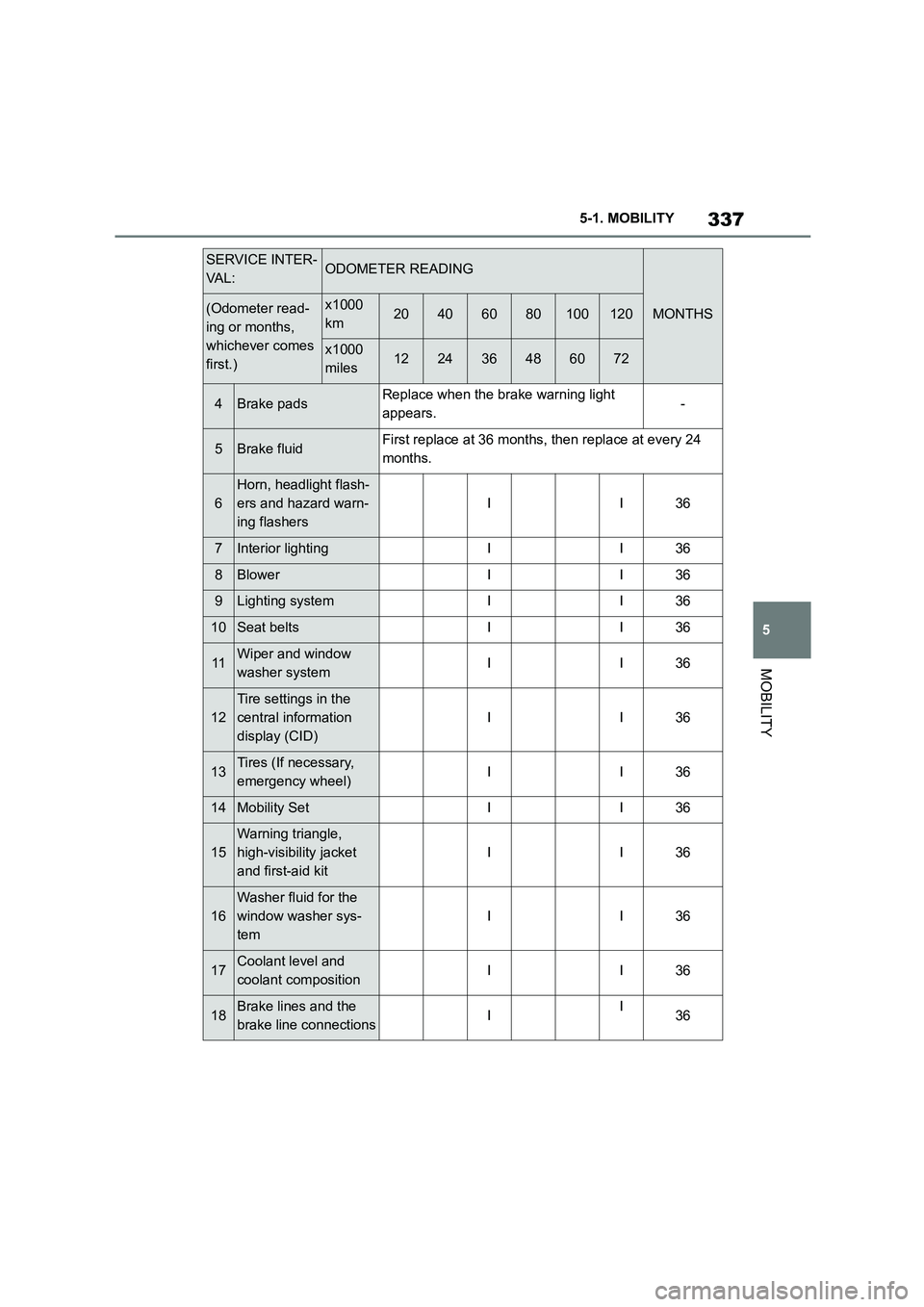
4Brake padsReplace when the brake warning light
appears.-
5Brake fluidFirst replace at 36 months, then replace at every 24
months.
6
Horn, headlight flash-
ers and hazard warn-
ing flashers
II36
7Interior lightingII36
8BlowerII36
9Lighting systemII36
10Seat beltsII36
11Wiper and window
washer systemII36
12
Tire settings in the
central information
display (CID)
II36
13Tires (If necessary,
emergency wheel)II36
14Mobility SetII36
15
Warning triangle,
high-visibility jacket
and first-aid kit
II36
16
Washer fluid for the
window washer sys-
tem
II36
17Coolant level and
coolant compositionII36
18Brake lines and the
brake line connectionsII36
SERVICE INTER-
VA L :ODOMETER READING
MONTHS(Odometer read-
ing or months,
whichever comes
first.)
x1000
km20406080100120
x1000
miles122436486072
Page 340 of 498
3385-1. MOBILITY
NOTE:
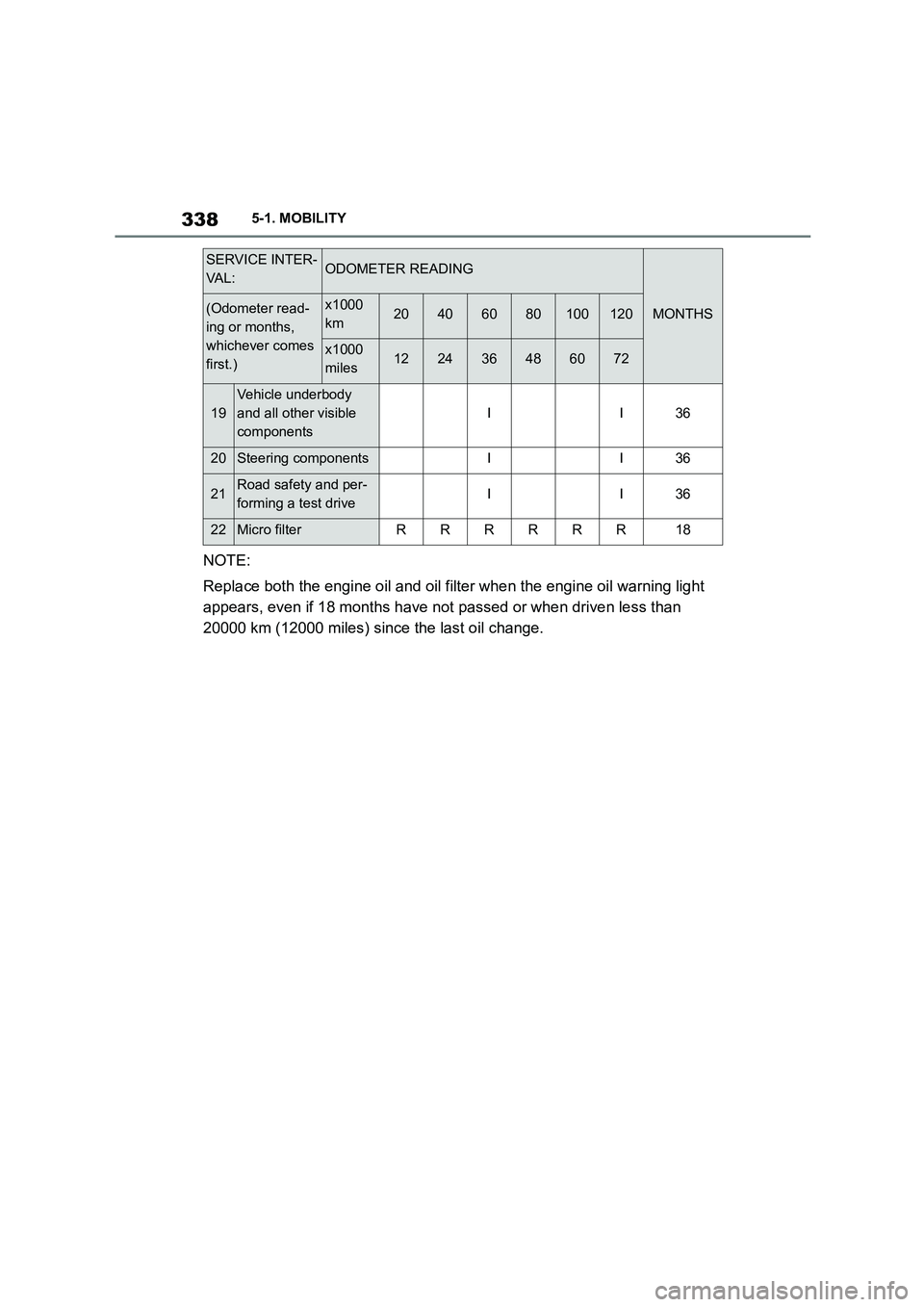
Replace both the engine oil and oil filter when the engine oil warning light
appears, even if 18 months have not passed or when driven less than
20000 km (12000 miles) since the last oil change.
19
Vehicle underbody
and all other visible
components
II36
20Steering componentsII36
21Road safety and per-
forming a test driveII36
22Micro filterRRRRRR18
SERVICE INTER-
VA L :ODOMETER READING
MONTHS(Odometer read-
ing or months,
whichever comes
first.)
x1000
km20406080100120
x1000
miles122436486072
Page 342 of 498
3405-1. MOBILITY
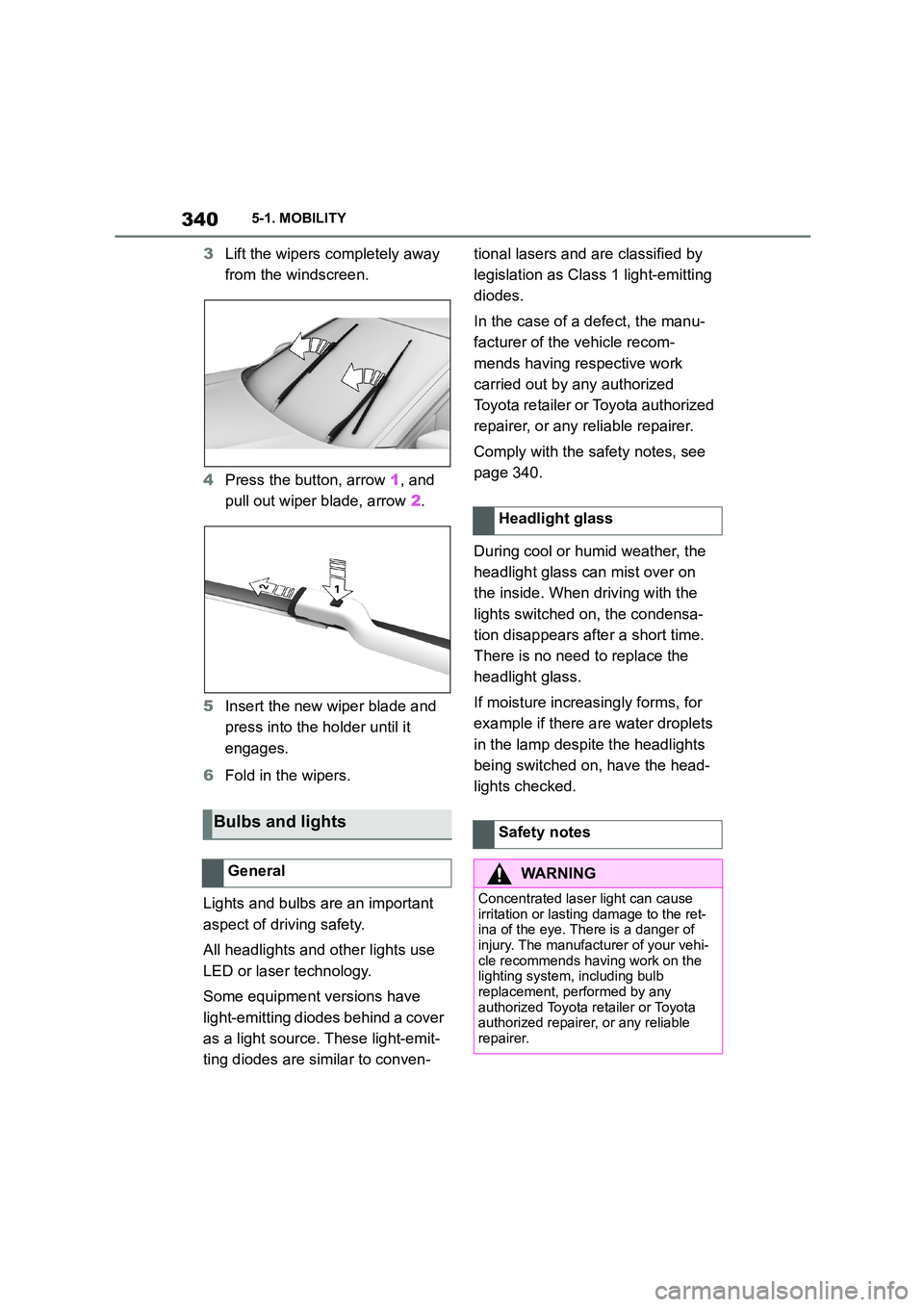
3Lift the wipers completely away
from the windscreen.
4 Press the button, arrow 1, and
pull out wiper blade, arrow 2.
5 Insert the new wiper blade and
press into the ho lder until it
engages.
6 Fold in the wipers.
Lights and bulbs are an important
aspect of driving safety.
All headlights and other lights use
LED or laser technology.
Some equipment versions have
light-emitting diodes behind a cover
as a light source. These light-emit-
ting diodes are similar to conven-
tional lasers and are classified by
legislation as Class 1 light-emitting
diodes.
In the case of a defect, the manu-
facturer of the vehicle recom-
mends having respective work
carried out by any authorized
Toyota retailer or Toyota authorized
repairer, or any reliable repairer.
Comply with the safety notes, see
page 340.
During cool or humid weather, the
headlight glass can mist over on
the inside. When driving with the
lights switched on, the condensa-
tion disappears after a short time.
There is no need to replace the
headlight glass.
If moisture increasingly forms, for
example if there are water droplets
in the lamp despite the headlights
being switched on, have the head-
lights checked.
Bulbs and lights
General
Headlight glass
Safety notes
WA R N I N G
Concentrated laser light can cause
irritation or lasting damage to the ret- ina of the eye. There is a danger of
injury. The manufacturer of your vehi-
cle recommends having work on the lighting system, including bulb
replacement, performed by any
authorized Toyota retailer or Toyota authorized repairer, or any reliable
repairer.
Page 343 of 498
341
5
5-1. MOBILITY
MOBILITY
The battery is maintenance-free.
More information regarding the bat-
tery can be obtained from any
authorized Toyota retailer or Toyota
authorized repairer, or any reliable
repairer.
The manufacturer of your vehicle
recommends having any author-
ized Toyota reta iler or Toyota
authorized repairer, or any reliable
repairer register the vehicle battery
to the vehicle after the battery has
been replaced. Once the battery
has been registered again, all com-
fort functions will be available with-
out restriction and any vehicle
messages relating to the comfort
functions will no longer be dis-
played.
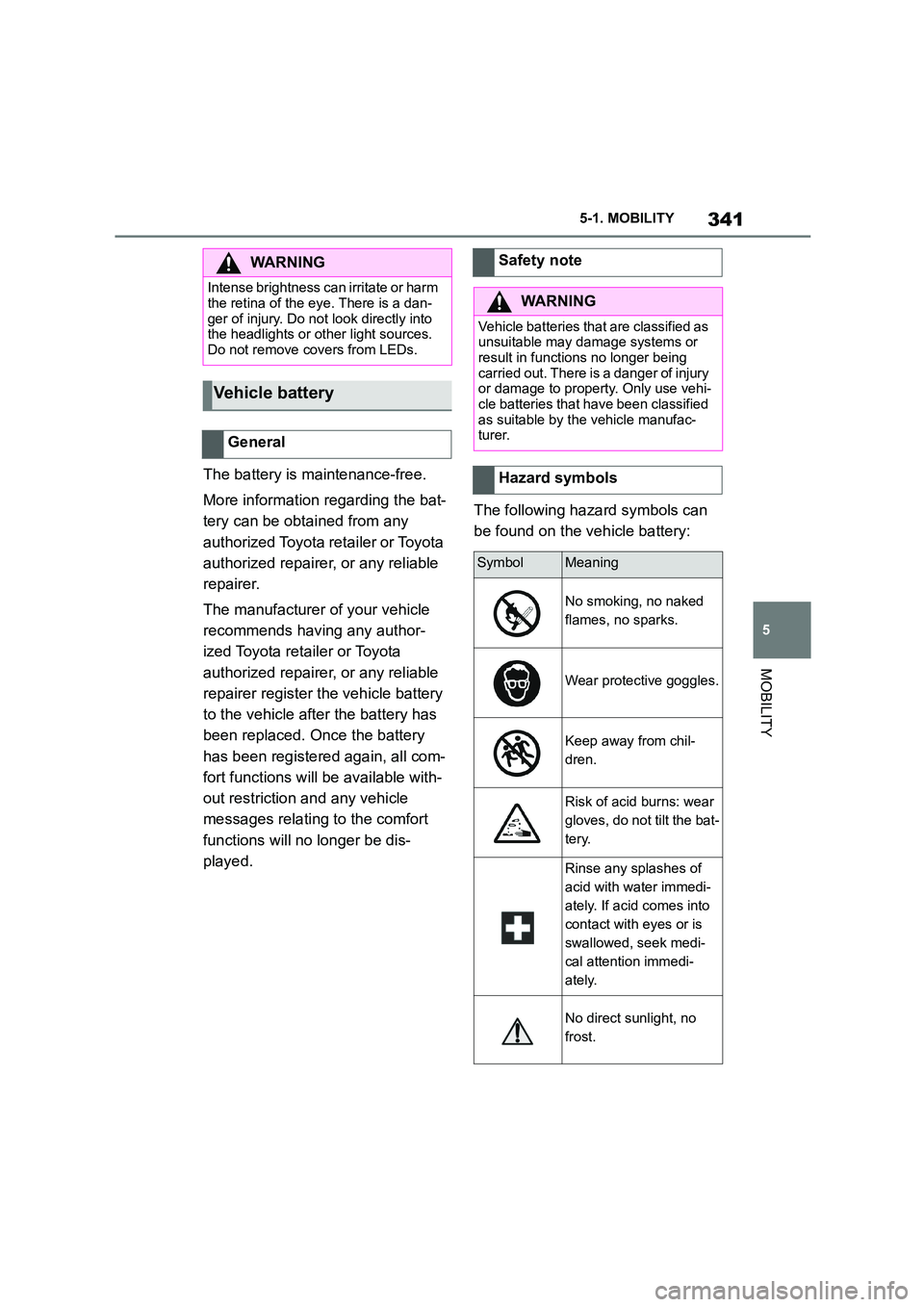
The following hazard symbols can
be found on the vehicle battery:
WA R N I N G
Intense brightness can irritate or harm
the retina of the eye. There is a dan-
ger of injury. Do not look directly into the headlights or other light sources.
Do not remove covers from LEDs.
Vehicle battery
General
Safety note
WA R N I N G
Vehicle batteries that are classified as
unsuitable may damage systems or result in functions no longer being
carried out. There is a danger of injury
or damage to property. Only use vehi- cle batteries that have been classified
as suitable by the vehicle manufac-
turer.
Hazard symbols
SymbolMeaning
No smoking, no naked
flames, no sparks.
Wear protective goggles.
Keep away from chil-
dren.
Risk of acid burns: wear
gloves, do not tilt the bat-
tery.
Rinse any splashes of
acid with water immedi-
ately. If acid comes into
contact with eyes or is
swallowed, seek medi-
cal attention immedi-
ately.
No direct sunlight, no
frost.
Page 345 of 498
343
5
5-1. MOBILITY
MOBILITY
repairer, or any reliable repairer.
Following an electrical power fail-
ure, some equipme nt will have to
be reinitialised or in dividual settings
will need to be updated, for exam-
ple:
Memory function: save positions
again.
Time: update.
Date: update.
Observe the following information
on storing vehicle batteries:
Store the battery in a cool and
dry place.
Protect the battery from direct
sunlight and frost.
Only clean the battery with a
damp, anti-static cloth.
Store the battery upright and
secure it against falling over.
Install the oldest batteries first.
Do not remove the protective cap
from the contacts.
Charge or install the battery by
the date on the battery label at
the latest. Once fully charged,
the battery will wo rk for another
10 months.
Batteries filled with acid should be
transported upright. Protect batter-
ies against falling over when in
transit.
The fuses are located at different
positions in the vehicle.
Fuses are located behind a cover in
the driver's side or front passen-
ger's side footwell.
Power failure
Storing the battery
Disposing of the old battery
Dispose of old batteries at
any authorized Toyota
retailer or Toyota author-
ized repairer, or any relia-
ble repairer or hand them
in to an authorised collect-
ing point.
Fuses
General
Safety note
WA R N I N G
Incorrect or repaired fuses can over-
load electrical cables and compo- nents. There is a risk of fire. Do not
repair blown fuses or replace them
with fuses with a different colour or amp rating.
In the interior
Page 350 of 498
3485-1. MOBILITY
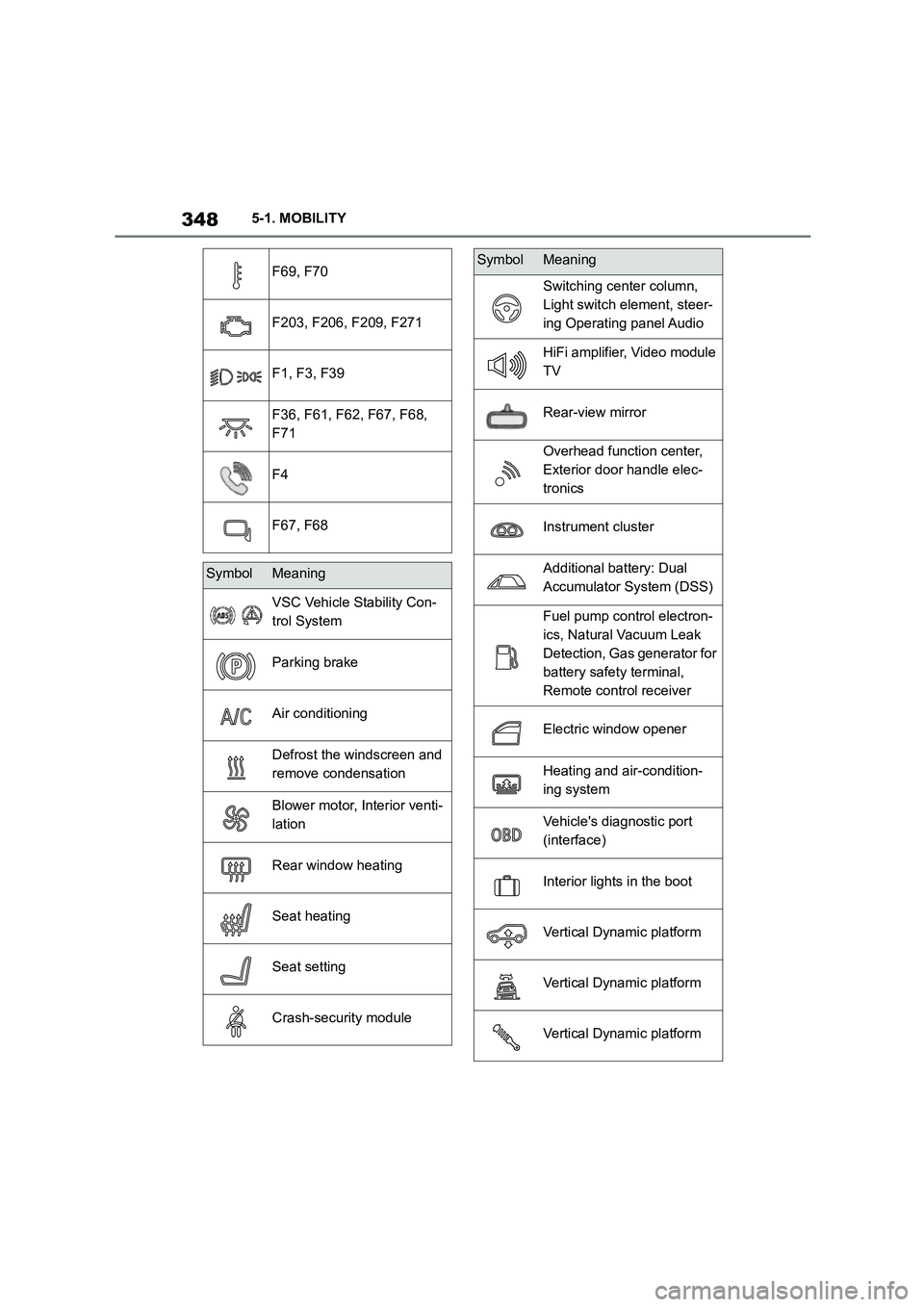
F69, F70
F203, F206, F209, F271
F1, F3, F39
F36, F61, F62, F67, F68,
F71
F4
F67, F68
SymbolMeaning
VSC Vehicle Stability Con-
trol System
Parking brake
Air conditioning
Defrost the windscreen and
remove condensation
Blower motor, Interior venti-
lation
Rear window heating
Seat heating
Seat setting
Crash-security module
Switching center column,
Light switch element, steer-
ing Operating panel Audio
HiFi amplifier, Video module
TV
Rear-view mirror
Overhead function center,
Exterior door handle elec-
tronics
Instrument cluster
Additional battery: Dual
Accumulator System (DSS)
Fuel pump control electron-
ics, Natural Vacuum Leak
Detection, Gas generator for
battery safety terminal,
Remote control receiver
Electric window opener
Heating and air-condition-
ing system
Vehicle's diagnostic port
(interface)
Interior lights in the boot
Vertical Dynamic platform
Vertical Dynamic platform
Vertical Dynamic platform
SymbolMeaning
Page 351 of 498
349
5
5-1. MOBILITY
MOBILITY
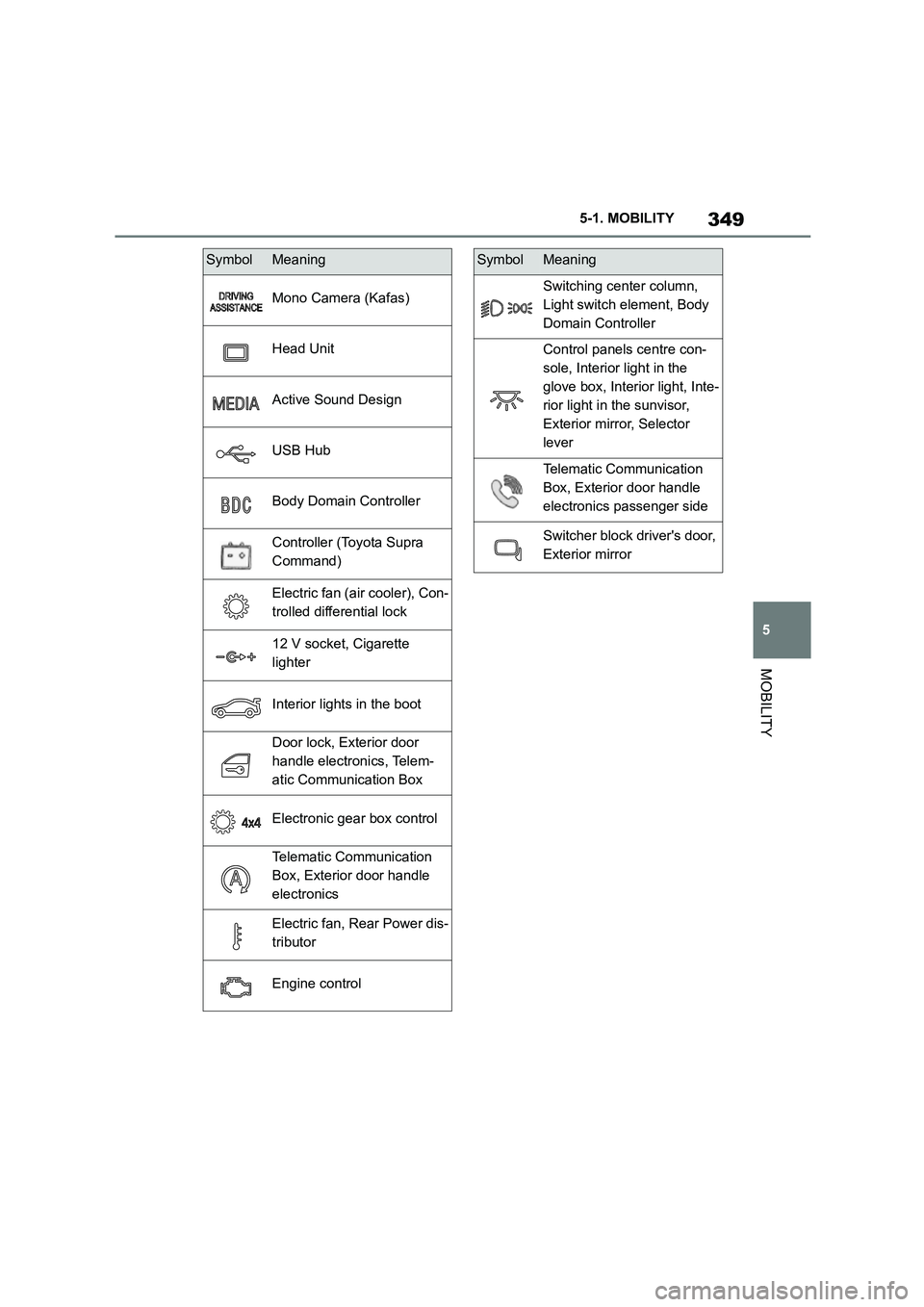
Mono Camera (Kafas)
Head Unit
Active Sound Design
USB Hub
Body Domain Controller
Controller (Toyota Supra
Command)
Electric fan (air cooler), Con-
trolled differential lock
12 V socket, Cigarette
lighter
Interior lights in the boot
Door lock, Exterior door
handle electronics, Telem-
atic Communication Box
Electronic gear box control
Telematic Communication
Box, Exterior door handle
electronics
Electric fan, Rear Power dis-
tributor
Engine control
SymbolMeaning
Switching center column,
Light switch element, Body
Domain Controller
Control panels centre con-
sole, Interior light in the
glove box, Interior light, Inte-
rior light in the sunvisor,
Exterior mirror, Selector
lever
Telematic Communication
Box, Exterior door handle
electronics passenger side
Switcher block driver's door,
Exterior mirror
SymbolMeaning
Page 352 of 498

3505-1. MOBILITY
This chapter describes all standard,
country-specific and special equip-
ment available for the model series.
It may therefore describe equip-
ment and functions which are not
installed in your vehicle, for exam-
ple on account of the special equip-
ment selected or the country
specification. This also applies to
safety-relevant functions and sys-
tems. Please comply with the rele-
vant laws and regulations when
using the corresponding functions
and systems.
Breakdown Assist
Vehicle equipment
If a malfunction occurs
while driving
WA R N I N G
If a malfunction occurs while driving,
immediately stop the vehicle in a safe
place.
If a warning light illuminates or flashes, or a warning message is dis-
played, immediately stop the vehicle
in a safe place. Do not open the hood to inspect the engine, as doing so
may lead to serious injury, such as
steam burns. If a warning message is displayed, perform the necessary pro-
cedures according to the displayed
message or explanation in the owner’s manual.
These warning messages indicate that a malfunction has occurred in a
system or function of the vehicle. If
you continue to drive the vehicle, the engine may stop suddenly, possibly
leading to an accident. Also, even if
no warning lights are illuminated or messages are displayed, if any
abnormal sounds, smells or vibrations
are detected, or of the engine stops suddenly, refrain from opening the
hood to inspect the engine and con-
sult any authorized Toyota retailer or Toyota authorized repairer, or any reli-
able repairer.
WA R N I N G
If you hear a loud noise or feel some-
thing impact the underside of the vehicle while driving, immediately
stop the vehicle in a safe place.
After stopping the vehicle in a safe
place, check the underside of the
vehicle for any leaking brake fluid, oil or fuel. If any fluid is leaking, stop
driving immediately and have the
vehicle inspected by any authorized Toyota retailer or Toyota authorized
repairer, or any reliable repairer.