2022 TOYOTA SUPRA ESP
[x] Cancel search: ESPPage 344 of 498
3425-1. MOBILITY
The installed battery is designed
specifically for this vehicle. If an
inappropriate battery is used, oper-
ation of the Auto Start/Stop function
may be restricted in order to protect
the battery. Also, the battery may
deteriorate faster than normal and
the engine may not be able to be
restarted. Contact any authorized
Toyota retailer or Toyota authorized
repairer, or any reliable repairer.
The battery is operational. No spe-
cial precautions are required for
start-up.
Ensure the battery is sufficiently
charged to guarantee the entire life-
time of the battery.
Charge the battery under the fol-
lowing circumstances:
If the inspection glass on the top
of the battery is black.
If there is insufficient starting
capability.
The following condit ions can have a
negative effect on battery output:
Frequently driving short dis-
tances.
If the vehicle is not used for peri-
ods of longer than one month.
Only charge the battery via the
jump-starting connections, see
page 358, in the engine compart-
ment and with the engine switched
off.
Battery chargers developed espe-
cially for the vehicle and suitable for
the on-board network can be
obtained from any authorized
Toyota retailer or Toyota authorized
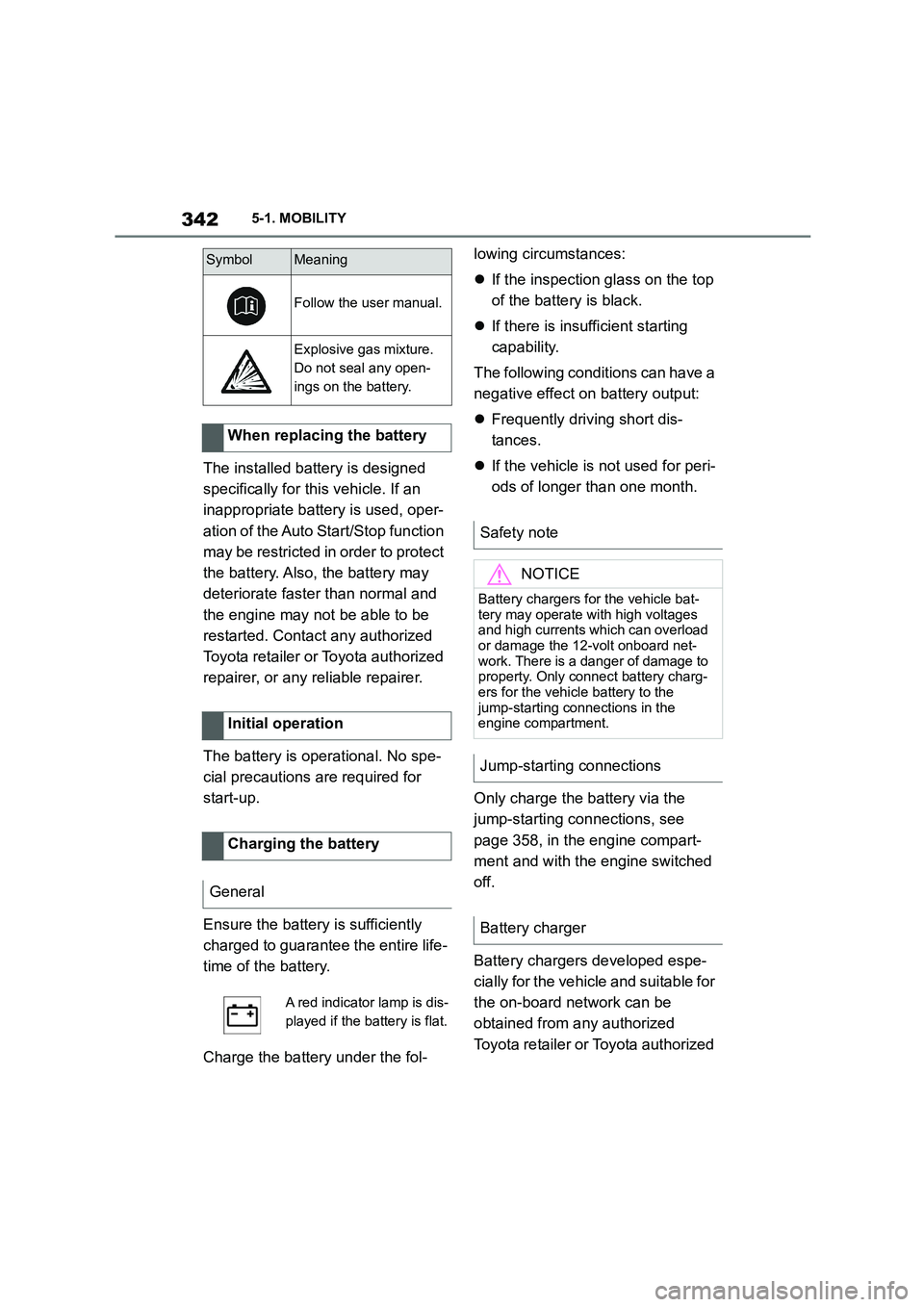
Follow the user manual.
Explosive gas mixture.
Do not seal any open-
ings on the battery.
When replacing the battery
Initial operation
Charging the battery
General
A red indicator lamp is dis-
played if the battery is flat.
SymbolMeaning
Safety note
NOTICE
Battery chargers for the vehicle bat-
tery may operate with high voltages
and high currents which can overload or damage the 12-volt onboard net-
work. There is a danger of damage to
property. Only connect battery charg- ers for the vehicle battery to the
jump-starting connections in the
engine compartment.
Jump-starting connections
Battery charger
Page 352 of 498

3505-1. MOBILITY
This chapter describes all standard,
country-specific and special equip-
ment available for the model series.
It may therefore describe equip-
ment and functions which are not
installed in your vehicle, for exam-
ple on account of the special equip-
ment selected or the country
specification. This also applies to
safety-relevant functions and sys-
tems. Please comply with the rele-
vant laws and regulations when
using the corresponding functions
and systems.
Breakdown Assist
Vehicle equipment
If a malfunction occurs
while driving
WA R N I N G
If a malfunction occurs while driving,
immediately stop the vehicle in a safe
place.
If a warning light illuminates or flashes, or a warning message is dis-
played, immediately stop the vehicle
in a safe place. Do not open the hood to inspect the engine, as doing so
may lead to serious injury, such as
steam burns. If a warning message is displayed, perform the necessary pro-
cedures according to the displayed
message or explanation in the owner’s manual.
These warning messages indicate that a malfunction has occurred in a
system or function of the vehicle. If
you continue to drive the vehicle, the engine may stop suddenly, possibly
leading to an accident. Also, even if
no warning lights are illuminated or messages are displayed, if any
abnormal sounds, smells or vibrations
are detected, or of the engine stops suddenly, refrain from opening the
hood to inspect the engine and con-
sult any authorized Toyota retailer or Toyota authorized repairer, or any reli-
able repairer.
WA R N I N G
If you hear a loud noise or feel some-
thing impact the underside of the vehicle while driving, immediately
stop the vehicle in a safe place.
After stopping the vehicle in a safe
place, check the underside of the
vehicle for any leaking brake fluid, oil or fuel. If any fluid is leaking, stop
driving immediately and have the
vehicle inspected by any authorized Toyota retailer or Toyota authorized
repairer, or any reliable repairer.
Page 353 of 498
351
5
5-1. MOBILITY
MOBILITY
WA R N I N G
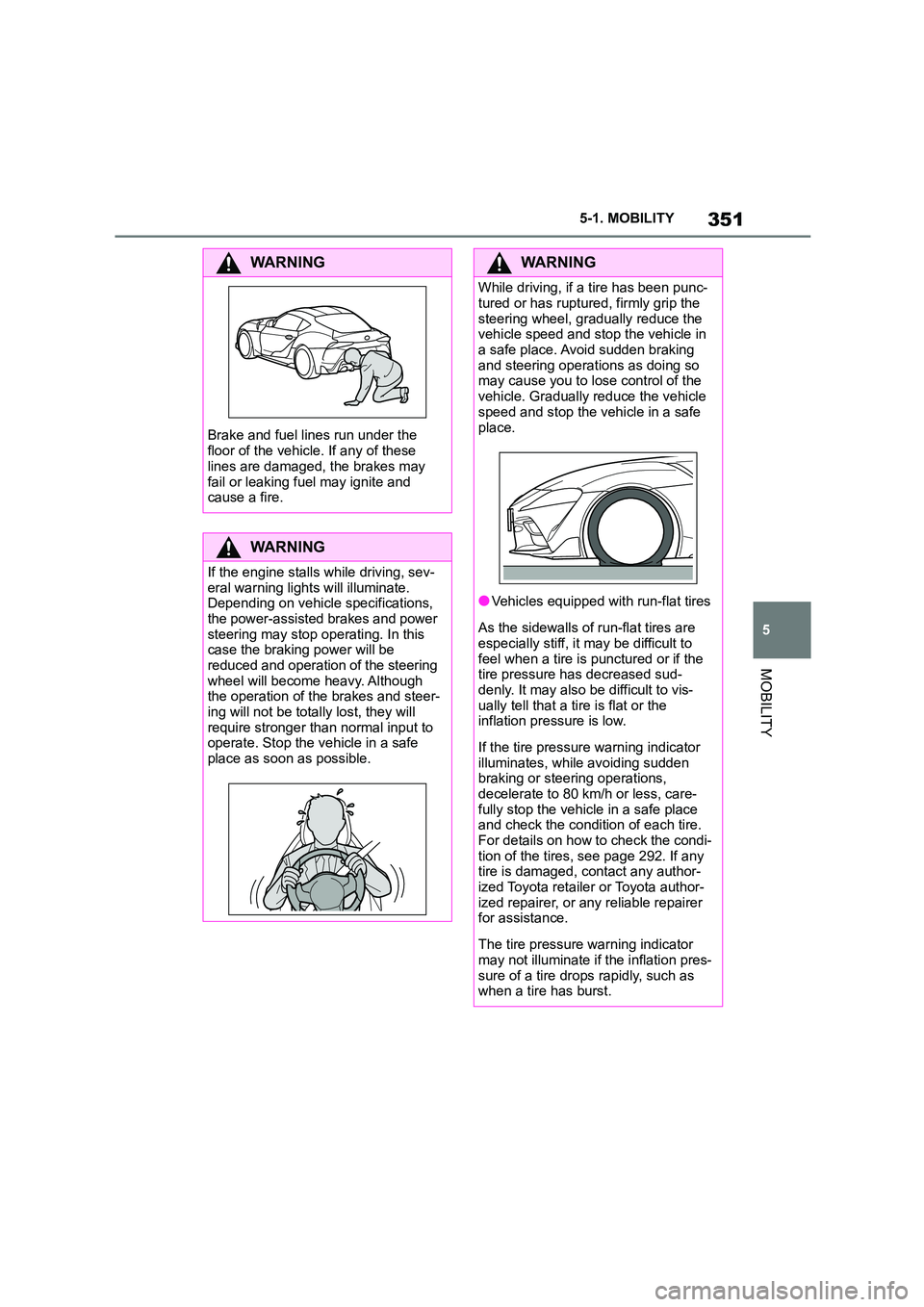
Brake and fuel lines run under the
floor of the vehicle. If any of these
lines are damaged, the brakes may
fail or leaking fuel may ignite and cause a fire.
WA R N I N G
If the engine stalls while driving, sev-
eral warning lights will illuminate. Depending on vehicle specifications,
the power-assisted brakes and power
steering may stop operating. In this case the braking power will be
reduced and operation of the steering
wheel will become heavy. Although the operation of the brakes and steer-
ing will not be totally lost, they will
require stronger than normal input to
operate. Stop the vehicle in a safe place as soon as possible.
WA R N I N G
While driving, if a tire has been punc-
tured or has ruptured, firmly grip the
steering wheel, gradually reduce the vehicle speed and stop the vehicle in
a safe place. Avoid sudden braking
and steering operations as doing so may cause you to lo se control of the
vehicle. Gradually reduce the vehicle
speed and stop the vehicle in a safe
place.
●Vehicles equipped with run-flat tires
As the sidewalls of run-flat tires are
especially stiff, it may be difficult to
feel when a tire is punctured or if the tire pressure has decreased sud-
denly. It may also be difficult to vis-
ually tell that a tire is flat or the inflation pressure is low.
If the tire pressure warning indicator illuminates, while avoiding sudden
braking or steering operations,
decelerate to 80 km /h or less, care- fully stop the vehicle in a safe place
and check the condition of each tire.
For details on how to check the condi- tion of the tires, see page 292. If any
tire is damaged, contact any author-
ized Toyota retailer or Toyota author- ized repairer, or any reliable repairer
for assistance.
The tire pressure warning indicator
may not illuminate if the inflation pres-
sure of a tire drops rapidly, such as when a tire has burst.
Page 356 of 498
3545-1. MOBILITY
Standby state is switched on.
Emergency call system is func-
tional.
If the vehicle is equipped with
automatic emergency call: the
SIM card integrated in the vehi-
cle is activated.
In certain circumstances, for exam-
ple deployment of the airbags, an
emergency call may be placed
automatically immediately after an
accident of corresponding severity.
An automatic emergency call is not
influenced by pressing the SOS
button.
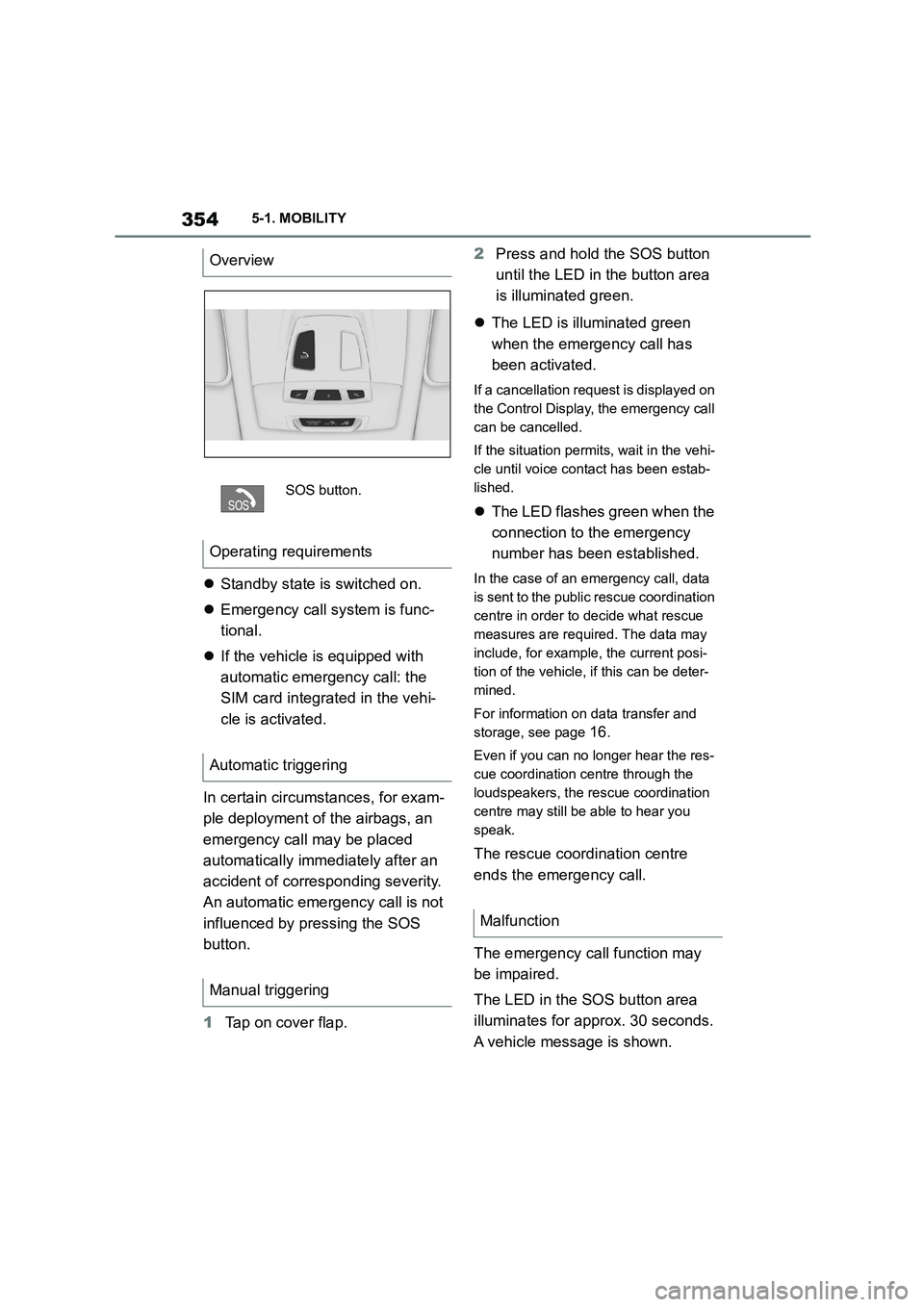
1 Tap on cover flap.
2 Press and hold the SOS button
until the LED in the button area
is illuminated green.
The LED is illuminated green
when the emergency call has
been activated.
If a cancellation request is displayed on
the Control Display, the emergency call
can be cancelled.
If the situation permits, wait in the vehi-
cle until voice contact has been estab-
lished.
The LED flashes green when the
connection to the emergency
number has been established.
In the case of an emergency call, data
is sent to the public rescue coordination
centre in order to decide what rescue
measures are required. The data may
include, for example, the current posi-
tion of the vehicle, if this can be deter-
mined.
For information on data transfer and
storage, see page 16.
Even if you can no longer hear the res-
cue coordination centre through the
loudspeakers, the rescue coordination
centre may still be able to hear you
speak.
The rescue coordination centre
ends the emergency call.
The emergency call function may
be impaired.
The LED in the SOS button area
illuminates for appr ox. 30 seconds.
A vehicle message is shown.
Overview
SOS button.
Operating requirements
Automatic triggering
Manual triggering
Malfunction
Page 360 of 498
3585-1. MOBILITY
3Switch off any power consumers
in both vehicles.
The jump-starting connection in the
engine compartment serves as the
battery positive terminal.
A special connection on the body
serves as the negative battery ter-
minal in the engine compartment.
For further information:
Overview of the engine compart-
ment, see page 320.
Open the lid of the positive battery
terminal.
Before starting, switch off all unnec-
essary power consumers, for
example the radio, on both vehi-
cles.
1 Open the cover of the
jump-starting connection.
2 Connect a terminal clamp on the
positive/+ jump lead to the posi-
tive terminal of the battery or the
corresponding jump-starting
connection on the donor vehicle.
3 Connect the second terminal
clamp to the battery's positive
terminal or to the corresponding
jump-starting connection on the
vehicle to be started.
4 Connect a terminal clamp on the
negative/– jump lead to the neg-
ative terminal of the battery or
the corresponding engine or
body earth connection on the
donor vehicle.
5 Connect the second terminal
clamp to the negative terminal of
the battery or to a corresponding
engine or body earth connection
on the vehicle to be started.
Do not use spray products sold as
starting aids.
1 Start the engine of the donor
vehicle and allow it to run for a
few minutes at a slightly
increased idle speed.
2 Start the engine of the vehicle to
be started as normal.
If an initial attempt to start the engine
fails, wait several minutes until the dis-
charged battery has been recharged somewhat.
3 Allow both engines to run for a
few minutes.
4 Disconnect the jump leads in
reverse order to connection.
Check the battery and have it
recharged if necessary.
Jump-starting connections
Connecting the cables
Starting the engine
Page 364 of 498

3625-1. MOBILITY
This chapter describes all standard,
country-specific and special equip-
ment available for the model series.
It may therefore describe equip-
ment and functions which are not
installed in your vehicle, for exam-
ple on account of the special equip-
ment selected or the country
specification. This also applies to
safety-relevant functions and sys-
tems. Please comply with the rele-
vant laws and regulations when
using the corresponding functions
and systems.
Regularly remove foreign bodies,
for example leaves, from the area
below the windscreen with the bon-
net raised.
Wash the vehicle frequently, espe-
cially in winter . Heavy soiling and
road salt can cause damage to the
vehicle.
Maximum temperature:
60°C/140°F.
Minimum distance to sensors,
cameras, seals: 30 cm, approxi-
mately 12 in.
General care
Vehicle equipment
Washing the vehicle
General
Safety notes
WA R N I N G
Damages may occur if the fuel filler
flap is open while washing. There is a risk of material damage. Close the
fuel filler flap before washing.
Remove any dirt behind the fuel filler flap with a cloth.
Steam-jet cleaners and
high-pressure cleaners
Safety note
NOTICE
When cleaning with high-pressure cleaners, excessive pressure or
excessive temperatures can damage
various components. There is a dan- ger of damage to property. Ensure a
sufficient distance and do not spray
for an extended period of time. Com-
ply with the instructions for the high-pressure cleaner.
Distances and temperature
Page 372 of 498

3706-1. REFERENCE
6-1.REFERENCE
This chapter describes all standard,
country-specific and special equip-
ment available for the model series.
It may therefore describe equip-
ment and functions which are not
installed in your vehicle, for exam-
ple on account of the special equip-
ment selected or the country
specification. This also applies to
safety-relevant functions and sys-
tems. Please comply with the rele-
vant laws and regulations when
using the corresponding functions
and systems.
The technical data and specifica-
tions in the Owner's Manual are ref-
erence figures. The vehicle-specific
data can deviate from this, for
example, due to selected special
equipment, country variants or
country-specific measurement
methods. Detailed values can be
found in the permit documents, on
information plates on the vehicle or
can be requested from any author-
ized Toyota retailer or Toyota
authorized repairer, or any reliable
repairer.
The information in the vehicle docu-
ments always takes precedence
over the information in this Owner's
Manual.
Dimensions can vary depending on the model version, equipment or coun-
try-specific m easurement method.
The heights specified do not take into account add-on parts such as a roof
aerial, roof railing or spo iler. The heights can deviate, for example, due to
selected special equipment, tyre s, loads and suspension design.
Technical data
Vehicle equipment
General
Dimensions
Width with mirrorsmm (in)2026 (79.8)
Width without mirrorsmm (in)1854 (73.0)
Heightmm (in)
SZ models1292 (50.9)
SZ-R models1299 (51.1)*1
1292 (50.9)*3
RZ models1299 (51.1)
Lengthmm (in)4379 (172.4)
Page 489 of 498

487Alphabetical Index
Driving Assistant, see Toyota Supra
Safety .......................................... 205
Driving hints ................................. 281
Driving information, general........ 281
Driving information, running in ... 280
Driving lights control, automatic 185
Driving on racing tracks .............. 285
Driving path lines, rear-view camera
..................................................... 255
Driving Stability Control Systems228
Driving through water .................. 284
Drying air, see Cooling function . 262
Dynamic radar cruise control with
full-speed range ......................... 238
E
Electrical power window switches
..................................................... 105
Electronic oil measurement......... 324
Electronic Stability Programme, ESP,
see VSC ....................................... 229
Emergency assistance, see Break-
down assistance ........................ 353
Emergency braking function when
parking, Parking Sensors with
emergency braking function ..... 251
Emergency release, fuel filler flap
..................................................... 291
Emergency running properties, tyres
..................................................... 298
Emergency services, see Breakdown
assistance ................................... 353
Emergency unlocking, transmission
lockout ........................................ 158
Emergency wheel ......................... 318
Engine ........................................... 372
Engine compartment .................... 320
Engine coolant .............................. 327
Engine coolant, Capacity............. 375
Engine oil .............................. 323, 374
Engine oil change......................... 327
Engine oil filler neck .................... 325
Engine oil grades for topping up 326
Engine oil level, checking electroni-
cally ............................................. 324
Engine oil temperature ................. 169
Engine start, starting assistance 357
Engine, automatic start-stop func-
tion ............................................... 145
Entering letters and numbers ........ 63
Entry comparison, navigation ....... 57
ESP, Electronic Stab ility Programme,
see VSC ....................................... 229
Exhaust gas particle filter ............281
Exhaust system ............................ 281
Exhaust, see Exhaust system ..... 281
Exterior lights when unlocking ..... 89
Exterior lights with the vehicle
locked ............................................ 91
Exterior mirror, automatic parking
function ....................................... 118
Exterior mirror, automatically dim-
ming ............................................. 118
Exterior mirrors............................. 117
Exterior mirrors, malfunction ...... 118
External start, see Starting assis-
tance ............................................357
Extinguisher, see Fire extinguisher
..................................................... 356
Eye for towing ............................... 360
Eyes, see Lashing eye in the boot
..................................................... 276
F
Failure notification, see Vehicle mes-
sages ...........................................163
False alarm, see Avoiding false
alarms .......................................... 104
Fan run-on, see Exhaust gas particle
filter..............................................281
Fastening seat belts, see Seat belts
..................................................... 111
Fatigue warning function .............226
Fault display, see Vehicle messages
..................................................... 163
Favourites buttons, Toyota Supra
Command ...................................... 68