2022 TOYOTA MIRAI light
[x] Cancel search: lightPage 19 of 556
19Pictorial index
Owners Manual_USA_M62084_en
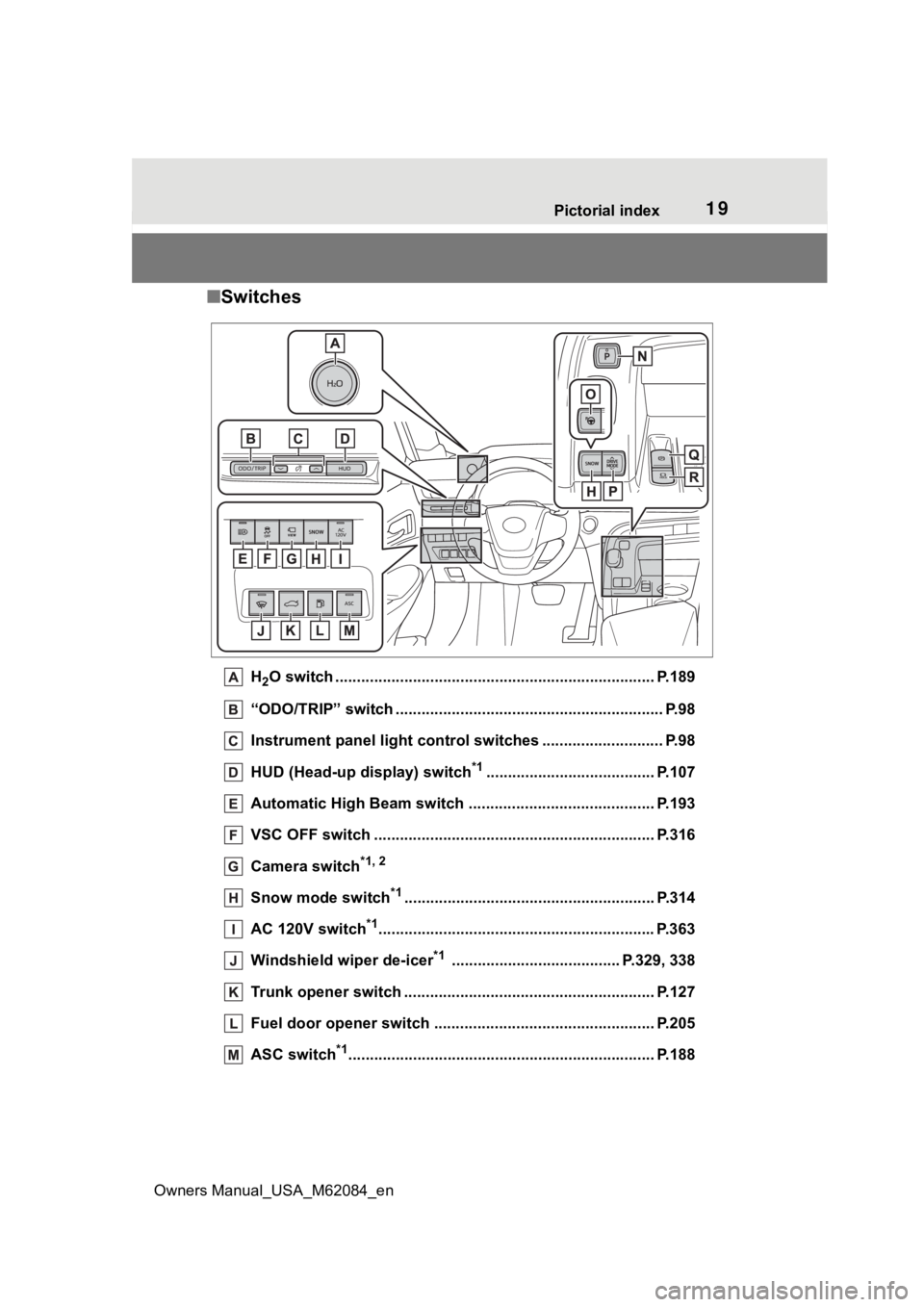
■ Switches
H2O switch ....................................................... ................... P.189
“ODO/TRIP” switch .............................................. ................ P.98
Instrument panel light control switches ........................ .... P.98
HUD (Head-up display) switch
*1....................................... P.107
Automatic High Beam switch ..................................... ...... P.193
VSC OFF switch ................................................. ................ P.316
Camera switch
*1, 2
Snow mode switch*1.......................................................... P.314
AC 120V switch
*1............................................................... .P.363
Windshield wiper de-icer
*1 ....................................... P.329, 338
Trunk opener switch ............................................ .............. P.127
Fuel door opener switch ........................................ ........... P.205
ASC switch
*1............................................................... ........ P.188
Page 23 of 556
23Pictorial index
Owners Manual_USA_M62084_en
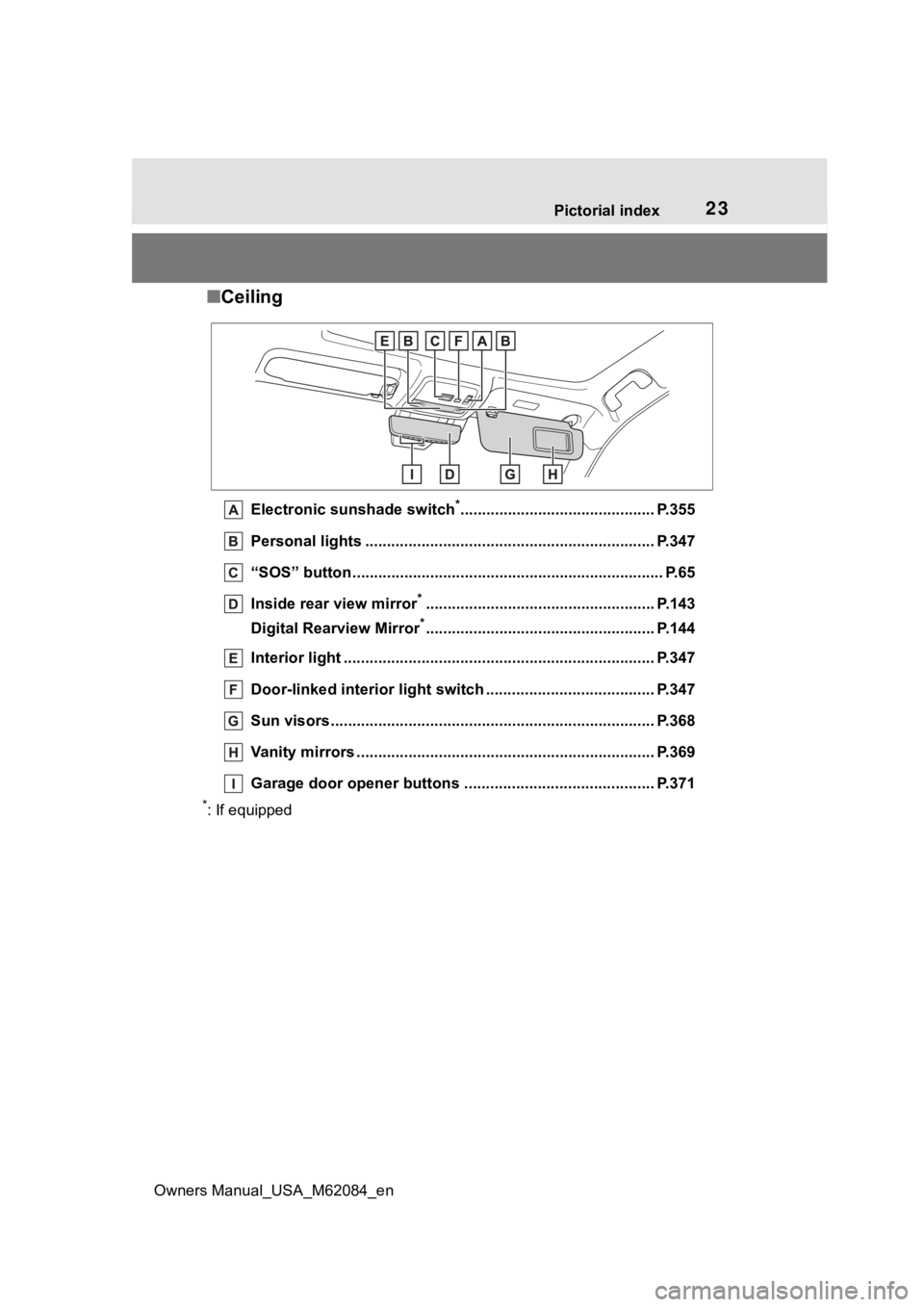
■ Ceiling
Electronic sunshade switch*............................................. P.355
Personal lights ................................................ ................... P.347
“SOS” button ................................................... ..................... P.65
Inside rear view mirror
*..................................................... P.143
Digital Rearview Mirror
*..................................................... P.144
Interior light ........................................................................ P.347
Door-linked interior light switch .............................. ......... P.347
Sun visors........................................................................... P.368
Vanity mirrors ................................................. .................... P.369
Garage door opener buttons ..................................... ....... P.371
*: If equipped
Page 27 of 556
271-1. For safe use
Owners Manual_USA_M62084_en
1
For safety and security
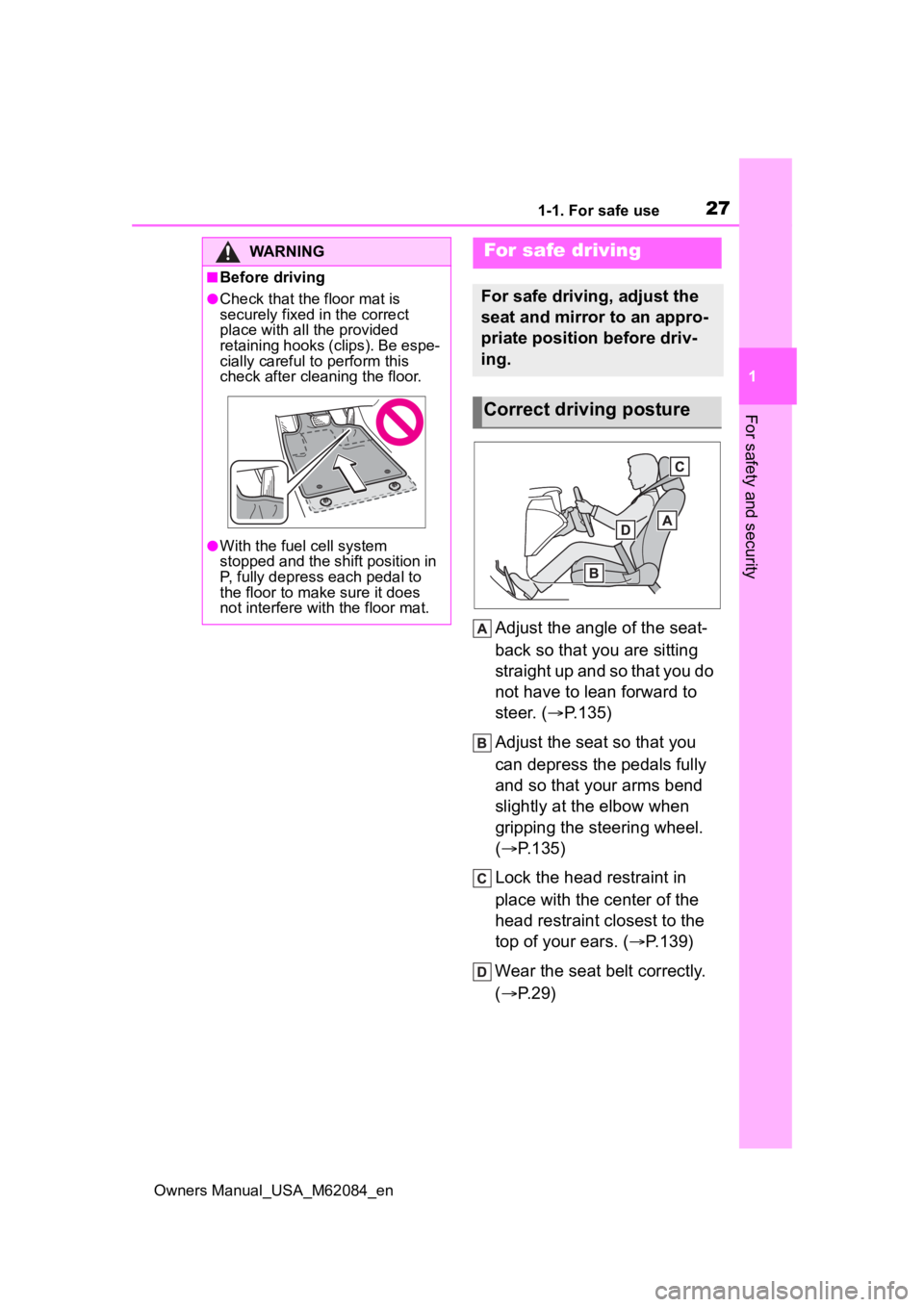
Adjust the angle of the seat-
back so that you are sitting
straight up and so that you do
not have to lean forward to
steer. ( P.135)
Adjust the seat so that you
can depress the pedals fully
and so that your arms bend
slightly at the elbow when
gripping the steering wheel.
( P.135)
Lock the head restraint in
place with the center of the
head restraint closest to the
top of your ears. ( P.139)
Wear the seat belt correctly.
( P.29)
WARNING
■Before driving
●Check that the floor mat is
securely fixed in the correct
place with all the provided
retaining hooks (clips). Be espe-
cially careful to perform this
check after cleaning the floor.
●With the fuel cell system
stopped and the shift position in
P, fully depress each pedal to
the floor to make sure it does
not interfere with the floor mat.
For safe driving
For safe driving, adjust the
seat and mirror to an appro-
priate position before driv-
ing.
Correct driving posture
Page 31 of 556
311-1. For safe use
Owners Manual_USA_M62084_en
1
For safety and security
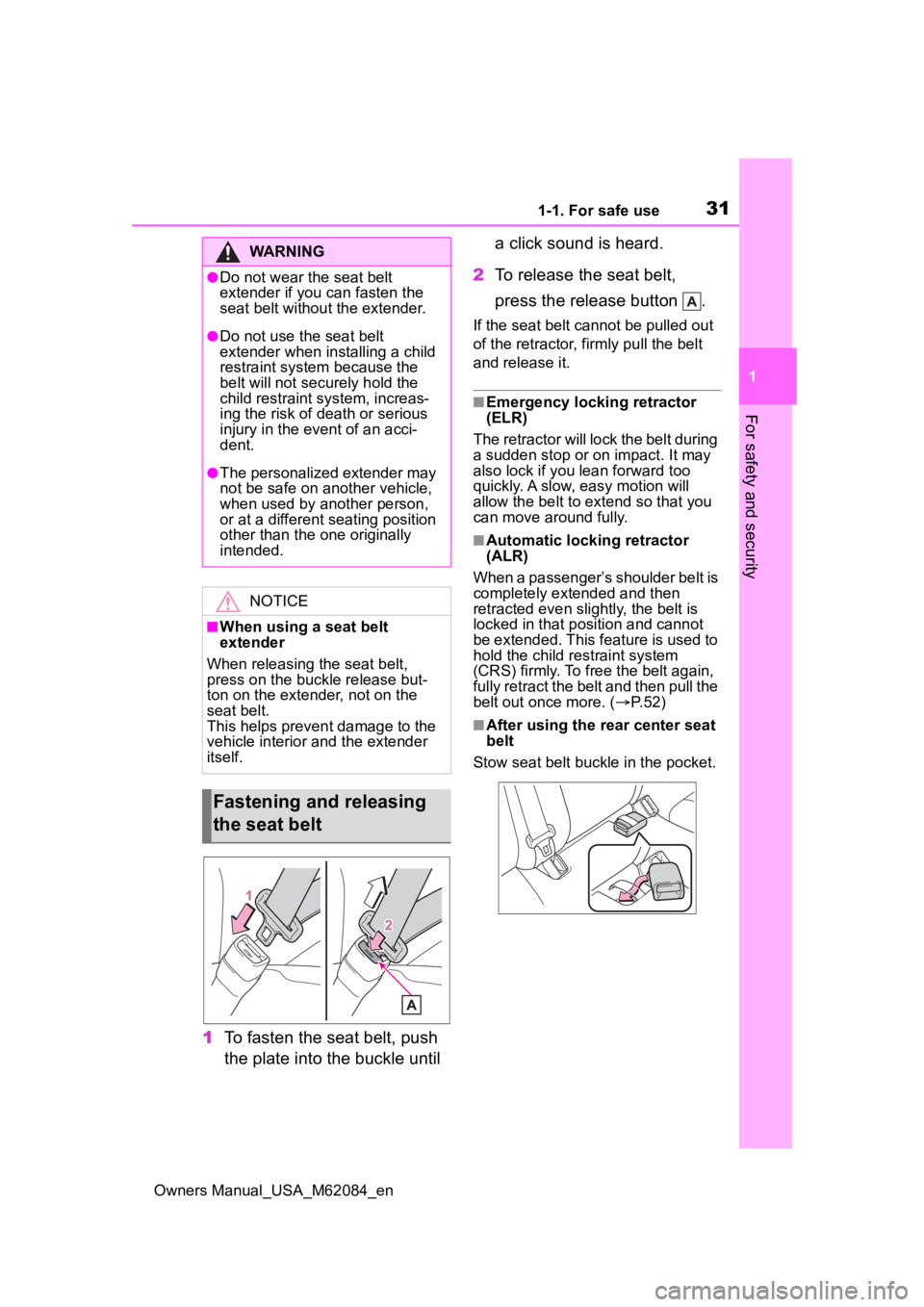
1 To fasten the seat belt, push
the plate into the buckle until a click sound is heard.
2 To release the seat belt,
press the release button .
If the seat belt cannot be pulled out
of the retractor, firmly pull the belt
and release it.
■Emergency locking retractor
(ELR)
The retractor will lock the belt during
a sudden stop or on impact. It may
also lock if you lean forward too
quickly. A slow, easy motion will
allow the belt to extend so that you
can move around fully.
■Automatic locking retractor
(ALR)
When a passenger’s shoulder belt is
completely extended and then
retracted even slightly, the belt is
locked in that position and cannot
be extended. This feature is used to
hold the child restraint system
(CRS) firmly. To free the belt again,
fully retract the belt and then pull the
belt out once more. ( P. 5 2 )
■After using the rear center seat
belt
Stow seat belt buckle in the pocket.
WARNING
●Do not wear the seat belt
extender if you can fasten the
seat belt without the extender.
●Do not use the seat belt
extender when installing a child
restraint system because the
belt will not securely hold the
child restraint system, increas-
ing the risk of death or serious
injury in the event of an acci-
dent.
●The personalized extender may
not be safe on another vehicle,
when used by another person,
or at a different seating position
other than the one originally
intended.
NOTICE
■When using a seat belt
extender
When releasing the seat belt,
press on the buckle release but-
ton on the extender, not on the
seat belt.
This helps prevent damage to the
vehicle interior and the extender
itself.
Fastening and releasing
the seat belt
Page 33 of 556
331-1. For safe use
Owners Manual_USA_M62084_en
1
For safety and security
WARNING
■Seat belt pretensioners
Observe the following precautions
to reduce the risk of injury in the
event of sudden braking, sudden
swerving or an accident.
Failure to do so may cause death
or serious injury.
●Do not place anything, such as
a cushion, on the front passen-
ger’s seat. Doing so will
disperse the passenger’s
weight, which prevents the sen-
sor from detecting the passen-
ger’s weight properly. As a
result, the seat belt pretensioner
for the front passenger’s seat
may not activate in the event of
a collision.
●If the pretensioner has acti-
vated, the SRS warning light will
come on. In that case, the seat
belt cannot be used again and
must be replaced at your Toyota
dealer.
Page 35 of 556

351-1. For safe use
Owners Manual_USA_M62084_en
1
For safety and security
• Can help prevent the occupants from being thrown from the vehi cle in the
event of vehicle rollover
■SRS airbag system components
Front impact sensors
Knee airbags
Front passenger airbag
Curtain shield airbags
Side impact sensors (front door)
Seat belt pretensioners
Side airbags
SRS warning light
Driver airbag
Side impact sensors (rear)
Side impact sensors (front)
Driver’s seat position sensor
Driver’s seat bel t buckle switch
Airbag sensor assembly
Page 36 of 556

361-1. For safe use
Owners Manual_USA_M62084_en
Front passenger occupant classification system (ECU and sen-
sors)
“AIRBAG ON” and “AIRBAG OFF” indicator lights
Your vehicle is equipped with ADVANCED AIRBAGS designed
based on the US motor vehicle safety standards (FMVSS208). The
airbag sensor assembly (ECU) cont rols airbag deployment based on
information obtained from the sensors etc. shown in the system
components diagram above. This in formation includes crash sever-
ity and occupant information. As the airbags deploy, a chemical
reaction in the inflators quickly fills the airbags with non-toxic gas to
help restrain the motion of the occupants.
■If the SRS airbags deploy
(inflate)
●Slight abrasions, burns, bruising,
etc., may be sustained from SRS
airbags, due to the extremely high
speed deployment (inflation) by
hot gases.
●A loud noise and white powder will
be emitted.
●Parts of the airbag module (steer-
ing wheel hub, airbag cover and
inflator) as well as the front seats,
parts of the front and rear pillars,
and roof side rails, may be hot for
several minutes. T he airbag itself
may also be hot.
●The windshield may crack.
●The fuel cell system will be
stopped and hydr ogen supply will
be stopped fro m the hydrogen
tank valves. ( P. 8 7 )
●All of the doors will be unlocked.
( P.122)
●The brakes and st op lights will be
controlled automatically. ( P.316)
●The interior lights will turn on auto-
matically. ( P.348)
●The emergency flashers will turn
on automatically. ( P.432)
●For Safety Connect subscribers, if
any of the following situations
occur, the system is designed to send an emergency call to the
response center, notifying them of
the vehicle’s location (without
needing to push the “SOS” button)
and an agent will attempt to speak
with the occupants to ascertain
the level of emergency and assis-
tance required. If the occupants
are unable to communicate, the
agent automatically treats the call
as an emergency and helps to dis-
patch the necessary emergency
services. (
P. 6 5 )
• An SRS airbag is deployed.
• A seat belt pretensioner is acti- vated.
• The vehicle is involved in a severe rear-end collision.
■SRS airbag deployment condi-
tions (SRS front airbags)
●The SRS front airbags will deploy
in the event of an impact that
exceeds the set threshold level
(the level of forc e corresponding
to an approximately 12 - 18 mph
[20 - 30 km/h] frontal collision with
a fixed wall that does not move or
deform).
However, this threshold velocity will
be considerably higher in the follow-
ing situations:
• If the vehicle strikes an object, such as a parked vehicle or sign
pole, which can move or deform
on impact
Page 44 of 556
441-1. For safe use
Owners Manual_USA_M62084_en
■Pop Up Hood precautions
●Before scrapping your vehicle,
make sure to contact your Toyota
dealer.
●The Pop Up Hood system cannot
be reused once it has operated.
Have it replaced by your Toyota
dealer.
■PCS-linked Pop Up Hood opera-
tion control
If the PCS (Pre-Collision System)
determines that the possibility of a
collision with a pedestrian or bicy-
clist is high, the Pop Up Hood will be
prepared to operate.
■Pop Up Hood operational condi-
tions
The Pop Up Hood will operate when
the vehicle detect s an impact such
as the following:
●The front bumper detects a frontal
impact equivalent to or greater
than that of a pedestrian while the
vehicle being driven within the
operational speed range of
approximately 16 to 34 mph (25 to
55 km/h). (The system is operated
by an impact of threshold level or
greater, even in the case of a
minor collision that may not leave
a trace on the front bumper. Also,
depending on the impact condi-
tions or vehicle speed, the system
may operate by a collision with a
light or small object or a small ani-
mal.)
●In other situations, such as the fol-
lowing the system may operate
when an impact is applied to the
lower part of the vehicle or front
bumper:
• Colliding with a curb
• Falling into a deep hole
• Landing hard
• Hitting the slope of a parking lot, an undulating road, a protruding
object or fa lling object
■Conditions under which the
Pop Up Hood may not operate
properly
●If a pedestrian c ollides with the
right or left corner of the front
bumper or the side of the vehicle.
As such impacts may be difficult to
detect, the system may not oper-
ate.
●If the vehicle speed is not
detected correctly , such as if the
vehicle is sliding sideways, the
system may not operate properly.
■Conditions under which the
Pop Up Hood will not operate
The Pop Up Hood will not operate in
the following situations:
●Colliding with a lying person
●A frontal impac t applied to the
front bumper while driving at
speeds outside of the operational
speed range
●A side impact or rear impact
●A vehicle rollover (In some acci-
dent situations, the Pop Up Hood
may operate.)
WARNING
■When the Pop Up Hood is
operated
●Do not pull the hood lock
release lever. Doing so after the
Pop Up Hood has operated will
further raise the hood and may
cause an injury. Do not drive
with the hood raised, as doing
so may block the driver’s vision,
possibly causing an accident.
●Do not forcibly push down the
hood. As the popped up hood
cannot be lowered by hand,
doing so may deform the hood
or cause an injury.