Page 424 of 678
4227-3. Do-it-yourself maintenance
1ZR-FAE engine
Washer fluid tank ( P.428)
Engine coolant reservoir ( P. 4 2 5 )
Fuse boxes ( P.452)
Engine oil level dipstick ( P.423)
Engine oil filler cap ( P.424)
Battery ( P.427)
Radiator ( P.426)
Condenser ( P.426)
Electric cooling fan
Engine compartment
Components
Page 425 of 678
423
7
7-3. Do-it-yourself maintenance
Maintenance and care
M15A-FKS engine
Washer fluid tank ( P.428)
Engine coolant reservoir ( P. 4 2 5 )
Fuse boxes ( P.452)
Engine oil filler cap ( P.424)
Engine oil level dipstick ( P.423)
Battery ( P.427)
Radiator ( P.426)
Condenser ( P.426)
Electric cooling fan
With the engine at operating tem-
perature and turned off, check the
oil level on the dipstick.
■Checking the engine oil
1 Park the vehicle on level
ground. After warming up the
engine and turning it off, wait
more than 5 minutes for the oil
to drain back into the bottom of
the engine.
Checking and adding the
engine oil
Page 428 of 678
4267-3. Do-it-yourself maintenance
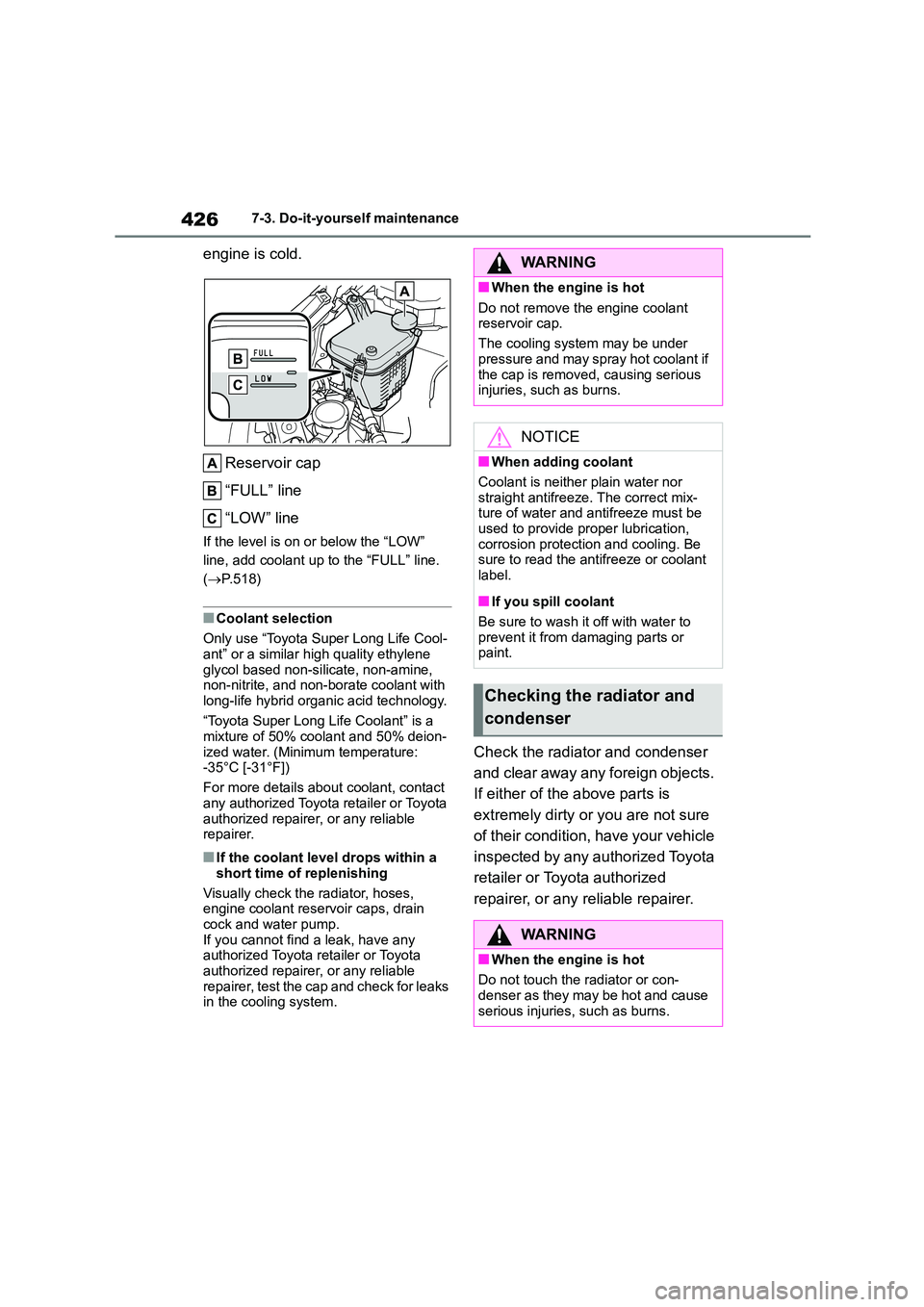
engine is cold.
Reservoir cap
“FULL” line
“LOW” line
If the level is on or below the “LOW”
line, add coolant up to the “FULL” line.
( P.518)
■Coolant selection
Only use “Toyota Super Long Life Cool-
ant” or a similar high quality ethylene glycol based non-silicate, non-amine,
non-nitrite, and non-borate coolant with
long-life hybrid organic acid technology.
“Toyota Super Long Life Coolant” is a
mixture of 50% coolant and 50% deion-
ized water. (Minimum temperature: -35°C [-31°F])
For more details about coolant, contact
any authorized Toyota retailer or Toyota authorized repairer, or any reliable
repairer.
■If the coolant level drops within a
short time of replenishing
Visually check the radiator, hoses,
engine coolant reservoir caps, drain
cock and water pump. If you cannot find a leak, have any
authorized Toyota retailer or Toyota
authorized repairer, or any reliable
repairer, test the cap and check for leaks in the cooling system.
Check the radiator and condenser
and clear away any foreign objects.
If either of the above parts is
extremely dirty or you are not sure
of their condition, have your vehicle
inspected by any authorized Toyota
retailer or Toyota authorized
repairer, or any reliable repairer.
WA R N I N G
■When the engine is hot
Do not remove the engine coolant
reservoir cap.
The cooling system may be under
pressure and may spray hot coolant if
the cap is removed, causing serious injuries, such as burns.
NOTICE
■When adding coolant
Coolant is neither plain water nor straight antifreeze. The correct mix-
ture of water and antifreeze must be
used to provide proper lubrication, corrosion protection and cooling. Be
sure to read the antifreeze or coolant
label.
■If you spill coolant
Be sure to wash it off with water to prevent it from damaging parts or
paint.
Checking the radiator and
condenser
WA R N I N G
■When the engine is hot
Do not touch the radiator or con- denser as they may be hot and cause
serious injuries, such as burns.
Page 522 of 678
5208-2. Steps to take in an emergency
1Stop the engine. Set the parking
brake and shift the shift lever to
P (Multidrive) or N (manual
transmission).
2 Remove the mud, snow or sand
from around the front wheels.
3 Place wood, stones or some
other material under the front
wheels to help provide traction.
4 Restart the engine.
5 Shift the shift lever to D or R
(Multidrive) or 1 or R (manual
transmission) and release the
parking brake. Then, while exer-
cising caution, depress the
accelerator pedal.
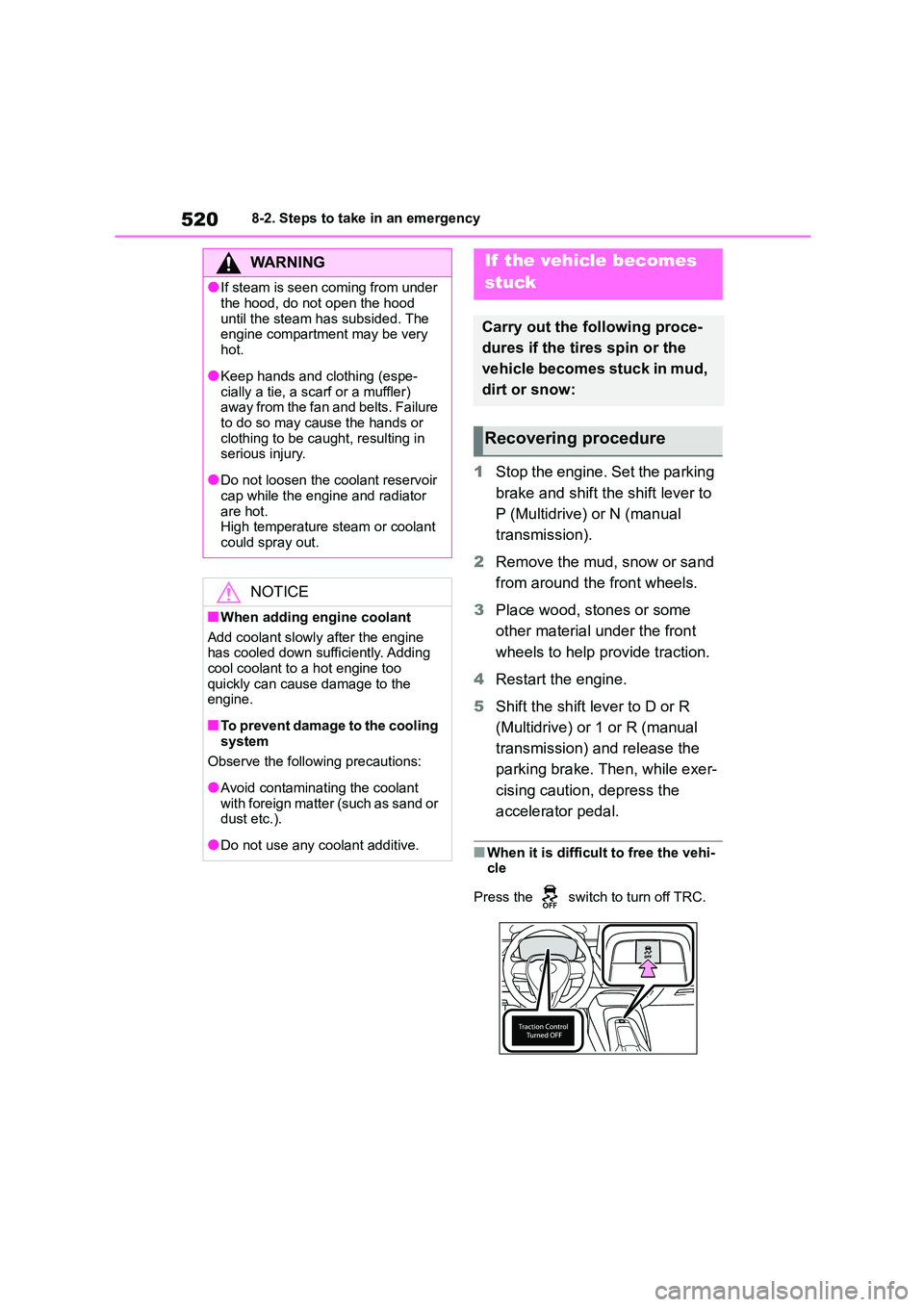
■When it is difficult to free the vehi- cle
Press the switch to turn off TRC.
WA R N I N G
●If steam is seen coming from under
the hood, do not open the hood
until the steam has subsided. The engine compartment may be very
hot.
●Keep hands and clothing (espe-
cially a tie, a scarf or a muffler)
away from the fan and belts. Failure
to do so may cause the hands or clothing to be caught, resulting in
serious injury.
●Do not loosen the coolant reservoir
cap while the engine and radiator
are hot. High temperature steam or coolant
could spray out.
NOTICE
■When adding engine coolant
Add coolant slowly after the engine
has cooled down sufficiently. Adding
cool coolant to a hot engine too
quickly can cause damage to the engine.
■To prevent damage to the cooling system
Observe the following precautions:
●Avoid contaminating the coolant
with foreign matter (such as sand or
dust etc.).
●Do not use any coolant additive.
If the vehicle becomes
stuck
Carry out the following proce-
dures if the tires spin or the
vehicle becomes stuck in mud,
dirt or snow:
Recovering procedure

