2022 TOYOTA COROLLA height
[x] Cancel search: heightPage 210 of 678

2084-5. Using the driving support systems
• If a vehicle ahead has extremely high
ground clearance
• If a vehicle ahead is carrying a load
which protrudes past its rear bumper • If a vehicle ahead is irregularly
shaped, such as a tractor or side car
• If a vehicle ahead is a child sized bicy- cle, a bicycle that is carrying a large
load, a bicycle ridden by more than
one person, or a uniquely shaped bicycle (bicycle with a child seat, tan-
dem bicycle, etc.)
• If a pedestrian/or the riding height of a bicyclist ahead is shorter than approx-
imately 1 m (3.2 ft.) or taller than
approximately 2 m (6.5 ft.) • If a pedestrian/bicyclist is wearing
oversized clothing (a rain coat, long
skirt, etc.), making their silhouette obscure
• If a pedestrian is bending forward or
squatting or bicyclist is bending for- ward
• If a pedestrian/bicyclist is moving fast
• If a pedestrian is pushing a stroller, wheelchair, bicycle or other vehicle
• When driving in inclement weather
such as heavy rain, fog, snow or a
sandstorm • When driving through steam or smoke
• When the surrounding area is dim,
such as at dawn or dusk, or while at night or in a tunnel, making a detecta-
ble object appear to be nearly the
same color as its surroundings
• When driving in a place where the sur- rounding brightness changes sud-
denly, such as at the entrance or exit
of a tunnel • After the engine has started the vehi-
cle has not been driven for a certain
amount of time • While making a left/right turn and for a
few seconds after making a left/right
turn • While driving on a curve and for a few
seconds after driving on a curve
• If your vehicle is skidding • If the front of the vehicle is raised or
lowered
• If the wheels are misaligned
• If a wiper blade is blocking the front
camera • The vehicle is being driven at
extremely high speeds
• When driving on a hill • If the radar sensor or front camera is
misaligned
●In some situations such as the follow-
ing, sufficient braking force may not
be obtained, prev enting the system from performing properly:
• If the braking functions cannot operate
to their full extent, such as when the brake parts are extremely cold,
extremely hot, or wet
• If the vehicle is not properly main- tained (brakes or ti res are excessively
worn, improper tire inflation pressure,
etc.)
• When the vehicle is being driven on a gravel road or other slippery surface
■If VSC is disabled
●If VSC is disabled ( P.317), the pre-collision brake assist and pre-col-
lision braking functions are also disa-
Page 265 of 678

263
4
4-5. Using the driving support systems
Driving
• When an accessory (such as a bicycle
carrier) is installed to the rear of the vehicle
• When there is a significant difference
in height between your vehicle and the vehicle that enters the detection
area
• Immediately after the Blind Spot Moni- tor is turned on
●Instances of the Blind Spot Monitor unnecessarily detecting a vehicle
and/or object may increase in the fol-
lowing situations: • When the sensor is misaligned due to
a strong impact to the sensor or its
surrounding area • When the distance between your vehi-
cle and a guardrail, wall, etc. that
enters the detection area is short • When driving up and down consecu-
tive steep inclines, such as hills, dips
in the road, etc. • When vehicle lanes are narrow, or
when driving on the edge of a lane,
and a vehicle traveling in a lane other than the adjacent lanes enters the
detection area
• When driving on roads with sharp bends, consecutive curves, or uneven
surfaces
• When the tires are slipping or spinning • When the distance between your vehi-
cle and a following vehicle is short
• When an accessory (such as a bicycle carrier) is installed to the rear of the
vehicle
*: If equipped
■Types of sensors
Front corner sensors
Front center sensors
Rear corner sensors
Rear center sensors
Front side sensors (if equipped)
Rear side sensors (if equipped)
■Display
When the sensors detect an object,
such as a wall, a graphic is shown
Toyota parking
assist-sensor*
The distance from your vehicle
to objects, such as a wall,
when parallel parking or
maneuvering into a garage is
measured by the sensors and
communicated via the
multi-information display,
head-up display (if equipped)
and a buzzer. Always check the
surrounding area when using
this system.
System components
Page 277 of 678

275
4
4-5. Using the driving support systems
Driving
●When backing out of a sharp angle parking spot
●When towing a trailer
●When there is a significant difference
in height between your vehicle and the vehicle that enters the detection
area
●When a sensor or the area around a
sensor is extremely hot or cold
●If the suspension has been modified
or tires of a size other than specified
are installed
●If the front of the vehicle is raised or
lowered due to the carried load
●When turning while backing up
●When a vehicle turns into the detec-
tion area
■Situations in which the system may
operate even if there is no possibil- ity of a collision
Instances of the RCTA function unnec-
essary detecting a vehicle and/or object may increase in the following situations:
●When the parking space faces a street and vehicles are being driven on the
street
●When the distance between your vehi-
cle and metal objects, such as a
guardrail, wall, sigh, or parked vehicle, which may reflect electrical waves
toward the rear of the vehicle, is short
●When equipment that may obstruct a
sensor is installed, such as a towing
eyelet, bumper protector (an addi- tional trim strip, etc.), bicycle carrier,
or snow plow
●When a vehicle passes by the side of your vehicle
Page 466 of 678
4648-1. Essential information
If the door can be opened, open
the door and exit the vehicle.
If the door can not be opened,
open the window using the
power window switch and ensure
an escape route.
If the window can be opened,
exit the vehicle through the win-
dow.
If the door and window cannot be
opened due to the rising water,
remain calm, wait until the water
level inside the vehicle rises to
the point that the water pressure
inside of the vehicle equals the
water pressure outside of the
vehicle and then open the door
after waiting for the rising water
to enter the vehicle, and exit the
vehicle. When the outside water
level exceeds half the height of
the door, the door cannot be
opened from the inside due to
water pressure.
■Water level exceeds the floor
When the water level exceeds the floor and time has passed, the electrical
equipment will get damaged, the power
windows will not operate, the engine stop, and the vehicle may not be able to
get moving.
■Using an emergency escape ham-
mer*
Laminated glass is used in the wind- shield on this vehicle.
Laminated glass cannot be shattered
with an emergency hammer*. Tempered glass is used in the windows
on this vehicle.*: Contact any authorized Toyota retailer
or Toyota authorized repairer, or any
reliable repairer or aftermarket acces-
sory manufacturer for further informa-
tion about an emergency hammer.
If the vehicle is sub-
merged or water on the
road is rising
This vehicle is not designed to
be able to drive on roads that
are deeply flooded with water.
Do not drive on roads where
the roads may be submerged
or the water may be rising. It is
dangerous to remain in the
vehicle, if it anticipated that the
vehicle will be flooded or set a
drift. Remain calm and follow
the following.
WA R N I N G
■Caution while driving
Do not drive on roads where the roads may be submerged or the water
may be rising. Otherwise the vehicle
may be damaged and cannot move, as well as become flooded and set a
drift, which may lead to death.
Page 503 of 678
501
8
8-2. Steps to take in an emergency
When trouble arises
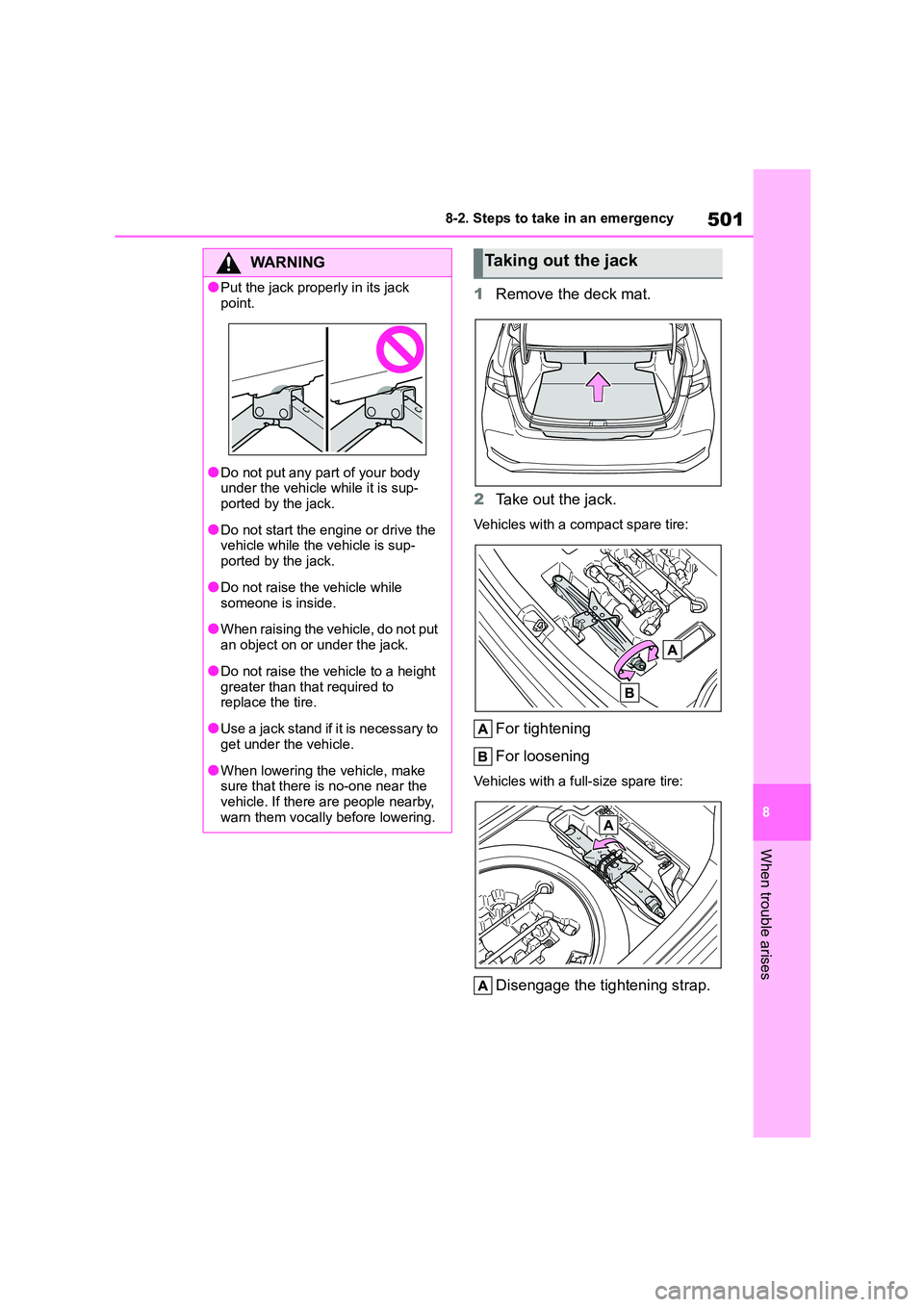
1 Remove the deck mat.
2 Take out the jack.
Vehicles with a compact spare tire:
For tightening
For loosening
Vehicles with a full-size spare tire:
Disengage the tightening strap.
WA R N I N G
●Put the jack properly in its jack
point.
●Do not put any part of your body under the vehicle while it is sup-
ported by the jack.
●Do not start the engine or drive the
vehicle while the vehicle is sup-
ported by the jack.
●Do not raise the vehicle while
someone is inside.
●When raising the vehicle, do not put
an object on or under the jack.
●Do not raise the vehicle to a height
greater than that required to replace the tire.
●Use a jack stand if it is necessary to get under the vehicle.
●When lowering the vehicle, make sure that there is no-one near the
vehicle. If there are people nearby,
warn them vocally before lowering.
Taking out the jack
Page 526 of 678
5249-1. Specifications
9-1.Specifications
*1: Unladen vehicles
*2: M15A-FKS engine
*3: Vehicles with rough road package
*4: 1ZR-FAE engine with Multidrive
*5: 1ZR-FAE engine with manual transmission
■Vehicle identification number
The vehicle identification number
(VIN) is the legal identifier for your
vehicle. This is the primary identifi-
cation number for your Toyota. It is
used in registering the ownership of
your vehicle.
This number is stamped under the
right-hand front seat.
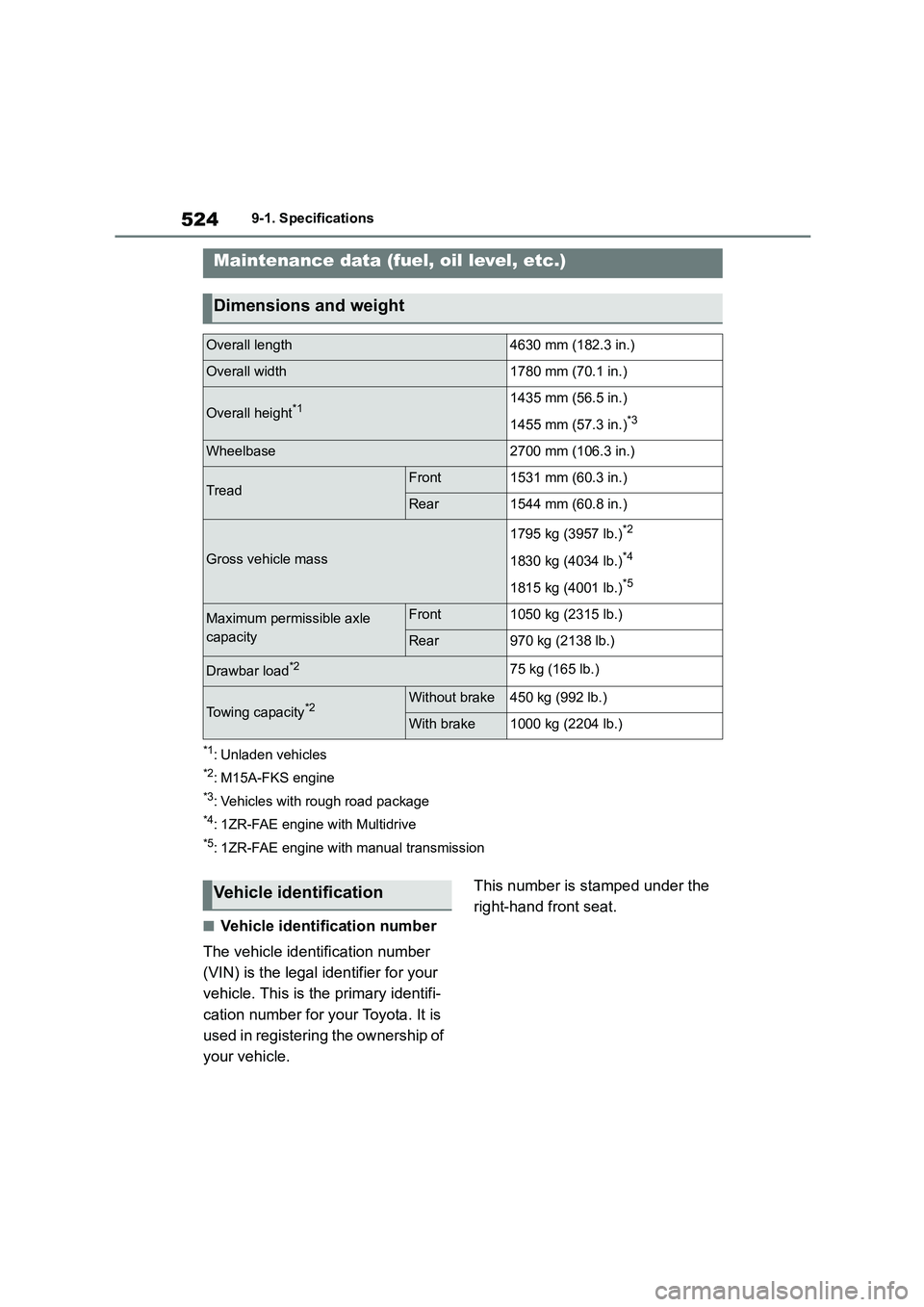
Maintenance data (fuel, oil level, etc.)
Dimensions and weight
Overall length4630 mm (182.3 in.)
Overall width1780 mm (70.1 in.)
Overall height*11435 mm (56.5 in.)
1455 mm (57.3 in.)*3
Wheelbase2700 mm (106.3 in.)
TreadFront1531 mm (60.3 in.)
Rear1544 mm (60.8 in.)
Gross vehicle mass
1795 kg (3957 lb.)*2
1830 kg (4034 lb.)*4
1815 kg (4001 lb.)*5
Maximum permissible axle
capacity
Front1050 kg (2315 lb.)
Rear970 kg (2138 lb.)
Drawbar load*275 kg (165 lb.)
Towing capacity*2Without brake450 kg (992 lb.)
With brake1000 kg (2204 lb.)
Vehicle identification