2022 TOYOTA COROLLA spare wheel
[x] Cancel search: spare wheelPage 159 of 678
157
4
4-1. Before driving
Driving
of your vehicle and trailer and
ensure that the vehicle-to-vehicle
distance is sufficient before execut-
ing lane changes.
■Transmission information
Multidrive
To maintain engine braking effi-
ciency and charging system perfor-
mance when using engine braking,
do not use the transmission in D,
must be in M and select gear step 4
or lower. ( P. 1 6 5 )
Manual transmission
Refrain from driving in 6th gear to
maintain the effectiveness of
engine braking and to maintain
charging system performance.
■If the engine overheats
Towing a loaded trailer up a long,
steep incline in temperatures
exceeding 30°C (85°F) may result
in the engine overheating. If the
engine coolant temperature gauge
indicates that the engine is over-
heating, turn the air conditioning off
immediately, leave the road and
stop the vehicle in a safe place.
( P.518)
■When parking the vehicle
Always place wheel chocks under
the wheels of both the vehicle and
trailer. Firmly set the parking brake
and shift the shift lever to P
(Multidrive) and 1 or R (manual
transmission).
WA R N I N G
Follow all the instructions described in
this section. Failure to do so could
cause an accident resulting in death or serious injury.
■Trailer towing precautions
When towing, make sure that none of
the weight limits are exceeded.
( P.153)
■Vehicle speed in towing
Observe the legal maximum speeds
for trailer towing.
■Before descending hills or long
declines
Reduce speed and downshift. How-
ever, never downshift suddenly while
descending steep or long downhill grades.
■Operation of the brake pedal
Do not hold the brake pedal
depressed often or for long periods of
time. Doing so may result in the brake overheating or reduce braking effects.
■To avoid accident or injury
●Vehicles with a compact spare tire:
Do not tow a trailer when the com-
pact spare tire is installed on your vehicle.
●Vehicles with the emergency tire puncture repair kit: Do not tow a
trailer when the tire installed is
repaired with the emergency tire puncture repair kit.
●Do not use the following systems when trailer towing.
• Cruise control (if equipped)
• Dynamic radar cruise control (if
equipped)
• Dynamic radar cruise control with
full-speed range (if equipped)
Page 206 of 678

2044-5. Using the driving support systems
■Enabling/disabling the pre-col-
lision system
The pre-collisio n system can be
enabled/disabled on ( P.538)
of the multi-information display.
The system is auto matically enabled
each time the engine switch is turned to
ON.
If the system is disabled, the PCS
warning light will turn on and a
message will be di splayed on the
multi-information display.
■Changing the pre-collision
warning timing
The pre-collision warning timing
can be changed on ( P.538) of
the multi-information display.
The warning timing setting is retained
when the engine switch is turned off.
However, if the pr e-collision system is
disabled and re-enabled, the operation
timing will return to the default setting
(middle).
1 Early
2 Middle
WA R N I N G
●When inspecting the vehicle using
a drum tester such as a chassis
dynamometer or speedometer tester, or when using an on vehicle
wheel balancer
●When a strong impact is applied to
the front bumper or front grille, due
to an accident or other reasons
●If the vehicle cannot be driven in a
stable manner, such as when the
vehicle has been in an accident or is malfunctioning
●When the vehicle is driven in a sporty manner or off-road
●When the tires are not properly inflated
●When the tires are very worn
●When tires of a size other than
specified are installed
●When tire chains are installed
●When a compact spare tire or an
emergency tire puncture repair kit is
used
●If equipment (snow plow, etc.) that
may obstruct the radar sensor or front camera is temporarily installed
to the vehicle
Changing settings of the
pre-collision system
Page 212 of 678
2104-5. Using the driving support systems
WA R N I N G
■Before using LTA system
●Do not rely solely upon the LTA sys-
tem. The LTA system does not automatically drive the vehicle or
reduce the amount of attention that
must be paid to the area in front of the vehicle. The driver must always
assume full responsibility for driving
safely by paying careful attention to
the surrounding conditions and operating the steering wheel to cor-
rect the path of the vehicle. Also,
the driver must take adequate breaks when fatigued, such as from
driving for a long period of time.
●Failure to perform appropriate driv-
ing operations and pay careful
attention may lead to an accident, resulting in death or serious injury.
●When not using the LTA system, use the LTA switch to turn the sys-
tem off.
■Situations unsuitable for LTA
system
In the following situations, use the LTA switch to turn the system off. Fail-
ure to do so may lead to an accident,
resulting in death or serious injury.
●Vehicle is driven on a road surface
which is slippery due to rainy weather, fallen snow, freezing, etc.
●Vehicle is driven on a snow-cov-ered road.
●White (yellow) lines are difficult to see due to rain, snow, fog, dust,
etc.
●Vehicle is driven in a temporary
lane or restricted lane due to con-
struction work.
●Vehicle is driven in a construction
zone.
●A spare tire, tire chains, etc. are
equipped.
●When the tires have been exces- sively worn, or when the tire infla-
tion pressure is low.
●When tires of a size other than
specified are installed.
●Vehicle is driven in traffic lanes
other than that highways and free-
ways.
●When your vehicle is towing a
trailer or during emergency towing
■Preventing LTA system malfunc-
tions and operations performed by mistake
●Do not modify the headlights or
place stickers, etc. on the surface of the lights.
●Do not modify the suspension etc. If the suspension etc. needs to be
replaced, contact any authorized
Toyota retailer or Toyota authorized repairer, or any reliable repairer.
●Do not install or place anything on the hood or grille. Also, do not
install a grille guar d (bull bars, kan-
garoo bar, etc.).
●If your windshield needs repairs,
contact any authorized Toyota retailer or Toyota authorized
repairer, or any reliable repairer.
■Conditions in which functions
may not operate properly
In the following situations, the func- tions may not operate properly and
the vehicle may depart from its lane.
Drive safely by always paying careful attention to your surroundings and
operate the steering wheel to correct
the path of the vehicle without relying
solely on the functions.
Page 221 of 678
219
4
4-5. Using the driving support systems
Driving
*: If equipped
LDA (Lane Depar ture
Alert with steering con-
trol)*
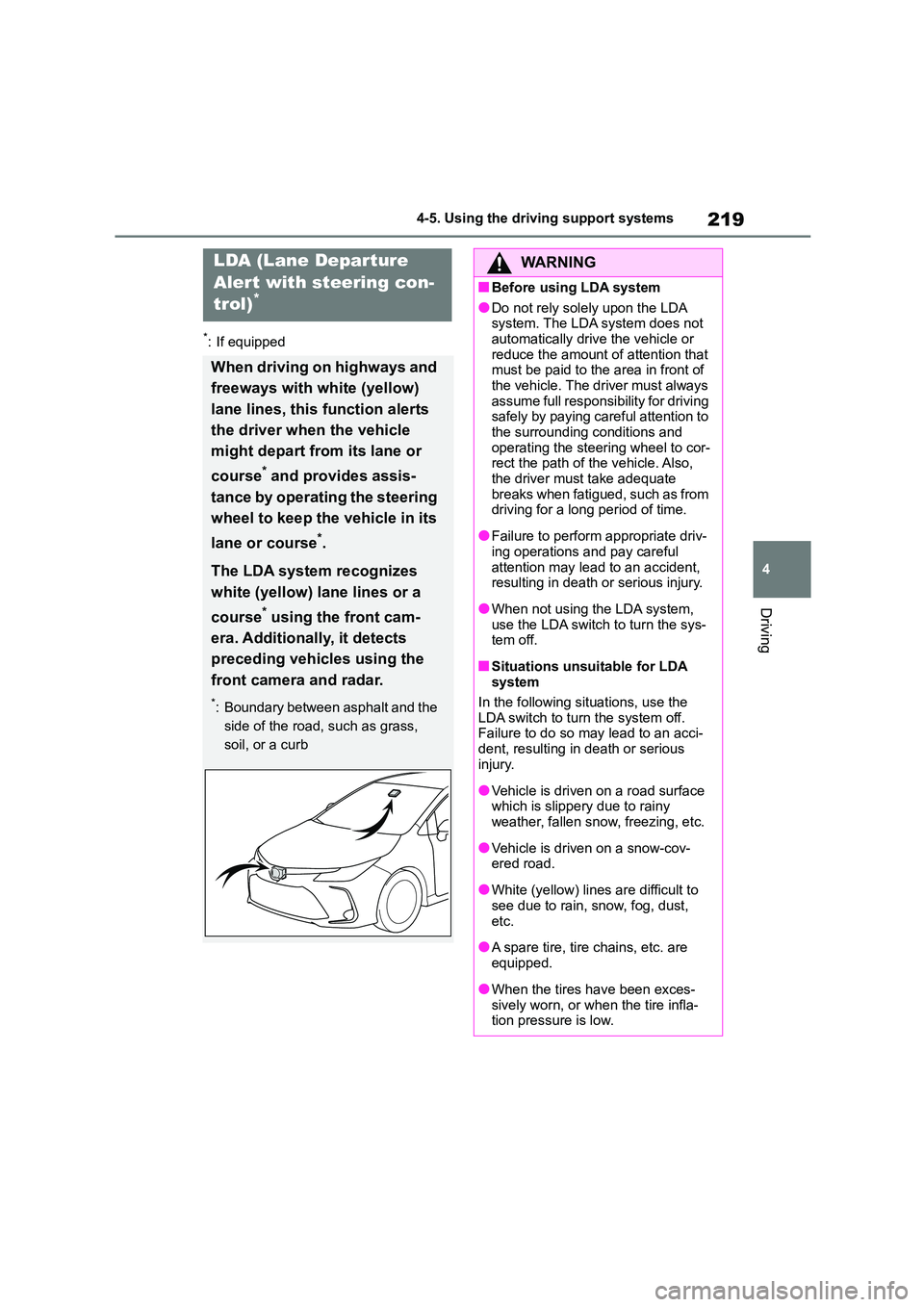
When driving on highways and
freeways with white (yellow)
lane lines, this function alerts
the driver when the vehicle
might depart from its lane or
course* and provides assis-
tance by operating the steering
wheel to keep the vehicle in its
lane or course*.
The LDA system recognizes
white (yellow) lane lines or a
course* using the front cam-
era. Additionally , it detects
preceding vehicles using the
front camera and radar.
*: Boundary between asphalt and the
side of the road, such as grass,
soil, or a curb
WA R N I N G
■Before using LDA system
●Do not rely solely upon the LDA
system. The LDA system does not automatically drive the vehicle or
reduce the amount of attention that
must be paid to the area in front of the vehicle. The driver must always
assume full responsibility for driving
safely by paying careful attention to
the surrounding conditions and operating the steering wheel to cor-
rect the path of the vehicle. Also,
the driver must take adequate breaks when fatigued, such as from
driving for a long period of time.
●Failure to perform appropriate driv-
ing operations and pay careful
attention may lead to an accident, resulting in death or serious injury.
●When not using the LDA system, use the LDA switch to turn the sys-
tem off.
■Situations unsuitable for LDA
system
In the following situations, use the LDA switch to turn the system off.
Failure to do so may lead to an acci-
dent, resulting in death or serious injury.
●Vehicle is driven on a road surface which is slippery due to rainy
weather, fallen snow, freezing, etc.
●Vehicle is driven on a snow-cov-
ered road.
●White (yellow) lines are difficult to
see due to rain, snow, fog, dust,
etc.
●A spare tire, tire chains, etc. are
equipped.
●When the tires have been exces-
sively worn, or when the tire infla- tion pressure is low.
Page 314 of 678

3124-5. Using the driving support systems
WA R N I N G
●If it seems the vehicle may make
contact with a pedestrian, another
vehicle or any other obstacles, stop the vehicle by depressing the brake
pedal, and then press the S-IPA
switch to turn off the system.
●Use the system in a parking lot with
a flat surface.
●Observe the following precautions,
as the steering wheel automatically
turns during use.
• There is risk of a necktie, scarf,
your arm, etc. being caught on the
steering wheel. Please do not allow your upper body to be close to the
steering wheel. Also, do not allow
children close to the steering wheel.
• There is a possibility of injury when
the steering wheel turns if you have long fingernails.
• In case of emergency, stop the vehicle by depressing the brake
pedal, and then press the S-IPA
switch to turn off the system.
●Always confirm that there is appro-
priate space before attempting to park the vehicle and operate the
system.
●Do not use the syst em in the follow-
ing situations, as the system may
be unable to correctly assist you in reaching the target parking spot
and may lead to an unexpected
accident.
• In an area that is not a parking lot
• A parking lot that is not paved and has no parking space lines, such as
a sand or gravel parking lot
• A parking lot that has a slope or
undulations in the road
• A frozen, snow-covered or slippery
road
• The asphalt is melting due to hot weather
• There is an obstacle between the vehicle and the target parking spot
• Using tire chains or compact spare tire (if equipped)
●Do not use tire other than that pro-vided by the manufacturer. The sys-
tem may not operate properly.
When replacing tires, contact any authorized Toyota retailer or Toyota
authorized repairer, or any reliable
repairer.
●The system may not be able posi-
tion the vehicle in the set location in the following situations.
• The tires are extremely worn or the
tire pressure is low
• The vehicle is carrying very heavy
load
• The vehicle is tilted due to having
luggage, etc. located on one side of the vehicle
• There are road heaters installed in the parking lot to prevent the road
surface from freezing.
In any other situations when the set
position and vehicle position greatly
differ, have the vehicle inspected by any authorized Toyota retailer or
Toyota authorized repairer, or any reli-
able repairer.
Page 432 of 678
4307-3. Do-it-yourself maintenance
Replace the tires if the treadwear indi-
cators are showing on a tire.
■When to replace your vehicle’s
tires
Tires should be replaced if:
●The treadwear indicators are showing on a tire.
●You have tire damage such as cuts, splits, cracks deep enough to expose
the fabric, and bulges indicating inter-
nal damage
●A tire goes flat repeatedly or cannot
be properly repaired due to the size or location of a cut or other damage
If you are not sure, consult with any
authorized Toyota retailer or Toyota authorized repairer, or any reliable
repairer.
■Tire life
Any tire over 6 years old must be checked by a qualified technician even if
it has seldom or never been used or
damage is not obvious.
■Low profile tires (17-inch tires and 18-inch tires)
Generally, low profile tires will wear
more rapidly and tire grip performance will be reduced on snowy and/or icy
roads when compared to standard tires.
Be sure to use snow tires or tire chains
on snowy and/or icy roads and drive carefully at a speed appropriate for road
and weather conditions.
■If the tread on snow tires wears
down below 4 mm (0.16 in.)
The effectiveness of the tires as snow
tires is lost.
■Checking the tire valves
When replacing the tires, check the tire valves for deformat ion, cracks, and
other damage.
WA R N I N G
■When inspecting or replacing
tires
Observe the following precautions to prevent accidents.
Failure to do so may cause damage
to parts of the drive train as well as dangerous handling characteristics,
which may lead to an accident result-
ing in death or serious injury.
●Do not mix tires of different makes,
models or tread patterns.
Also, do not mix tires of remarkably different treadwear.
●Do not use tire sizes other than those recommended by Toyota.
●Do not mix differently constructed tires (radial, bias-belted or bias-ply
tires).
●Do not mix summer, all season and
snow tires.
●Do not use tires that have been
used on another vehicle.
Do not use tires if you do not know how they were used previously.
●Vehicles with a compact spare tire: Do not tow if your vehicle has a
compact spare tire installed.
●Vehicles with an emergency tire
puncture repair kit: Do not tow any-
thing if a tire that has been repaired using the emergency tire puncture
repair kit is installed. The load on
the tire may cause unexpected damage to the tire.
NOTICE
■Low profile tires (17-inch tires
and 18-inch tires)
Low profile tires may cause greater
damage than usual to the tire wheel
when sustaining impact from the road surface. Therefore, pay attention to
the following:
Page 481 of 678
479
8
8-2. Steps to take in an emergency
When trouble arises
If the tire pressure warning light
comes on
1 After the temperature of the tires has lowered sufficiently, check the infla-
tion pressure of each tire and adjust
them to the specified level.
2 If the warning light does not turn off even after several minutes have
elapsed, check that the inflation
pressure of each tire is at the speci- fied level and perform initialization.
( P.442)
■The tire pressure warning light may
come on due to natural causes
The tire pressure warning light may
come on due to natural causes such as
natural air leaks and tire inflation pres- sure changes caused by temperature. In
this case, adjusting the tire inflation
pressure will turn off the warning light (after a few minutes).
■When a tire is replaced with a spare
tire
Vehicles with a compact spare tire: The compact spare tire is not equipped with
a tire pressure warning valve and trans-
mitter. If a tire goes flat, the tire pressure warning light will not turn off even
though the flat tire has been replaced
with the spare tire. Replace the spare tire with the repaired tire and adjust the
tire inflation pressure. The tire pressure
warning light will go off after a few min- utes.
Vehicles with a full-size spare tire: The
spare tire is also equipped with a tire pressure warning valve and transmitter.
The tire pressure warning light will turn
on if the tire inflation pressure of the spare tire is low. If a tire goes flat, the
tire pressure warning light will not turn
off even though the flat tire has been
replaced with the spare tire. Replace the spare tire with the repaired tire and
adjust the tire inflation pressure. The tire
pressure warning light will go off after a few minutes.
■Conditions that th e tire pressure
warning system may not function properly
P. 4 3 1
WA R N I N G
■If both the ABS and the brake system warning lights remain on
Stop your vehicle in a safe place
immediately and contact any author-
ized Toyota retailer or Toyota author- ized repairer, or any reliable repairer.
The vehicle will become extremely
unstable during br aking, and the ABS system may fail, which could cause
an accident resulting in death or seri-
ous injury.
■When the electric power steer-
ing system warning light comes on
When the light comes on yellow, the
assist to the power steering is restricted. When th e light comes on
red, the assist to the power steering is
lost and handling operations of the steering wheel become extremely
heavy.
When steering wheel operations are heavier than usual, grip the steering
wheel firmly and operate it using more
force than usual.
■If the tire pressure warning light
comes on
Be sure to observe the following pre-
cautions.
Failure to do so could cause a loss of vehicle control and re sult in death or
serious injury.
●Stop your vehicle in a safe place as
soon as possible. Adjust the tire
inflation pressure immediately.
Page 482 of 678
4808-2. Steps to take in an emergency
■Warning messages
The warning messages explained below
may differ from the actual messages
according to operation conditions and vehicle specifications.
■Warning buzzer
A buzzer may sound when a message is
displayed. The buzzer may not be audible if the
vehicle is in a noisy location or if the
audio system volume is high.
WA R N I N G
●Vehicles with a compact spare tire:
If the tire pressure warning light
comes on even after tire inflation pressure adjustment, it is probable
that you have a flat tire. Check the
tires. If a tire is flat, change it with the spare tire and have the flat tire
repaired by the nearest any author-
ized Toyota retailer or Toyota
authorized repairer, or any reliable repairer.
●Vehicles with emergency tire punc-ture repair kit: If the tire pressure
warning light comes on even after
tire inflation pressure adjustment, it is probable that you have a flat tire.
Check the tires. If a tire is flat, repair
the flat tire by using emergency tire puncture repair kit.
●Avoid abrupt maneuvering and braking.
If the vehicle tires deteriorate, you
could lose control of the steering wheel or the brakes.
■If a blowout or sudden air leak-age should occur
The tire pressure warning system
may not activate immediately.
NOTICE
■To ensure the tire pressure warn- ing system operates properly
Do not install tires with different speci-
fications or makers, as the tire pres- sure warning system may not operate
properly.
If a war ning message is
displayed
The multi-information display
shows warnings for system
malfunctions and incorrectly
performed operations, and
messages that indicate a need
for maintenance. When a mes-
sage is displayed, perform the
appropriate corrective action
for the message.
If a warning message is dis-
played again after the appro-
priate actions have been
performed, contact any author-
ized Toyota retailer or Toyota
authorized repairer, or any reli-
able repairer.
Additionally, if a warning light
comes on or flashes at the
same time that a warning mes-
sage is displayed, take the
appropriate corrective action
for the warning light. ( P.471)