2022 TOYOTA COROLLA CROSS Child safety seat
[x] Cancel search: Child safety seatPage 1 of 612

1
2
3
4
5
6
COROLLA CROSS_MTMUS_U
7
8
9
10
Pictorial indexSearch by illustration
For safety
and securityMake sure to read through them
(Main topics: Child seat, theft deterrent system)
Vehicle status
information and
indicatorsReading driving-related information
(Main topics: Meters, multi-information display)
Before driving
Opening and closing the doors and windows,
adjustment before driving
(Main topics: Keys, doors, seats)
Driving
Operations and advice which are necessary for
driving
(Main topics: Starting engine, refueling)
AudioOperating the Audio
(Main topics: Audio/visual, phone)
Interior featuresUsage of the interior features
(Main topics: Air conditioner, storage features)
Maintenance
and careCaring for your vehicle and maintenance
procedures
(Main topics: Interior and exterior, light bulbs)
When trouble
arisesWhat to do in case of malfunction and emergency
(Main topics: Battery discharge, flat tire)
Vehicle
specificationsVehicle specifications, customizable features
(Main topics: Fuel, oil, tire inflation pressure)
For ownersReporting safety defects for U.S. owners, and seat
belt and SRS airbag instructions for Canadian
owners
IndexSearch by symptom
Search alphabetically
Page 2 of 612

2TABLE OF CONTENTS
For your information ........................7
Reading this manual ...................... 12
How to search ................................ 13
Pictorial index ................................ 14
1-1. For safe use Before driving ........................ 24
For safe driving ..................... 25
Seat belts .............................. 27
SRS airbags .......................... 31
Front passenger occupant clas- sification system.................. 40
Exhaust gas precautions....... 44
1-2. Child safety Riding with children ............... 45
Child restraint systems .......... 46
1-3. Emergency assistance Safety Connect ..................... 67
1-4. Theft deterrent system Engine immobilizer system ... 71
Alarm ..................................... 72
2-1. Instrument cluster Warning lights and indicators............................................ 76
Gauges and meters (4.2-inch display)................................ 81
Gauges and meters (7-inch dis- play) .................................... 85
Multi-information display ....... 90
Fuel consumption information ............................................ 973-1. Key information
Keys ................................... 100
3-2. Opening, closing and locking
th e doors
Side doors .......................... 104
Back door ........................... 109
Smart key system .............. 119
3-3. Adjusting the seats Front seats ......................... 124
Rear seats.......................... 125
Head restraints................... 127
3-4. Adjust ing the steering wheel
and mirrors
Ste ering wheel ................... 129
Inside rear view mirror ....... 130
Outside rear view mirrors ... 131
3-5. Opening and closing the win- dows
Power windows .................. 133
Moon roof ........................... 136
4-1. Before driving Driving the vehicle.............. 141
Cargo and luggage ............ 147
Vehicle load limits .............. 150
Trailer towing...................... 151
Dinghy towing .................... 161
4-2. Driving procedures Engine (ignition) switch (vehicles without a smart key system)......................................... 162
Engine (ignition) switch (vehicles with a smart key system) . 163
Continuously variable transmis- sion .
................................. 167
Turn signal lever................. 170
1For safety and security
2Vehicle status information
and indicators
3Before driving
4Driving
Page 23 of 612

23
1
1
For safety and security
For safety and security
.1-1. For safe useBefore driving ................. 24
For safe driving .............. 25
Seat belts ....................... 27
SRS airbags ................... 31
Front passenger occupant classification system .... 40
Exhaust gas precautions ..................................... 44
1-2. Child safety Riding with children ........ 45
Child restraint systems... 46
1-3. Emergency assistance Safety Connect .............. 67
1-4. Theft deterrent system Engine immobilizer system..................................... 71
Alarm.............................. 72
Page 27 of 612
271-1. For safe use
1
For safety and security
Seat belts
Make sure that all occu-
pants are wearing their seat
belts before driving the
vehicle.
WARNING
Observe the following precautions
to reduce the risk of injury in the
event of sudden braking, sudden
swerving or an accident.
Failure to do so may cause death
or serious injury.
■Wearing a seat belt
●Ensure that all passengers wear
a seat belt.
●Always wear a seat belt prop-
erly.
●Each seat belt should be used
by one person only. Do not use
a seat belt for more than one
person at once, including chil-
dren.
●Toyota recommends that chil-
dren be seated in the rear seat
and always use a seat belt
and/or an appropriate child
restraint system.
●To achieve a proper seating
position, do not recline the seat
more than necessary. The seat
belt is most effective when the
occupants are sitting up straight
and well back in the seats.
●Do not wear the shoulder belt
under your arm.
●Always wear your seat belt low
and snug across your hips.
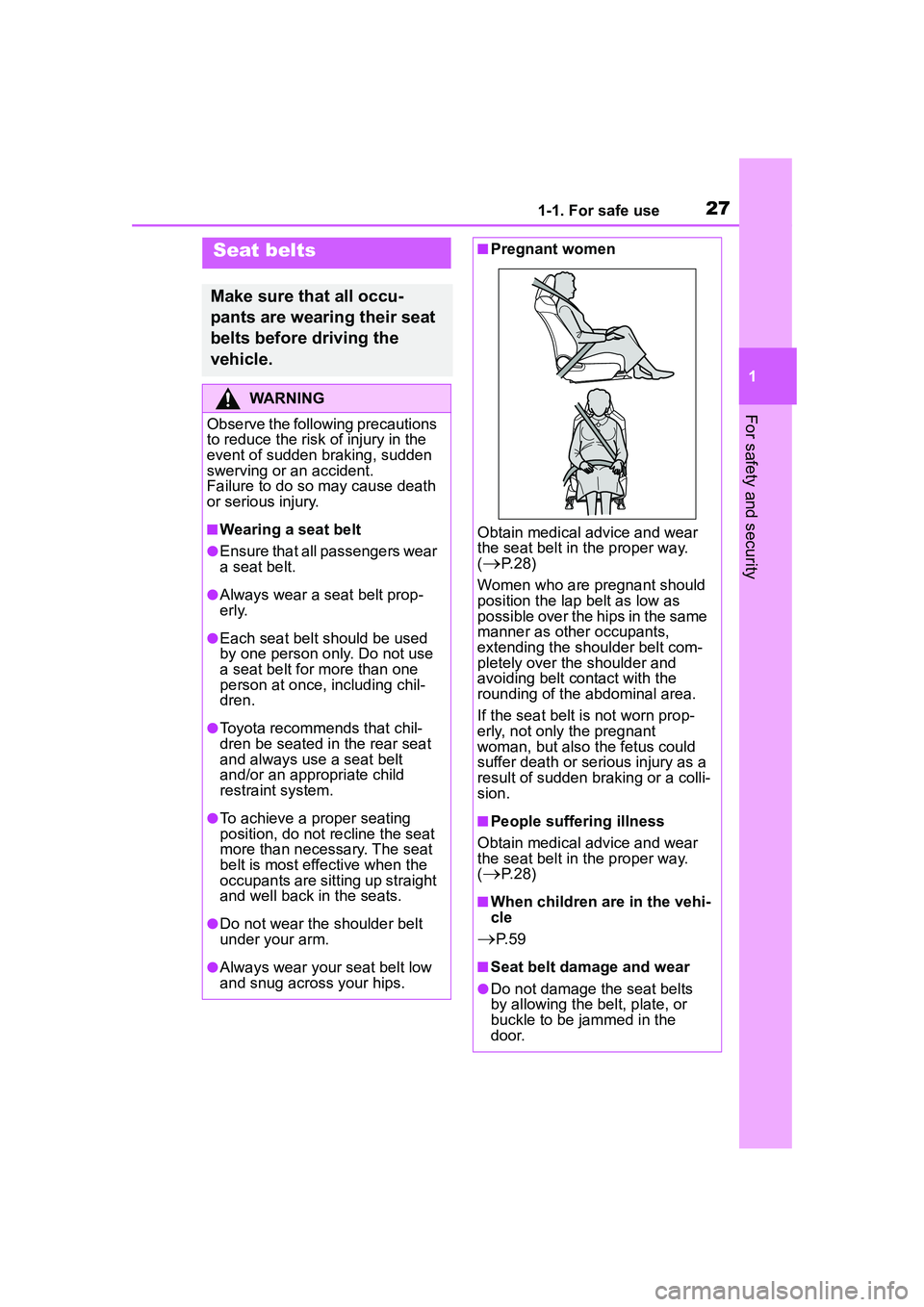
■Pregnant women
Obtain medical advice and wear
the seat belt in the proper way.
(
P. 2 8 )
Women who are pregnant should
position the lap belt as low as
possible over the hips in the same
manner as other occupants,
extending the shoulder belt com-
pletely over the shoulder and
avoiding belt contact with the
rounding of the abdominal area.
If the seat belt is not worn prop-
erly, not only the pregnant
woman, but also the fetus could
suffer death or serious injury as a
result of sudden braking or a colli-
sion.
■People suffering illness
Obtain medical advice and wear
the seat belt in the proper way.
(
P. 2 8 )
■When children are in the vehi-
cle
P. 5 9
■Seat belt damage and wear
●Do not damage the seat belts
by allowing the belt, plate, or
buckle to be jammed in the
door.
Page 29 of 612
291-1. For safe use
1
For safety and security
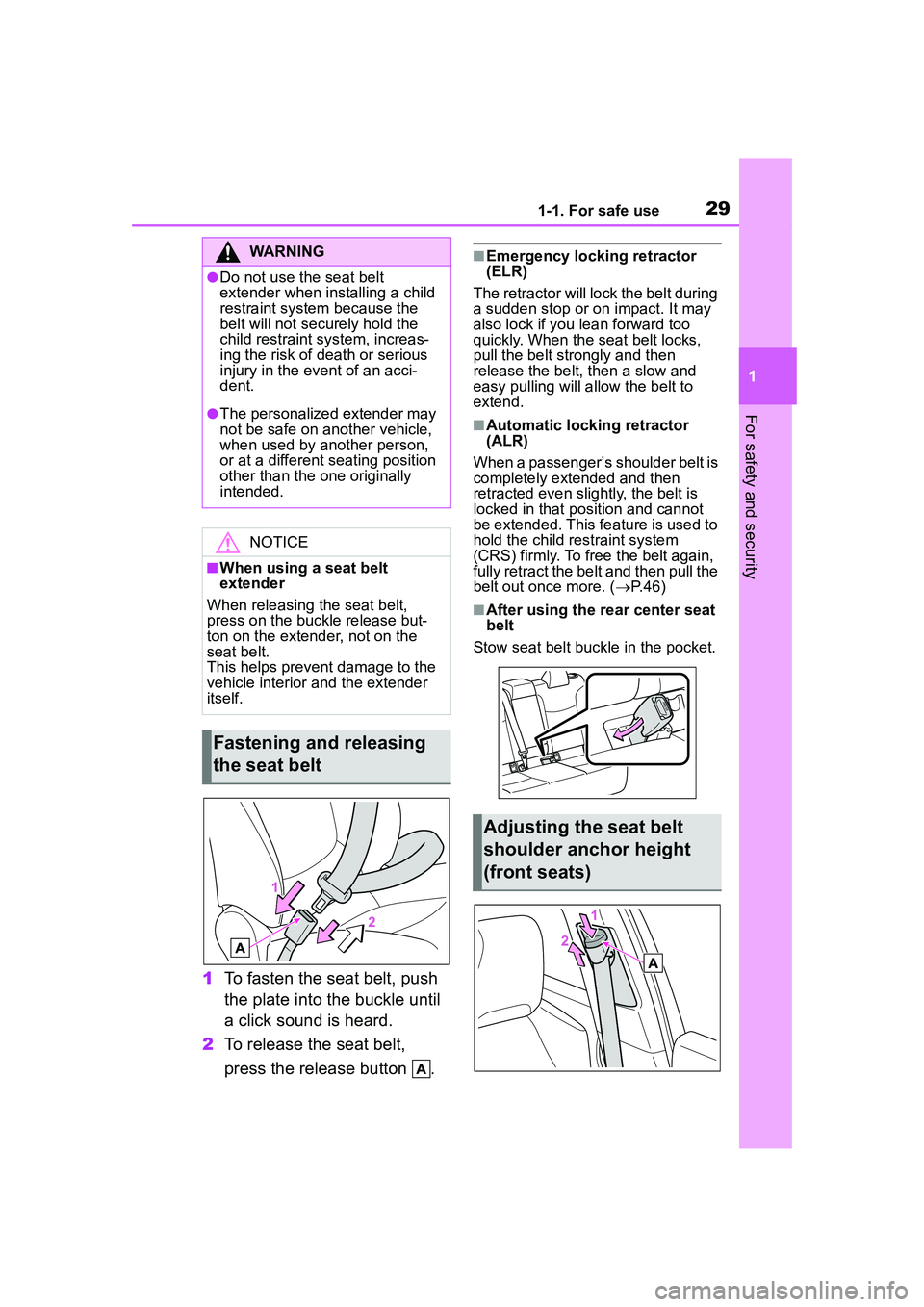
1To fasten the seat belt, push
the plate into the buckle until
a click sound is heard.
2 To release the seat belt,
press the release button .
■Emergency locking retractor
(ELR)
The retractor will lock the belt during
a sudden stop or on impact. It may
also lock if you lean forward too
quickly. When the seat belt locks,
pull the belt strongly and then
release the belt, then a slow and
easy pulling will allow the belt to
extend.
■Automatic locking retractor
(ALR)
When a passenger’s shoulder belt is
completely extended and then
retracted even slightly, the belt is
locked in that position and cannot
be extended. This feature is used to
hold the child restraint system
(CRS) firmly. To free the belt again,
fully retract the belt and then pull the
belt out once more. ( P. 4 6 )
■After using the rear center seat
belt
Stow seat belt buckle in the pocket.
WARNING
●Do not use the seat belt
extender when installing a child
restraint system because the
belt will not securely hold the
child restraint system, increas-
ing the risk of death or serious
injury in the event of an acci-
dent.
●The personalized extender may
not be safe on another vehicle,
when used by another person,
or at a different seating position
other than the one originally
intended.
NOTICE
■When using a seat belt
extender
When releasing the seat belt,
press on the buckle release but-
ton on the extender, not on the
seat belt.
This helps prevent damage to the
vehicle interior and the extender
itself.
Fastening and releasing
the seat belt
Adjusting the seat belt
shoulder anchor height
(front seats)
Page 37 of 612
371-1. For safe use
1
For safety and security
WARNING
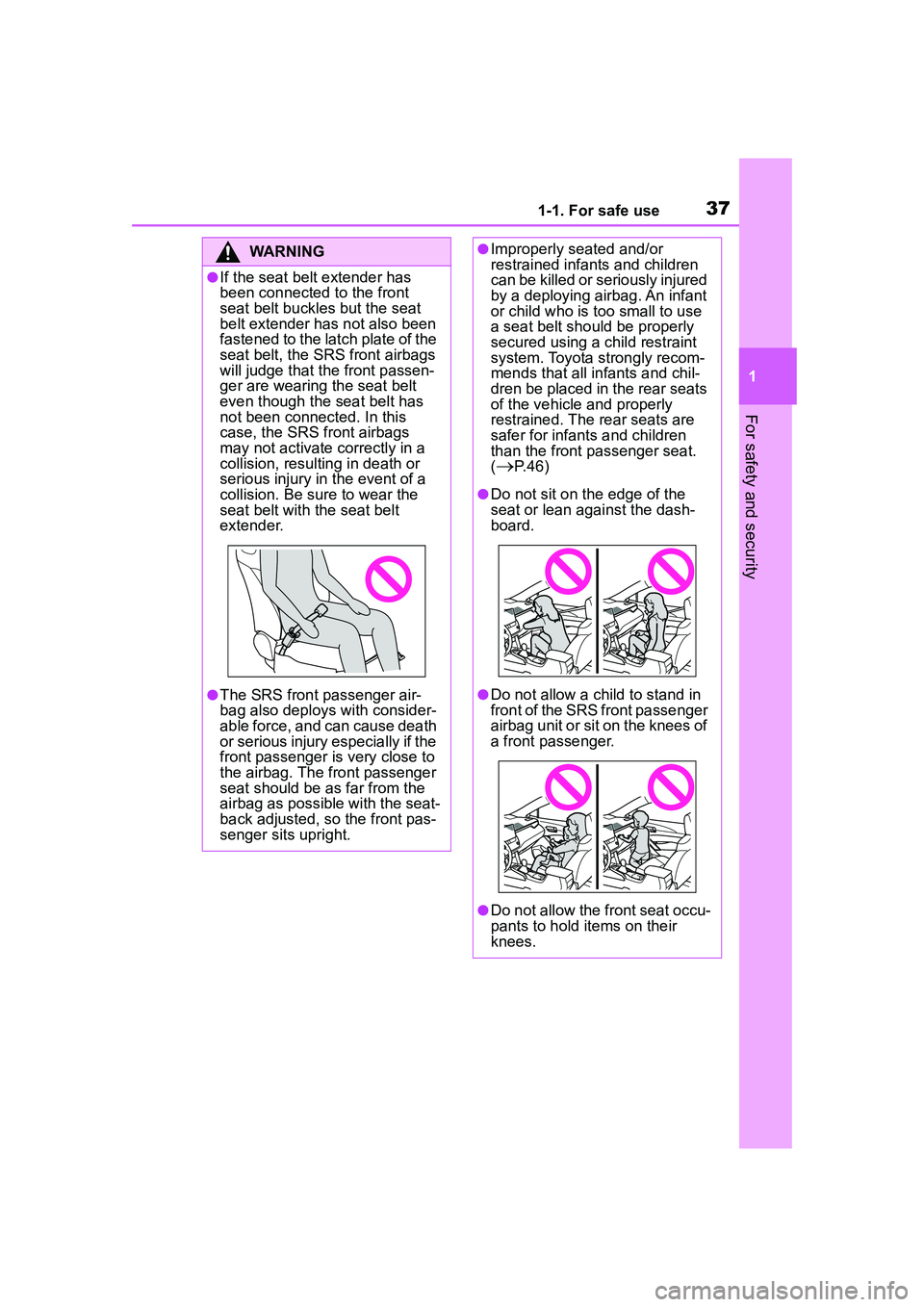
●If the seat belt extender has
been connected to the front
seat belt buckles but the seat
belt extender has not also been
fastened to the latch plate of the
seat belt, the SRS front airbags
will judge that the front passen-
ger are wearing the seat belt
even though the seat belt has
not been connected. In this
case, the SRS front airbags
may not activate correctly in a
collision, resulting in death or
serious injury in the event of a
collision. Be sure to wear the
seat belt with the seat belt
extender.
●The SRS front passenger air-
bag also deploys with consider-
able force, and can cause death
or serious injury especially if the
front passenger is very close to
the airbag. The front passenger
seat should be as far from the
airbag as possible with the seat-
back adjusted, so the front pas-
senger sits upright.
●Improperly seated and/or
restrained infants and children
can be killed or seriously injured
by a deploying airbag. An infant
or child who is too small to use
a seat belt should be properly
secured using a child restraint
system. Toyota strongly recom-
mends that all infants and chil-
dren be placed in the rear seats
of the vehicle and properly
restrained. The rear seats are
safer for infants and children
than the front passenger seat.
(
P. 4 6 )
●Do not sit on the edge of the
seat or lean against the dash-
board.
●Do not allow a child to stand in
front of the SRS front passenger
airbag unit or sit on the knees of
a front passenger.
●Do not allow the front seat occu-
pants to hold items on their
knees.
Page 41 of 612
411-1. For safe use
1
For safety and security
WARNING
●Make sure the “AIR BAG OFF”
indicator light is not illuminated
when using the seat belt
extender for the front passenger
seat. If the “AIR BAG OFF” indi-
cator light is illuminated, discon-
nect the extender tongue from
the seat belt buckle, and recon-
nect the seat belt. Reconnect
the seat belt extender after
making sure the “AIR BAG ON”
indicator light is illuminated. If
you use the seat belt extender
while the “AIR BAG OFF” indi-
cator light is illuminated, the
SRS airbags for the front pas-
senger will not activate, which
could cause death or serious
injury in the event of a collision.
●Do not apply a heavy load to the
front passenger seat or equip-
ment (e.g. seatback pocket).
●Do not put weight on the front
passenger seat by putting your
hands or feet on the front pas-
senger seat seatback from the
rear passenger seat.
●Do not let a rear passenger lift
the front passenger seat with
their feet or press on the seat-
back with their legs.
●Do not put objects under the
front passenger seat.
●Do not recline the front passen-
ger seatback so far that it
touches a rear seat. This may
cause the “AIR BAG OFF” indi-
cator light to be illuminated,
which indicates that the SRS
airbags for the front passenger
will not activate in the event of a
severe accident. If the seatback
touches the rear seat, return the
seatback to a position where it
does not touch the rear seat.
Keep the front passenger seat-
back as upright as possible
when the vehicle is moving.
Reclining the seatback exces-
sively may lessen the effective-
ness of the seat belt system.
●If an adult sits in the front pas-
senger seat, the “AIR BAG ON”
indicator light is illuminated. If
the “AIR BAG OFF” indicator is
illuminated, ask the passenger
to sit up straight, well back in
the seat, feet on the floor, and
with the seat belt worn correctly.
If the “AIR BAG OFF” indicator
still remains illuminated, either
ask the passenger to move to
the rear seat, or if that is not
possible, move the front pas-
senger seat fully rearward.
●When it is unavoidable to install
a forward-facing child restraint
system on the front passenger
seat, install the child restraint
system on the front passenger
seat in the proper order.
(
P. 4 8 )
●Do not modify or remove the
front seats.
●Do not kick the front passenger
seat or subject it to severe
impact. Otherwise, the SRS
warning light may come on to
indicate a malfunction of the
front passenger occupant clas-
sification system. In this case,
contact your Toyota dealer
immediately.
Page 43 of 612
431-1. For safe use
1
For safety and security
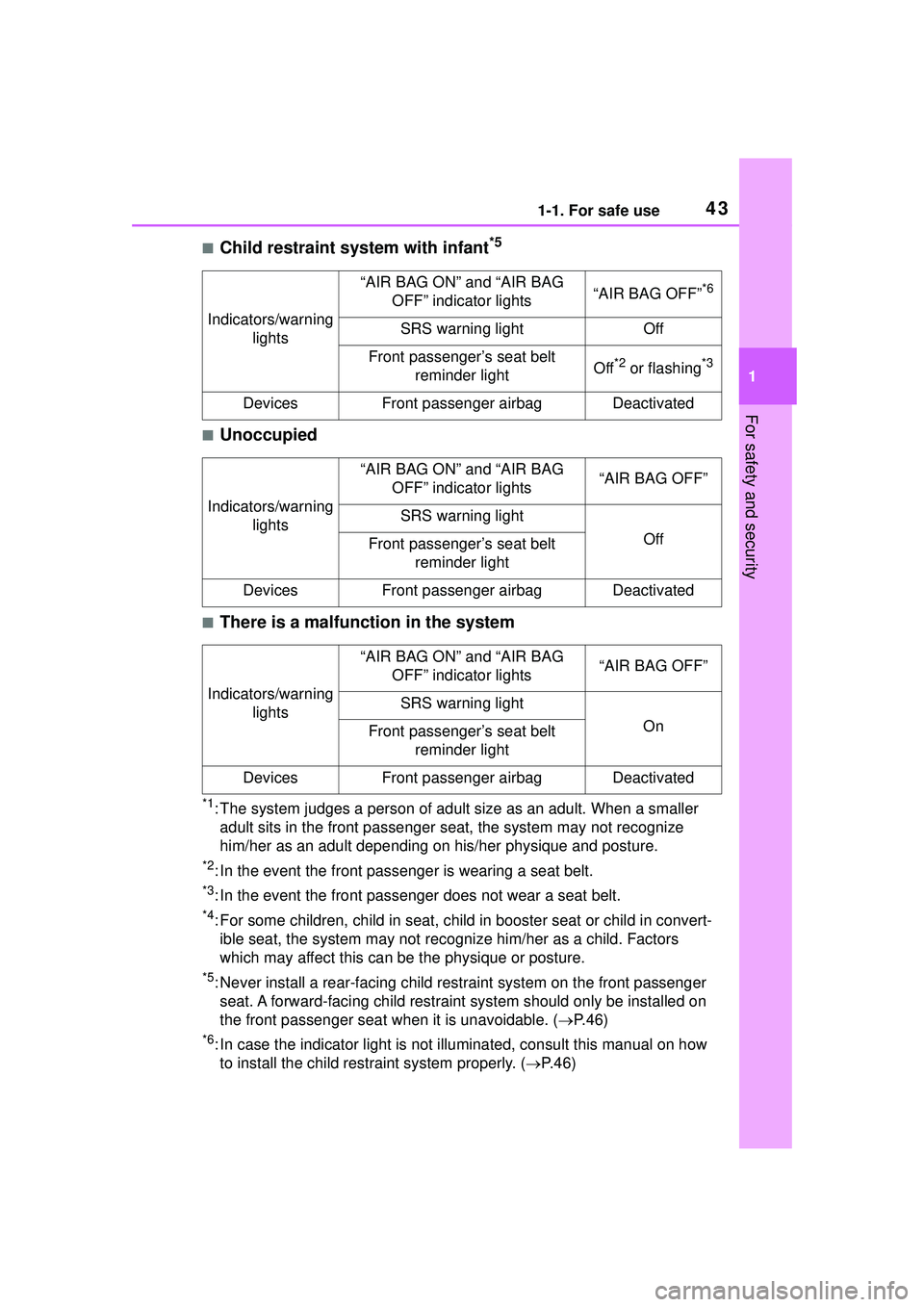
■Child restraint system with infant*5
■Unoccupied
■There is a malfunction in the system
*1: The system judges a person of adult size as an adult. When a smaller adult sits in the front passenger seat, the system may not recognize
him/her as an adult depending on his/her physique and posture.
*2: In the event the front passenger is wearing a seat belt.
*3: In the event the front passenger does not wear a seat belt.
*4: For some children, child in seat, child in booster seat or child in convert-
ible seat, the system may not rec ognize him/her as a child. Factors
which may affect this can be the physique or posture.
*5: Never install a rear-facing child rest raint system on the front passenger
seat. A forward-facing child restraint system should only be installed on
the front passenger seat w hen it is unavoidable. (P.46)
*6: In case the indicator light is not illu minated, consult this manual on how
to install the child restraint system properly. ( P. 4 6 )
Indicators/warning
lights
“AIR BAG ON” and “AIR BAG OFF” indicator lights“AIR BAG OFF”*6
SRS warning lightOff
Front passenger’s seat belt reminder lightOff*2 or flashing*3
DevicesFront passenger airbagDeactivated
Indicators/warning lights
“AIR BAG ON” and “AIR BAG OFF” indicator lights“AIR BAG OFF”
SRS warning light
OffFront passenger’s seat belt reminder light
DevicesFront passenger airbagDeactivated
Indicators/warning lights
“AIR BAG ON” and “AIR BAG OFF” indicator lights“AIR BAG OFF”
SRS warning light
OnFront passenger’s seat belt reminder light
DevicesFront passenger airbagDeactivated