2022 TOYOTA COROLLA CROSS ECU
[x] Cancel search: ECUPage 45 of 612
451-2. Child safety
1
For safety and security
1-2.Child safety
Riding with children
Observe the following pre-
cautions when children are
in the vehicle.
Use a child restraint system
appropriate for the child,
until the child becomes
large enough to properly
wear the vehicle’s seat belt.
It is recommended that chil-
dren sit in the rear seats to
avoid accidental contact
with the shift lever, wiper
switch, etc.
Use the rear door child-pro-
tector lock or the window
lock switch to avoid children
opening the door while driv-
ing or operating the power
window accidentally.
( P.108, 135)
Do not let small children
operate equipment which
may catch or pinch body
parts, such as the power
window, hood, back door,
seats, etc.
WARNING
■When children are in the vehi-
cle
Never leave children unattended
in the vehicle, and never allow
children to have or use the key.
Children may be able to start the
vehicle or shift the vehicle into
neutral. There is also a danger
that children ma y injure them-
selves by playing with the win-
dows, the moon roof (if equipped)
or other features of the vehicle. In
addition, heat build-up or
extremely cold temperatures
inside the vehicle can be fatal to
children.
Page 47 of 612
471-2. Child safety
1
For safety and security
WARNING
●For effective protection in auto-
mobile accidents and sudden
stops, a child must be properly
restrained, using a seat belt or
child restraint system which is
correctly installed. For installa-
tion details, refer to the opera-
tion manual enclosed with the
child restraint system. General
installation instruction is pro-
vided in this manual.
●Toyota strongly urges the use of
a proper child restraint system
that conforms to the weight and
size of the child, installed on the
rear seat. According to accident
statistics, the child is safer when
properly restrained in the rear
seat than in the front seat.
●Holding a child in your or some-
one else’s arms is not a substi-
tute for a child restraint system.
In an accident, the child can be
crushed against the windshield
or between the holder and the
interior of the vehicle.
■Handling the child restraint
system
If the child restrain t system is not
properly fixed in place, the child or
other passengers may be seri-
ously injured or even killed in the
event of sudden braking, sudden
swerving, or an accident.
●If the vehicle were to receive a
strong impact from an accident,
etc., it is possible that the child
restraint system has damage
that is not readily visible. In
such cases, do not reuse the
restraint system.
●For Puerto Rico: Depending on
the child restraint system, instal-
lation may be difficult or impos-
sible. In those cases, check
whether the child restraint sys-
tem is suitable fo r installment in
the vehicle. (
P.50) Be sure to
install and observe the usage
rules after carefully reading the
child restraint system fixing
method in this manual, as well
as the operation manual
enclosed with the child restraint
system.
●Except for Puerto Rico: Make
sure you have complied with all
installation instru ctions provided
with the child restraint system
manufacturer and that the sys-
tem is properly secured.
●Keep the child restraint system
properly secured on the seat
even if it is not in use. Do not
store the child restraint system
unsecured in the passenger
compartment.
●If it is necessary to detach the
child restraint sy stem, remove it
from the vehicle or store it
securely in the luggage com-
partment.
Page 49 of 612
491-2. Child safety
1
For safety and security
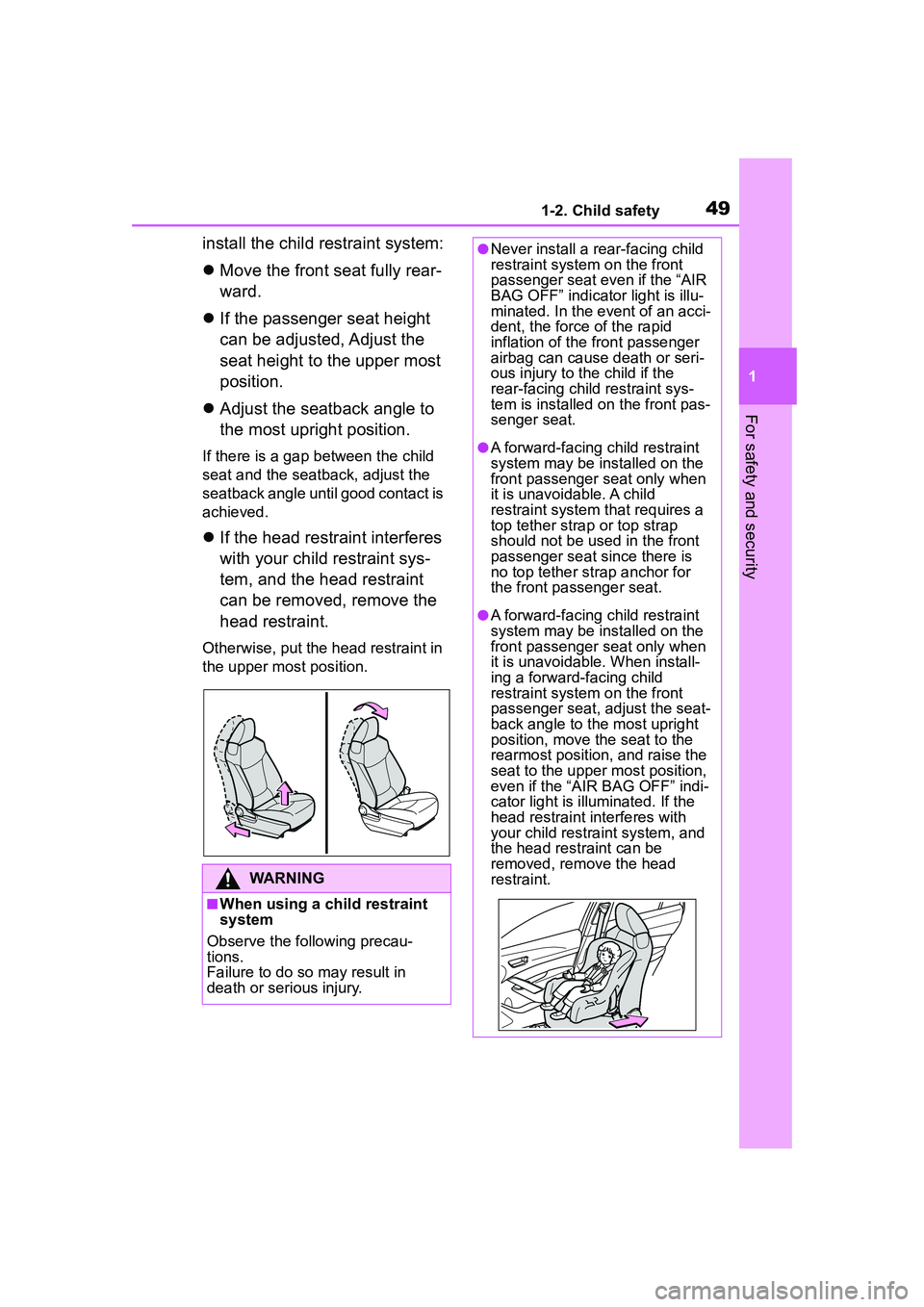
install the child restraint system:
Move the front seat fully rear-
ward.
If the passenger seat height
can be adjusted, Adjust the
seat height to the upper most
position.
Adjust the seatback angle to
the most upright position.
If there is a gap between the child
seat and the seatback, adjust the
seatback angle until good contact is
achieved.
If the head restraint interferes
with your child restraint sys-
tem, and the head restraint
can be removed, remove the
head restraint.
Otherwise, put the head restraint in
the upper most position.
WARNING
■When using a child restraint
system
Observe the following precau-
tions.
Failure to do so may result in
death or serious injury.
●Never install a re ar-facing child
restraint system on the front
passenger seat even if the “AIR
BAG OFF” indicator light is illu-
minated. In the event of an acci-
dent, the force of the rapid
inflation of the front passenger
airbag can cause death or seri-
ous injury to the child if the
rear-facing child restraint sys-
tem is installed on the front pas-
senger seat.
●A forward-facing child restraint
system may be installed on the
front passenger seat only when
it is unavoidable. A child
restraint system that requires a
top tether strap or top strap
should not be used in the front
passenger seat since there is
no top tether strap anchor for
the front passenger seat.
●A forward-facing child restraint
system may be installed on the
front passenger seat only when
it is unavoidable. When install-
ing a forward-facing child
restraint system on the front
passenger seat, adjust the seat-
back angle to the most upright
position, move the seat to the
rearmost position, and raise the
seat to the upper most position,
even if the “AIR BAG OFF” indi-
cator light is illuminated. If the
head restraint interferes with
your child restraint system, and
the head restraint can be
removed, remove the head
restraint.
Page 51 of 612

511-2. Child safety
1
For safety and security
Check the selected child
restraint system together with
the following [Before confirming
the compatibility of each seating
position with child restraint sys-
tems].
■Before confirming the com-
patibility of each seating
position with child restraint
systems
1 Checking the child restraint
system standards.
Use a child restraint system
that conforms to UN(ECE)
R44
*1 or UN(ECE) R129*1, 2.
The following approval mark
is displayed on child restraint
systems which are con-
formed.
Check for an approval mark
attached to the child restraint
system.
Example of the displayed regulation
number
UN(ECE) R44 approval
mark
*3
The weight range of the child
who is applicable for an
UN(ECE) R44 approval mark
is indicated.
UN(ECE) R129 approval
mark
*3
The height range of the child
who is applicable as well as
available weights for an
UN(ECE) R129 approval
mark is indicated.
2 Checking the category of the
child restraint system.
Check the approval mark of
the child restraint system for
which of the following catego-
ries the child restraint system
is suitable.
Also, if there are any uncer-
tainties, check the user’s
guide included with the child
restraint system or contact
the retailer of the child
restraint system.
• “universal”
• “semi-universal”
• “restricted”
• “vehicle specific”
*1: UN(ECE) R44 and UN(ECE) R129 are U.N. regulations for
child restraint systems.
Page 53 of 612
531-2. Child safety
1
For safety and security
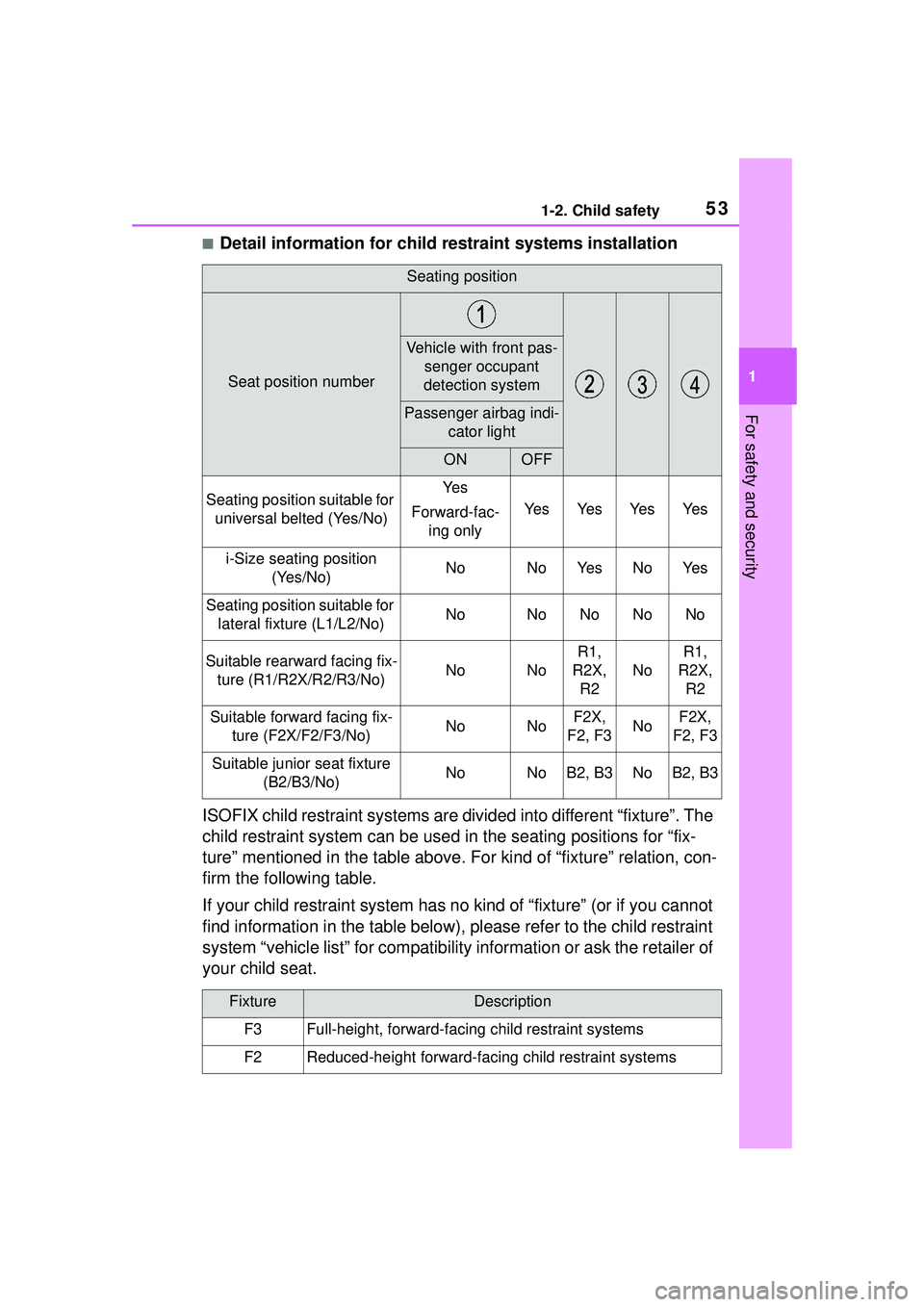
■Detail information for child restraint systems installation
ISOFIX child restraint systems are divided into different “fixture”. The
child restraint system can be used in the seating positions for “fix-
ture” mentioned in the table above. For kind of “fixture” relation, con-
firm the following table.
If your child restraint system has no kind of “fixture” (or if you cannot
find information in the table below), please refer to the child restraint
system “vehicle list” for compatibility information or ask the retailer of
your child seat.
Seating position
Seat position number
Vehicle with front pas- senger occupant
detection system
Passenger airbag indi- cator light
ONOFF
Seating position suitable for universal belted (Yes/No)Ye s
Forward-fac- ing only
Ye sYe sYe sYe s
i-Size seating position (Yes/No)NoNoYe sNoYe s
Seating position suitable for lateral fixture (L1/L2/No)NoNoNoNoNo
Suitable rearward facing fix-ture (R1/R2X/R2/R3/No)NoNo
R1,
R2X, R2
No
R1,
R2X, R2
Suitable forward facing fix- ture (F2X/F2/F3/No)NoNoF2X,
F2, F3NoF2X,
F2, F3
Suitable junior seat fixture (B2/B3/No)NoNoB2, B3NoB2, B3
FixtureDescription
F3Full-height, forward-facing child restraint systems
F2Reduced-height forward-facing child restraint systems
Page 54 of 612
541-2. Child safety
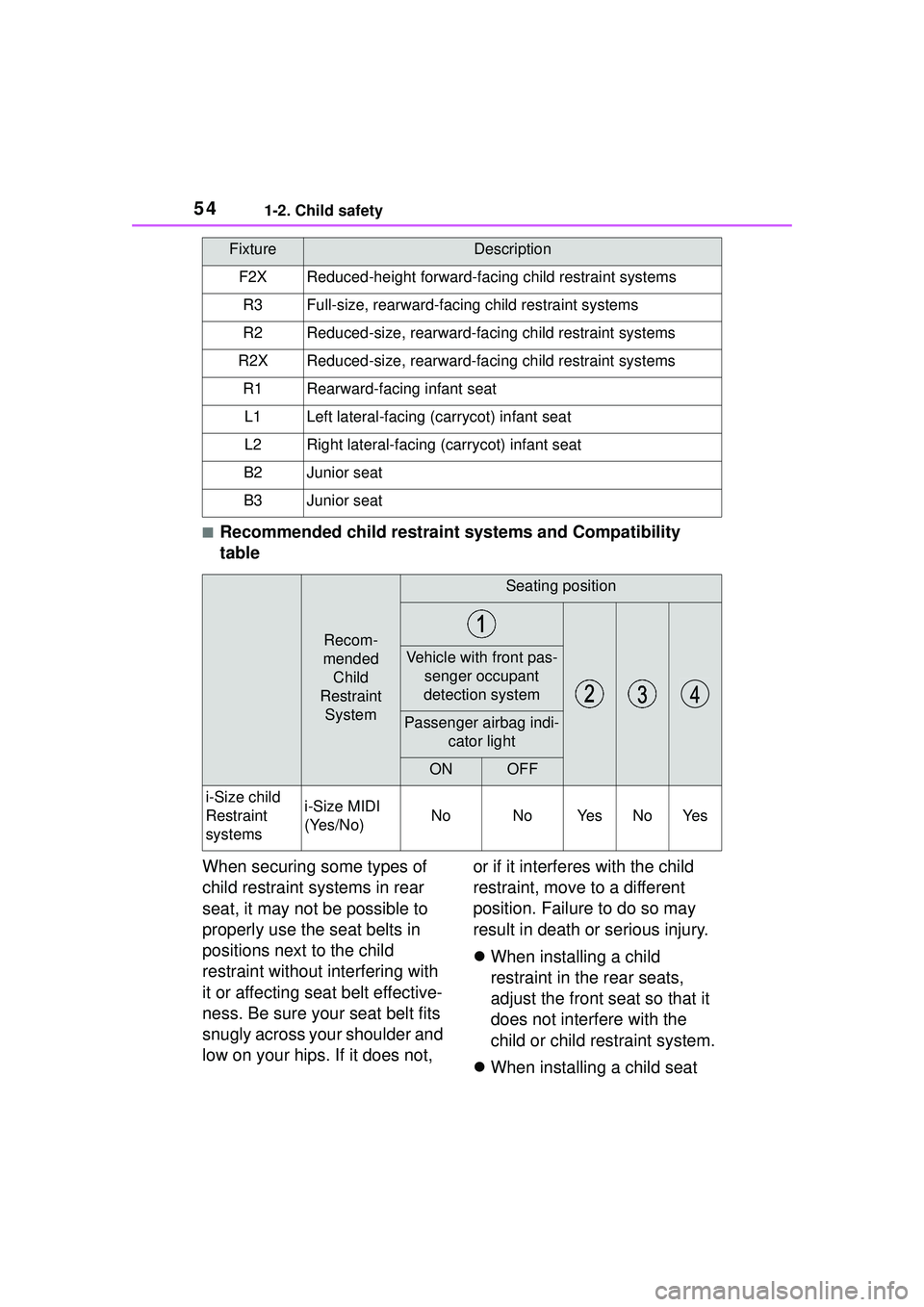
■Recommended child restraint systems and Compatibility
table
When securing some types of
child restraint systems in rear
seat, it may not be possible to
properly use the seat belts in
positions next to the child
restraint without interfering with
it or affecting seat belt effective-
ness. Be sure your seat belt fits
snugly across your shoulder and
low on your hips. If it does not, or if it interferes with the child
restraint, move to a different
position. Failure to do so may
result in death or serious injury.
When installing a child
restraint in the rear seats,
adjust the front seat so that it
does not interfere with the
child or child restraint system.
When installing a child seat
F2XReduced-height forward-facing child restraint systems
R3Full-size, rearward-facing child restraint systems
R2Reduced-size, rearward-fac ing child restraint systems
R2XReduced-size, rearward-facing child restraint systems
R1Rearward-facing infant seat
L1Left lateral-facing (carrycot) infant seat
L2Right lateral-facing (carrycot) infant seat
B2Junior seat
B3Junior seat
Recom-
mended Child
Restraint System
Seating position
Vehicle with front pas- senger occupant
detection system
Passenger airbag indi- cator light
ONOFF
i-Size child
Restraint
systemsi-Size MIDI
(Yes/No)NoNoYe sNoYe s
FixtureDescription
Page 55 of 612
551-2. Child safety
1
For safety and security
with support base, if the child
seat interferes with the seat-
back when latching it into the
support base, adjust the seat-
back rearward until there is no
interference.
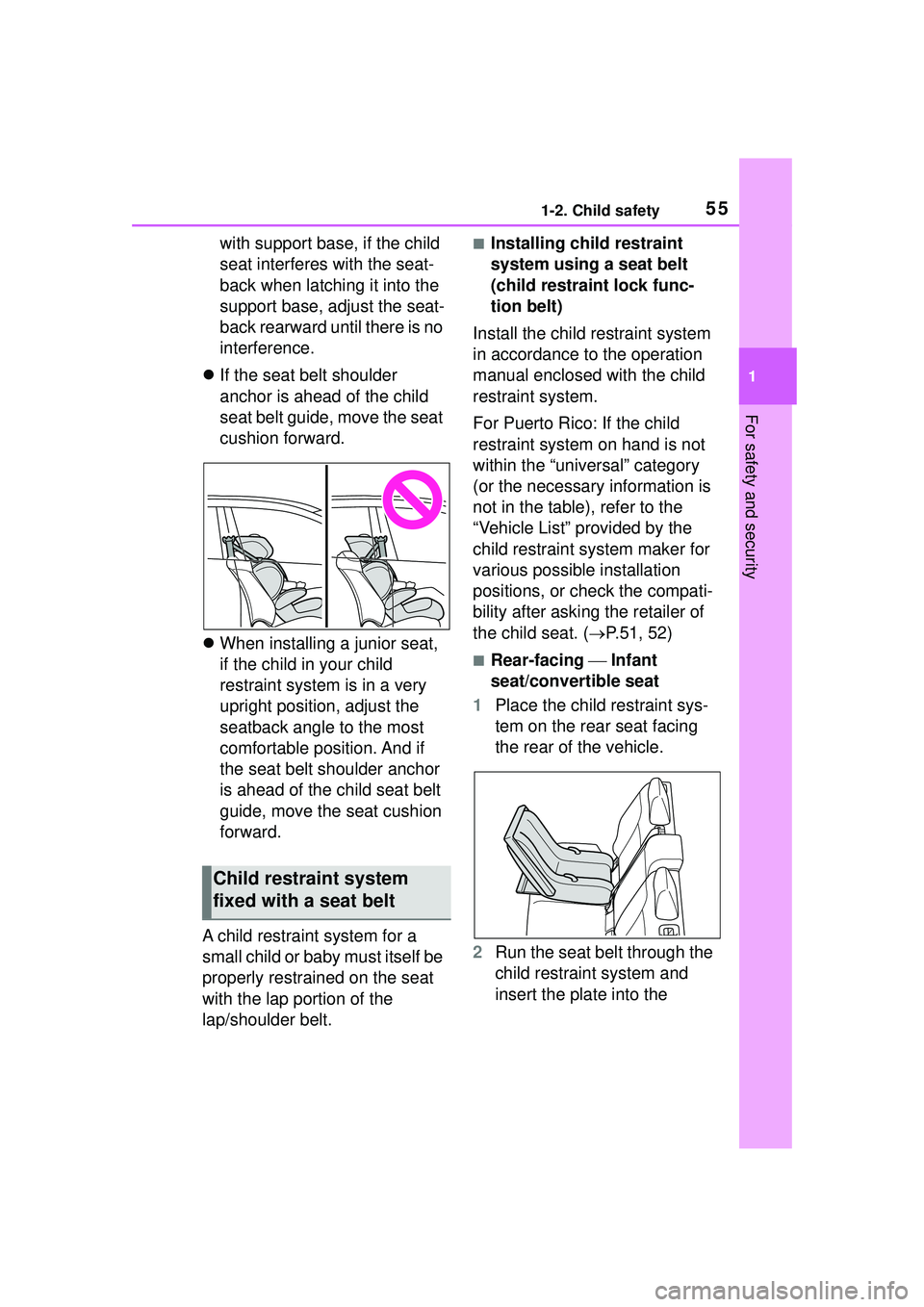
If the seat belt shoulder
anchor is ahead of the child
seat belt guide, move the seat
cushion forward.
When installing a junior seat,
if the child in your child
restraint system is in a very
upright position, adjust the
seatback angle to the most
comfortable position. And if
the seat belt shoulder anchor
is ahead of the child seat belt
guide, move the seat cushion
forward.
A child restraint system for a
small child or baby must itself be
properly restrained on the seat
with the lap portion of the
lap/shoulder belt.■Installing child restraint
system using a seat belt
(child restraint lock func-
tion belt)
Install the child restraint system
in accordance to the operation
manual enclosed with the child
restraint system.
For Puerto Rico: If the child
restraint system on hand is not
within the “universal” category
(or the necessary information is
not in the table), refer to the
“Vehicle List” provided by the
child restraint system maker for
various possible installation
positions, or check the compati-
bility after asking the retailer of
the child seat. ( P.51, 52)
■Rear-facing Infant
seat/convertible seat
1 Place the child restraint sys-
tem on the rear seat facing
the rear of the vehicle.
2 Run the seat belt through the
child restraint system and
insert the plate into the
Child restraint system
fixed with a seat belt
Page 56 of 612
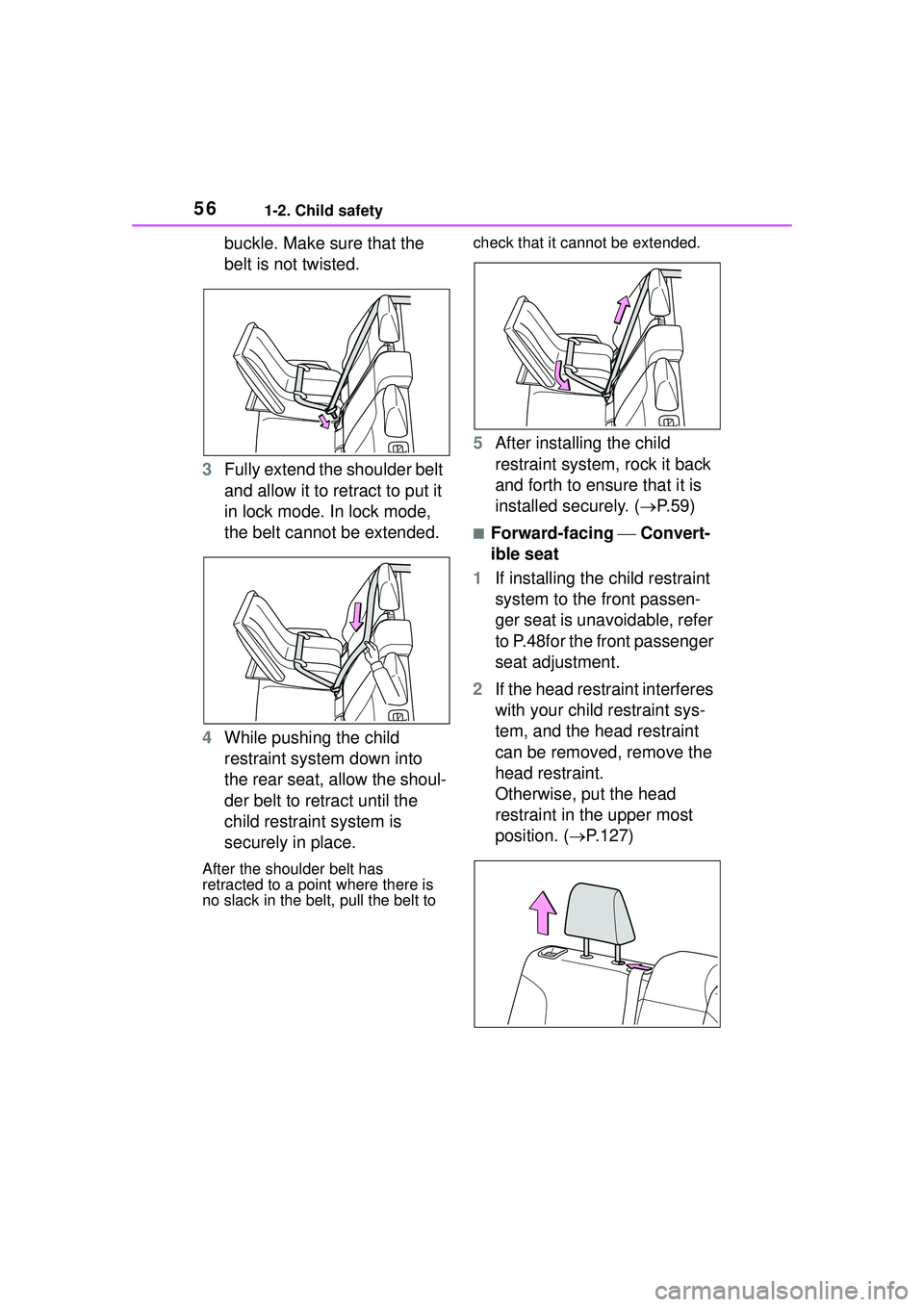
561-2. Child safety
buckle. Make sure that the
belt is not twisted.
3 Fully extend the shoulder belt
and allow it to retract to put it
in lock mode. In lock mode,
the belt cannot be extended.
4 While pushing the child
restraint system down into
the rear seat, allow the shoul-
der belt to retract until the
child restraint system is
securely in place.
After the shoulder belt has
retracted to a point where there is
no slack in the belt, pull the belt to check that it cannot be extended.
5
After installing the child
restraint system, rock it back
and forth to ensure that it is
installed securely. ( P.59)
■Forward-facing Convert-
ible seat
1 If installing the child restraint
system to the front passen-
ger seat is unavoidable, refer
to P.48for the front passenger
seat adjustment.
2 If the head restraint interferes
with your child restraint sys-
tem, and the head restraint
can be removed, remove the
head restraint.
Otherwise, put the head
restraint in the upper most
position. ( P.127)