2022 TOYOTA 86 brake
[x] Cancel search: brakePage 192 of 449

1924-5. EyeSight
WARNING
●Frozen roads, snow-covered
roads or other slippery road sur-
faces
• The tires may spin, causing loss of control of the vehicle.
●Traffic conditions when fre-
quent acceleration and deceler-
ation make it difficult to maintain
the following distance
• It may not be po ssible for the
system to perform as the traffic
conditions require.
●Steep downhill grades
• The set vehicle speed may be exceeded.
●On a steep continuous downhill
grade
• The brakes may overheat.
●Roads and overpasses with
repeated steep uphill and down-
hill grades
• Detection of the vehicle in front may be lost, or the road surface
may be detected instead of the
vehicle in front, making correct
control impossible.
●Entering a sharp curve/turn into
an interchange or junction, or a
service area, parking area, toll
booth or other facilities
• Detection of the vehicle in front may not be possible.
●There are changes in bright-
ness, such as at a tunnel
entrance or exit.
●Visibility is poor due to sand,
smoke or water vapor blowing in
the wind, or the front vision is
obscured due to water
splashes, snow, dirt, water
spray from road sprinklers or
snow clearing sprinklers on the
road, or dust stir up generated
by the vehicle in front or oncom-
ing traffic.
• Detection of the vehicle in front may be lost, or water or other
substances may be incorrectly
detected instead, making cor-
rect control impossible.
●In adverse weather, such as
heavy snow or snowstorms
Page 193 of 449

1934-5. EyeSight
4
Driving
WARNING
●The windshield has become
fogged, scratched or smeared,
or snow, dirt, dust or frost has
adhered to it, or it is otherwise
affected. These will reduce the
stereo camera’s field of view.
Also, light is reflecting off the
dirt, etc.
●Water droplets from rain or the
window washer, or dirt has not
been fully wiped off the wind-
shield.
• It may not be po ssible to detect
the vehicle in front, making cor-
rect control impossible.
●The stereo camera’s field of
view is obstructed.
The stereo camera may have diffi-
culty detectin g the following
objects or conditions. Operate the
brake pedal and take other
actions as necessary.
●Vehicles at significantly different
speeds (vehicles driving slowly,
stopped or oncoming vehicles,
etc.)
●Vehicles cutting into your lane
●Motorcycles, bicycles, pedestri-
ans and animals, etc.
●Light is poor in the evening or
early morning.
●At night or in a tunnel without
the headlights on
●At night or in a tunnel when
there is a vehicle in front that
does not have its tail lights on
●Strong light is coming from the
front (sunlight or headlight high
beams, etc.).
●Vehicles in front that have a rear
aspect that is low, small or irreg-
ular (the system may recognize
another part of the vehicle and
will determine operation from
that)
• An empty truck or trailer that has no tailgate or longbed
• Vehicles that have cargo pro- truding from their back ends
• Non-standard shaped vehicles (vehicle transporters or vehi-
cles with a sideca r fitted, etc.)
• Vehicles that are low
●Objects that are located close to
the bumper of your vehicle
■Detection of the vehicle in
front by the EyeSight stereo
camera
*
●Under the following road condi-
tions or conditions of your vehi-
cle, detection of the vehicle in
front may not be possible. Vehi-
cles in neighboring traffic lanes
or roadside objects may also be
incorrectly detected. Under con-
ditions such as these, do not
use Adaptive Cruise Control. If
cruise control is currently in use,
operate the brake pedal and
take other actions as necessary.
Page 195 of 449

1954-5. EyeSight
4
Driving
WARNING
●There are limits to the situation
judgment capabilities of the
Adaptive Cruise Control system.
Deceleration may not take place
in time in the following situa-
tions. Apply the brake pedal to
decelerate the vehicle if neces-
sary.
• The speed difference with the vehicle in front is too large or
the vehicle in front decelerates
unexpectedly.
• The decelerating vehicle in front unexpectedly sl ows down or
suddenly brakes.
●If the alert/notification sounds
frequently, do not use Adaptive
Cruise Control.
●Even when the following dis-
tance is short, the “Obstacle
Detected” warning may not acti-
vate in the following situations.
• The difference in speed with the vehicle in front is small. The two
vehicles are traveling at almost
the same speed.
• The vehicle in fr ont is traveling
faster than your vehicle. The fol-
lowing distance is gradually
increasing.
• Another vehicle cuts into your lane very close to your vehicle.
• The vehicle in front decelerates suddenly.
• There are repeated uphill and downhill grades.
*: The recognition status of the
lead vehicle using the stereo
camera can be confirmed by the
illumination status of the lead
vehicle indicator. (
P.196)
NOTICE
●After Adaptive Cruise Control
has started, it maintains control
continuously according to the
behavior of the veh icle in front.
When your vehicle comes to a
stop because the vehicle in front
has stopped, the automatic
braking function will be can-
celed immediately after stop-
ping and the veh icle will start
creeping forward gradually (at
the same time 3 intermittent
beeps, 1 short beep and 1 long
beep will sound). Be sure to
depress the brake pedal and
stop the vehicle completely.
Note that the v ehicle is not
maintained at a standstill posi-
tion and will not automatically
start moving from a standstill
position.
●Braking may not be sufficient
depending on the following con-
ditions. Depress the brake
pedal and decelerate as neces-
sary.
• Vehicle conditions (amount of load, number of occupants, etc.)
• Road conditions (grade, slip- periness, shape, bumps, etc.)
• Vehicle maintenance condition (brake systems, tire wear, air
pressure, temporary spare tire
is being used, etc.)
• The brakes are cold. (For exam- ple, just after the engine is
started or the outside tempera-
ture is low.)
• For a short period of time when driving after the engine is
started until the engine has
warmed-up
• The brakes are overheated on downhill grades (braking perfor-
mance may be reduced).
Page 196 of 449

1964-5. EyeSight
■Setting Adaptive Cruise
Control
1 Setting Adaptive Cruise Con-
trol to standby status
Press the “ON-OFF” switch. At this
time, (white) a nd the following
distance setting indicator are dis-
played on the meter display.
The set vehicle speed display will
read “- - - MPH (- - - km/h)”.
Adaptive Cruise Control indi-
cator
Set vehicle speed
Your vehicle indicator Following distance setting
indicator
Following distance setting
indicator (icon)
When the multi-information display
is set to display content other than
the driving support system informa-
tion display, the following distance
setting indicator is shown as an
icon.
To set the ready status: Adap-
tive Cruise Control can be acti-
vated when all of the following
conditions are met and
“READY” indicator is displayed
on the meter display.
• Both the driver's door and the
front passenger's door are
closed.
• The driver’s seatbelt is fas- tened.
• The shift lever is in the D or M position.
• The brake pedal is not depressed.
• EyeSight operation is not tem-
porarily stopped. (white) is
turned off. ( P.228)
• The road is not a steep slope.
• The steering wheel has not been turned significantly in
either direction.
• The vehicle speed is between 0 mph (0 km/h) and approxi-
mately 90 mph (145 km/h).
• Parking brake is released.
• The driving mode is set to normal mode or sport mode.
( P.257)
NOTICE
• In rain or after washing the vehi-
cle (the brakes may become
wet and braking performance
may be reduced.)
How to use Adaptive
Cruise Control
A
C
D
Page 199 of 449

1994-5. EyeSight
4
Driving
will drive at that constant speed.
If a vehicle in front is detected while
accelerating to the set vehicle
speed, vehicle following will be
started again.
●When the brakes are applied by
Adaptive Cruise Control, the vehi-
cle’s stop lights will illuminate.
●Even if there is no lead vehicle
present, on a downhill grade, the
Adaptive Cruise Control’s auto-
matic brake may operate in order
to maintain the set vehicle speed.
●Some noises may be audible
during automatic braking. This is
caused by the braking control and
does not indicate a malfunction.
●To temporarily accelerate quickly,
use the accelerator pedal. After
accelerating, the vehicle will grad-
ually return to the set vehicle
speed shown in the set vehicle
speed display.
●If the vehicle in front is no longer
detected while your vehicle is still
controlled by the automatic brak-
ing operation, th e brake will be
automatically released gradually.
Depress the accelerator pedal if
necessary.
●The lead-vehicle following func-
tion has the following characteris-
tics:
• If the lead vehicle’s stop lights are
detected, deceleration will start
earlier than without detection.
• If the vehicle moves to the fast
lane while traveling more than approximately 37 mph (60 km/h),
the system starts acceleration to
the set vehicle speed more quickly
because it is linke
d with the turn
signal.
• If the setting of driving lane is dif-
ferent from the actual driving
direction, the vehicle may start to
accelerate faster than usual when
the driver signals a lane change to
move from the passing lane to the
driving lane. ( P.400)
●Cruise control acceleration char-
acteristics can be set to one of
four levels. ( P.400)
■Increasing the set vehicle
speed
Using the cruise control
switch
Push to the “+ RES” side
briefly.
Every time the switch is pushed,
the set vehicle speed will increase
in increments o f 1 mph (1 km/h)
increment.
Push to the “+ RES” side con-
tinuously.
While the switch is being pushed,
the set vehicle speed will increase
in increments o f 5 mph (5 km/h).
When operating the switch, the
set vehicle speed changes on
the meter display.
NOTICE
If the driver oper ates the brake
pedal during automatic braking,
the pedal may feel stiff; however,
this is not a malfunction. By
depressing the brake pedal fur-
ther you can apply more braking
force. When the brake pedal is
released it will return to its original
condition.
Page 201 of 449
2014-5. EyeSight
4
Driving
tinuously.
While the switch is being pushed,
the set vehicle speed will decrease
in decrements o f 5 mph (5 km/h).
When operating the switch, the
set vehicle speed changes on
the meter display.
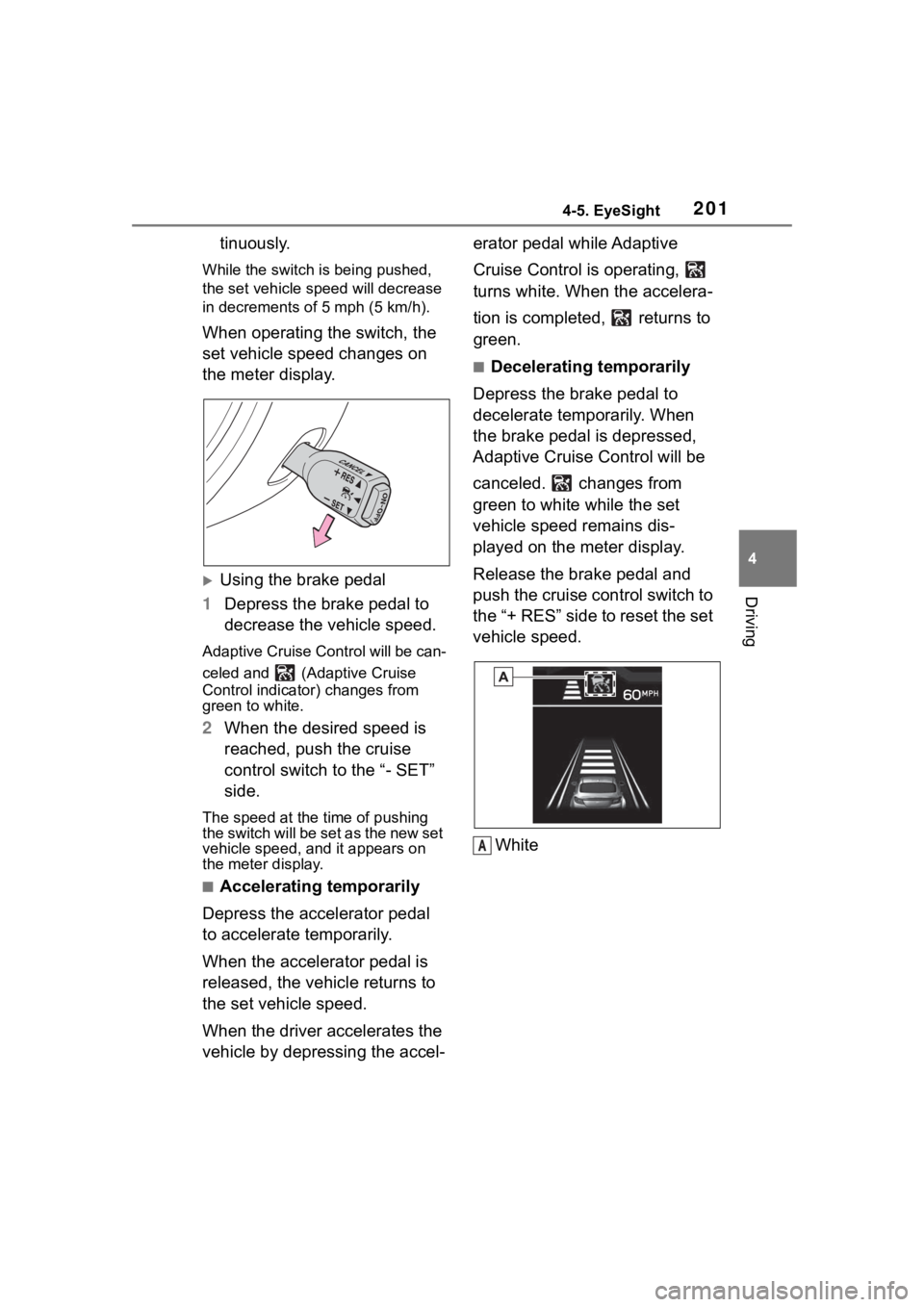
Using the brake pedal
1 Depress the brake pedal to
decrease the vehicle speed.
Adaptive Cruise Control will be can-
celed and (Adaptive Cruise
Control indicator) changes from
green to white.
2When the desired speed is
reached, push the cruise
control switch to the “- SET”
side.
The speed at the time of pushing
the switch will be set as the new set
vehicle speed, a nd it appears on
the meter display.
■Accelerating temporarily
Depress the accelerator pedal
to accelerate temporarily.
When the accelerator pedal is
released, the vehicle returns to
the set vehicle speed.
When the driver accelerates the
vehicle by depressing the accel- erator pedal while Adaptive
Cruise Control is operating,
turns white. When the accelera-
tion is completed, returns to
green.
■Decelerating temporarily
Depress the brake pedal to
decelerate temporarily. When
the brake pedal is depressed,
Adaptive Cruise Control will be
canceled. changes from
green to white while the set
vehicle speed remains dis-
played on the meter display.
Release the brake pedal and
push the cruise control switch to
the “+ RES” side to reset the set
vehicle speed.
White
A
Page 202 of 449

2024-5. EyeSight
■Changing the following dis-
tance from the vehicle in
front
The following distance from the
vehicle in front setting can be
changed in 4 stages.
Each time the (Following
distance setting) switch is
pressed, the distance from the
vehicle in front changes.
●The following distance changes
corresponding with the vehicle
speed. The faster the vehicle trav-
els, the greater the following dis-
tance.
Approximate guide to following
distances
●The following distance previously
set is restored when you turn back
on Adaptive Cruise Control by
pressing the “ON-OFF” switch.
■Canceling by driver opera-
tion
Any of the following operations
will cancel Adaptive Cruise Con-
trol.
Depress the brake pedal.
changes from green to white
while the set vehicle speed remains
displayed on the meter display.
NOTICE
Ordinarily, while the vehicle is fol-
lowing the lead vehicle, accelera-
tion and deceleration are
performed automatically in accor-
dance with the speed of the lead
vehicle. However, when your
vehicle approaches a lead vehi-
cle, for example if it is necessary
to accelerate for a lane change or
other reason, and if the vehicle in
front suddenly decelerates, or if
another vehicle cuts into your
path, operate the accelerator
pedal or brake pedal to accelerate
or decelerate as appropriate for
the existing conditions.Following distance
indicator
When your vehicle
speed is 25 mph
(40 km/h)When your vehicle
speed is 60 mph
(100 km/h)
Approx.
100 ft (30
m)Approx.
200 ft (60
m)
Approx. 80
ft (25 m)Approx.
160 ft (50
m)
Approx. 65
ft (20 m)Approx.
130 ft (40
m)
Approx. 50
ft (15 m)Approx.
100 ft (30
m)
Canceling Adaptive
Cruise Control
Page 203 of 449

2034-5. EyeSight
4
Driving
White
Pull the cruise control switch
to the “CANCEL” side.
changes from green to white
while the set vehicle speed remains
displayed on the meter display.
■Automatic cancellation by
the system
When the Adaptive Cruise Con-
trol system brings your vehicle
to a complete stop, 3 intermit-
tent beeps, 1 short beep and 1
long beep will sound, and the
Adaptive Cruise Control system
will release control of your vehi-
cle. In the following cases, a notifica-
tion will sound 1 short beep and
1 long beep and Adaptive
Cruise Control is automatically
canceled. changes from
green to white. Also, the Adap-
tive Cruise Control cancellation
message is displayed on the
multi-information display.
The grade of the road is very
steep.
TRAC or VSC is activated.
The vehicle speed has
exceeded approximately 100
mph (160 km/h) while cruise
control is activated.
The steering wheel is turned
significantly in either direction.
The shift lever is moved to a
position other than D or M.
• Adaptive Cruise Control can be
resumed after the shift lever is
returned to the D or M position.
Either the driver's door or the
front passenger's door is
opened.
The driver’s seatbelt is unfas-
tened.
The EyeSight system has a
A
NOTICE
When the vehicle has stopped,
the automatic braking function will
be gradually released and the
vehicle will start creeping. Make
sure to stop the vehicle com-
pletely by depressing the brake
pedal after the vehicle has
stopped.