2022 HYUNDAI SANTA CRUZ trailer
[x] Cancel search: trailerPage 479 of 598
07
7-127
WARNING
• Even though the warning message
does not appear on the cluster, Rear
Cross-Traffic Collision-Avoidance
Assist may not operate properly.
• Rear Cross-Traffic Collision-
Avoidance Assist may not operate
properly in an area (for example,
open terrain), where any objects are
not detected after turning ON the
engine.
CAUTION
Turn off Rear Cross-Traffic Collision-
Avoidance Assist to install or remove a
trailer, carrier, or another attachment.
Turn on Rear Cross-Traffic Collision-
Avoidance Assist when finished.
Limitations of Rear Cross-Traffic
Collision-Avoidance Assist
RRear Cross-Traffic Collision-Avoidance
Assist may not operate properly, or it
may operate unexpectedly under the
following circumstances:
• Departing from where trees or grass
are overgrown
• Departing from where roads are wet
• Speed of the approaching vehicle is
fast or slow
Braking control may not work, driver’s
attention is required in the following
circumstances:
• The vehicle severely vibrates while
driving over a bumpy road, uneven
road or concrete patch
• Driving on a slippery surface due to
snow, water puddle, ice, etc.
• The tire pressure is low or a tire is
damaged
• The brake is tuned
Information
For more details on the limitations of the
rear corner radar, refer to “Blind-Spot
Collision-Avoidance Assist (BCA)” section
in chapter 7.
WARNING
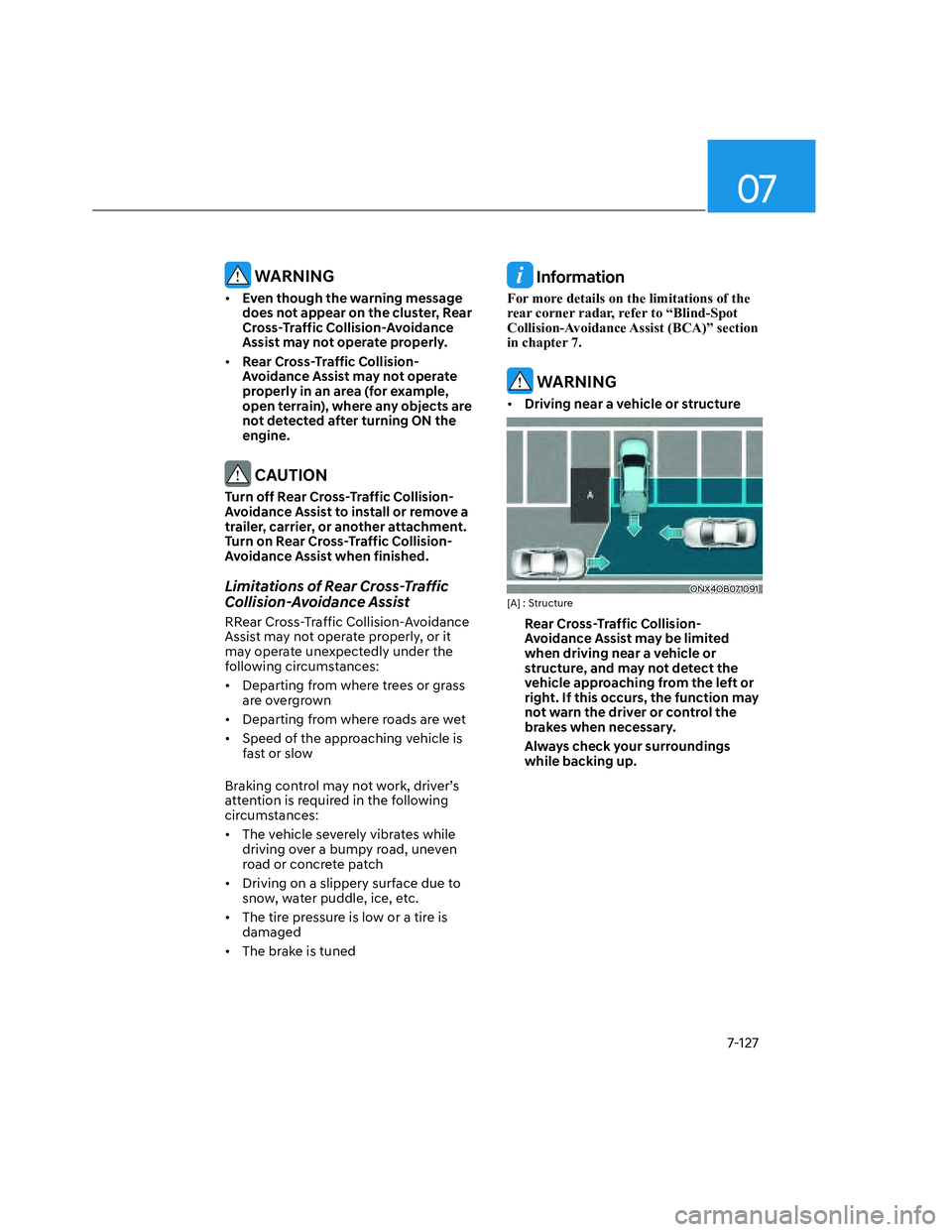
• Driving near a vehicle or structure
ONX4OB071091ONX4OB071091[A] : Structure
Rear Cross-Traffic Collision-
Avoidance Assist may be limited
when driving near a vehicle or
structure, and may not detect the
vehicle approaching from the left or
right. If this occurs, the function may
not warn the driver or control the
brakes when necessary.
Always check your surroundings
while backing up.
Page 482 of 598
Driver Assistance System
7-130
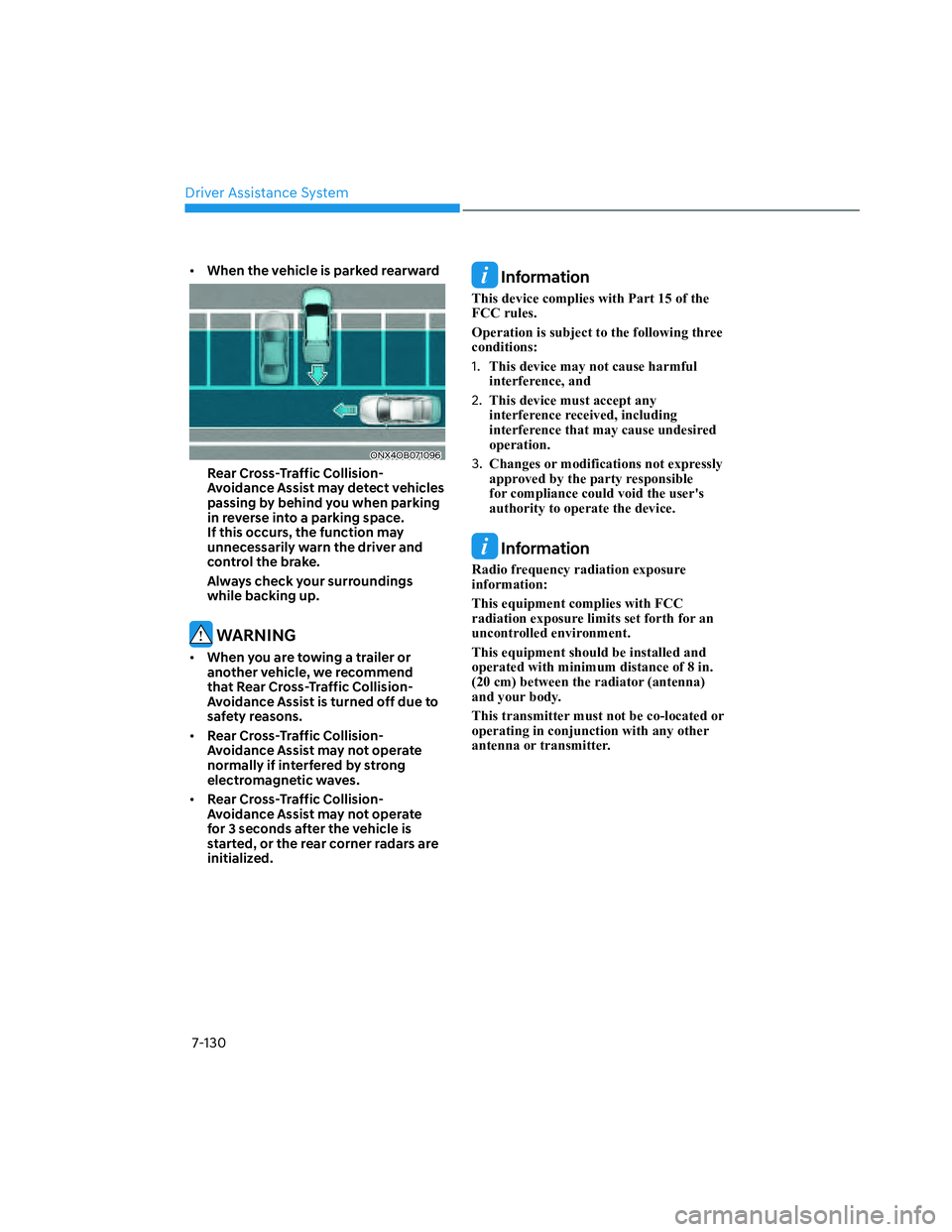
• When the vehicle is parked rearward
ONX4OB071096ONX4OB071096
Rear Cross-Traffic Collision-
Avoidance Assist may detect vehicles
passing by behind you when parking
in reverse into a parking space.
If this occurs, the function may
unnecessarily warn the driver and
control the brake.
Always check your surroundings
while backing up.
WARNING
• When you are towing a trailer or
another vehicle, we recommend
that Rear Cross-Traffic Collision-
Avoidance Assist is turned off due to
safety reasons.
• Rear Cross-Traffic Collision-
Avoidance Assist may not operate
normally if interfered by strong
electromagnetic waves.
• Rear Cross-Traffic Collision-
Avoidance Assist may not operate
for 3 seconds after the vehicle is
started, or the rear corner radars are
initialized.
Information
This device complies with Part 15 of the
FCC rules.
Operation is subject to the following three
conditions:
1. This device may not cause harmful
interference, and
2. This device must accept any
interference received, including
interference that may cause undesired
operation.
3. Changes or modifications not expressly
approved by the party responsible
for compliance could void the user's
authority to operate the device.
Information
Radio frequency radiation exposure
information:
This equipment complies with FCC
radiation exposure limits set forth for an
uncontrolled environment.
This equipment should be installed and
operated with minimum distance of 8 in.
(20 cm) between the radiator (antenna)
and your body.
This transmitter must not be co-located or
operating in conjunction with any other
antenna or transmitter.
Page 504 of 598
Emergency Situations
8-20
Use of compact spare tires
Compact spare tires are designed for
emergency use only. Drive carefully on
the compact spare tire and always follow
the safety precautions.
WARNING
To prevent compact spare tire failure
and loss of control possibly resulting in
an accident:
• Use the compact spare tire only in an
emergency.
• NEVER operate your vehicle over 50
mph (80 km/h).
• Do not exceed the vehicle’s
maximum load rating or the load
carrying capacity shown on the
sidewall of the compact spare tire.
• Do not use the compact spare tire
continuously. Repair or replace the
original tire as soon as possible to
avoid failure of the compact spare
tire.
When driving with the compact spare tire
mounted to your vehicle:
• Check the tire pressure after installing
the compact spare tire. The compact
spare tire should be inflated to 60 psi
(420 kPa).
• Do not take this vehicle through
an automatic car wash while the
compact spare tire is installed.
• Do not use the compact spare tire on
any other vehicle because this tire
has been designed especially for your
vehicle.
• The compact spare tire’s tread life is
shorter than a regular tire. Inspect
your compact spare tire regularly and
replace worn compact spare tires with
the same size and design, mounted on
the same wheel.
• Do not use more than one compact
spare tire at a time.
• Do not tow a trailer while the compact
spare tire is installed.
Information
When the original tire and wheel are
repaired and reinstalled on the vehicle, the
wheel nuts torque must be set correctly.
The correct wheel nuts tightening torque
is 79~94 lbf.ft (11~13 kgf.m).
NOTICE
To prevent damaging the compact
spare tire and your vehicle:
• Drive slowly enough for the road
conditions to avoid all hazards, such
as a potholes or debris.
• Avoid driving over obstacles. The
compact spare tire diameter is
smaller than the diameter of a
conventional tire and reduces the
ground clearance approximately 1
inch (25 mm).
• Do not use tire chains on the
compact spare tire. Because of the
smaller size, a tire chain will not fit
properly.
• Do not use the compact spare tire
on any other wheels, nor should
standard tires, snow tires, wheel
covers or trim rings be used with the
compact spare wheel.
Page 507 of 598
![HYUNDAI SANTA CRUZ 2022 Owners Manual 08
8-23
TOWING
Towing Service
A
ONX4OB081016ONX4OB081016[A] : Dollies
If emergency towing is necessary,
we recommend having it done by
an authorized HYUNDAI dealer or a
commercial tow-truck service](/manual-img/35/41171/w960_41171-506.png "HYUNDAI SANTA CRUZ 2022 Owners Manual 08
8-23
TOWING
Towing Service
A
ONX4OB081016ONX4OB081016[A] : Dollies
If emergency towing is necessary,
we recommend having it done by
an authorized HYUNDAI dealer or a
commercial tow-truck service")
08
8-23
TOWING
Towing Service
A
ONX4OB081016ONX4OB081016[A] : Dollies
If emergency towing is necessary,
we recommend having it done by
an authorized HYUNDAI dealer or a
commercial tow-truck service.
Proper lifting and towing procedures
are necessary to prevent damage to
the vehicle. The use of wheel dollies or
flatbed is recommended.
For FWD vehicles, it is acceptable to tow
the vehicle using a tow truck as long as
the front wheels (which are the drive
wheels) are off the ground. The rear
wheels can be on the ground without the
use of dollies.
For AWD vehicles, all wheels must be off
the ground. Therefore, a flat bed trailer is
recommended.
If any of the loaded wheels or suspension
components are damaged or the vehicle
is being towed with the rear wheels on
the ground, use a towing dolly under the
rear wheels.
When being towed by a commercial tow
truck and wheel dollies are not used,
the front of the vehicle should always be
lifted, not the rear.
For AWD vehicles, it must be towed
with a wheel lift and dollies or flatbed
equipment with all the wheels off the
ground.
NOTICE
Do not lift the vehicle by the tow fitting
or body and chassis parts. Otherwise
the vehicle may be damaged.
CAUTION
• Do not tow the vehicle with the front
wheels on the ground as this may
cause damage to the vehicle.
ONX4OB081017ONX4OB081017
• Do not tow with sling-type
equipment. Use wheel lift or flatbed
equipment.
ONX4OB081018ONX4OB081018
Page 515 of 598
09
9-7
Follow Normal Maintenance Schedule if the vehicle is usually operated where none of
the following conditions apply. If any of the following conditions apply, you must follow
the Maintenance Under Severe Usage Conditions.
• Repeated driving short distance of less than 5 miles (8 km) in normal temperature or
less than 10 miles (16 km) in freezing temperature
• Extensive engine idling or low speed driving for long distances
• Driving on rough, dusty, muddy, unpaved, graveled or salt-spread roads
• Driving in areas using salt or other corrosive materials or in very cold weather
• Driving in heavy dust conditions
• Driving in heavy traffic area
• Driving on uphill, downhill, or mountain road repeatedly
• Towing a trailer or using a camper, or driving with loads on the roof
• Driving as a patrol car, taxi, other commercial use of vehicle towing
• Frequently driving under high speed or rapid acceleration/deceleration
• Frequently driving in stop-and-go condition
• Engine oil usage which is not recommended (Mineral type, Semi-synthetic, Lower
grade spec, etc.)
If your vehicle is operated under the above conditions, you should inspect, replace
or refill more frequently than the following Normal Maintenance Schedule. After the
periods or distance shown in the chart, continue to follow the prescribed maintenance
intervals.
NOTICE
After 10 years or 100,000 miles, we recommend to use severe maintenance
schedule.
Information
• As it is normal for engine oil to be consumed during driving, the engine oil level should
be checked on regular basis.
• The engine oil change interval for normal operating conditions is based on the use of
the recommended engine specification. If the recommended engine oil specification
is not used, then replace the engine oil according to the maintenance schedule under
severe operating conditions.
SCHEDULED MAINTENANCE SERVICES
Page 521 of 598
09
9-13
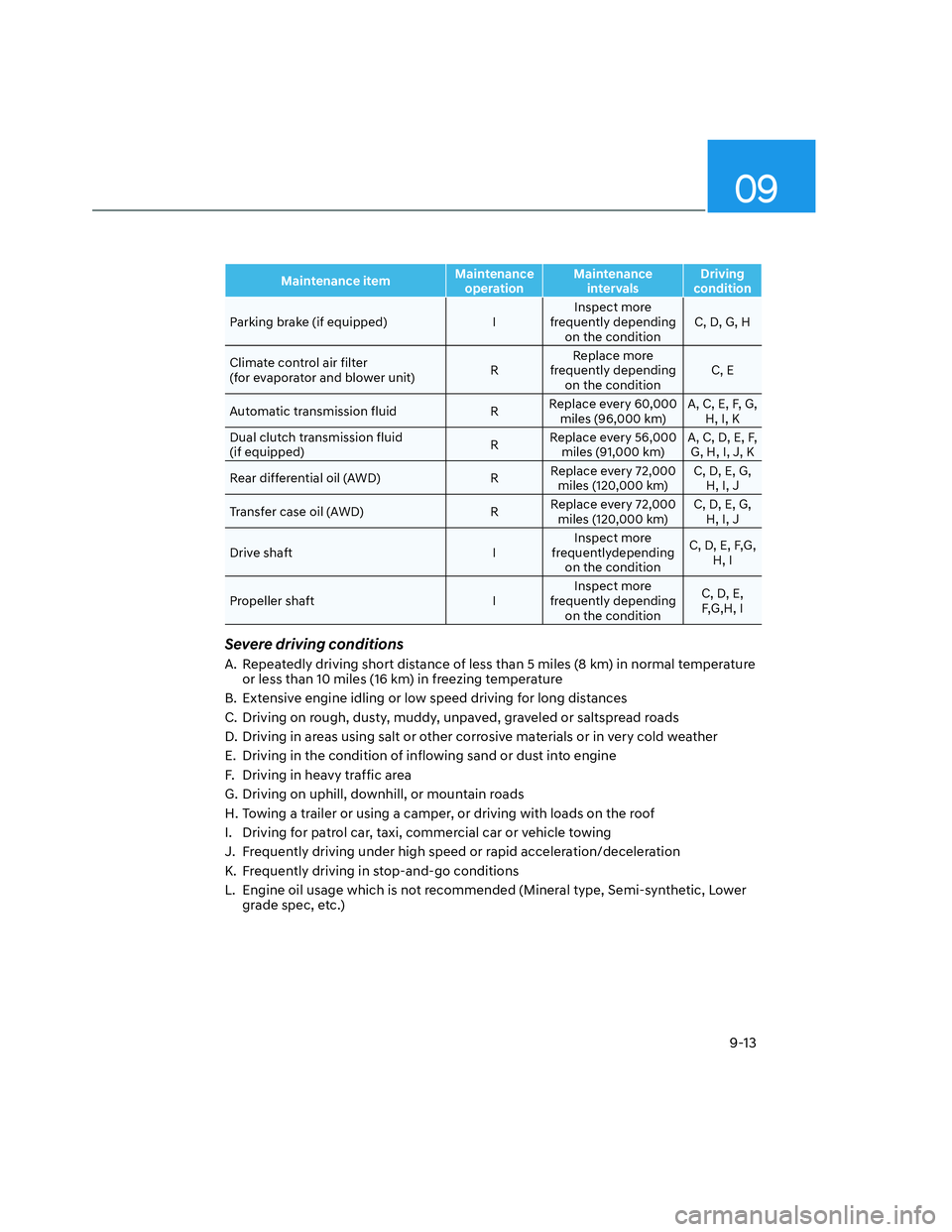
Maintenance itemMaintenance
operationMaintenance
intervalsDriving
condition
Parking brake (if equipped) IInspect more
frequently depending
on the conditionC, D, G, H
Climate control air filter
(for evaporator and blower unit)RReplace more
frequently depending
on the conditionC, E
Automatic transmission fluid RReplace every 60,000
miles (96,000 km)A, C, E, F, G,
H, I, K
Dual clutch transmission fluid
(if equipped)RReplace every 56,000
miles (91,000 km)A, C, D, E, F,
G, H, I, J, K
Rear differential oil (AWD) RReplace every 72,000
miles (120,000 km)C, D, E, G,
H, I, J
Transfer case oil (AWD) RReplace every 72,000
miles (120,000 km)C, D, E, G,
H, I, J
Drive shaft IInspect more
frequentlydepending
on the conditionC, D, E, F,G,
H, I
Propeller shaft IInspect more
frequently depending
on the conditionC, D, E,
F,G,H, I
Severe driving conditions
A. Repeatedly driving short distance of less than 5 miles (8 km) in normal temperature
or less than 10 miles (16 km) in freezing temperature
B. Extensive engine idling or low speed driving for long distances
C. Driving on rough, dusty, muddy, unpaved, graveled or saltspread roads
D. Driving in areas using salt or other corrosive materials or in very cold weather
E. Driving in the condition of inflowing sand or dust into engine
F. Driving in heavy traffic area
G. Driving on uphill, downhill, or mountain roads
H. Towing a trailer or using a camper, or driving with loads on the roof
I. Driving for patrol car, taxi, commercial car or vehicle towing
J. Frequently driving under high speed or rapid acceleration/deceleration
K. Frequently driving in stop-and-go conditions
L. Engine oil usage which is not recommended (Mineral type, Semi-synthetic, Lower
grade spec, etc.)
Page 563 of 598
![HYUNDAI SANTA CRUZ 2022 Owners Manual 09
9-55
Engine compartment fuse panel
Type Fuse NameFuse
RatingCircuit Protected
MULTI
FUSEMDPS80A MDPS Unit
COOLING FAN180A [G4KP] Cooling Fan Controller
COOLING FAN260A [G4KN] Cooling Fan Controlle](/manual-img/35/41171/w960_41171-562.png "HYUNDAI SANTA CRUZ 2022 Owners Manual 09
9-55
Engine compartment fuse panel
Type Fuse NameFuse
RatingCircuit Protected
MULTI
FUSEMDPS80A MDPS Unit
COOLING FAN180A [G4KP] Cooling Fan Controller
COOLING FAN260A [G4KN] Cooling Fan Controlle")
09
9-55
Engine compartment fuse panel
Type Fuse NameFuse
RatingCircuit Protected
MULTI
FUSEMDPS80A MDPS Unit
COOLING FAN180A [G4KP] Cooling Fan Controller
COOLING FAN260A [G4KN] Cooling Fan Controller
B+260A ICU Junction Block (IPS7, IPS8, IPS9, IPS10, IPS11, IPS12)
B+360AICU Junction Block (Fuse - P/SEAT DRV, SAFETY P/
WINDOW RH, S/HEATER DRV/PASS, SUNROOF1, BED
STORAGE, Power Window Main Relay)
E-CVVT150A E/R Junction Block (E-CVVT Relay)
BLOWER40A E/R Junction Block (Blower Relay)
EPB140A ESC Module
REAR HEATED40A E/R Junction Block (Rear Heated Relay)
TRAILER 130A [G4KP] Trailer Connector
B+440AICU Junction Block (Fuse - DOOR LOCK, SAFETY P/
WINDOW LH, TAILGATE OPEN, AMP, IBU2, AIR BAG2,
CARGO LP, BRAKE SWITCH, MODULE9, Long Term
Load Latch Relay)
EPB260A ESC Module
FUEL PUMP20A E/R Junction Block (Fuel Pump Relay)
4WD20A AWD ECM
TRAILER 230A
[G4KN] Trailer Controller
AMS10A Battery Sensor
TRAILER 330A
[G4KN] Trailer Connector
ECU215A PCM/ECM
VACUUM PUMP120A
[G4KP] E/R Junction Block (Vacuum Pump Relay)
TCU115A [G4KN] PCM
ROOF LIGHT FRT15A Accessory Light Switch
E-CVVT220A [G4KP] ECM
HEATED MIRROR10AE/R Junction Block (Rear Heated Relay), Driver/
Passenger Power Outside Mirror
VACUUM PUMP210A [G4KP] ESC Module
TCU360A [G4KP] TCM
EOP60A [G4KP] Electronic Oil Pump
B+150A ICU Junction Block (IPS1, IPS3, IPS4, IPS5, IPS6,)
PTC HEATER50A E/R Junction Block (PTC Heater Relay)
INVERTER30A AC Inverter Module
Page 587 of 598
I
I-3
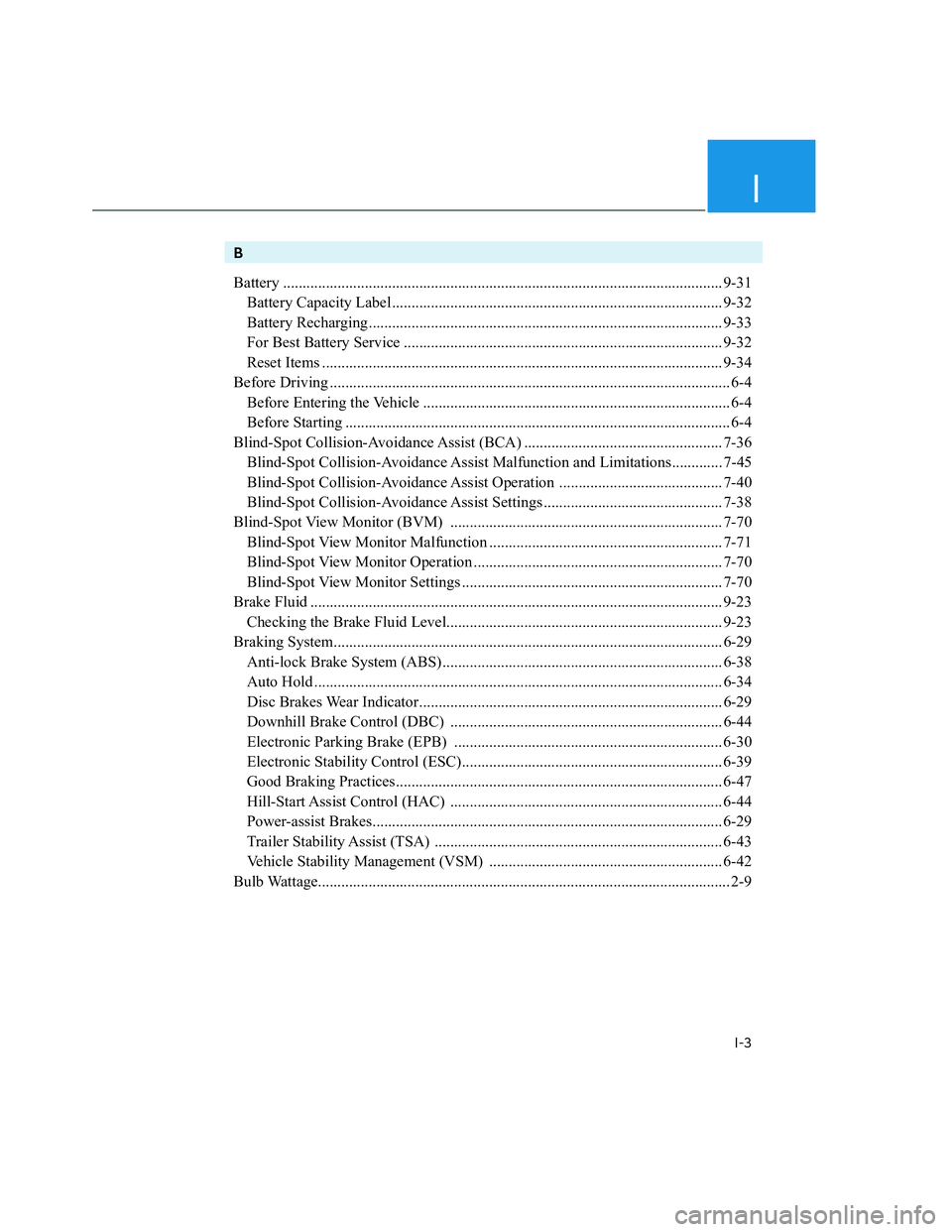
B
Battery ................................................................................................................. 9-31
Battery Capacity Label ..................................................................................... 9-32
Battery Recharging........................................................................................... 9-33
For Best Battery Service .................................................................................. 9-32
Reset Items ....................................................................................................... 9-34
Before Driving ....................................................................................................... 6-4
Before Entering the Vehicle ............................................................................... 6-4
Before Starting ................................................................................................... 6-4
Blind-Spot Collision-Avoidance Assist (BCA) ................................................... 7-36
Blind-Spot Collision-Avoidance Assist Malfunction and Limitations............. 7-45
Blind-Spot Collision-Avoidance Assist Operation .......................................... 7-40
Blind-Spot Collision-Avoidance Assist Settings .............................................. 7-38
Blind-Spot View Monitor (BVM) ...................................................................... 7-70
Blind-Spot View Monitor Malfunction ............................................................ 7-71
Blind-Spot View Monitor Operation ................................................................ 7-70
Blind-Spot View Monitor Settings ................................................................... 7-70
Brake Fluid .......................................................................................................... 9-23
Checking the Brake Fluid Level....................................................................... 9-23
Braking System.................................................................................................... 6-29
Anti-lock Brake System (ABS) ........................................................................ 6-38
Auto Hold ......................................................................................................... 6-34
Disc Brakes Wear Indicator.............................................................................. 6-29
Downhill Brake Control (DBC) ...................................................................... 6-44
Electronic Parking Brake (EPB) ..................................................................... 6-30
Electronic Stability Control (ESC)................................................................... 6-39
Good Braking Practices.................................................................................... 6-47
Hill-Start Assist Control (HAC) ...................................................................... 6-44
Power-assist Brakes.......................................................................................... 6-29
Trailer Stability Assist (TSA) .......................................................................... 6-43
Vehicle Stability Management (VSM) ............................................................ 6-42
Bulb Wattage.......................................................................................................... 2-9