2022 CITROEN E-MEHARI light
[x] Cancel search: lightPage 41 of 84

39
Rear seat belts not fastened
alerts
Seat belts unfastened alert
When the ignition is switched on, with the
motor running or the vehicle driving above
6 mph (10 km/h), warning lamp A and the
corresponding dots in warning lamp B come on
for around thirty seconds, if one or more rear
passengers have not fastened their seat belts.
After the ignition is switched on, warning
lamp A and the corresponding dots in warning
lamp B come on if the driver and/or one or
more passengers unfasten their seat belts.
These warning lamps flash for 30
seconds,
accompanied by an audible signal. Beyond
this period of time, the warning lamps stay on
continuously until the seat belts are fastened.
Airbags
General information
This system contributes towards improving the
safety of passengers (with the exception of the
rear centre passenger) in the event of violent
collisions. The airbags supplement the action
of the seat belts fitted with force limiters (with
the exception of the rear centre passenger).
If a
collision occurs, the electronic detectors
record and analyse the front and side impacts
sustained in the impact detection zones:
-
i
n the event of a serious impact, the airbags
are deployed instantly and contribute
towards better protection of the passengers
(with the exception of the rear centre
passenger); immediately after the impact,
the airbags deflate rapidly so that they
do not hinder visibility or the exit of the
passengers,
-
i
n the case of a minor or rear impact or in
certain roll-over conditions, the airbags
may not be deployed; the seat belt
alone contributes towards ensuring your
protection in these situations.
The airbags do not operate when the
ignition is switched off.
This equipment will only deploy once. If
a
second impact occurs (during the same
or a
subsequent accident), the airbag will
not be deployed again.
Impact detection zones
A. Front impact zone.
B. Side impact zone.
Airbag deployment generates slight
smoke emissions and a
noise, due to the
activation of the pyrotechnic cartridge
incorporated in the system.
This smoke is not harmful, but sensitive
individuals may experience slight irritation.
The detonation noise associated with the
deployment of an airbag may result in
a
slight loss of hearing for a short time.
5
Safety
Page 52 of 84

50
Driving recommendations
Observe the driving regulations and remain
vigilant whatever the traffic conditions.
Pay close attention to the traffic and keep your
hands on the wheel so that you are ready to
react at any time to any eventuality.
As a safety measure, the driver must only carry
out any operations that require close attention
when the vehicle is stationary.
On a
long journey, a break every two hours is
strongly recommended.
In bad weather, drive smoothly, anticipate the
need to brake and increase the distance from
other vehicles.
Important!
Never drive with the parking brake applied
– Risk of overheating and damage to the
braking system!
Never leave a
vehicle unsuper vised with
the motor running. If you have to leave
your vehicle with the motor running,
apply the parking brake and put the drive
selector into position N or P .
Driving on flooded roads
We strongly advise against driving on flooded
roads, as this could cause serious damage
to the motor or gearbox, as well as to the
electrical systems of your vehicle.
If you are obliged to drive through water:
-
c
heck that the depth of water does not
exceed 6
inches (15 cm), taking account
of waves that might be generated by other
users,
-
d
rive as slowly as possible. In all cases, do
not exceed 6
mph (10 km/h),
On leaving the flooded road, as soon as
circumstances allow, make several light brake
applications to dry the brake discs and pads.
If in doubt about the state of your vehicle,
contact a
CITROËN dealer or a qualified
workshop.
Driving your E-MEHARI
Never leave a child or a disabled adult
w ho usually needs help from others alone
in the vehicle.
Pets should not be left alone in the
vehicle.
Secure any loads in your vehicle so that
they cannot slide about.
Do not load the vehicle higher than the
seat backrests.
A badly supported load may result in
serious physical injuries if there is an
abrupt stop or collision.
If the vehicle is not handled carefully and
in a
safe way, you risk losing control of it
and causing an accident.
Driving
Page 55 of 84
53
Manual parking brake
Always check that your manual parking
brake is applied before leaving the vehicle.
When parking on a slope, turn the front
wheels into the kerb, apply the parking
brake and switch off at the starting switch.
Check that the parking brake is released
before moving off.
Not releasing the parking brake could
result in its failure and cause an accident.
Never release the parking brake from
outside the vehicle. Never leave children unsuper vised inside
the vehicle.
They might release the parking brake and
cause an accident.
Only release the brake pedal once the
parking brake has been fully applied.
Failure to apply the parking brake could
allow the vehicle to move on its own and
cause an accident.
In very cold conditions, the manual
parking brake could freeze and be
impossible to release.
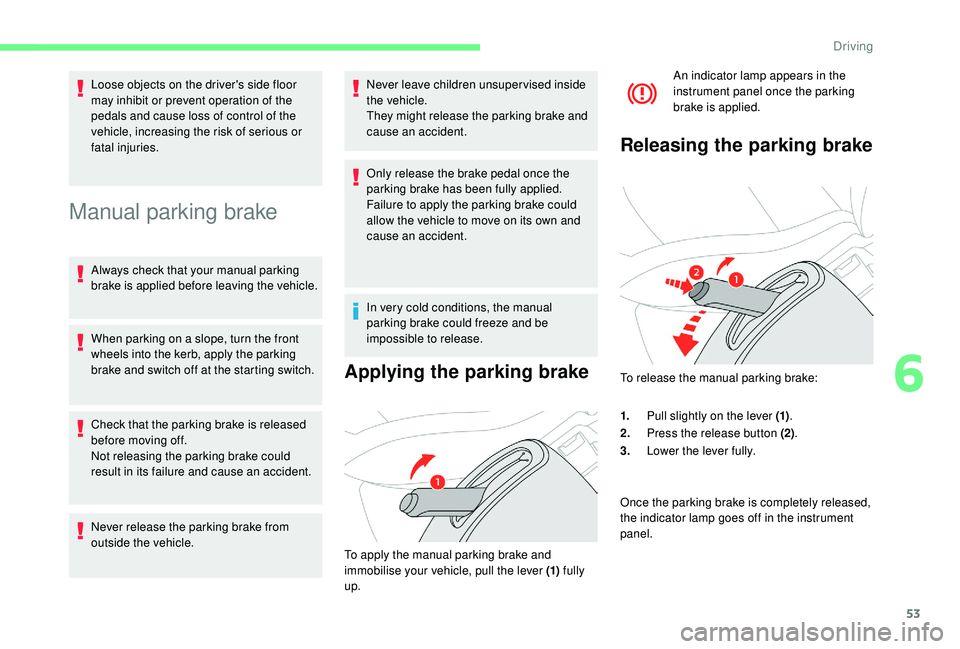
Applying the parking brake
To apply the manual parking brake and
immobilise your vehicle, pull the lever (1)
fully
up. An indicator lamp appears in the
instrument panel once the parking
brake is applied.
Releasing the parking brake
Loose objects on the driver's side floor
may inhibit or prevent operation of the
pedals and cause loss of control of the
vehicle, increasing the risk of serious or
fatal injuries.
To release the manual parking brake:
1.Pull slightly on the lever (1) .
2. Press the release button (2) .
3. Lower the lever fully.
Once the parking brake is completely released,
the indicator lamp goes off in the instrument
panel.
6
Driving
Page 59 of 84

57
Maintaining and servicing
your E-MEHARI
The maintenance and servicing of your vehicle
must be carried out by a CITROËN authorised
repairer or a
qualified professional and in line
with the principles stated in the Maintenance
and Warranty Guide.
Washing precautions
Never wash the charging socket, the
traction battery or under the bonnet using
a
high pressure jet wash: risk of damage
to the electrical system.
Never wash the vehicle while it is
charging: risk of electric shock that could
cause death.
Cleaning the vehicle by the regular use
of a
high pressure car wash with rotating
brushes is not recommended.
Not recommended for care
of the bodywork
- Degreasing or cleaning the mechanical components under the body, parts with
hinges, exterior plastic panels using a
high
pressure jet wash or spraying products not
intended for this purpose, such as solvents.
-
W
ashing the vehicle in direct sunlight.
-
R
emoving mud or stains without first
soaking with water.
Recommended for care of
the bodywork
- Washing your E-MEHARI regularly using car shampoo specifically created for the
care of vehicles with plastic body parts
(never with abrasive products).
-
R
insing and thoroughly hosing off as
soon as possible resinous deposits from
trees, fallout from industrial pollution and
bird droppings which produce a
chemical
reaction with the bodywork causing rapid
discolouration. Only the seats, covered with an impermeable
material, and the floor can be washed using
a
water jet (check first that the drainage holes,
located at the front on each side of the central
console in the passenger footwells are not
blocked).
Care of interior trim
Stains should always be dealt with quickly.
For all types of stain, you should use warm or
cold soapy water based on natural soap.
Detergents (washing up liquid, powder
products, alcohol-based products, etc.) must
not be used.
-
U
se a soft cloth.
-
R
inse and absorb the excess.
-
F
inish by wiping gently with a dry, soft cloth.
As it is not watertight, the dashboard must
never be washed using water.
7
Practical information
Page 62 of 84

60
Obser ve the safety rules and follow the
steps indicated before use.
-
Us
e only the original charging cable.
-
D
o not attempt to dismantle or repair the
charging cable.
-
D
o not use an extension lead or adapter.
-
I
ncorrect use of the charging cable would
risk causing an accident such as an
electrical discharge or fire.
-
I
mmediately stop using the charging cable
if a
fault or problem occurs or if the FAULT
warning lamp lights up or flashes.
-
E
nsure that the plug is not allowed to
become wet.
-
D
o not touch the terminals on the charging
cable or the vehicle's charging socket.
-
D
o not use the charging cable if parts of
it are broken, frayed, cracked, open or
showing any other sign of damage.
-
K
eep the charging cable out of reach of
children.
-
W
hen using the charging cable, the
ambient temperature must not exceed
45
degrees Celsius.
-
H
andle the charging cable with care, avoid
dropping it and do not pull heavily on the
cable or the cord. The components of your E-MEHARI
comply with electromagnetic emission
standards. However, as a
precaution,
if you have a
pacemaker or any other
electrical medical device, ask your doctor
about any precautions to take.
-
E nsure that the electrical power supply is
220 -240 V 50 Hz alternating current.
-
B
efore connecting the charging cable,
check the nominal current indicated on
the charging cable, to ensure that the
power point and supply circuit are rated
sufficiently highly to charge your vehicle.
-
T
he charging cable allows 10 A of
continuous consumption, you must ensure
that the electrical installation (socket,
cables, etc.) for the charging have this
value of nominal current at a
minimum
and comply with the most recent electrical
cable standards and regulations in force in
your country or region.
-
T
he maximum nominal current depends
on the country.
-
T
he socket and wiring circuit must be
earthed and protected by a
circuit breaker
specifically designed for this purpose or
a
fuse to avoid any accident of electrical
origin.
-
C
ontact a qualified electrician if in any
doubt over the power point and wiring
circuit.
Practical information
Page 63 of 84

61
Starting the charge
To start charging, the ignition must be
switched off, the car must be unlocked
with the RFID key ring, and the parking
brake activated.
1. Connect the plug (1) to a
230 V/16 A socket
that can support a
continuous current of 10
A. All the LEDs on the control unit light up
for half a
second then the POWER warning
lamp lights up permanently. 2.
Open and hold open the vehicle's charging
socket panel (on the right-hand rear wing).
Ensure that there is no foreign body in the
connector terminals or the charging plug.
3. Push the charging nozzle (2) into the
charging socket until it clicks in place. The
indicator lamp on the charging shut-off
button (1) starts to flash.
-
C
omponent parts may be damaged by
incorrect use.
-
E
nsure that the control unit of the
charging cable is placed so that any
contact with water is avoided.
-
A
void introducing any foreign bodies or
particles into the connector terminals
or charging plug.
-
A
void treading on, folding or knotting
the cable or cord.
-
A
void using the charging cable during
a
storm.
-
D
o not place heavy objects on the
charging cable.
-
W
hen charging, keep the charging
cable away from objects that become
hot.
-
W
hen the charging cable is not in
use, stow it with its protective cover in
a
cool, dry place that is not exposed to
direct sunlight.
-
D
o not use an extension lead with your
charging cable.
7
Practical information
Page 65 of 84

63
Indications given by the LEDs on the control unit
POWER LEDCHARGING
LEDFA U LT L E D
Description
On for ½ sec. On for ½ sec. On for ½ sec. All of the LEDs come on for ½ second to verify that they work, when the charging cable is
plugged into the power point.
On OffOffThe charging cable is plugged into the power
point. If the Type 2
connector is in the vehicle's
charging socket, the charge has finished.
On OnOffThe vehicle's battery is charging.
On OffOn/flashingFault with the charging cable. Stop using
the charging cable immediately and
contact CITROËN ASSISTANCE.
Off OffOffNo electrical power supply is detected at the
power point by the charging cable. Check
the circuit breaker for the power point. If the
power point electrical supply is correct and
all the LEDs do not light up for half a
second
to verify that they are working properly,
the charging cable may be damaged. Stop
using it immediately and contact CITROËN
ASSISTANCE.
Comparison of charging times
Charging type Estimated charging
time (0-100%)
Charging point: 16
A8
to 9 hours
230 V/16 A
power point 10 A
consumed 13 hour s
When charging the vehicle, particularly
at the roadside, be especially careful of
children when handling the cable and the
charging point.
The cable reel can operate sharply and
cause injury.
Children could trap their fingers in the
charging point closing mechanism.
7
Practical information
Page 79 of 84

77
Access, charging socket .....................10, 58, 61
Accessories .................................................... 34
Adjusting the time
.......................................... 7- 9
Advice on driving
............................................ 50
Airbags
...............................
............39-41, 43-46
Airbags, curtain
......................................... 4 0 - 41
Airbags, front ....................................... 4 0 - 41, 4 4
Airbags, lateral
.......................................... 4 0 - 41
Air conditioning
......................................... 28-29
Anti-theft/Immobiliser
...............................10, 36
Assistance call
...............................
.....29, 35 -36
Care of interior trim
......................................... 57
C
are of the bodywork...................................... 57
Central locking
........................................... 1
0 -11
Characteristics (components)
....................72-73
Charger, built-in
.............................................. 73
Child seats
..............................
......42- 43, 47- 48
Conditioning, air
........................................ 28-29
Controls
.......................................................... 7- 9
Coolant, motor
................................................ 65
Courtesy lamp
................................................. 29A
B
C
Battery ..................................... 3 - 6, 66 - 67, 72-73
Bonnet ....................................................... 64-65
Boot flap
.......................................................... 17
Braking
...............
............................................. 76
Brightness
...................................................... 7- 9
Bulbs
............................................................... 69
F
H
I
Fault, electric .................................................5-6
Flap, charging ..................................... 1
0, 58, 61
Foglamp, rear
............................................. 31- 32
Fuses
.......................................................... 7
0 -71
Hard top (rigid roof)
.................................... 18
-21
Hazard warning lamps
..............................48-49
Headlamps, automatic illumination
................32
Headlamps, dipped beam
..........................31- 32
Headlamps, main beam
.............................31- 32
Heating
............................................................ 26
Hi
bernation mode
..................................... 66 - 67
High voltage
........3 - 6, 35 -36, 58, 64- 65, 70, 73 Identification, vehicle
......................................
72
Indicators: speed – time – temperature .........
7- 9
Inflating tyres
.............................................
74 -75
Instrument panel
............................................
7- 9
Instruments and controls ..................................
3
ISOFIX mountings ..................................... 47- 4 8
D
Dashboard ...................................................... 7- 9
Daytime running lamps ...................................31
Deactivating the passenger airbag
.....40, 43 - 46
Demisting/defrosting the windscreen
.............28
Design
........................................................... 3-6
Dimensions
..............................
.......................73
Direction indicators
................................... 31, 4 8
Doors
.......................................................... 10 -12
Drive selector
.................................................. 54K
Key ring, personal RFID ......................1 0 -11, 3 6
Lamps, indicator/warning
.............................. 7-
9
Levels
........................................................ 65-66
Lighting, exterior
........................................ 31- 33
Lighting, interior
...............................
...............29
Locking, central
...............................
...........11 -12
L
M
Maintenance ................................................... 57
Maintenance, mechanical .........................64-66
Mirrors
...............................
..............................25
Mobility, electric
............................................ 3-6
Motor characteristics
...................................... 72
O
Opening (access) ...................................... 10 -21
.
Alphabetical index