2021 VOLKSWAGEN T-ROC INTERVAL
[x] Cancel search: INTERVALPage 311 of 502
The vehicle electronics system may be damaged if the trailer's power consumption is too high.
Never connect the trailer's electrical system directly to the electrical connections of the tail light
clusters or to other power sources. Use only suitable connectors to supply power to the trailer.
Towing a trailer places additional demands on the vehicle. Volkswagen recommends additional
services between the normal inspection intervals if the vehicle is used frequently for towing a trailer.
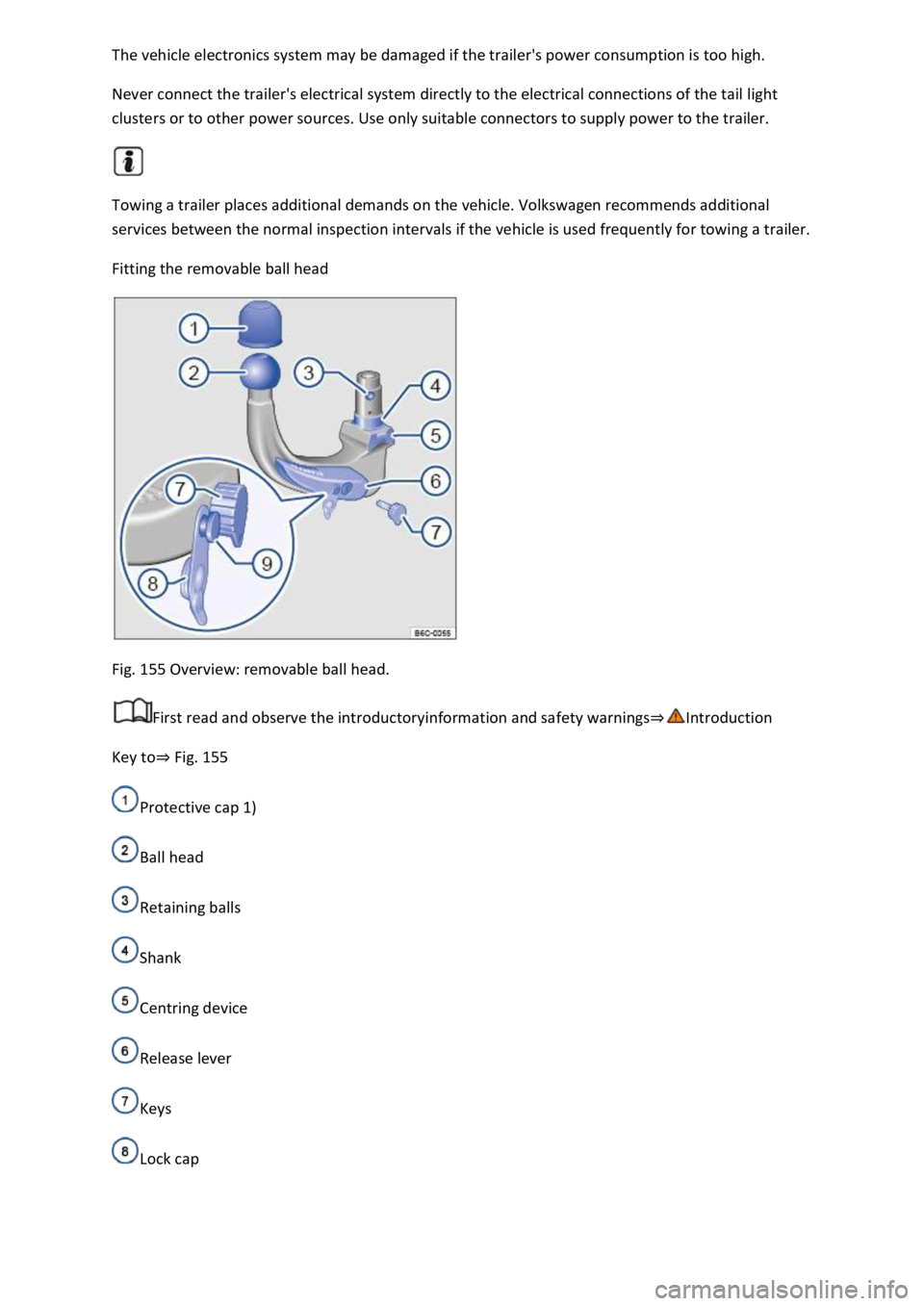
Fitting the removable ball head
Fig. 155 Overview: removable ball head.
First read and observe the introductoryinformation and safety warnings⇒Introduction
Key to⇒ Fig. 155
Protective cap 1)
Ball head
Retaining balls
Shank
Centring device
Release lever
Keys
Lock cap
Page 325 of 502

pecified on the pump meets the vehicle's
requirements.
-approved service additives in the approved quantity.
emergency, you have to use petrol with an octane number lower than the recommended number,
drive at medium engine speeds and avoid high engine loading. Avoid high engine speeds and heavy
engine loads. Refuel with petrol with the correct octane number as soon as possible.
Diesel
First read and observe the introductoryinformation and safety warnings⇒Introduction
Fill vehicles with a diesel engine only with diesel or diesel with a maximum RME fuel content of 7 %
⇒ .
If you use diesel with a high sulphur content, the service intervals are shorter. Information on
countries where the diesel has a high sulphur content is available from your Volkswagen dealership
or a qualified workshop.
The fuel quality affects the running properties, performance and service life of the engine. Refuel
with fuel that already contains suitable service additives ⇒ .
Information on the fuel standards can be found in the chapter on fuel standards ⇒ Fuel standards .
Winter-grade diesel fuel and filter preheater system
Winter-grade diesel fuel, which can be used at temperatures below -20°C (-4°F), is available during
the cold months. In countries with different climates, diesel with a different temperature behaviour
is offered. Information is available from your Volkswagen dealership, qualified workshops and filling
stations in the respective country.
Diesel vehicles are equipped with a filter preheater system. When using winter-grade diesel fuel, the
fuel system is safe for operation at temperatures down to around -24°C (-11°F). In order to ensure
that the vehicle can also be started at low outside temperatures, Volkswagen recommends parking
the vehicle in a location that is protected from the whether, e.g. in a garage ⇒ Troubleshooting .
Misfuelling prevention device
The tank filler neck in diesel vehicles may be fitted with a misfuelling prevention device. This is
intended to help ensure that the vehicle is refuelled only using diesel filler nozzles.
If the nozzle cannot be inserted correctly into the tank filler neck, first check whether you are using a
diesel filler nozzle. When you have made sure that you are using the correct filler nozzle, move the
diesel filler nozzle to and fro slightly with light pressure. This can open the misfuelling prevention
device and make it possible to refuel the vehicle. If the misfuelling prevention device still remains
closed, go to a qualified workshop and have the system checked.
If it is necessary to refuel the vehicle using a fuel canister in the event of an emergency, the
misfuelling prevention device will not open. In order to nevertheless fill the tank with fuel, pour the
diesel into the tank extremely slowly in very small quantities.
Page 373 of 502

The engine oil must be changed on a regular basis. Always observe the service intervals applicable to
your vehicle ⇒ Service .
The engine oil and filter change should be carried out by a qualified workshop due to the special
tools and knowledge required, this also applies to the disposal of used oil. Volkswagen recommends
using a Volkswagen dealership for this purpose.
More details on the service intervals can be found in the chapter on service ⇒ Service .
Additives in the engine oil can cause new engine oil to discolour quickly. This is normal and does not
mean that the engine oil should be changed more frequently.
WARNING
If, in exceptional cases, you have to carry out an oil change yourself, please observe the following:
al when removing the oil drain plug with your fingers to help prevent oil
from running down your arm.
engine filling quantity.
l in empty food containers, bottles or any other non-original containers as
people finding these containers may not know that they contain engine oil.
Before changing the engine oil, first find out where old oil can be disposed of properly near you.
Used oil must be disposed of in accordance with regulations governing the protection of the
environment. Never dispose of used oil in locations such as gardens, woods, sewerage systems, on
streets and roads, or in rivers and waterways.
Engine oil consumption
First read and observe the introductoryinformation and safety warnings⇒Introduction
Engine oil consumption can vary from engine to engine and can change during the service life of an
engine.
The vehicle may consume up to 1.0 litre of engine oil per 2,000 km, depending on your driving style
and the conditions in which the car is used. In new vehicles, consumption may be higher for the first
5,000 km. The engine oil level must therefore be checked at regular intervals, preferably each time
the vehicle is refuelled and before long journeys.
Page 389 of 502

Connecting the 12-volt vehicle battery
-volt vehicle
battery.
e cable and then the negative cable ⇒ .
Various indicator lamps may light up after the 12-volt vehicle battery has been connected and the
ignition is switched on. They will go out when you drive a short distance at a speed of approximately
15 – 20 km/h (10 – 12 mph). If the indicator lamps remain lit up, the vehicle should be checked by a
qualified workshop.
If the 12-volt vehicle battery was disconnected for an extended period, the system may not able to
calculate or correctly display the time when the next service is due ⇒ Instrument cluster . Observe
the maximum permissible service intervals ⇒ Service .
Automatic switch-off for electrical consumers
The intelligent vehicle electrical system management function automatically implements a range of
measures to prevent the 12-volt vehicle battery from discharging under high loads:
power supply to the 12-volt socket and the cigarette lighter may be interrupted temporarily
while the engine is being started.
The vehicle electrics management system cannot always prevent the 12-volt vehicle battery from
being discharged, for example if the ignition is left on over a long period with the engine off or the
side lights or parking lights are left on over a long period of time.
12-volt vehicle battery is discharged
gnition is switched on.
⇒ Auxiliary heater and ventilation .
WARNING
Incorrectly mounting the battery and using incorrect 12-volt vehicle batteries can cause short
circuits, fire and serious injuries.
-free and leak-proof 12-volt vehicle batteries that have the same
properties, specifications and dimensions as the factory-fitted 12-volt vehicle battery.
WARNING
A highly explosive mixture of gases is given off when the 12-volt vehicle battery is being charged.
Page 432 of 502
advisor will note these on the order.
The LongLife mobility guarantee is valid until the next inspection is due. Documentation takes place
at every due inspection.
The type and scope of service work may differ from vehicle to vehicle. Information on specific work
for your vehicle can be requested from a qualified workshop.
WARNING
Inadequate servicing, no servicing at all, or failure to adhere to service intervals can result in
breakdowns, accidents and serious injury.
NOTICE
Volkswagen is not responsible for any vehicle damage caused by inadequate service work or the lack
of part availability.
Regular servicing of your vehicle not only maintains its value, it also ensures that your vehicle
remains roadworthy and in working order. You should therefore have your vehicle serviced
according to the Volkswagen guidelines.
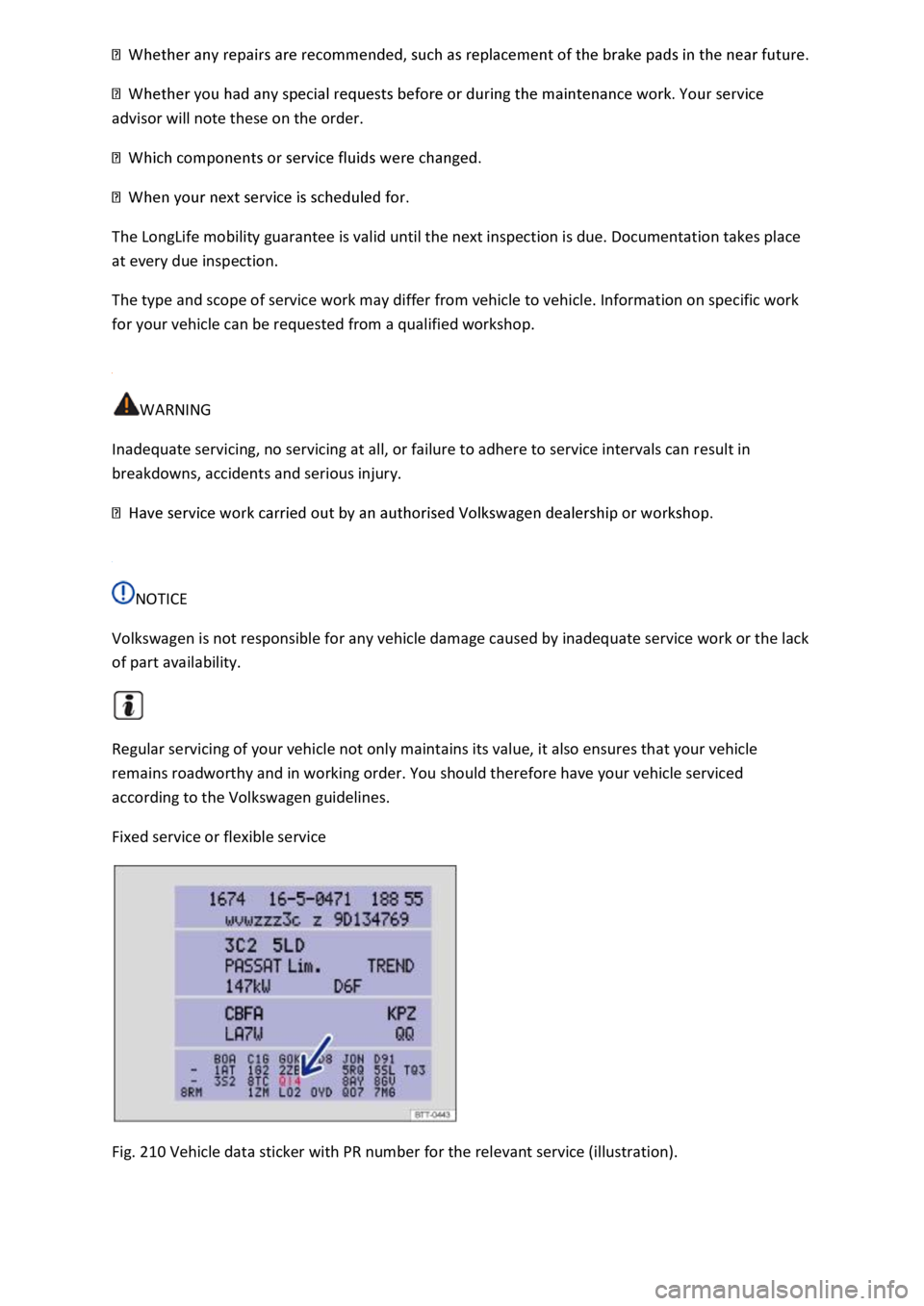
Fixed service or flexible service
Fig. 210 Vehicle data sticker with PR number for the relevant service (illustration).
Page 433 of 502

The service events differ according to oil change service and inspection. The service interval display
in the display of the instrument cluster serves as a reminder for the due date of the next service
event.
Your vehicle will receive either the fixed service or flexible service for the oil change service,
depending on the vehicle equipment, the engine type and the operating conditions.
How do I know which type of service my vehicle needs?
⇒ Fig. 210 (arrow) ⇒ Technical data .
Service eventa) PR No. Service type Service interval
Oil change service QI1 Fixed Every 5,000 km or 1 yearb).
QI2 Every 7,500 km or 1 yearb).
QI3 Every 10,000 km or 1 yearb).
QI4 Every 15,000 km or 1 yearb).
QI6 Flexible According to service interval display.
Inspection According to service interval display.
Observe the information on engine oil specifications according to VW standards ⇒ Engine oil .
Features of the flexible service
With the flexible service, you only need to have an oil change service carried out if your vehicle
requires one. Individual operating conditions and personal driving style are taken into account in
order to determine this point in time. An important part of the flexible service is the use of LongLife
engine oil instead of conventional oil.
Observe the information on engine oil specifications according to VW standards ⇒ Engine oil .
If you do not wish to have the flexible service, you can opt for the fixed service instead. However, a
fixed service can affect your service costs. Your service advisor will be pleased to help.
Service interval display
Scheduled services at Volkswagen are displayed in the service interval display in the instrument
cluster ⇒ Service interval display or in the Vehicle settings menu in the Infotainment system
⇒ Vehicle settings menu . This service interval display provides information on services that include
an oil change or inspection. When an individual service is due, additional work that is due can also be
carried out, e.g. changing brake fluid and spark plugs.
a) Information is stated for vehicles used under normal operating conditions.
b) Whichever comes first.
Page 434 of 502

Information on operating conditions
The specified service intervals and scope of service are always for vehicles used under normal
operating conditions.
If the vehicle is operated under severe conditions, some work will have to be performed before the
next service or at shorter intervals than those specified.
Severe operating conditions are, for example:
th high levels of dust,
This applies particularly to the following components (according to equipment):
Care allergen filter
The service advisor at your qualified workshop will be pleased to advise you on whether your vehicle
requires more frequent work between the normal service intervals due to the conditions under
which it is used.
WARNING
Inadequate servicing, no servicing at all, or failure to adhere to service intervals may result in
breakdowns, accidents or serious injury.
Have service work carried out by an authorised Volkswagen dealership or workshop.
NOTICE
Volkswagen is not responsible for any vehicle damage caused by inadequate service work or the lack
of part availability.