2021 VOLKSWAGEN T-ROC Heating control
[x] Cancel search: Heating controlPage 154 of 502
Switch off the air recirculation mode when it is no longer required.
WARNING
Stale air can quickly make the driver tired and affect their concentration, which in turn can cause
collisions, accidents and serious injuries.
Never switch off the blower or switch on the air recirculation mode for an extended period as this
prevents fresh air from entering the vehicle interior.
NOTICE
Food, medicine and other items that are sensitive to heat or cold could be either damaged or
rendered useless by the air flowing out of the vents.
Never leave food, medicines or other temperature-sensitive objects in front of the vents.
NOTICE
If the air conditioning system is not working, switch the air conditioning system off immediately and
have it checked by a qualified workshop. This can help to prevent secondary damage.
Some settings can be stored in the user accounts of the personalisation function and therefore
change automatically when the user account changes ⇒ Personalisation .
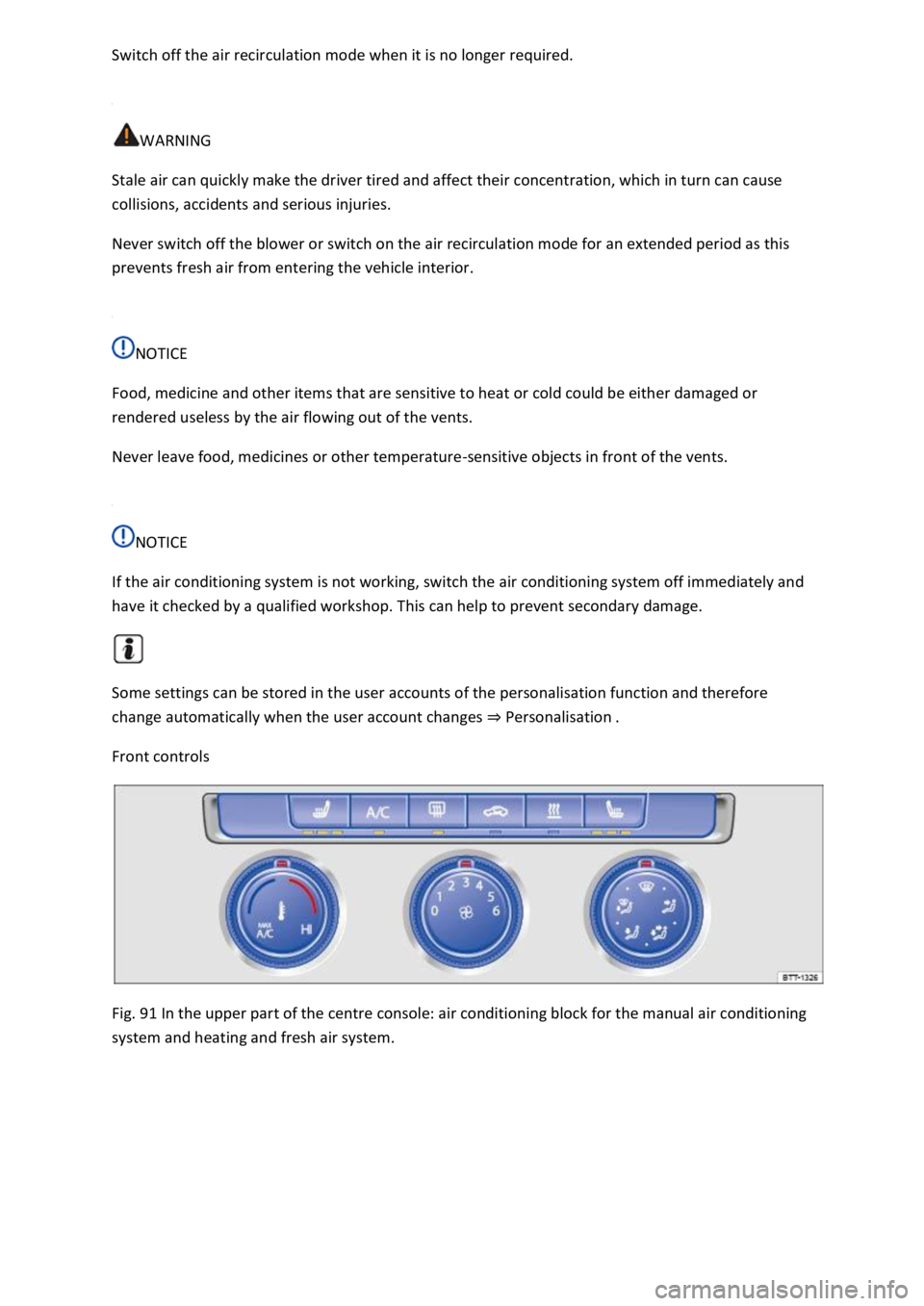
Front controls
Fig. 91 In the upper part of the centre console: air conditioning block for the manual air conditioning
system and heating and fresh air system.
Page 155 of 502

Fig. 92 In the upper part of the centre console: Climatronic air conditioning block.
First read and observe the introductoryinformation and safety warnings⇒Introduction
Some functions and buttons may vary according to the vehicle equipment and the type of system
installed.
– Air conditioning settings in the Infotainment system
Press the button in the air conditioning block to open the Climatronic air conditioning settings
in the Infotainment system.
The upper part of the screen shows the current air conditioning settings.
Blue: cooling.
Red: heating.
Touch the function button to set the automatic control of air recirculation mode, the
supplementary heater and the windscreen heating.
Touch the function button to switch cooling mode, air distribution and the blower on and off via
the Infotainment system.
Touch the Presettings function button to set the automatic mode, the maximum cooling output, the
defrost function and the manual mode of the cooling system via the Infotainment system.
Touch the function button to set the blower speed in mode.
Switching off
Press the button in the air conditioning block (vehicles without auxiliary heater).
OR: touch the function button on the Infotainment system.
Manual air conditioning system: turn the centre rotary control to position ⇒ Fig. 91 .
Climatronic: turn the centre rotary control anti-clockwise as far as it will go ⇒ Fig. 92 .
– Climatronic with allergen filter
The allergen filter of the Air Care Climatronic can reduce the amount of pollutants and also allergens
that enter the vehicle interior.
Page 156 of 502

Press the button in the air conditioning block.
Touch the Air Care function button.
Touch the Active function button to switch the Air Care function on or off.
– Synchronising the temperature settings
Press the button to adopt the temperature settings of the driver side for the front passenger
side.
– Automatic mode
The automatic mode ensures constant temperatures in the vehicle interior. The air temperature, air
quantity and air distribution are regulated automatically. Automatic mode switches off if ventilation
is adjusted manually.
– Cooling mode
Press the button in the air conditioning block to switch cooling mode on or off.
In cooling mode, the air is dehumidified.
– Maximum cooling
Manual air conditioning system: turn the left rotary control to position . Air
recirculation mode is switched on automatically.
Climatronic: press the button. Air recirculation mode is switched on automatically
and the air distribution is set to the position.
/ – Temperature
Manual air conditioning system: turn the left rotary control ⇒ Fig. 91 .
Climatronic: turn the outer rotary controls ⇒ Fig. 92 to adjust the temperatures for the driver
and front passenger sides.
The set temperatures are displayed above the rotary controls for Climatronic.
– Seat and steering wheel heating
Press the buttons or to switch the seat heating on and off ⇒ Seat heating .
To operate the seat heating and steering wheel heating at the same time with the button, link
the two functions via the air conditioning settings in the Infotainment system ⇒ Switching the
steering wheel heating on or off together with the seat heating (only for Climatronic) .
/ – Auxiliary heater
Page 157 of 502

Press the button in the air conditioning block to switch the auxiliary heater on and off when the
ignition is switched off ⇒ .
Touch the function button in the Infotainment system air conditioning settings to access the
Auxiliary heater menu ⇒ Auxiliary heater and ventilation .
The auxiliary heater provides additional heating when the ignition is switched on.
– Blower
Turn the middle rotary control.
When Climatronic is in automatic mode, no blower speed is displayed in the rotary control.
– Air recirculation mode
Press the button.
Air distribution
– air distribution to the upper body via the vents in the dash panel.
– air distribution to footwell.
– air distribution to the upper body and the footwell.
– air distribution to the windscreen and the footwell.
– air distribution to the windscreen.
| – Defrost function
Manual air conditioning system: turn the right rotary knob to position ⇒ Fig. 91 .
Climatronic: press the button ⇒ Fig. 92 .
Manual air conditioning system: in the defrost function, the air recirculation mode switches off
and the air conditioning compressor for the cooling system switches on in order to dehumidify the
air. When the defrost function is switched on, it is not possible to switch the air recirculation mode
on or the air conditioning compressor off1).
– Rear window heating
Press to switch the rear window heating on or off while the engine is running.
The rear window heating will switch off after 10 minutes at the latest.
Recommended settings for manual air conditioning system
Switch off air recirculation mode.
Set blower to setting or .
Page 162 of 502

The cooling system cannot be switched on or its function is restricted
The cooling system functions only when the engine is running and at ambient temperatures above
+3°C (+38°F).
The cooling system is switched off when the engine is very warm.
Switch on the blower.
Check the fuse of the air conditioning system ⇒ Fuses in the dash panel .
Change the dust and pollen filter ⇒ Service .
If the fault persists, seek expert assistance.
The heating and fresh air system cannot be switched on or its function is restricted
The heating and defrost function are more effective when the engine is warm.
If the fault persists, seek expert assistance.
Condensation on the windows
Keep the air intake in front of the windscreen free of ice, snow or leaves in order to improve heating
and cooling performance ⇒ Vehicle care .
Do not cover the air vents in the rear of the luggage compartment to allow air to flow through the
vehicle from the front to the rear.
Press the button or turn the rotary knob to position in order to switch on the defrost
function ⇒ .
The wrong unit of temperature is set
Change the unit of temperature for all temperature displays in the vehicle using the Infotainment
system ⇒ Infotainment system controls and displays .
Change the unit of temperature in the instrument cluster menu ⇒ Instrument cluster .
Water under the vehicle
If the humidity and temperature outside the vehicle are high, condensation can drip off the
evaporator of the cooling system and form a pool underneath the vehicle. This is normal and does
not indicate a leak!
If the outside humidity is high and the outside temperature low, condensation may evaporate when
the auxiliary heater is running ⇒ Auxiliary heater and ventilation . If this is the case, steam may
appear underneath the vehicle. This is not a sign that the vehicle is damaged.
WARNING
Poor visibility through all windows increases the risk of collisions and accidents, which can cause
serious injuries.
Page 163 of 502

Always ensure that all windows are free of ice, snow and mist to ensure good visibility.
Maximum heat output and the fastest possible defrosting of the windows are possible only when
the engine is running. Do not start your journey until you have good visibility.
To help ensure good visibility, make sure that you use the air conditioning system and the rear
window heating correctly.
Auxiliary heater and ventilation
Introduction
This chapter contains information on the followingsubjects:
⇒ Switching the auxiliary heater and ventilation on and off
⇒ Programming the auxiliary heater and ventilation
⇒ Remote control
The auxiliary heater and ventilation system can be used to heat the vehicle interior in the winter and
ventilate it in the summer. It is able to clear ice, condensation and a thin layer of snow from the
windscreen. The auxiliary heater is supplied with fuel from the vehicle fuel tank and can be operated
when the vehicle is stationary with the ignition switched off. The auxiliary ventilation system is
powered by the 12-volt vehicle battery.
Auxiliary heater exhaust system
The emissions generated by the auxiliary heater are discharged via an exhaust pipe underneath the
vehicle. The exhaust pipe must not be blocked by snow, mud or other objects.
WARNING
Among other things, the emissions from the auxiliary heater contain carbon monoxide, which is an
odourless and colourless poisonous gas. Carbon monoxide can cause people to lose consciousness. It
can also cause death.
Never switch on the auxiliary heater when the vehicle is in unventilated or closed rooms nor let the
auxiliary heater run in unventilated or closed rooms.
Never program the auxiliary heater so that it is switched on and runs in unventilated or closed
rooms.
WARNING
Parts of the auxiliary heater exhaust system become very hot. This can cause fires.
Park the vehicle so that no part of the exhaust system can come into contact with any inflammable
material underneath the vehicle, e.g. dry grass.
Page 166 of 502
Before programming, check that the date and time set in the vehicle are correct ⇒ Time .
Open the Auxiliary heater menu.
Touch the Set function button.
Select one of the memory locations for a Departure time.
Touch the Activate function button.
Manual air conditioning system: the programmed departure time determines the time at which
the auxiliary heater or ventilation should switch off. The point at which the heating or ventilation
process starts is determined depending on the programmed running time.
Climatronic: on the basis of the programmed departure time, the vehicle automatically
calculates the start time for heating or ventilation to the currently set temperature depending on
the outside temperature.
Press the Running time function button under Adjust in order to select the running time when the
auxiliary heater is switched on using the immediate heat button or remote control.
Checking programming
If a departure time has been activated, the LED in the immediate heat button will light up on the
Climatronic control panel for approximately 10 seconds after the ignition is switched off.
WARNING
Never program the auxiliary heating system so that is switched on and run in unventilated or
enclosed spaces. Among other things, the emissions from the auxiliary heater contain carbon
monoxide, which is an odourless and colourless poisonous gas. Carbon monoxide can cause people
to lose consciousness. It can also cause death.
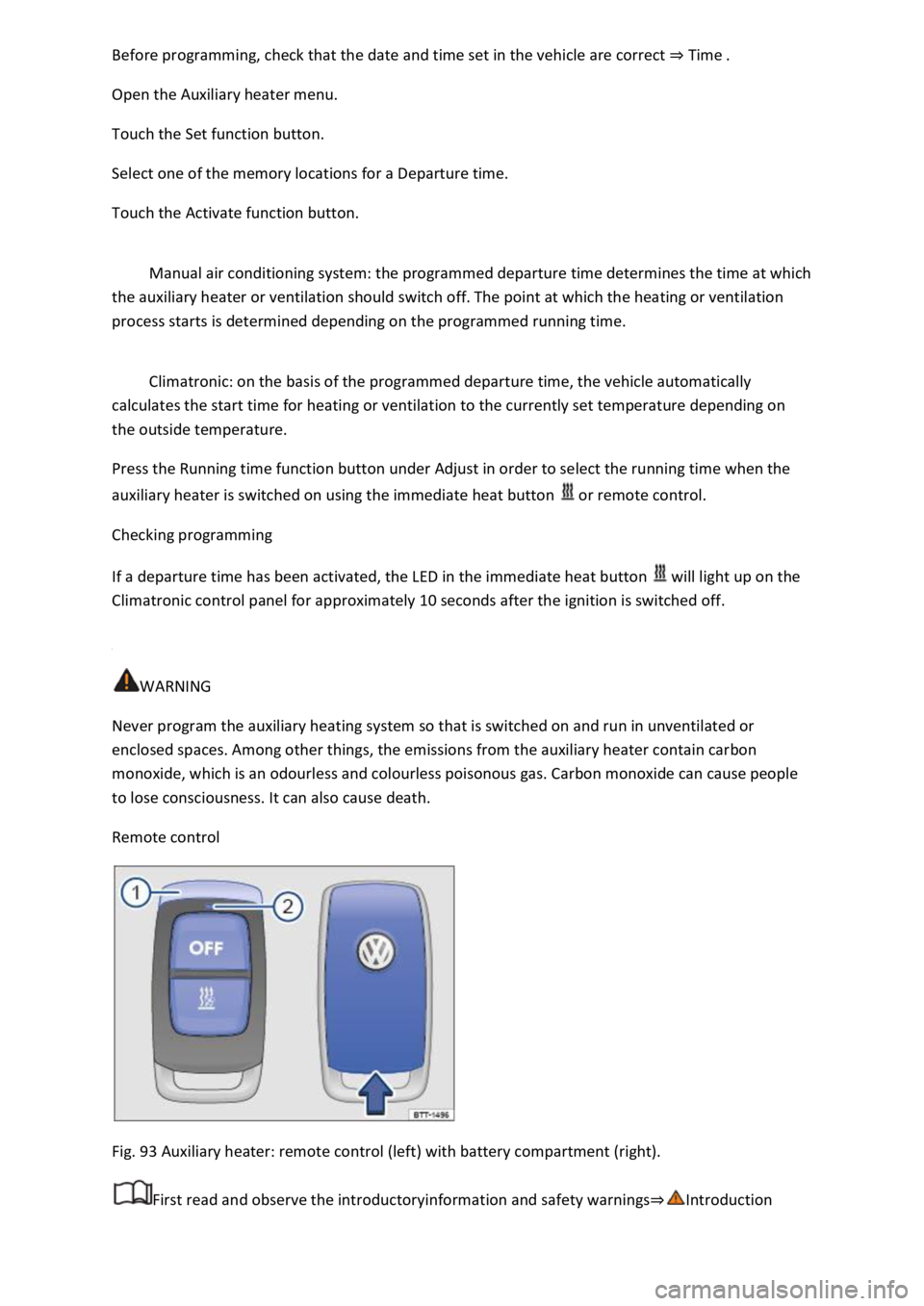
Remote control
Fig. 93 Auxiliary heater: remote control (left) with battery compartment (right).
First read and observe the introductoryinformation and safety warnings⇒Introduction
Page 226 of 502

An incorrect tyre pressure can cause overheating, sudden tyre damage including tyre bursts and
ripping of the tread surface and thus to a loss of control over the vehicle.
Driving on steep terrain
First read and observe the introductoryinformation and safety warnings⇒Introduction
Driving uphill or downhill
Get out of the vehicle and assess the situation before you attempt to drive up or down a hill:
Walk along the section and check the firmness of the ground. Look out for obstacles and other
hidden dangers ⇒ .
Check the section beyond the hill.
You should not follow the route if it is too steep, uneven or if the ground surface is too loose. Select
another route.
Drive slowly and at constant speed straight up or down a slope.
Accelerate only to the speed you need to climb the slope. Too much acceleration can cause the
wheels to spin and lead to a loss of control of the vehicle. Insufficient throttle increases the
probability of stalling the engine.
Never attempt to stop or turn on a slope.
Avoid allowing the engine to stall.
Do not change gear or engage the clutch when climbing a slope.
Use the offroad display ⇒ Offroad display .
If you cannot continue to drive up a hill
Never turn the vehicle around on an uphill gradient.
If the engine has stalled, depress the footbrake and start the engine again.
Select reverse gear and reverse back slowly in a straight line.
Use the foot brake to keep a constant speed until you have reached a safe place.
Driving downhill
Never exceed the tilt angle of the vehicle! If, in an emergency, you have to traverse the slope when
driving down it and the vehicle threatens to tip over, steer into the fall line immediately.
There is an increased risk of rolling over when driving downhill. Concentrate on steering the vehicle
when driving downhill in particular.
Use the offroad display on steep downhill stretches ⇒ Offroad display .
Drive down steep inclines in first gear.
Use the foot brake sparingly in order not to lose control of the vehicle.