2021 TOYOTA YARIS CROSS braking
[x] Cancel search: brakingPage 37 of 650
35
1
YARIS CROSS Owner's Manual_Europe_M52K60_en
1-1. For safe use
For safety and security
Seat belts
Make sure that all occupants
are wearing their seat belts
before driving the vehicle.
WARNING
Observe the following precautions to
reduce the risk of injury in the event of sudden braking, sudden swerving or an accident.
Failure to do so may cause death or serious injury.
■Wearing a seat belt
●Ensure that all passengers wear a seat belt.
●Always wear a seat belt properly.
●Each seat belt should be used by one person only. Do not use a seat belt for more than one person at
once, including children.
●Toyota recommends that children
be seated in the rear seat and always use a seat belt and/or an appropriate child restraint system.
●To achieve a proper seating posi-tion, do not recline the seat more
than necessary. The seat belt is most effective when the occupants are sitting up straight and well back
in the seats.
●Do not wear the shoulder belt under
your arm.
●Always wear your seat belt low and
snug across your hips.
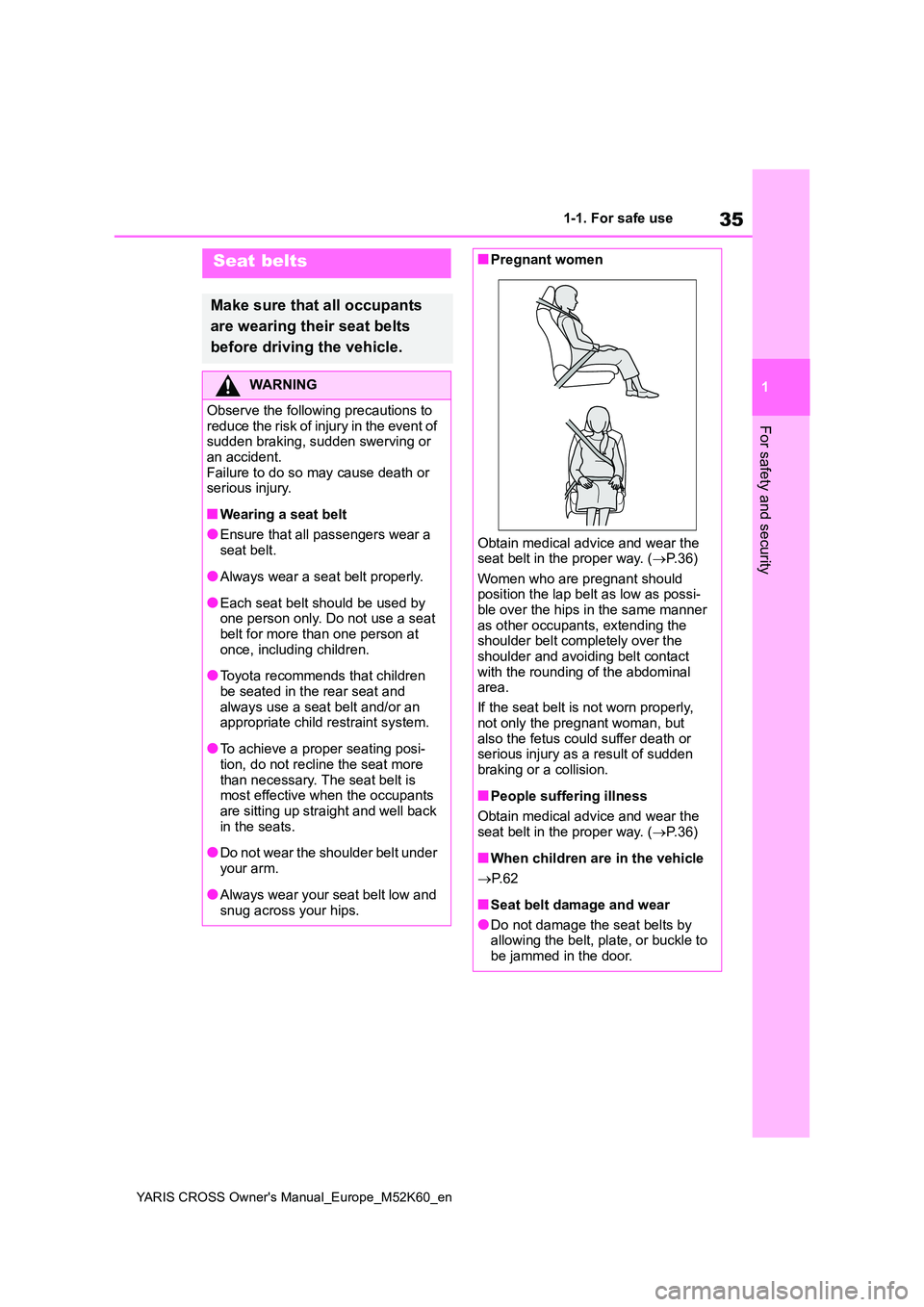
■Pregnant women
Obtain medical advice and wear the seat belt in the proper way. ( P. 3 6 )
Women who are pregnant should position the lap belt as low as possi-ble over the hips in the same manner
as other occupants, extending the shoulder belt completely over the shoulder and avoiding belt contact
with the rounding of the abdominal area.
If the seat belt is not worn properly,
not only the pregnant woman, but also the fetus could suffer death or serious injury as a result of sudden
braking or a collision.
■People suffering illness
Obtain medical advice and wear the seat belt in the proper way. ( P. 3 6 )
■When children are in the vehicle
P. 6 2
■Seat belt damage and wear
●Do not damage the seat belts by allowing the belt, plate, or buckle to
be jammed in the door.
Page 52 of 650
50
YARIS CROSS Owner's Manual_Europe_M52K60_en
1-2. Child safety
■When installing a child
restraint system to a front pas-
senger seat
For the safety of a child, install a
child restraint system to a rear seat.
When installing a child restraint
system to a front passenger seat is
unavoidable, adjust the seat as fol-
lows and install the child restraint
system:
Move the front seat fully rear-
ward.
Adjust the seat height to the
upper most position.
Adjust the seatback angle to the
most upright position.
When installing a forward-facing child
WARNING
●For effective protection in automo- bile accidents and sudden stops, a
child must be properly restrained, using a seat belt or child restraint system which is correctly installed.
For installation details, refer to the operation manual enclosed with the child restraint system. General
installation instruction is provided in this manual.
●Toyota strongly urges the use of a proper child restraint system that conforms to the weight and size of
the child, installed on the rear seat. According to accident statistics, the child is safer when properly
restrained in the rear seat than in the front seat.
●Holding a child in your or someone else’s arms is not a substitute for a child restraint system. In an acci-
dent, the child can be crushed against the windshield or between the holder and the interior of the
vehicle.
■Handling the child restraint sys-
tem
If the child restraint system is not properly fixed in place, the child or
other passengers may be seriously injured or even killed in the event of sudden braking, sudden swerving, or
an accident.
●If the vehicle were to receive a
strong impact from an accident, etc., it is possible that the child restraint system has damage that is
not readily visible. In such cases, do not reuse the restraint system.
●Depending on the child restraint system, installation may be difficult or impossible. In those cases,
check whether the child restraint system is suitable for installment in the vehicle. ( P.53) Be sure to
install and observe the usage rules after carefully reading the child restraint system fixing method in
this manual, as well as the opera- tion manual enclosed with the child restraint system.
●Keep the child restraint system properly secured on the seat even if
it is not in use. Do not store the child restraint system unsecured in the passenger compartment.
●If it is necessary to detach the child restraint system, remove it from the
vehicle or store it securely in the luggage compartment.
When using a child restraint
system
Page 78 of 650
76
YARIS CROSS Owner's Manual_Europe_M52K60_en
1-4. Hybrid system
motor) drives the vehicle. At slow
speeds or when traveling down a
gentle slope, the engine is stopped*
and the electric motor (traction
motor) is used.
When the shift lever is in N, the
hybrid battery (traction battery) is
not being charged.
*: When the hybrid battery (traction bat-
tery) requires charging or the engine
is warming up, etc., the gasoline
engine will not automatically stop.
( P. 7 6 )
■During normal driving
The gasoline engine is predomi-
nantly used. The electric motor
(traction motor) charges the hybrid
battery (traction battery) as neces-
sary.
■When accelerating sharply
When the accelerator pedal is
depressed heavily, the power of the
hybrid battery (traction battery) is
added to that of the gasoline engine
via the electric motor (traction
motor).
■When braking (regenerative
braking)
The wheels operate the electric
motor (traction motor) as a power
generator, and the hybrid battery
(traction battery) is charged.
■Regenerative braking
●In the following situations, kinetic
energy is converted to electric energy and deceleration force can be obtained in conjunction with the
recharging of the hybrid battery (trac-
tion battery). • The accelerator pedal is released while driving with the shift lever in D or
B. • The brake pedal is depressed while driving with the shift lever in D or B.
●Vehicles with GPF system: While the GPF system ( P.335) is operating to
regenerate the exhaust gas filter, the hybrid battery (traction battery) may not be recharged.
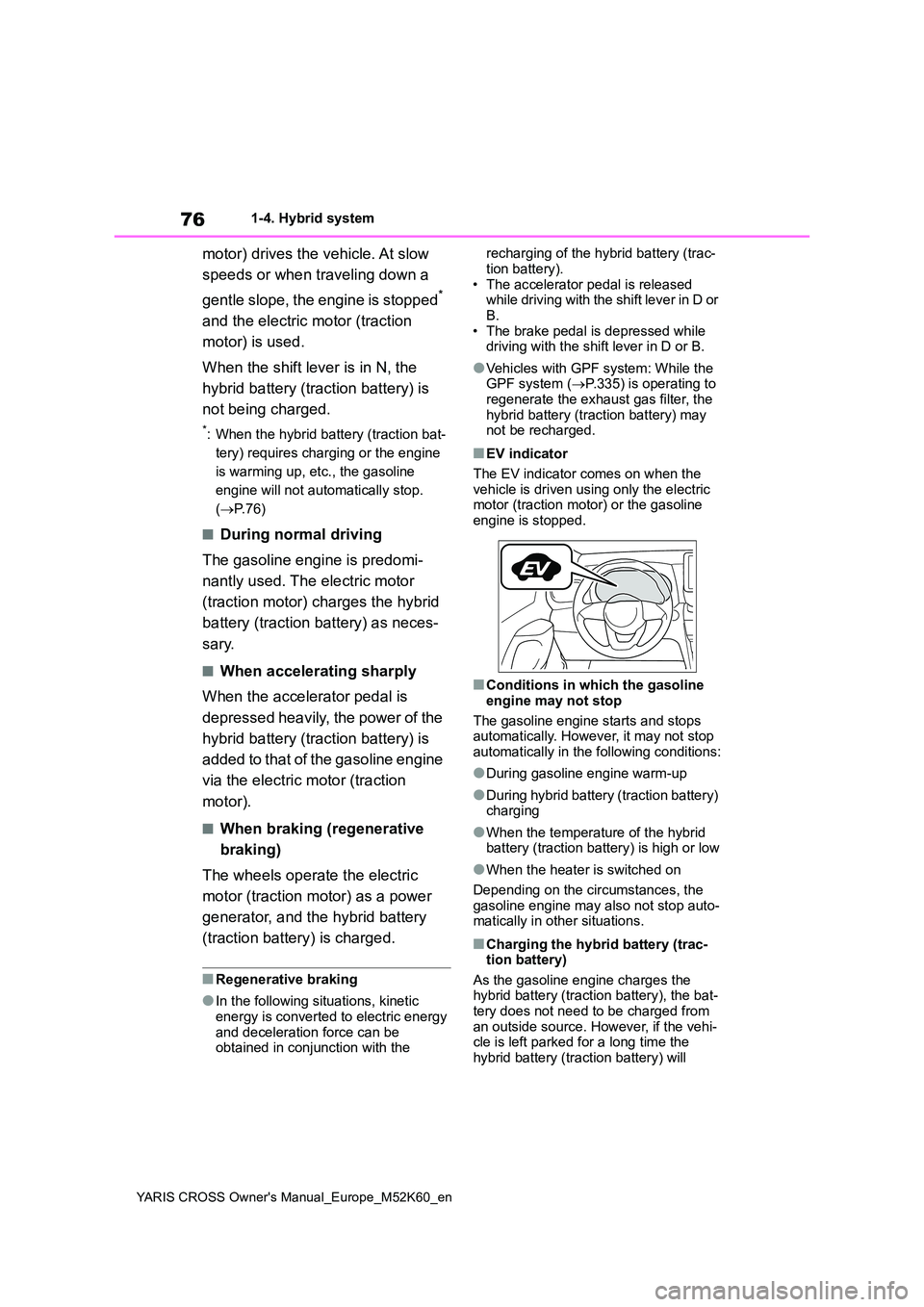
■EV indicator
The EV indicator comes on when the vehicle is driven using only the electric motor (traction motor) or the gasoline
engine is stopped.
■Conditions in which the gasoline
engine may not stop
The gasoline engine starts and stops automatically. However, it may not stop
automatically in the following conditions:
●During gasoline engine warm-up
●During hybrid battery (traction battery) charging
●When the temperature of the hybrid battery (traction battery) is high or low
●When the heater is switched on
Depending on the circumstances, the
gasoline engine may also not stop auto- matically in other situations.
■Charging the hybrid battery (trac-tion battery)
As the gasoline engine charges the hybrid battery (traction battery), the bat-tery does not need to be charged from
an outside source. However, if the vehi- cle is left parked for a long time the hybrid battery (traction battery) will
Page 79 of 650

77
1
YARIS CROSS Owner's Manual_Europe_M52K60_en
1-4. Hybrid system
For safety and security
slowly discharge. For this reason, be
sure to drive the vehicle at least once every few months for at least 30 minutes or 16 km (10 miles). If the hybrid battery
(traction battery) becomes fully dis- charged and you are unable to start the hybrid system, contact any authorized
Toyota retailer or Toyota authorized repairer, or any reliable repairer.
■Charging the 12-volt battery
P. 4 7 8
■After the 12-volt battery has dis-
charged or when the terminal has been removed and installed during exchange, etc.
The gasoline engine may not stop even if the vehicle is being driven by the hybrid battery (traction battery). If this
continues for a few days, contact any authorized Toyota retailer or Toyota authorized repairer, or any reliable
repairer.
■Sounds and vibrations specific to a hybrid vehicle
There may be no engine sound or vibra-
tion even though the vehicle is able to move with the “READY” indicator is illu-minated. For safety, apply the parking
brake and make sure to shift the shift lever to P when parked.
The following sounds or vibrations may
occur when the hybrid system is operat- ing and are not a malfunction:
●Motor sounds may be heard from the engine compartment.
●Sounds may be heard from the hybrid battery (traction battery) under the rear seats when the hybrid system
starts or stops.
●Relay operating sounds such as a
snap or soft clank will be emitted from the hybrid battery (traction battery), under the rear seats, when the hybrid
system is started or stopped.
●Sounds from the hybrid system may
be heard when the back door is open.
●Sounds may be heard from the trans-
mission when the gasoline engine
starts or stops, when driving at low
speeds, or during idling.
●Engine sounds may be heard when
accelerating sharply.
●Sounds may be heard due to regener-
ative braking when the brake pedal is depressed or as the accelerator pedal is released.
●Vibration may be felt when the gaso-line engine starts or stops.
●Cooling fan sounds may be heard from the air intake vent on the side of
the lower part of the rear left seat.
■Maintenance, repair, recycling, and disposal
Contact any authorized Toyota retailer
or Toyota authorized repairer, or any reli- able repairer regarding maintenance, repair, recycling and disposal. Do not
dispose of the vehicle yourself.
■Customization
Some functions can be customized. ( P.498)
When the gasoline engine is off
while driving, a sound is produced
to warn pedestrians, people riding
bicycles or other people and vehi-
cles in the surrounding area that
the vehicle is approaching. The
pitch of the sound adjusts accord-
ing to vehicle speed. When vehicle
speed is approximately 25 km/h (16
mph) or more, the warning system
turns off.
■Acoustic vehicle alerting system
In the following cases, the acoustic vehi- cle alerting system sound may be diffi-cult for pedestrians, people riding
bicycles or other people and vehicles in
Acoustic vehicle alerting
system
Page 99 of 650

97
2
YARIS CROSS Owner's Manual_Europe_M52K60_en
2-1. Instrument cluster
Vehicle status information and indicators
• When the outside temperature has
changed suddenly (at the entrance/exit of a garage, tunnel, etc.)
●When “--” is displayed, the system may be malfunctioning. Take your vehicle to any authorized Toyota
retailer or Toyota authorized repairer, or any reliable repairer.
■Fuel gauge and driving range dis-play
The fuel gauge and driving range dis- play are linked. If the fuel gauge and driving range display do not update after
refueling a small amount, they can be updated by performing the following pro-cedure:
1 Stop the vehicle on a level surface.
Wait until the fuel in the fuel tank stabi- lizes.
2 Press the display change button to change the odometer and trip meter
display to the odometer.
3 Turn the power switch off.
4 While pressing and holding the dis- play change button, turn the power switch to ON.
5 Continue holding the display change
button for approximately 5 seconds.
Release the button when the odometer begins blinking.
Updating will be complete when the odometer blinks for approximately 5 seconds and then returns to the normal
display.
■Liquid crystal display
P. 1 0 6
■Customization
The gauges and meters can be custom-
ized in of the multi-information dis-
play. ( P.498)
■Changing the display
Press the display change button
until the desired item is displayed.
WARNING
■The information display at low temperatures
Allow the interior of the vehicle to warm up before using the liquid crys-tal information display. At extremely
low temperatures, the information dis- play monitor may respond slowly, and display changes may be delayed.
For example, there is a lag between the driver’s shifting and the new gear
number appearing on the display. This lag could cause the driver to downshift again, causing rapid and
excessive engine braking and possi- bly an accident resulting in death or injury.
NOTICE
■To prevent damage to the engine and its components
The engine may be overheating if the engine coolant temperature gauge is in the red zone (H). In this case,
immediately stop the vehicle in a safe place, and check the engine after it
has cooled completely. ( P.481)
Odometer and trip meter
display
Page 105 of 650

103
2
YARIS CROSS Owner's Manual_Europe_M52K60_en
2-1. Instrument cluster
Vehicle status information and indicators
Shows that an Eco-friendly driving range
is being exceeded (during full power
driving, etc.)
*: When used in this manual, regenera-
tion refers to the conversion of energy
created by the movement of the vehi-
cle into electrical energy.
In the following situation, the Hybrid
System Indicator does not operate.
●“READY” indicator is not illuminated.
●The shift position is in a range other than D or B.
■Outside temperature display
●In the following situations, the correct outside temperature may not be dis-
played, or the display may take longer than normal to change:• When stopped, or driving at low
speeds (less than 25 km/h [16 mph]) • When the outside temperature has changed suddenly (at the
entrance/exit of a garage, tunnel, etc.)
●When “--” is displayed, the system
may be malfunctioning. Take your vehicle to any authorized Toyota retailer or Toyota authorized repairer,
or any reliable repairer.
■Fuel gauge and driving range dis- play
The fuel gauge and driving range dis-
play are linked. If the fuel gauge and driving range display do not update after refueling a small amount, they can be
updated by performing the following pro- cedure:
1 Stop the vehicle on a level surface.
Wait until the fuel in the fuel tank stabi-
lizes.
2 Press the display change button to change the odometer and trip meter display to the odometer.
3 Turn the power switch off.
4 While pressing and holding the dis-
play change button, turn the power switch to ON.
5 Continue holding the display change
button for approximately 5 seconds.
Release the button when the odometer begins blinking.
Updating will be complete when the odometer blinks for approximately 5 seconds and then returns to the normal
display.
■Liquid crystal display
P. 1 1 3
■Customization
The gauges and meters can be custom-
ized in of the multi-information dis-
play. ( P.498)
WARNING
■The information display at low temperatures
Allow the interior of the vehicle to warm up before using the liquid crys-tal information display. At extremely
low temperatures, the information dis- play monitor may respond slowly, and display changes may be delayed.
For example, there is a lag between the driver’s shifting and the new gear
number appearing on the display. This lag could cause the driver to downshift again, causing rapid and
excessive engine braking and possi- bly an accident resulting in death or injury.
NOTICE
■To prevent damage to the engine
and its components
The engine may be overheating if the engine coolant temperature gauge is
in the red zone (H). In this case, immediately stop the vehicle in a safe place, and check the engine after it
has cooled completely. ( P.481)
Page 141 of 650
139
3
YARIS CROSS Owner's Manual_Europe_M52K60_en
3-2. Opening, closing and locking the doors
Before driving
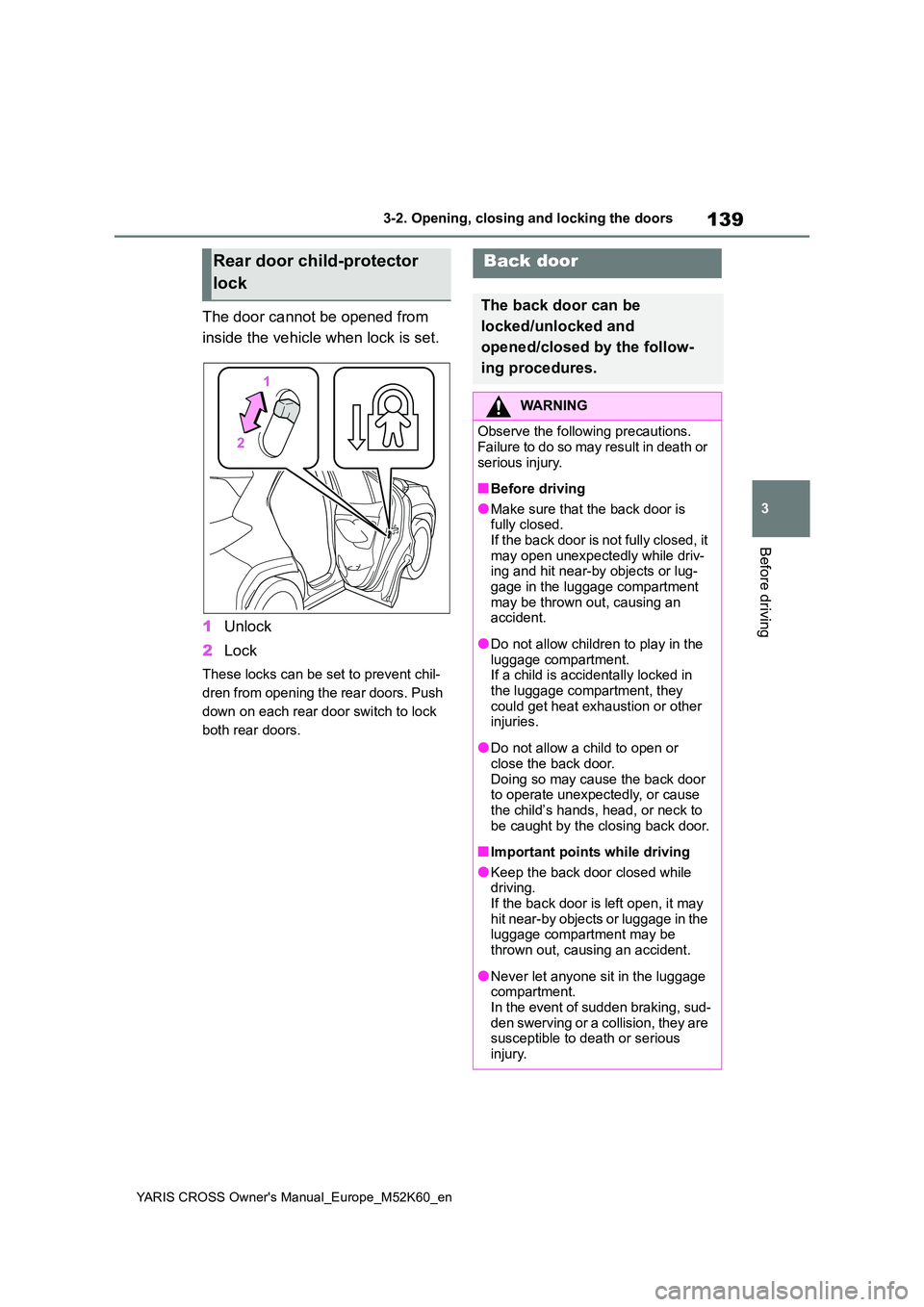
The door cannot be opened from
inside the vehicle when lock is set.
1 Unlock
2 Lock
These locks can be set to prevent chil-
dren from opening the rear doors. Push
down on each rear door switch to lock
both rear doors.
Rear door child-protector
lock
Back door
The back door can be
locked/unlocked and
opened/closed by the follow-
ing procedures.
WARNING
Observe the following precautions. Failure to do so may result in death or
serious injury.
■Before driving
●Make sure that the back door is fully closed. If the back door is not fully closed, it
may open unexpectedly while driv- ing and hit near-by objects or lug-gage in the luggage compartment
may be thrown out, causing an accident.
●Do not allow children to play in the luggage compartment.If a child is accidentally locked in
the luggage compartment, they could get heat exhaustion or other injuries.
●Do not allow a child to open or close the back door.
Doing so may cause the back door to operate unexpectedly, or cause the child’s hands, head, or neck to
be caught by the closing back door.
■Important points while driving
●Keep the back door closed while driving.If the back door is left open, it may
hit near-by objects or luggage in the luggage compartment may be thrown out, causing an accident.
●Never let anyone sit in the luggage compartment.
In the event of sudden braking, sud- den swerving or a collision, they are susceptible to death or serious
injury.
Page 180 of 650

178
YARIS CROSS Owner's Manual_Europe_M52K60_en
4-1. Before driving
WARNING
■When shifting the shift lever
●Do not let the vehicle roll backward
while a forward driving position is selected, or roll forward while the shift lever is in R.
Doing so may result in an accident or damage to the vehicle.
●Do not shift the shift lever to P while the vehicle is moving.Doing so can damage the transmis-
sion and may result in a loss of vehicle control.
●Do no t sh i ft t h e sh if t l e ve r t o R whi l e the vehicle is moving forward.Doing so can damage the transmis-
sion and may result in a loss of vehicle control.
●Do not shift the shift lever to a driv-ing position while the vehicle is moving backward.
Doing so can damage the transmis- sion and may result in a loss of vehicle control.
●Moving the shift lever to N while the vehicle is moving will disengage the
hybrid system. Engine braking is not available with the hybrid system disengaged.
●Be careful not to shift the shift lever with the accelerator pedal
depressed. Shifting the shift lever to any positions other than P or N may lead to unexpected rapid accelera-
tion of the vehicle that may cause an accident and result in death or serious injury.
■If you hear a squealing or scrap-ing noise (brake pad wear indica-
tors)
Have the brake pads checked and replaced by any authorized Toyota
retailer or Toyota authorized repairer, or any reliable repairer as soon as possible.
Rotor damage may result if the pads are not replaced when needed.
It is dangerous to drive the vehicle when the wear limits of the brake pads and/or those of the brake discs
are exceeded.
■When the vehicle is stopped
●Do not depress the accelerator pedal unnecessarily.If the shift lever is any position other
than P or N, the vehicle may accel- erate suddenly and unexpectedly, causing an accident.
●In order to prevent accidents due to the vehicle rolling away, always
keep depressing the brake pedal while stopped with the “READY” indicator is illuminated, and apply
the parking brake as necessary.
●If the vehicle is stopped on an
incline, in order to prevent acci- dents caused by the vehicle rolling forward or backward, always
depress the brake pedal and securely apply the parking brake as needed.
●Avoid revving or racing the engine.Running the engine at high speed
while the vehicle is stopped may cause the exhaust system to over-heat, which could result in a fire if
combustible material is nearby.
■When the vehicle is parked
●Do not leave glasses, cigarette lighters, spray cans, or soft drink cans in the vehicle when it is in the
sun. Doing so may result in the follow-ing:
• Gas may leak from a cigarette lighter or spray can, and may lead
to a fire.
• The temperature inside the vehicle
may cause the plastic lenses and plastic material of glasses to deform or crack.