2021 TOYOTA YARIS CROSS Motor
[x] Cancel search: MotorPage 83 of 650

81
1
YARIS CROSS Owner's Manual_Europe_M52K60_en
1-4. Hybrid system
For safety and security
WARNING
●Do not touch the high voltage parts, cables and connectors.
●If electric wires are exposed inside or outside your vehicle, an electric
shock may occur. Never touch exposed electric wires.
●If a fire occurs in the hybrid vehicle, leave the vehicle as soon as possi-ble. Never use a fire extinguisher
that is not meant for electric fires. Using even a small amount of water may be dangerous.
●If your vehicle needs to be towed, do so with the front wheels (2WD
models) or four wheels (AWD mod- els) raised. If the wheels connected to the electric motor (traction motor)
are on the ground when towing, the motor may continue to generate electricity. This may cause a fire.
( P.433)
●Carefully inspect the ground under
the vehicle. If you find that liquid has leaked onto the ground, the fuel system may have been damaged.
Leave the vehicle as soon as possi- ble.
●Do not touch the battery if liquid is leaking from or adhering to it. If electrolyte (carbonate ester-based
organic electrolyte) from the hybrid battery (traction battery) comes into contact with the eyes or skin, it
could cause blindness or skin wounds. In the unlikely event that it comes into contact with the eyes or
skin, wash it off immediately with a large amount of water, and seek immediate medical attention.
●If electrolyte is leaking from the hybrid battery (traction battery), do not approach the vehicle. Even in
the unlikely event that the hybrid battery (traction battery) is dam-aged, the internal construction of
the battery will prevent a large amount of electrolyte from leaking out. However, any electrolyte that
does leak out will give off a vapor. This vapor is an irritant to skin and eyes and could cause acute poi-
soning if inhaled.
●Do not bring burning or high-tem-
perature items close to the electro- lyte. The electrolyte may ignite and cause a fire.
■Hybrid battery (traction battery)
●Your vehicle contains a sealed lith-
ium-ion battery.
●Never resell, hand over or modify
the hybrid battery. To prevent acci- dents, hybrid batteries that have been removed from a disposed
vehicle are collected through any authorized Toyota retailer or Toyota authorized repairer, or any reliable
repairer. Do not dispose of the bat- tery yourself.
Unless the battery is properly col-
lected, the following may occur,
resulting in death or serious injury:
• The hybrid battery may be illegally disposed of or dumped, and it is
hazardous to the environment or someone may touch a high voltage part, resulting in an electric shock.
• The hybrid battery is intended to be used exclusively with your hybrid
vehicle. If the hybrid battery is used outside of your vehicle or modified in any way, accidents such as elec-
tric shock, heat generation, smoke generation, an explosion and elec-trolyte leakage may occur.
Page 127 of 650

125
2
YARIS CROSS Owner's Manual_Europe_M52K60_en
2-1. Instrument cluster
Vehicle status information and indicators
Front tire
Rear tire*
*: For FF vehicles, the arrows to are
not displayed.
Multimedia system(7-inch/8-inch
display)
The image shows all the arrows as an
example. The actual display will vary
depending on conditions.
Gasoline engine
Front electric motor (traction
motor)
Rear electric motor (traction
motor)
Hybrid battery (traction battery)
Front tire
Rear tire*
*: For FF vehicles, the arrows to
and are not displayed.
Multimedia system(7-inch/8-inch
display) (on “Home” screen)
The image shows all the arrows as an
example. The actual display will vary
depending on conditions.
Gasoline engine
Hybrid battery (traction battery)
Tire
Multimedia system(9-inch dis-
play)
The image shows all the arrows as an
example. The actual display will vary
depending on conditions.
Gasoline engine
Front electric motor (traction
motor)
Rear electric motor (traction
motor)
Page 182 of 650

180
YARIS CROSS Owner's Manual_Europe_M52K60_en
4-1. Before driving
When the following unusual opera-
tion is performed with the accelera-
tor pedal depressed, the engine
WARNING
■If the vehicle becomes stuck (AWD models)
Do not spin the wheels excessively when any of the tires is up in the air, or the vehicle is stuck in sand, mud,
etc. This may damage the driveline components or propel the vehicle for-ward or backward, causing an acci-
dent.
NOTICE
■When driving the vehicle
●Do not depress the accelerator and
brake pedals at the same time during driving, as this may restrain the hybrid system output.
●Do not use the accelerator pedal or depress the accelerator and brake
pedals at the same time to hold the vehicle on a hill.
■When parking the vehicle
Always set the parking brake and shift
the shift lever to P. Failure to do so may cause the vehicle to move or the vehicle may accelerate suddenly if
the accelerator pedal is accidentally depressed.
■Avoiding damage to vehicle parts
●Do not turn the steering wheel fully in either direction and hold it there
for an extended period of time. Doing so may damage the power steering motor.
●When driving over bumps in the road, drive as slowly as possible to
avoid damaging the wheels, under- side of the vehicle, etc.
■If you get a flat tire while driving
A flat or damaged tire may cause the following situations. Hold the steering
wheel firmly and gradually depress the brake pedal to slow down the vehicle.
●It may be difficult to control your vehicle.
●The vehicle will make abnormal sounds or vibrations.
●The vehicle will lean abnormally.
Information on what to do in case of a
flat tire ( P.452, 463)
■When encountering flooded
roads
Do not drive on a road that has flooded after heavy rain, etc. Doing so
may cause the following serious dam- age to the vehicle:
●Engine stalling
●Short in electrical components
●Engine damage caused by water immersion
In the event that you drive on a flooded road and the vehicle
becomes flooded or stuck in mud or sand, be sure to have any authorized Toyota retailer or Toyota authorized
repairer, or any reliable repairer check the following:
●Brake function
●Changes in quantity and quality of
oil and fluid used for the engine, hybrid transmission, differential, etc.
●Lubricant condition for the bearings and suspension joints (where possi-
ble), and the function of all joints, bearings, etc.
Sudden start restraint con-
trol (Drive-Start Control
[DSC])
Page 194 of 650
192
YARIS CROSS Owner's Manual_Europe_M52K60_en
4-2. Driving procedures
until the “READY” indicator is steady
on, as steady means the vehicle is able to move.
●When the hybrid battery (traction bat-tery) is extremely cold (below approxi-mately -30°C [-22°F]) under the
influence of the outside temperature, it may not be possible to start the hybrid system. In this case, try to start the
hybrid system again after the tem- perature of the hybrid battery increases due to the outside tempera-
ture increase, etc.
■Sounds and vibrations specific to a hybrid vehicle
P. 7 7
■If the 12-volt battery is discharged
The hybrid system cannot be started using the smart entry & start system. Refer to P.476 to restart the hybrid sys-
tem.
■Electronic key battery depletion
P. 1 3 1
■Conditions affecting operation
P. 1 5 4
■Notes for the entry function
P. 1 5 4
■Steering lock function
●After turning the power switch off and
opening and closing the doors, the steering wheel will be locked due to the steering lock function. Operating
the power switch again automatically cancels the steering lock.
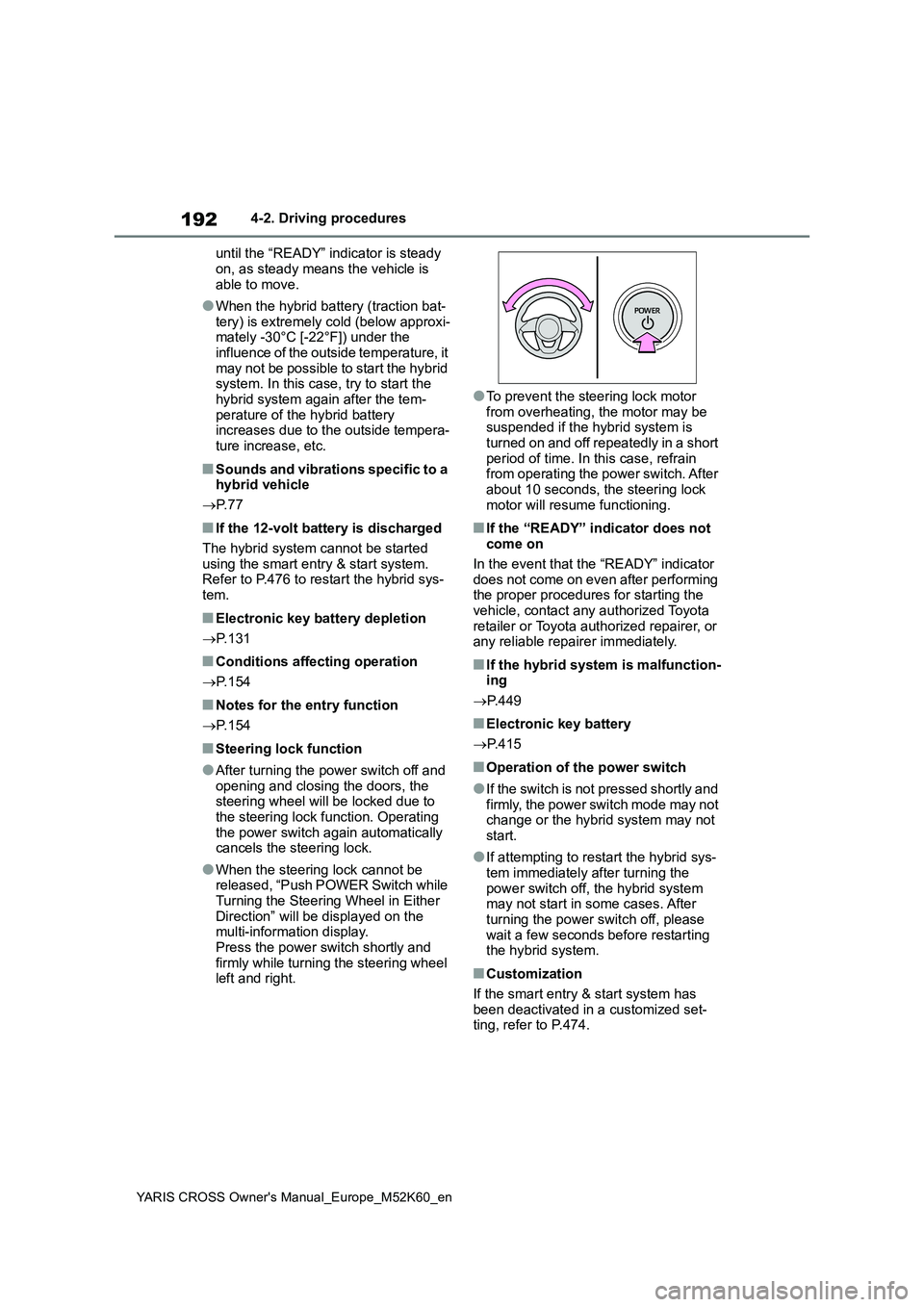
●When the steering lock cannot be released, “Push POWER Switch while Turning the Steering Wheel in Either
Direction” will be displayed on the multi-information display. Press the power switch shortly and
firmly while turning the steering wheel left and right.
●To prevent the steering lock motor
from overheating, the motor may be suspended if the hybrid system is turned on and off repeatedly in a short
period of time. In this case, refrain from operating the power switch. After about 10 seconds, the steering lock
motor will resume functioning.
■If the “READY” indicator does not come on
In the event that the “READY” indicator
does not come on even after performing the proper procedures for starting the vehicle, contact any authorized Toyota
retailer or Toyota authorized repairer, or any reliable repairer immediately.
■If the hybrid system is malfunction-ing
P. 4 4 9
■Electronic key battery
P. 4 1 5
■Operation of the power switch
●If the switch is not pressed shortly and firmly, the power switch mode may not change or the hybrid system may not
start.
●If attempting to restart the hybrid sys-
tem immediately after turning the power switch off, the hybrid system may not start in some cases. After
turning the power switch off, please wait a few seconds before restarting the hybrid system.
■Customization
If the smart entry & start system has been deactivated in a customized set-ting, refer to P.474.
Page 197 of 650
195
4
YARIS CROSS Owner's Manual_Europe_M52K60_en
4-2. Driving procedures
Driving
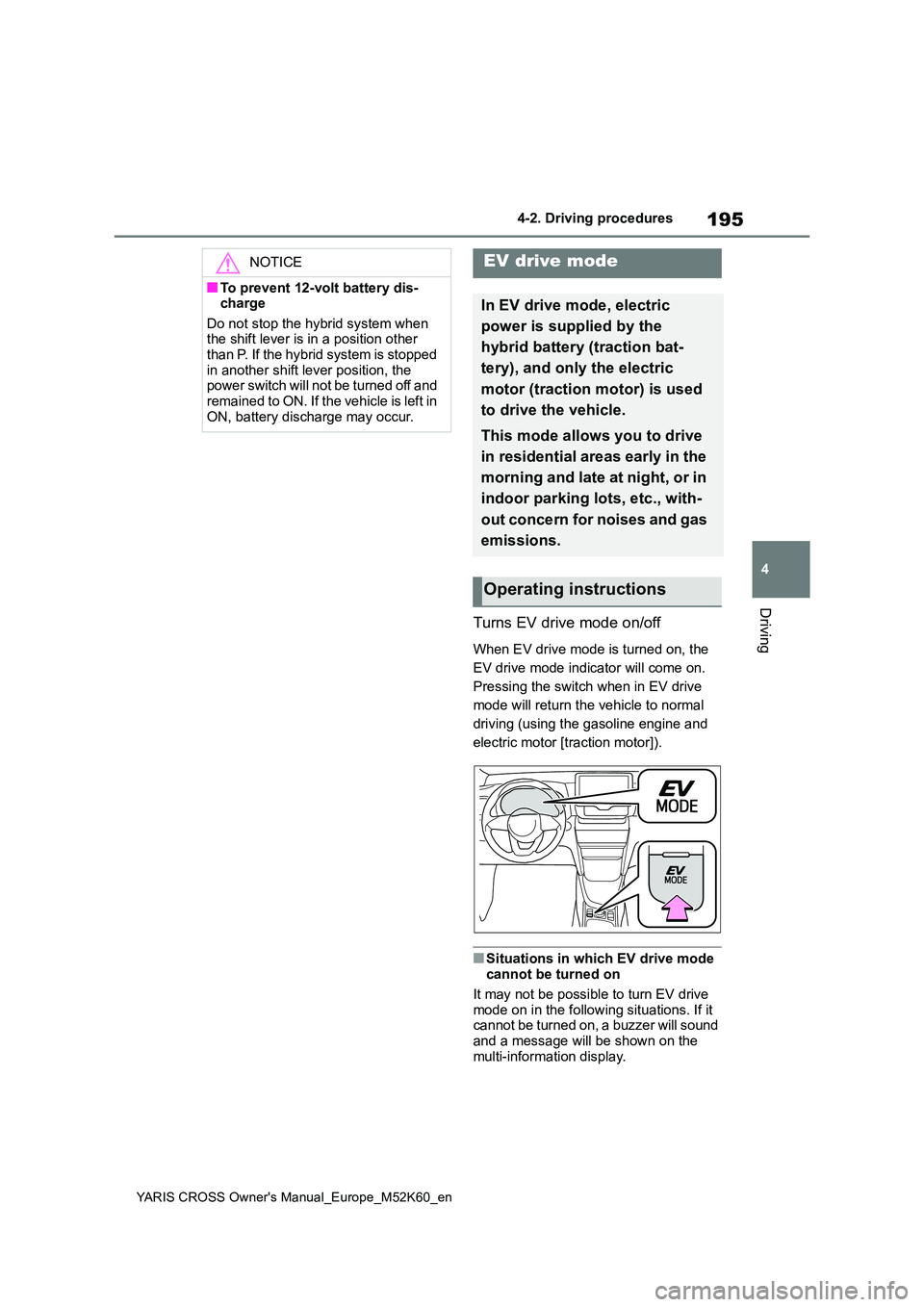
Turns EV drive mode on/off
When EV drive mode is turned on, the
EV drive mode indicator will come on.
Pressing the switch when in EV drive
mode will return the vehicle to normal
driving (using the gasoline engine and
electric motor [traction motor]).
■Situations in which EV drive mode cannot be turned on
It may not be possible to turn EV drive
mode on in the following situations. If it cannot be turned on, a buzzer will sound and a message will be shown on the
multi-information display.
NOTICE
■To prevent 12-volt battery dis- charge
Do not stop the hybrid system when the shift lever is in a position other than P. If the hybrid system is stopped
in another shift lever position, the power switch will not be turned off and remained to ON. If the vehicle is left in
ON, battery discharge may occur.
EV drive mode
In EV drive mode, electric
power is supplied by the
hybrid battery (traction bat-
tery), and only the electric
motor (traction motor) is used
to drive the vehicle.
This mode allows you to drive
in residential areas early in the
morning and late at night, or in
indoor parking lots, etc., with-
out concern for noises and gas
emissions.
Operating instructions
Page 198 of 650

196
YARIS CROSS Owner's Manual_Europe_M52K60_en
4-2. Driving procedures
●The temperature of the hybrid system
is high. The vehicle has been left in the sun, driven on a hill, driven at high speeds,
etc.
●The temperature of the hybrid system
is low. The vehicle has been left in tempera-tures lower than about 0°C (32°F) for
a long period of time, etc.
●The gasoline engine is warming up.
●The hybrid battery (traction battery) is low.
The remaining battery level indicated in the energy monitor display is low. ( P.123)
●Vehicle speed is high.
●The accelerator pedal is depressed firmly or the vehicle is on a hill, etc.
●The windshield defogger is in use.
■Switching to EV drive mode when the gasoline engine is cold
If the hybrid system is started while the
gasoline engine is cold, the gasoline engine will start automatically after a short period of time in order to warm up.
In this case, you will become unable to switch to EV drive mode.
After the hybrid system has started and
the “READY” indicator has illuminated, press the EV drive mode switch before the gasoline engine starts to switch to
EV drive mode.
■Automatic cancelation of EV drive mode
When driving in EV drive mode, the gas-
oline engine may start automatically and the vehicle may be driven by the gaso-line engine and electric motor (traction
motor) in the following situations. When EV drive mode is canceled, a buzzer will sound, the EV drive mode indicator will
flash, and a message will be displayed on the multi-information display.
●The hybrid battery (traction battery) becomes low.The remaining battery level indicated
in the energy monitor display is low.
( P.123)
●Vehicle speed is high.
●The accelerator pedal is depressed firmly or the vehicle is on a hill, etc.
■Possible driving distance when driving in EV drive mode
EV drive mode’s possible driving dis- tance ranges from a few hundred meters to approximately 1 km (0.6 mile).
However, depending on vehicle condi- tions, there are situations when EV drive mode cannot be used.
(The distance that is possible depends on the hybrid battery [traction battery] level and driving conditions.)
■Fuel economy
The hybrid system is designed to achieve the best possible fuel economy during normal driving (using the gaso-
line engine and electric motor [traction motor]). Driving in EV drive mode more than necessary may lower fuel econ-
omy.
■If “EV Mode Unavailable” is shown on the multi-information display
The EV drive mode is not available. The
reason the EV drive mode is not avail- able (the vehicle is idling, battery charge is low, vehicle speed is higher than the
EV drive mode operating speed range or accelerator pedal is depressed too much) may be displayed. Use the EV
drive mode when it becomes available.
■If “EV Mode Deactivated” is shown on the multi-information display
The EV drive mode has been automati-
cally canceled. The reason the EV drive mode is not available (the battery charge is low, vehicle speed is higher
than the EV drive mode operating speed range or accelerator pedal is depressed too much) may be displayed. Drive the
vehicle for a while before attempting to turn on the EV drive mode again.
Page 204 of 650
202
YARIS CROSS Owner's Manual_Europe_M52K60_en
4-2. Driving procedures
●The driver’s door is closed
●The driver is wearing the seat belt
●The shift lever is a forward or reverse position.
●The malfunction indicator lamp or brake system warning light is not illu-minated.
If the automatic release function does not operate, manually release the park-ing brake.
■Parking brake automatic lock func-
tion
The parking brake will be set automati- cally under the following conditions:
●The driver does not operate the brake pedal.
●The driver’s door is not closed.
●The driver is not wearing the seat belt.
●The shift lever position is not in P or N.
●The malfunction indicator lamp or brake system warning light is not illu-
minated.
■If “Parking Brake Temporarily Unavailable” is displayed on the multi-information display
If the parking brake is operated repeat- edly over a short period of time, the sys-tem may restrict operation to prevent
overheating. If this happens, refrain from operating the parking brake. Normal operation will return after about 1 min-
ute.
■If “Parking Brake Unavailable” is displayed on the multi-information display
Operate the parking brake switch. If the message does not disappear after oper-ating the switch several times, the sys-
tem may be malfunctioning. Have the vehicle inspected by any authorized Toyota retailer or Toyota authorized
repairer, or any reliable repairer.
■Parking brake operation sound
When the parking brake operates, a motor sound (whirring sound) may be
heard. This does not indicate a malfunc-
tion.
■Parking brake operation
●Depending on the power switch mode, the parking brake indicator and park-
ing brake light will turn on and stay on as described below:ON: Comes on until the parking brake
is released. Not in ON: Stays on for approximately 15 seconds.
●When the power switch is turned off with the parking brake set, the parking
brake indicator and parking brake light will stay on for about 15 seconds. This does not indicate a malfunction.
■When the parking brake switch
malfunctions
Automatic mode (automatic brake set- ting and releasing) will be turned on
automatically.
■Parking the vehicle
P. 1 7 5
■Parking brake engaged warning buzzer
A buzzer will sound if the vehicle is driven with the parking brake engaged. “Parking Brake ON” is displayed on the
multi-information display. (with the vehi- cle reached a speed of 5 km/h [3 mph])
■If the brake system warning light comes on
P. 4 3 9
■Usage in winter time
P. 3 4 6
WARNING
■When parking the vehicle
Do not leave a child in the vehicle alone. The parking brake may be released unintentionally and there is
the danger of the vehicle moving that may lead to an accident resulting in death or serious injury.
Page 242 of 650
240
YARIS CROSS Owner's Manual_Europe_M52K60_en
4-5. Using the driving support systems
• When there are many things which
can reflect the radio waves of the radar in the vicinity (tunnels, truss bridges, gravel roads, snow covered
road that have tracks, etc.) • When there is an effect on the radio waves to the radar that is installed on
another vehicle • When multiple detectable objects are close together
• If the sun or other light is shining directly on a detectable object• When a detectable object is a shade
of white and looks extremely bright • When a detectable object appears to be nearly the same color or brightness
as its surroundings • If a detectable object cuts or suddenly emerges in front of your vehicle
• When the front of your vehicle is hit by water, snow, dust, etc.• When a very bright light ahead, such
as the sun or the headlights of oncom- ing traffic, shines directly into the front camera
• When approaching the side or front of a vehicle ahead• If a vehicle ahead is a motorcycle or
bicycle (for region C) • If a vehicle ahead is narrow, such as a personal mobility vehicle
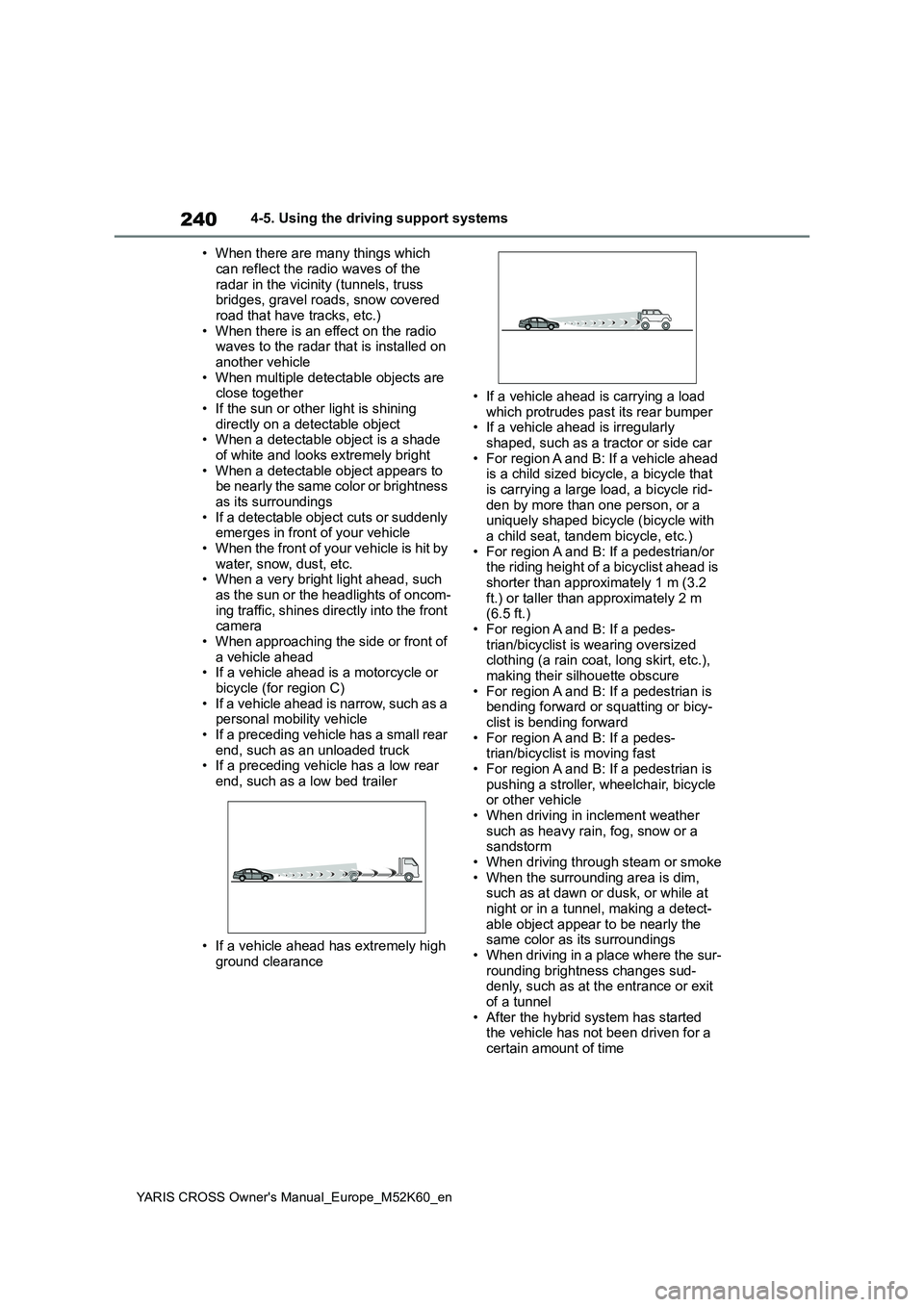
• If a preceding vehicle has a small rear end, such as an unloaded truck• If a preceding vehicle has a low rear
end, such as a low bed trailer
• If a vehicle ahead has extremely high
ground clearance
• If a vehicle ahead is carrying a load
which protrudes past its rear bumper • If a vehicle ahead is irregularly shaped, such as a tractor or side car
• For region A and B: If a vehicle ahead is a child sized bicycle, a bicycle that is carrying a large load, a bicycle rid-
den by more than one person, or a uniquely shaped bicycle (bicycle with a child seat, tandem bicycle, etc.)
• For region A and B: If a pedestrian/or the riding height of a bicyclist ahead is shorter than approximately 1 m (3.2
ft.) or taller than approximately 2 m (6.5 ft.)• For region A and B: If a pedes-
trian/bicyclist is wearing oversized clothing (a rain coat, long skirt, etc.), making their silhouette obscure
• For region A and B: If a pedestrian is bending forward or squatting or bicy-clist is bending forward
• For region A and B: If a pedes- trian/bicyclist is moving fast• For region A and B: If a pedestrian is
pushing a stroller, wheelchair, bicycle or other vehicle• When driving in inclement weather
such as heavy rain, fog, snow or a sandstorm• When driving through steam or smoke
• When the surrounding area is dim, such as at dawn or dusk, or while at night or in a tunnel, making a detect-
able object appear to be nearly the same color as its surroundings• When driving in a place where the sur-
rounding brightness changes sud- denly, such as at the entrance or exit of a tunnel
• After the hybrid system has started the vehicle has not been driven for a certain amount of time