Page 322 of 457

The braking and driving
characteristics may be
gr eatly impaired. #
Do not continue driving. #
Consult a quali�/ed specialist workshop. Countr
Countr
ies t
ies t hat hav
hat hav e Mer
e Mercedes-Benz Ser
cedes-Benz Ser vice24h:
vice24h:
yo u will �/nd a stic ker with thete lephone number,
e.g. on the B‑pillar on the driver's side. #
Correct the tyre pressure if it is still at least
130 kPa (1.3 bar/19 psi). See the tyre pres-
sure table on the fuel �/ller �0ap forva lues.
Incr
Incr easing t
easing t he tyr
he tyre pr
e pressure
essure #
Switch on the tyre in�0ation compressor.
Decr
Decr easing t
easing t he tyr
he tyre pr
e pressure
essure #
Remo vethe tyre sealant bottle from the tyre
in�0ation compressor. #
Insert the �/ller hose in the soc ket of the tyre
in�0ation compressor and turn it a quarter turn
clockwise. #
Press pressure release button Cnext to
manome terB.
When t
When t he tyr
he tyre pr
e pressur
essur e is corr
e is corr ect
ect #
Unscr ewthe �/lling hose from theva lve of the
sealed tyre. #
Screw theva lve cap onto theva lve of the
sealed tyre. #
Stow the tyre sealant bottle and the tyre in�0a-
tion compressor. #
Drive tothe nearest quali�/ed specialist work-
shop and ha vethe tyre, tyre sealant bottle and
�/lling hose replaced there. Batt
Batt
er
ery (v
y (v ehicle)
ehicle) N
No
ot
tes on t
es on t he 12 V batt
he 12 V batt ery
ery &
W
WARNING
ARNING Risk ofexplosion due toelec-
trostatic charge
Electrostatic charge can ignite the highly
ex plosive gas mixtu reinthe batter y. #
Todischar geany elect rostatic charge
th at may ha vebuilt up, touch the me tal
ve hicle body before handling the batter y. The high
ly�0ammable gas mixtu reis created while
th e battery is charging and during starting assis-
ta nce. &
W
WARNI NG
ARNI NGDanger of chemical burns from
th e battery acid
Battery acid is caustic. #
Avoid contact with the skin, eyes or
clo thing. #
Do not lean overth e batter y. #
Do not inhale battery gases. Breakdown assis
tance
319
319
Page 325 of 457

#
Take care toonly connect battery term i-
nals of identical polarity when receiving
starting assistance. #
Obser vethe sequence described for
connecting and disconnecting the jump
leads when receiving starting assistance. #
Do not connect or disconnect the bat-
te ry term inals while the engine is run-
ning. &
W
WARNI NG
ARNI NGRisk of explosion due toexplo-
sive mixture of gases
An explosive mixture of gases can escape
from the battery during charging and starting
assis tance. #
Fire , naked �0ames, smoking and creating
spar ksmust be avoided. #
Make sure there is adequate ventilation. #
Do not stand overth e batter y. &
W
WARNI NG
ARNI NGRisk of explosion from a frozen
battery
A dischar ged battery may freeze at temp era-
tures slightly abo veor below freezing point.
During starting assistance or battery charging,
battery gas can be released. #
Always allow a battery tothaw before
ch arging it or per form ing starting assis-
ta nce. If
th e indicator/warning lamps in the instrument
cluster do not light up at low temp eratures, it is
ve ry likely that the dischar ged battery has frozen.
In this case you may neither jump-start theve hi-
cle nor charge the batter y.
The service life of a bat tery that has been thawed
may be dramatically shor tened. The starting char-
acteristics may be impaired, especially at low
te mp eratures.
It is recommended that you ha veath awe d battery
ch ecked at a quali�/ed specialist workshop. All v
All v ehicles
ehicles
* NO
NOTE
TEDamage caused bynume rous or
ex tended attem ptsto start the engine Numerous or
extended attem ptsto start the
engine may damage the catalytic con verter
due tonon-combusted fuel. #
Avoid numerous and extended attem pts
to start the engine. Obser
vethefo llowing points during starting assis-
ta nce and when charging the batter y:
R Only use undamaged jump lead/charging
cables with a su�1cient cross-section and
insulated term inal clamps.
R Non-insulated parts of thete rm inal clamps
must not come into contact with other me tal
parts while the jump lead/charging cable is
connected tothe battery/jump-start connec-
tion point.
R The jump lead/charging cable must not come
into contact with any parts which may mo ve
when the engine is running. 322 322
Breakdown assistance
Page 343 of 457
Do not drive with tyres
that ha vetoo little tread
dep th. This signi�/cantly reduces traction on wet
ro ads (aquaplaning).
On vehicles with the same front and rear wheel
size, you can inter change the wheels every
5,000 to10,000 km, depending on thewe ar.
Ensu rethe direction of rotation is maintained for
th e wheels.
Obser vethe inst ructions and saf ety no tes on
"Changing a wheel" when doing so (/ page 340).N
No
ot
tes on st
es on st or
oring wheels
ing wheels When storing wheels, obser
vethefo llowing no tes:
R A�Ter removing wheels, store them in a cool,
dry and preferably dark place.
R Protect the tyres from contact with oil, grease
or fuel. Ov Ov
er
ervie
vie w of t
w of t he tyr
he tyr e-c
e-chang
hang e t
e tool kit
ool kit Apart from some count
ry-speci�/c variants, vehi-
cles are not equipped with a tyre-change tool kit.
Fo r more information on which tyre-changing to
ols are requ ired and appro vedfo r per form ing a
wheel change on your vehicle, consult a quali�/ed
specialist workshop.
Yo ure qu ire thefo llowing tools, forex ample, to
ch ange a wheel:
R Jack
R Chock
R Wheel wrench
R Centring pin
% The jack weighs appr oximately 3.4 kg.
The maximum load capacity of the jack can
be found on the stic ker a�1xed tothe jac k.
The jack is maintenance-free. If there is a
malfunction, please contact a quali�/ed spe-
cialist workshop.
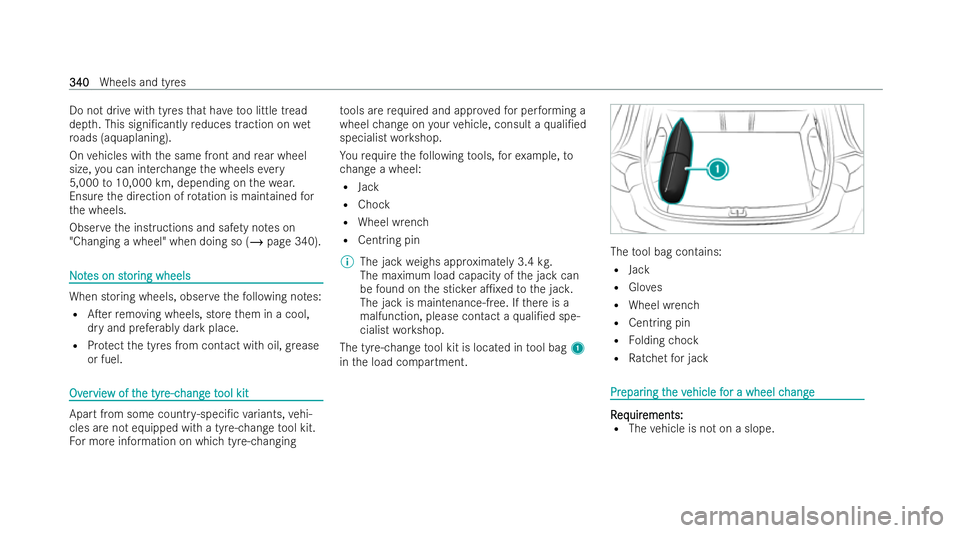
The tyre-change tool kit is located in tool bag 1
in the load compartment. The
tool bag contains:
R Jack
R Gloves
R Wheel wrench
R Centring pin
R Folding chock
R Ratchet for jack Pr Pr
epar
epar ing t
ing the v
he vehicle f
ehicle f or a wheel c
or a wheel c hange
hange R
R
eq
eq uir
uir ements:
ements:
R The vehicle is not on a slope. 340
340
Wheels and tyres