2021 LEXUS ES350 fuel
[x] Cancel search: fuelPage 397 of 464

397
8
8
Vehicle specifications
Vehicle specifications
8-1. SpecificationsMaintenance data (fuel, oil level, etc.) .............................................. 398
Fuel information ......................... 408
Tire information........................... 410
8-2. Customization Customizable features............. 419
8-3. Items to initialize Items to initialize ........................ 430
Page 400 of 464
![LEXUS ES350 2021 Owners Manual 4008-1. Specifications
A25A-FKS engine
2GR-FKS engine
■Oil capacity (Drain and refill [Ref-
erence
*])
*: The engine oil capacity is a reference quantity to be used when changing the
engine o](/manual-img/36/58918/w960_58918-399.png "LEXUS ES350 2021 Owners Manual 4008-1. Specifications
A25A-FKS engine
2GR-FKS engine
■Oil capacity (Drain and refill [Ref-
erence
*])
*: The engine oil capacity is a reference quantity to be used when changing the
engine o")
4008-1. Specifications
A25A-FKS engine
2GR-FKS engine
■Oil capacity (Drain and refill [Ref-
erence
*])
*: The engine oil capacity is a reference quantity to be used when changing the
engine oil. Warm up and turn off the
engine, wait more than 5 minutes, and
check the oil level on the dipstick.
■Engine oil selection
“Toyota Genuine Motor Oil” is used in
your Lexus vehicle. Use Lexus
approved “Toyota Genuine Motor
Oil” or equivalent to satisfy the follow-
ing grade and viscosity.
Oil grade: ILSAC GF-5 multigrade
engine oil
Recommended viscosity: SAE 0W-20
SAE 0W-20 is the best choice for
good fuel economy and good starting
in cold weather.
Valve clearanceAutomatic adjustment
Drive belt tensionAutomatic adjustment
Model2.5 L 4-cylinder (A25A-FKS)
Type4-cylinder in line, 4-cycle, gasoline
Bore and stroke3.44 4.07 in. (87.5 103.4 mm)
Displacement151.8 cu. in. (2487 cm3)
Valve clearanceAutomatic adjustment
Drive belt tensionAutomatic adjustment
Fuel
Fuel typeUnleaded gasoline only
Octane Rating87 (Research Octane Number 91) or
higher
Fuel tank capacity (Reference)
2WD models:
16.0 gal. (60.6 L, 13.3 Imp.gal.)
AWD models:
14.4 gal. (54.5 L, 12.0 Imp.gal.)
Lubrication system
With filter5.7 qt. (5.4 L, 4.8 Imp.qt.)
Without filter5.6 qt. (5.3 L, 4.7 Imp.qt.)
Page 401 of 464
4018-1. Specifications
8
Vehicle specifications
If SAE 0W-20 is not available, SAE
5W-20 oil may be used. However, it
must be replaced with SAE 0W-20 at
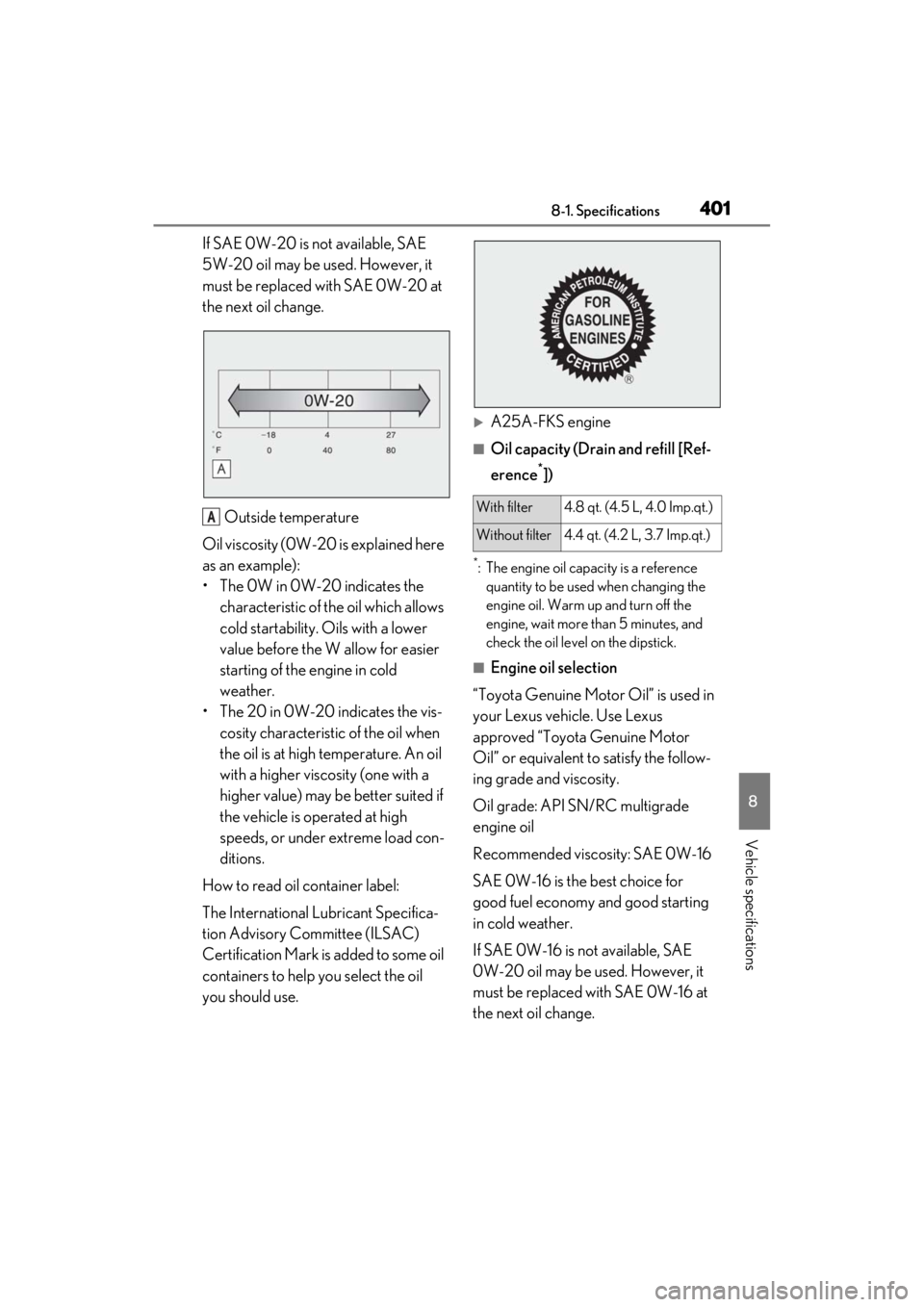
the next oil change.Outside temperature
Oil viscosity (0W-20 is explained here
as an example):
• The 0W in 0W-20 indicates the characteristic of the oil which allows
cold startability. Oils with a lower
value before the W allow for easier
starting of the engine in cold
weather.
• The 20 in 0W-20 indicates the vis- cosity characteristic of the oil when
the oil is at high temperature. An oil
with a higher viscosity (one with a
higher value) may be better suited if
the vehicle is operated at high
speeds, or under extreme load con-
ditions.
How to read oil container label:
The International Lubricant Specifica-
tion Advisory Committee (ILSAC)
Certification Mark is added to some oil
containers to help you select the oil
you should use.
A25A-FKS engine
■Oil capacity (Drain and refill [Ref-
erence
*])
*: The engine oil capacity is a reference quantity to be used when changing the
engine oil. Warm up and turn off the
engine, wait more than 5 minutes, and
check the oil level on the dipstick.
■Engine oil selection
“Toyota Genuine Motor Oil” is used in
your Lexus vehicle. Use Lexus
approved “Toyota Genuine Motor
Oil” or equivalent to satisfy the follow-
ing grade and viscosity.
Oil grade: API SN/RC multigrade
engine oil
Recommended viscosity: SAE 0W-16
SAE 0W-16 is the best choice for
good fuel economy and good starting
in cold weather.
If SAE 0W-16 is not available, SAE
0W-20 oil may be used. However, it
must be replaced with SAE 0W-16 at
the next oil change.
AWith filter4.8 qt. (4.5 L, 4.0 Imp.qt.)
Without filter4.4 qt. (4.2 L, 3.7 Imp.qt.)
Page 408 of 464
4088-1. Specifications
■Gasoline quality
In very few cases, driveability problems may
be caused by the brand of gasoline you are
using. If driveability problems persist, try
changing the brand of gasoline. If this does
not correct the problem, consult your Lexus
dealer.
■Gasoline quality standards
●Automotive manufacturers in the U.S.A.,
Europe and Japan have developed a
specification for fuel quality called the
World-Wide Fuel Charter (WWFC),
which is expected to be applied world-
wide.
●The WWFC improves air quality by low-
ering emissions in vehicle fleets, and
improves customer satisfaction through
better performance.
■Recommendation of the use of gasoline
containing detergent additives
●Lexus recommends the use of gasoline
that contains detergent additives to avoid
the build-up of engine deposits.
●All gasoline sold in the U.S.A. contains
minimum detergent additives to clean
and/or keep clean intake systems, per
EPA’s lowest additives concentration program.
●Lexus strongly recommends the use of
Top Tier Detergent Gasoline. For more
information on Top Tier Detergent Gas-
oline and a list of marketers, please go to
the official website www.toptiergas.com.
■Recommendation of the use of low
emissions gasoline
Gasolines containing oxygenates such as
ethers and ethanol, as well as reformulated
gasolines, are available in some cities.
These fuels are typically acceptable for use,
providing they meet other fuel require-
ments.
Lexus recommends these fuels, since the
formulations allow for reduced vehicle
emissions.
■Non-recommendation of the use of
blended gasoline
●Use only gasoline containing up to 15%
ethanol.
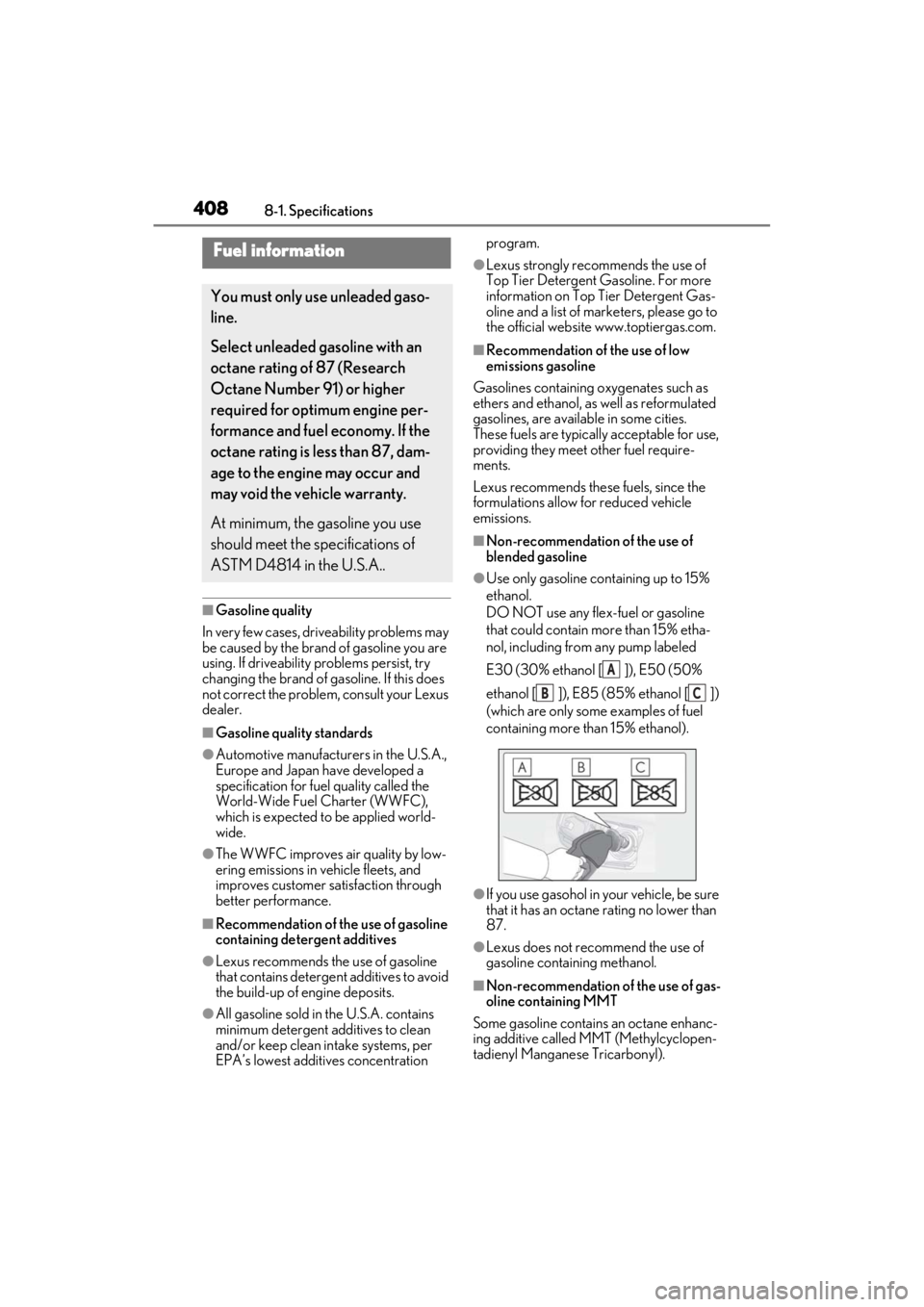
DO NOT use any flex-fuel or gasoline
that could contain more than 15% etha-
nol, including from any pump labeled
E30 (30% ethanol [ ]), E50 (50%
ethanol [ ]), E85 (85% ethanol [ ])
(which are only some examples of fuel
containing more than 15% ethanol).
●If you use gasohol in your vehicle, be sure
that it has an octane rating no lower than
87.
●Lexus does not recommend the use of
gasoline containing methanol.
■Non-recommendation of the use of gas-
oline containing MMT
Some gasoline contains an octane enhanc-
ing additive called MMT (Methylcyclopen-
tadienyl Manganese Tricarbonyl).
Fuel information
You must only use unleaded gaso-
line.
Select unleaded gasoline with an
octane rating of 87 (Research
Octane Number 91) or higher
required for optimum engine per-
formance and fuel economy. If the
octane rating is less than 87, dam-
age to the engine may occur and
may void the vehicle warranty.
At minimum, the gasoline you use
should meet the specifications of
ASTM D4814 in the U.S.A..
A
BC
Page 409 of 464

4098-1. Specifications
8
Vehicle specifications
Lexus does not recommend the use of gas-
oline that contains MMT. If fuel containing
MMT is used, your emission control system
may be adversely affected.
The malfunction indicator lamp on the
instrument cluster may come on. If this hap-
pens, contact your Lexus dealer for service.
■If your engine knocks
●Consult your Lexus dealer.
●You may occasionally notice light knock-
ing for a short time while accelerating or
driving uphill. This is normal and there is
no need for concern.
NOTICE
■Notice on fuel quality
●Do not use improper fuels. If improper
fuels are used, the engine will be dam-
aged.
●Do not use leaded gasoline.
Leaded gasoline can cause damage to
your vehicle’s three-way catalytic con-
verters causing the emission control
system to malfunction.
●Do not use gasohol other than the type
previously stated.
Other gasohol may cause fuel system
damage or vehicle performance prob-
lems.
●Using unleaded gasoline with an
octane number or rating lower than
the level previously stated may cause
persistent he avy knocking.
At worst, this may lead to engine dam-
age and will void the vehicle warranty.
■Fuel-related poor driveability
If poor driveability (poor hot starting,
vaporization, engine knocking, etc.) is
encountered after using a different type
of fuel, discontinue the use of that type of
fuel.
■When refueling with gasohol
Take care not to spill gasohol. It can
damage your vehicle’s paint.
Page 414 of 464
4148-1. Specifications
■Traction AA, A, B, C
The traction grades, from highest to
lowest, are AA, A, B and C, and they
represent the tire’s ability to stop on
wet pavement as measured under con-
trolled conditions on specified govern-
ment test surfaces of asphalt and
concrete.
A tire marked C may have poor traction
performance.
Warning: The traction grade assigned to
this tire is based on braking (straight
ahead) traction tests and does not include
cornering (turning) traction.
■Temperature A, B, C
The temperature grades are A (the
highest), B, and C, representing the
tire’s resistance to the generation of
heat and its ability to dissipate heat when tested under controlled condi-
tions on a specified indoor laboratory
test wheel.
Sustained high temperature can cause the
material of the tire to degenerate and
reduce tire life, and excessive temperature
can lead to sudd
en tire failure.
Grade C corresponds to a level of perfor-
mance which all passenger car tires must
meet under the Fede ral Motor Vehicle
Safety Standard No. 109.
Grades B and A represent higher levels of
performance on the laboratory test wheel
than the minimum required by law.
Warning: The temperature grades of a tire
assume that it is properly inflated and not
overloaded.
Excessive speed, unde rinflation, or exces-
sive loading, either separately or in combi-
nation, can cause heat buildup and
possible tire failure.
Glossary of tire terminology
Tire related termMeaning
Cold tire inflation
pressureTire pressure when the vehicle has been parked for three hours or
more, or has not been driven more than 1 mile or 1.5 km under that
condition
Maximum inflation
pressureThe maximum cold inflated pressure to which a tire may be inflated,
shown on the sidewall of the tire
Recommended
inflation pressureCold tire inflation pressure recommended by a manufacturer
Accessory weight
The combined weight (in excess of those standard items which may
be replaced) of automatic tran smission, power steering, power
brakes, power windows, power seats, radio and heater, to the extent
that these items are available as factory-installed equipment
(whether installed or not)
Curb weight
The weight of a motor vehicle with standard equipment, including the
maximum capacity of fuel, oil and coolant, and if so equipped, air
conditioning and additional weight optional engine
Page 420 of 464

4208-2. Customization
Settings that can be changed by your Lexus dealer
Definition of symbols: O = Available, = Not available
■Gauges, meters and multi-information display ( P.70, 73, 77)
Function*1Default settingCustomized setting
LanguageEnglishFrenchOOSpanish
Units*2miles (MPG)
km (km/L)
OOkm (L/100 km)
miles (MPG Impe-
rial)
Speedometer display*3DigitalAnalogO
Drive information 1
Current fuel
consumption
Customizable items: P.79O
Average fuel
economy (after reset)
Drive information 2
Distance (driv-ing range)
Average vehi-
cle speed (after
reset)
Clock12-hour display24-hour displayO
Pop-up displayOnOffO
Accent colorColor 1Color 2OO
Rev indicator*45000 r/min.
2000 - 6700 r/min.
O
Off
Rev peak*4OnOffO
Eco Driving Indicator LightOnOffO
Suggestion functionOn
On (when the vehi-cle is stopped)
OO
Off
C
ABC
Page 449 of 464

449Alphabetical index
Alphabetical index
A
A/C ................................................................... 263Air conditioning filter ............................... 339
Automatic air conditioning system ... 263
ABS (Anti-lock Brake System).............. 246 Function .......................................................... 246
Warning light ............................................... 363
ACA (Active Cornering Assist) ........... 246
Active Cornering Assist (ACA) ........... 246
Adaptive Front-lighting System (AFS) 160
Adaptive Variable Suspension System247
AFS (Adaptive Front-lighting System) 160
Airbags ............................................................... 28 Airbag operating conditions................... 30
Airbag precautions for your child ........ 33
Correct driving posture .............................23
Curtain shield airbag operating condi- tions .................................................................... 31
Curtain shield airbag precautions ....... 33
Front passenger occupant classification system ..............................................................37
General airbag precautions ................... 33
Locations of airbags.................................... 28
Modification and disposal of airbags . 35
Side airbag operating conditions ........... 31
Side airbag precautions ............................ 33
Side and curtain shield airbags operating conditions........................................................ 31
Side and curtain shield airbags precau- tions .................................................................. 33
SRS airbags ..................................................... 28
SRS warning light ...................................... 362
Air conditioning filter ................................. 339
Air conditioning system ............................ 263 Air conditioning filter ............................... 339
Automatic air conditioning system ... 263
Alarm ................................................................... 63 Alarm .................................................................. 63
Warning buzzer ...........................................361
Anchor brackets ..................................... 44, 53
Antennas (smart access system with push- button start) ................................................. 106
Anti-lock Brake System (ABS).............. 246 Function .......................................................... 246
Warning light ...............................................363
Approach warning........................................201
Armrest............................................................ 290
Assist grips ..................................................... 290
Audio system-linked display ...................... 82
Automatic headlight leveling system ....159
Automatic High Beam ................................. 161
Automatic light control system............... 158
Automatic transmission ..............................149 Paddle shift switches .........................151, 152
S mode ............................................................. 152
Auxiliary box.................................................. 279
Average fuel economy..................................79
Average vehicle speed .................................79
B
Back-up lights Replacing light bulbs ................................346
Battery Checking ....................................................... 323
If the battery is discharged ................... 389
Preparing and checking before winter........................................................................... 251
Warning light ...............................................362
Blind Spot Monitor (BSM)....................... 205
Boost gauge........................................................81
Brake Brake hold ...................................................... 156
Fluid.................................................................. 404
Parking brake ............................................... 154
Warning light ................................................ 361
Brake assist .................................................... 246
Break-in tips.....................................................135
Brightness control Instrument panel light control......... 72, 76
BSM (Blind Spot Monitor)....................... 205