2021 LEXUS ES350 maintenance
[x] Cancel search: maintenancePage 1 of 464

ES350_250_OM_OM06207U_(U)
1
2
3
4
5
6
7
8
9
Pictorial indexSearch by illustration
For safety and
securityMake sure to read through them
(Main topics: Child seat, theft deterrent system)
Vehicle status
information and
indicatorsReading driving-related information
(Main topics: Meters, multi-information display)
Before drivingOpening and closing the doors and windows,
adjustment before driving
(Main topics: Keys, doors, seats, power windows)
DrivingOperations and advice which are necessary for driving
(Main topics: Starting engine, refueling)
Interior featuresUsage of the interior features
(Main topics: Air conditioner, storage features)
Maintenance and
careCaring for your vehicle and maintenance procedures
(Main topics: Interior and exterior, light bulbs)
When trouble
arisesWhat to do in case of malfunction and emergency
(Main topics: Battery discharge, flat tire)
Vehicle
specificationsVehicle specifications, customizable features
(Main topics: Fuel, oil, tire inflation pressure)
For ownersReporting safety defects for U.S. owners, and seat belt,
SRS airbag and headlight aim instructions for Canadian
owners
IndexSearch by symptom
Search alphabetically
Page 3 of 464
3TABLE OF CONTENTS
1
2
3
4
5
6
7
8
9
Automatic transmission..............149
Turn signal lever............................. 153
Parking brake ................................. 154
Brake Hold....................................... 156
4-3. Operating the lights and wipers Headlight switch ............................ 158
Automatic High Beam ................. 161
Windshield wipers and washer 164
4-4. Refueling Opening the fuel tank cap......... 169
4-5. Using the driving support systems Lexus Safety System + 2.0 ......... 171
PCS (Pre-Collision System)..... 177
LTA (Lane Tracing Assist)......... 184
RSA (Road Sign Assist) .............. 193
Dynamic radar crui se control with
full-speed range.......................... 195
BSM (Blind Spot Monitor) ....... 205
Driving Mode Select switch ..... 210
PKSA (Parking Support Alert) 212
Intuitive parking assist ................. 213
RCTA (Rear cross traffic alert) function .......................................... 220
RCD (Rear Camera Detection) function .......................................... 224
PKSB (Parking Support Brake) ........................................................... 227
Parking Support Brake function (static objects) ............................ 233
Parking Support Brake function (rear-crossing vehicles).......... 239
Parking Support Brake function (rear pedestrians) ..................... 243
Driving assist systems ................. 246
4-6. Driving tips Winter driving tips ........................ 2515-1. Remote Touch
Remote Touch............................... 256
5-2. Lexus Climate Concierge Lexus Climate Concierge.......... 261
5-3. Using the air conditioning system Automatic air conditioning system.......................................................... 263
Heated steering wheel/seat heat- ers/seat ventilators................... 270
5-4. Using the interior lights Interior lights list ............................ 274
5-5. Using the storage features List of storage features ............... 277
Trunk features ............................... 280
5-6. Using the other interior features Other interior features ............... 281
Garage door opener ................. 293
Compass ......................................... 299
6-1. Maintenance and care Cleaning and protecting the vehi-cle exterior................................... 304
Cleaning and protecting the vehi- cle interior .................................... 307
6-2. Maintenance Maintenance re quirements .....309
General maintenance ...
.............. 310
Emission inspection and mainte- nance (I/M) programs ............. 313
5Interior features
6Maintenance and care
Page 4 of 464

4TABLE OF CONTENTS
6-3. Do-it-yourself maintenanceDo-it-yourself service precautions............................................................ 314
Hood................................................... 316
Positioning a floor jack................ 316
Engine compartment................... 318
Tires ................................................... 326
Tire inflation pressure ................. 336
Wheels.............................................. 338
Air conditioning filter..................339
Electronic key battery ................. 341
Checking and replacing fuses 342
Headlight aim................................. 344
Light bulbs ....................................... 346
7-1. Essential information Emergency flashers..................... 352
If your vehicle has to be stopped in an emergency ............................. 352
If the vehicle is trapped in rising water............................................... 353
7-2. Steps to take in an emergency If your vehicle needs to be towed........................................................... 355
If you think something is wrong ........................................................... 359
Fuel pump shut off system ........ 360
If a warning light turns on or a warn- ing buzzer sounds ...................... 361
If a warning message is displayed ............................................................ 371
If you have a flat tire..................... 375
If the engine wi ll not start .......... 384
If you lose your keys .................... 386If the fuel filler door cannot be
opened .......................................... 386
If the electronic key does not oper- ate properly ................................. 387
If the battery is discharged ....... 389
If your vehicle overheats ........... 393
If the vehicle becomes stuck ... 395
8-1. Specifications Maintenance data (fuel, oil level, etc.) ................................................. 398
Fuel information............................ 408
Tire information ............................. 410
8-2. Customization Customizable features ............... 419
8-3. Items to initialize Items to initialize ........................... 430
9-1. For owners Reporting safety defects for U.S. owners ........................................... 434
Seat belt instructions for Canadian owners (in French) ................... 434
SRS airbag instructions for Cana- dian owners (in French) ......... 436
Headlight aim instructions for Canadian owners (in French) 442
What to do if... (Troubleshooting) .......................................................... 446
Alphabetical index ..................... 44
9
7When trouble arises
8Vehicle specifications
9For owners
Index
Page 61 of 464

611-4. Theft deterrent system
1
For safety and security
1-4.Theft deterrent system
The indicator light flashes after the
engine switch has been turned off to
indicate that the system is operating.
The indicator light stops flashing after
the engine switch has been turned to ACCESSORY or IGNITION ON
mode to indicate that the system has
been canceled.
■System maintenance
The vehicle has a maintenance-free type
engine immobilizer system.
■Conditions that may cause the system to
malfunction
●If the grip portion of the key is in contact
with a metallic object
●If the key is in close proximity to or touch-
ing a key registered to the security sys-
tem (key with a built-in transponder chip)
of another vehicle
■Certifications for the en gine immobilizer system
For vehicles sold in the U.S.A., Hawaii, Guam and Puerto Rico
Engine immobilizer system
The vehicle’s keys have built-in
transponder chips that prevent the
engine from starting if a key has not
been previously registered in the
vehicle’s on-board computer.
Never leave the keys inside the
vehicle when you leave the vehicle.
This system is designed to help pre-
vent vehicle theft but does not guar-
antee absolute security against all
vehicle thefts.
Operating the system
Page 63 of 464

631-4. Theft deterrent system
1
For safety and security
■Items to check before locking the
vehicle
To prevent unexpected triggering of
the alarm and vehicle theft, make sure
of the following:
Nobody is in the vehicle.
The windows and moon roof (if
equipped) or panoramic moon roof
(if equipped) are closed before the
alarm is set.
No valuables or other personal
items are left in the vehicle.
■Setting
Close the doors, trunk and hood, and
lock all the doors using the entry func-
tion or wireless re mote control. The
system will be set automatically after
30 seconds.
Except for Canada, the alarm can also
be set using the mechanical key.
The indicator light changes from being on
to flashing when the system is set.
■Canceling or stopping
Do one of the following to deactivate
or stop the alarm:
Except for Canada: Unlock the
doors using the entry function, wire-
less remote control or mechanical
key.
For Canada: Unlock the doors using
the entry function or wireless
remote control.
Turn the engine switch to ACCES-
SORY or IGNITION ON mode, or
start the engine. (The alarm will be
deactivated or stopped after a few
seconds.)
■System maintenance
The vehicle has a maintenance-free type
alarm system.
Alarm
The alarm uses light and sound to
give an alert when an intrusion is
detected.
The alarm is triggered in the follow-
ing situations when the alarm is set:
A locked door is unlocked or
opened in any way other than
using the entry function, wireless
remote control or mechanical
key
*. (The doors will lock again
automatically.)
A locked trunk is unlocked or
opened in any way other than
using the entry function or wire-
less remote control.
The hood is opened.
*:Except for Canada
Setting/canceling/stopping the
alarm system
Page 303 of 464

303
6
6
Maintenance and care
Maintenance and care
6-1. Maintenance and careCleaning and protecting the vehi-cle exterior ................................ 304
Cleaning and protecting the vehi- cle interior ................................. 307
6-2. Maintenance Maintenance requirements .. 309
General maintenance .............. 310
Emission inspection and mainte- nance (I/M) programs .......... 313
6-3. Do-it-yourself maintenance Do-it-yourself service precautions......................................................... 314
Hood................................................ 316
Positioning a floor jack............. 316
Engine compartment................ 318
Tires ................................................ 326
Tire inflation pressure .............. 336
Wheels........................................... 338
Air conditioning filter...............339
Electronic key battery .............. 341
Checking and replacing fuses ........................................................ 342
Headlight aim.............................. 344
Light bulbs .................................... 346
Page 304 of 464

3046-1. Maintenance and care
6-1.Maintenance and care
Working from top to bottom, liber-
ally apply water to the vehicle body,
wheel wells and underside of the
vehicle to remove any dirt and dust.
Wash the vehicle body using a
sponge or soft cloth, such as a
chamois.
For hard-to-remove marks, use car
wash soap and rinse thoroughly with
water.
Wipe away any water.
Wax the vehicle when the water-
proof coating deteriorates.
If water does not bead on a clean surface,
apply wax when the vehicle body is cool.
■Self-restoring coat
The vehicle body has a self-restoring coat-
ing that is resistant to small surface
scratches caused in a car wash etc.
●The coating lasts for 5 to 8 years from
when the vehicle is delivered from the
plant.
●The restoration time differs depending on
the depth of the scratch and outside tem-
perature.
The restoration time may become
shorter when the coating is warmed by
applying warm water.
●Deep scratches caused by keys, coins,
etc. cannot be restored.
●Do not use wax that contain abrasives.
■Automatic car washes
●Fold the mirrors befo re washing the vehi-
cle. Start washing from the front of the
vehicle. Make sure to extend the mirrors
before driving.
●Brushes used in automatic car washes
may scratch the vehicle surface, parts
(wheel, etc.) and harm your vehicle’s
paint.
●Rear spoiler (if equipped) may not be
washable in some automatic car washes.
There may also be an increased risk of
damage to vehicle.
■High pressure car washes
As water may enter the cabin, do not bring
the nozzle tip near the gaps around the
doors or perimeter of windows, or spray
these areas continuously.
■Notes for the smart access system with
push-button start
If the door handle becomes wet while the
electronic key is within the effective range,
the door may lock and unlock repeatedly. In
that case, follow the following correction
procedures to wash the vehicle:
●Place the key in a position 6 ft. (2 m) or
more separate from the vehicle while the
vehicle is being wash ed. (Take care to
ensure that the key is not stolen.)
●Set the electronic key to battery-saving
mode to disable the smart access system
with push-button start. ( P.107)
■Wheels and wheel ornaments
●Remove any dirt immediately by using a
neutral detergent.
●Wash detergent off with water immedi-
ately after use.
●To protect the paint from damage, make
sure to observe the following precau-
tions.
• Do not use acidic, alkaline or abrasive detergent
• Do not use hard brushes
• Do not use detergent on the wheels when they are hot, such as after driving or
parking in hot weather
■Bumpers
Do not scrub with abrasive cleaners.
Cleaning and protecting the
vehicle exterior
Perform cleaning in a manner
appropriate to each component
and its material.
Cleaning instructions
Page 305 of 464
3056-1. Maintenance and care
6
Maintenance and care
■Front side windows water-repellent
coating
●The following precautions can extend the
effectiveness of the water-repellent coat-
ing.
• Remove any dirt, etc. from the front side windows regularly.
• Do not allow dirt and dust to accumulate
on the windows for a long period.
Clean the windows with a soft, damp
cloth as soon as possible.
• Do not use wax or glass cleaners that contain abrasives when cleaning the win-
dows.
• Do not use any metallic objects to remove condensation build up.
●When the water-repellent performance
has become insufficie nt, the coating can
be repaired. Contact your Lexus dealer.
■Plated portions
If dirt cannot be removed, clean the parts as
follows:
●Use a soft cloth dampened with an
approximately 5% solution of neutral
detergent and water to clean the dirt off.
●Wipe the surface with a dry, soft cloth to
remove any remaining moisture.
●To remove oily deposits, use alcohol wet
wipes or a similar product.
WARNING
■When washing the vehicle
Do not apply water to the inside of the
engine compartment. Doing so may
cause the electrical components etc. to
catch fire.
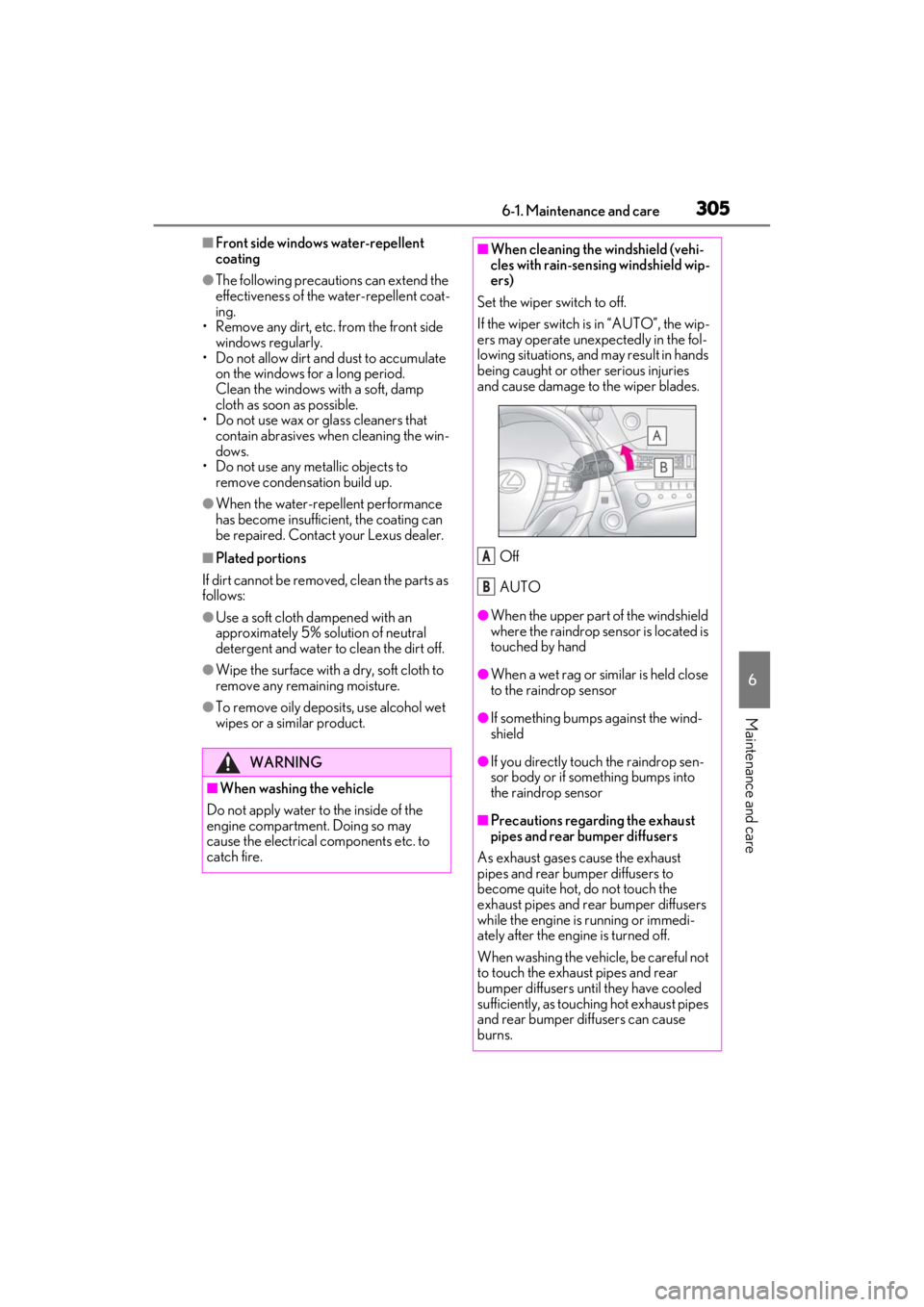
■When cleaning the windshield (vehi-
cles with rain-sensing windshield wip-
ers)
Set the wiper switch to off.
If the wiper switch is in “AUTO”, the wip-
ers may operate unexpectedly in the fol-
lowing situations, and may result in hands
being caught or other serious injuries
and cause damage to the wiper blades.
Off
AUTO
●When the upper part of the windshield
where the raindrop sensor is located is
touched by hand
●When a wet rag or similar is held close
to the raindrop sensor
●If something bumps against the wind-
shield
●If you directly touch the raindrop sen-
sor body or if something bumps into
the raindrop sensor
■Precautions regarding the exhaust
pipes and rear bumper diffusers
As exhaust gases cause the exhaust
pipes and rear bumper diffusers to
become quite hot, do not touch the
exhaust pipes and rear bumper diffusers
while the engine is running or immedi-
ately after the engine is turned off.
When washing the vehicle, be careful not
to touch the exhaust pipes and rear
bumper diffusers until they have cooled
sufficiently, as touching hot exhaust pipes
and rear bumper diffusers can cause
burns.
A
B