2021 ALFA ROMEO STELVIO maintenance
[x] Cancel search: maintenancePage 222 of 280
SERVICING AND MAINTENANCE
220
Full operating temperature must be reached.
The vehicle must also be parked on as level a
surface as possible.
The engine oil level can be checked using the
Information and Entertainment system. To
access the function, activate the main menu
(MENU button) and select the following
options in sequence:
1. “Applications”
2. “Vehicle Information”
3. “Oil level”
Ensure that the oil level is within the interval
on the dipstick between the minimum and
maximum limits (Quadrifoglio only).
Changing The Engine Oil
For the correct servicing intervals
Ú
page 209.
Choice Of Engine Oil Type
To ensure optimal performance and maximum
protection in all operating conditions, it is
advised to use certified engine oils
Ú
page 263.
Additives For Engine Oil
It is strongly recommended not to use addi -
tives (other than leak detection dyes) with the
engine oil.
The engine oil is a product designed specially
for the vehicle, and its performance may be
deteriorated through the use of further addi -
tives. Disposal Of Used Engine Oil And Filters
For the disposal of the engine oil and filters,
contact the appropriate body to determine
local regulations.
NOTE:
Incorrectly disposed used engine oil may seri
-
ously harm the environment.
Engine Oil Filter
Replacing the Engine Oil Filter
The engine oil filter must be replaced each
time the engine oil is changed. It is advised to
replace it with a genuine spare part, specifi -
cally designed for this vehicle.
Engine Air Cleaner Filter
Replacing the Engine Air Cleaner Filter
For the correct servicing intervals
Ú
page 209. It is advised to replace the engine
air cleaner filter with a genuine spare part,
specifically designed for this vehicle.
Air Conditioning System Maintenance
To ensure the best possible performance, the
air conditioning system must be checked and
undergo maintenance at an authorized dealer
at the beginning of the summer. Replace The Cabin Air Filter
For the correct servicing intervals
Ú
page 209. For cleaner replacement, contact
an authorized dealer.Lubricating Moving Parts Of The Bodywork
Ensure that the locks and bodywork junction
points, including components such as the seat
guides, door hinges (and rollers), liftgate and
hood are periodically lubricated with
lithium-based grease to ensure correct, silent
operation and to protect them from rust and
wear.
CAUTION!
Do not use chemicals to clean the air
conditioning system, since the internal
components may be damaged. This kind of
damage is not covered by warranty.
WARNING!
Use only refrigerants and compressor
lubricants approved by the manufacturer
for your air conditioning system. Some
unapproved refrigerants are flammable and
can explode, injuring you. Other
unapproved refrigerants or lubricants can
cause the system to fail, requiring costly
repairs. Refer to Warranty Information
Book, located in your owner’s information
kit, for further warranty information.
21_GU_OM_EN_USC_t.book Page 220
Page 224 of 280
SERVICING AND MAINTENANCE
222
than rest position (at the base of the wind-
shield), they will only return to rest position
following a command given using the stalk
(stalk upwards, into unstable position) or
when a speed of 3 mph (5 km/h) is exceeded.
Replacing The Windshield Wiper Blades
Proceed as follows:
1. Raise the wiper arm, push tab of the attachment spring and remove the blade
from the arm.
Wiper Release Tab
2. Fit the new blade, inserting the tab in the dedicated housing in the arm and
checking that it is locked.
3. Lower the wiper arm onto the windshield.
NOTE:
Do not operate the windshield wiper with the
blades lifted from the windshield. Front/Rear Windshield Washers
The window washer nozzles are fixed. If there
is no jet of fluid, first check that there is fluid in
the reservoir
Ú
page 214
Front Windshield Washers
Rear Windshield Washer Then, check that the nozzle holes are not
clogged; use a needle to unblock them if
necessary.
Exhaust System
Adequate maintenance of the engine exhaust
system represents the best protection against
leaks of carbon monoxide into the passenger
compartment.
If an unusual noise from the exhaust or the
presence of smoke in the passenger compart
-
ment is identified, or if the underbody or rear
section of the vehicle have been damaged,
have the entire exhaust system and adjoining
bodywork areas checked at an authorized
dealer to identify any components which are
broken, damaged, worn or have moved from
their correct fitting position.
Open welding or loose connections may permit
exhaust gas to enter the passenger compart -
ment.
Have the exhaust system checked every time
the vehicle is raised. Replace the components
where necessary (for these operations,
contact an authorized dealer).
In normal operating conditions, the catalytic
converter does not require maintenance. To
ensure that it operates correctly, and prevent
it from getting damaged, it is extremely
important that the engine operates perfectly.
21_GU_OM_EN_USC_t.book Page 222
Page 226 of 280
SERVICING AND MAINTENANCE
224
(Continued)
(Continued)
Topping Up / Draining / Flushing The Engine/
Intercooler Coolant
If the engine coolant (antifreeze) is dirty, have
cleaning and flushing carried out at an autho
-
rized dealer.
For the correct servicing intervals
Ú
page 209.
NOTE:
For topping off, and proper coolant specifi -
cations
Ú
page 263.
Do not use pure water, alcohol-based cool -
ants, corrosions inhibitors or additional
anti-rust products because they may be
incompatible with the engine coolant and
cause the clogging of the radiator. The use
of propylene glycol-based coolant is also not
recommended.
Engine Cooling/Intercooler System Cap
To prevent loss of engine coolant, make sure
that the expansion tank cap is closed. If it is
open, screw it completely until you reach/hear
the click.
Periodically check the cap and clean it from
any foreign bodies that may have deposited on
the external surface. Disposal of Used Coolant
Disposal of engine/intercooler coolant is
subject to legal requirements. Contact the
appropriate body to determine local regula
-
tions.
NOTE:
To prevent the fluid from being ingested by
children or animals, do not keep it in open
containers or pour it on the ground. If
ingested, contact a doctor immediately.
Eliminate any traces of fluid from the
ground immediately.
When the vehicle stops after a short trip,
steam may be seen coming out from the
front of the hood. This is a normal phenom -
enon which is due to the presence of rain,
snow or a lot of moisture on the surface of
the radiator.
With engine and system cold, do not top up
with coolant beyond the maximum level
indicated on the reservoir in the engine
compartment.
Braking System
In order to guarantee the efficiency of the
braking system, periodically check its compo -
nents; for this operation, contact an autho -
rized dealer.
For the correct servicing intervals
Ú page 209.
NOTE:
Driving with your foot resting on the brake
pedal may compromise its efficiency,
increasing the risk of accidents. When driving,
never keep your foot on the brake pedal and
don’t put unnecessary strain on it to prevent
the brakes from overheating. Excess pad wear
may cause damage to the braking system.
When an insufficient oil level is detected,
contact an authorized dealer to have the
system checked.
Always keep the cap of the brake fluid reser-
voir (in the engine compartment)
completely closed.
WARNING!
Never add coolant with the engine hot or
overheated.
Do not attempt to cool an overheated
engine by loosening or removing the cap.
The heat causes a considerable increase
in pressure in the cooling system.
To prevent damage to the engine, only use
the engine cooling circuit caps provided.
WARNING! (Continued)
WARNING!
Use only manufacturer's recommended
brake fluid
Ú
page 263. Using the wrong
type of brake fluid can severely damage
your brake system and/or impair its
performance. The proper type of brake
fluid for your vehicle is also identified on
the original factory installed hydraulic
master cylinder reservoir.
21_GU_OM_EN_USC_t.book Page 224
Page 227 of 280
225
Automatic Transmission
Use only a transmission oil with the character-
istics indicated
Ú
page 263.
Special Additives
Do not use any type of additive with the auto -
matic transmission oil. The automatic trans -
mission oil is a product designed specially for this vehicle and its performance may be
compromised through the use of further addi
-
tives.
Frequency of Oil Changes
In normal vehicle operating conditions, it is not
necessary to change the transmission oil.
Replacing The Battery
If necessary, replace the battery with another
battery with the same specifications. It is
advised to contact an authorized dealer for
replacement.
Follow the battery manufacturer's instructions
for maintenance.
Fuses
General Information
The fuses protect electrical systems against
excessive current.
When a device does not work, you must check
the electrical circuit inside of the fuse for a
break/melt.
Also, please be aware that using power outlets
for extended periods of time with the engine
off may result in vehicle battery discharge.
Blade Fuses
To avoid contamination from foreign
matter or moisture, use only new brake
fluid or fluid that has been in a tightly
closed container. Keep the master
cylinder reservoir cap secured at all times.
Brake fluid in a open container absorbs
moisture from the air resulting in a lower
boiling point. This may cause it to boil
unexpectedly during hard or prolonged
braking, resulting in sudden brake failure.
This could result in a collision.
Overfilling the brake fluid reservoir can
result in spilling brake fluid on hot engine
parts, causing the brake fluid to catch fire.
Brake fluid can also damage painted and
vinyl surfaces, care should be taken to
avoid its contact with these surfaces.
Do not allow petroleum-based fluid to
contaminate the brake fluid. Brake seal
components could be damaged, causing
partial or complete brake failure. This
could result in a collision.
WARNING! (Continued)
CAUTION!
Do not use chemical flushes in your
transmission as the chemicals can damage
your transmission components. Such
damage is not covered by the New Vehicle
Limited Warranty.
CAUTION!
If a transmission fluid leak occurs, visit an
authorized dealer immediately. Severe
transmission damage may occur. An
authorized dealer has the proper tools to
adjust the fluid level accurately.
1 — Electrical Circuit
2 — Blade Fuse With Good Electrical Circuit
3 — Blade Fuse With Bad Electrical Circuit
21_GU_OM_EN_USC_t.book Page 225
Page 228 of 280
SERVICING AND MAINTENANCE
226
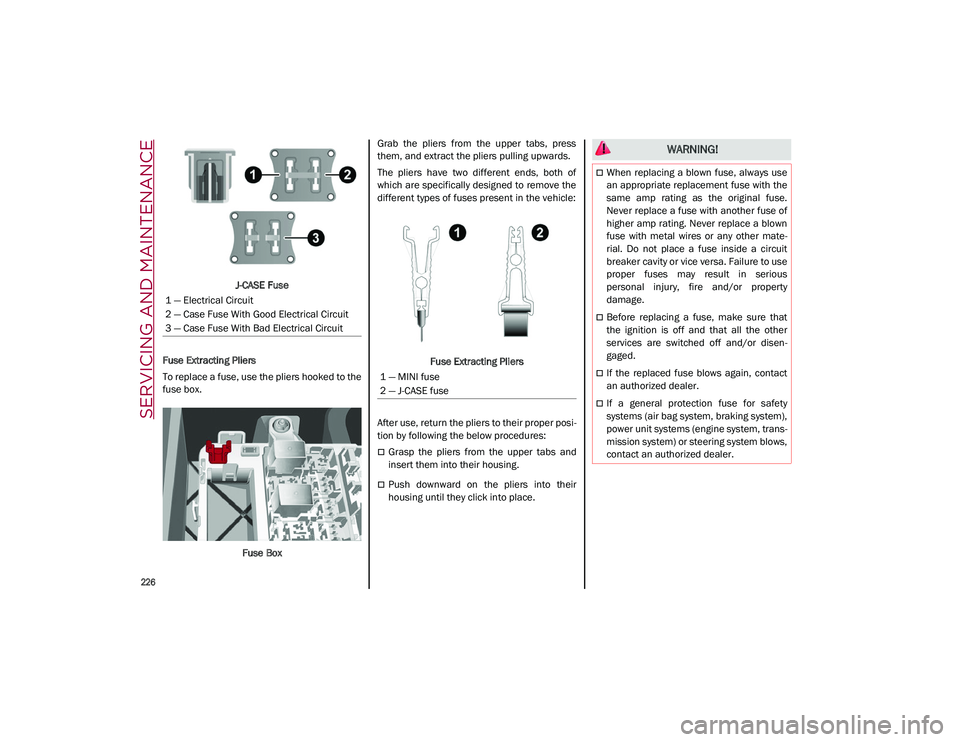
J-CASE Fuse
Fuse Extracting Pliers
To replace a fuse, use the pliers hooked to the
fuse box.
Fuse Box Grab the pliers from the upper tabs, press
them, and extract the pliers pulling upwards.
The pliers have two different ends, both of
which are specifically designed to remove the
different types of fuses present in the vehicle:
Fuse Extracting Pliers
After use, return the pliers to their proper posi -
tion by following the below procedures:
Grasp the pliers from the upper tabs and
insert them into their housing.
Push downward on the pliers into their
housing until they click into place.
1 — Electrical Circuit
2 — Case Fuse With Good Electrical Circuit
3 — Case Fuse With Bad Electrical Circuit
1 — MINI fuse
2 — J-CASE fuse
WARNING!
When replacing a blown fuse, always use
an appropriate replacement fuse with the
same amp rating as the original fuse.
Never replace a fuse with another fuse of
higher amp rating. Never replace a blown
fuse with metal wires or any other mate
-
rial. Do not place a fuse inside a circuit
breaker cavity or vice versa. Failure to use
proper fuses may result in serious
personal injury, fire and/or property
damage.
Before replacing a fuse, make sure that
the ignition is off and that all the other
services are switched off and/or disen -
gaged.
If the replaced fuse blows again, contact
an authorized dealer.
If a general protection fuse for safety
systems (air bag system, braking system),
power unit systems (engine system, trans -
mission system) or steering system blows,
contact an authorized dealer.
21_GU_OM_EN_USC_t.book Page 226
Page 230 of 280

SERVICING AND MAINTENANCE
228
Control Unit Under Passenger Side
Footboard
Passenger Side Control Unit
FUNCTIONFUSEAMPERAGE
Front power window (driver’s side) F3325
Front power window (passenger side) F3425
Supply for Information and Entertainment system, Climate Control system,
alarm, power door mirror folding, EOBD system, USB port F36
15
Safe Lock device (driver side door unlock – if equipped), doors unlock, central lock F3820
Windshield washer pump F4320
Rear left power window F4725
Rear right power window F4825
Heater rear window coil F9415
21_GU_OM_EN_USC_t.book Page 228
Page 232 of 280
SERVICING AND MAINTENANCE
230
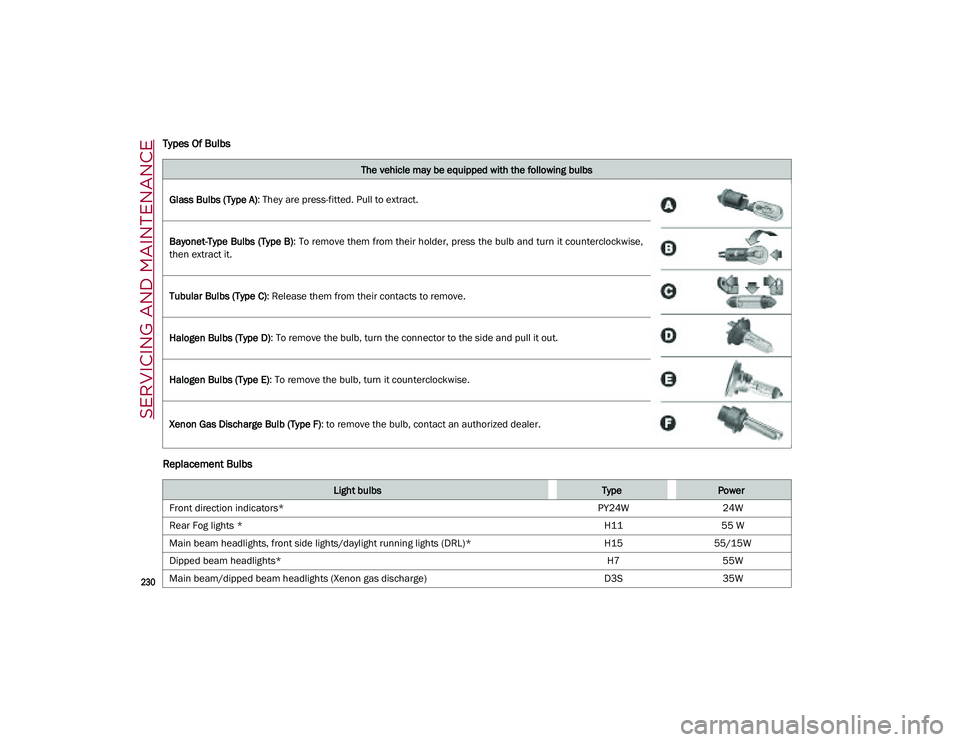
Types Of Bulbs
Replacement Bulbs
The vehicle may be equipped with the following bulbs
Glass Bulbs (Type A) : They are press-fitted. Pull to extract.
Bayonet-Type Bulbs (Type B) : To remove them from their holder, press the bulb and turn it counterclockwise,
then extract it.
Tubular Bulbs (Type C) : Release them from their contacts to remove.
Halogen Bulbs (Type D) : To remove the bulb, turn the connector to the side and pull it out.
Halogen Bulbs (Type E) : To remove the bulb, turn it counterclockwise.
Xenon Gas Discharge Bulb (Type F) : to remove the bulb, contact an authorized dealer.
Light bulbsTypePower
Front direction indicators* PY24W24W
Rear Fog lights * H1155 W
Main beam headlights, front side lights/daylight running lights (DRL)* H1555/15W
Dipped beam headlights* H755W
Main beam/dipped beam headlights (Xenon gas discharge) D3S35W
21_GU_OM_EN_USC_t.book Page 230
Page 234 of 280
SERVICING AND MAINTENANCE
232
Front Light Cluster With Main Beam Xenon
Gas Discharge Headlights
To replace the bulbs of the main beam head-
lights, contact an authorized dealer.
Replacing Interior Bulbs
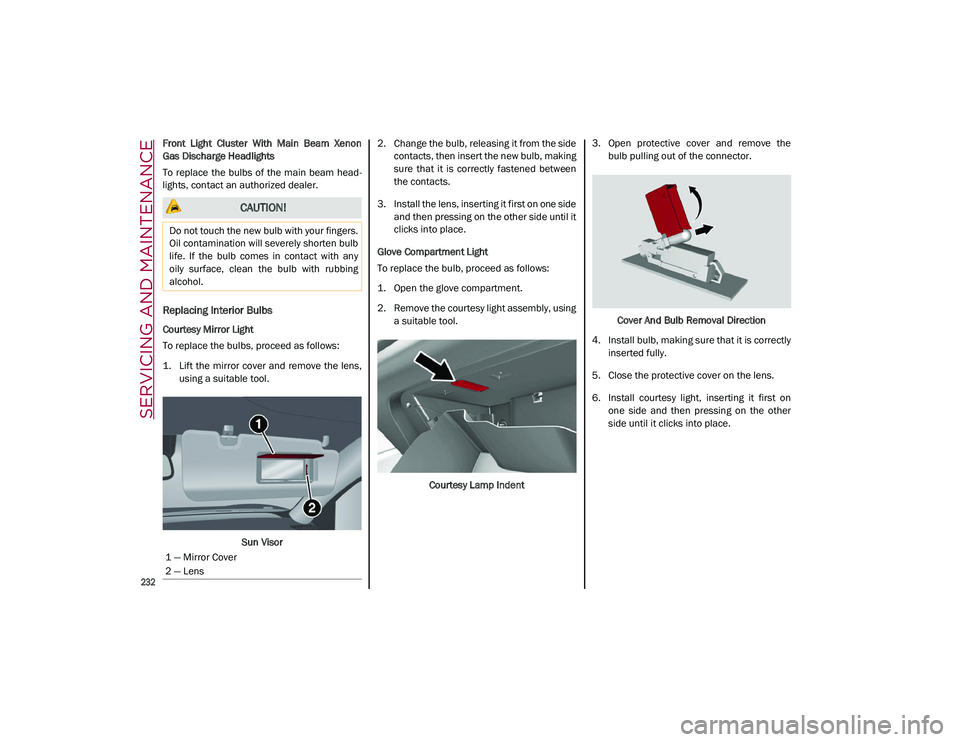
Courtesy Mirror Light
To replace the bulbs, proceed as follows:
1. Lift the mirror cover and remove the lens, using a suitable tool.
Sun Visor 2. Change the bulb, releasing it from the side
contacts, then insert the new bulb, making
sure that it is correctly fastened between
the contacts.
3. Install the lens, inserting it first on one side and then pressing on the other side until it
clicks into place.
Glove Compartment Light
To replace the bulb, proceed as follows:
1. Open the glove compartment.
2. Remove the courtesy light assembly, using a suitable tool.
Courtesy Lamp Indent 3. Open protective cover and remove the
bulb pulling out of the connector.
Cover And Bulb Removal Direction
4. Install bulb, making sure that it is correctly inserted fully.
5. Close the protective cover on the lens.
6. Install courtesy light, inserting it first on one side and then pressing on the other
side until it clicks into place.
CAUTION!
Do not touch the new bulb with your fingers.
Oil contamination will severely shorten bulb
life. If the bulb comes in contact with any
oily surface, clean the bulb with rubbing
alcohol.
1 — Mirror Cover
2 — Lens
21_GU_OM_EN_USC_t.book Page 232