2020 TOYOTA PROACE VERSO engine
[x] Cancel search: enginePage 133 of 418
133
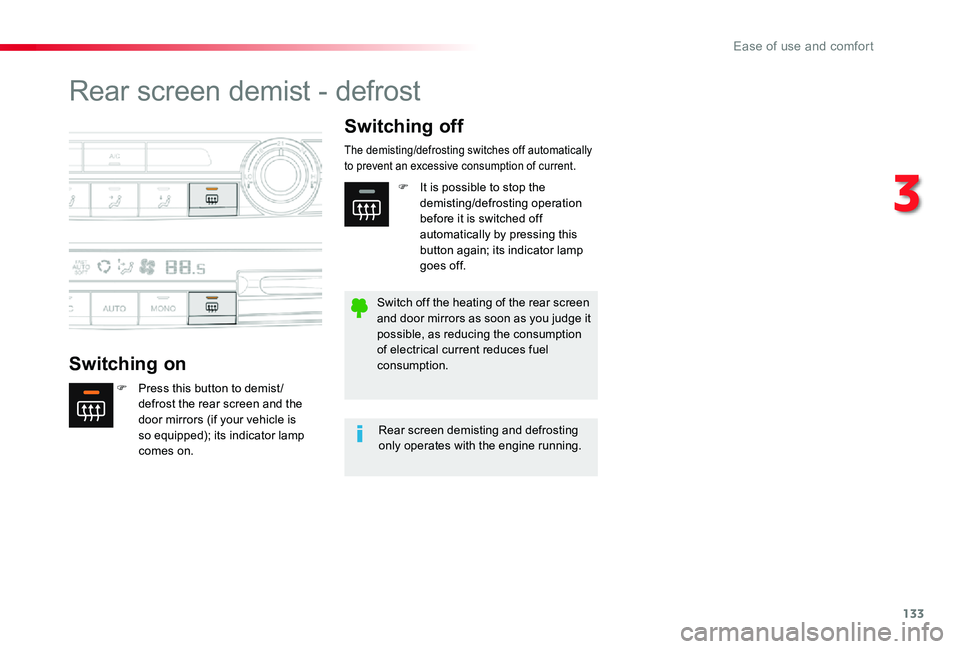
Rear screen demist - defrost
Switching on
Switching off
F Press this button to demist /defrost the rear screen and the door mirrors (if your vehicle is so equipped); its indicator lamp comes on.
The demisting/defrosting switches off automatically to prevent an excessive consumption of current.
Rear screen demisting and defrosting only operates with the engine running.
Switch off the heating of the rear screen and door mirrors as soon as you judge it possible, as reducing the consumption of electrical current reduces fuel consumption.
F It is possible to stop the demisting/defrosting operation before it is switched off automatically by pressing this button again; its indicator lamp goes off.
3
Ease of use and comfort
Page 134 of 418

134
In order for these systems to be fully effective, follow the operation and maintenance guidelines below:F To obtain an even air distribution, take care not to obstruct the exterior air intake grilles located at the base of the windscreen, the nozzles, the vents and the air outlets, as well as the air extractor located at the rear.F Do not cover the sunshine sensor, located at the top of the windscreen; this is used for regulation of the air conditioning system.F Operate the air conditioning system for at least 5 to 10 minutes, once or twice a month
to keep it in per fect working order.F Ensure that the passenger compartment filter is in good condition and have the filter elements replaced regularly. We recommend the use of a combined passenger compartment filter. Thanks to its special active additive, it contributes to the purification of the air breathed by the occupants and the cleanliness of the passenger compartment (reduction of allergic symptoms, bad odours and greasy deposits).F To ensure correct operation of the air conditioning system, you are also advised to have it checked regularly as recommended in the maintenance and warranty guide.F If the system does not produce cold air, switch it off and contact an authorized Toyota dealer or repairer, or another duly qualified and equipped professional.
Recommendations for heating, ventilation and air conditioning
If after an extended stop in sunshine, the interior temperature is very high, first ventilate the passenger compartment for a few moments.Put the air flow control at a setting high enough to quickly change the air in the passenger compartment.The air conditioning system does not contain chlorine and does not present any danger to the ozone layer.
The condensation created by the air conditioning results in a discharge of water under the vehicle which is per fectly normal.
When towing the maximum load on a steep gradient in high temperatures, switching off the air conditioning increases the available engine power and so improves the towing ability.
Stop & Start
The heating and air conditioning systems only work when the engine is running.To maintain a comfortable temperature in the passenger compartment, you can temporarily deactivate the Stop & Start system.For more information on Stop & Star t, refer to the corresponding section.
Air vents
To close a vent, move the control towards the outside of the vehicle. Slight resistance may be felt.
Ease of use and comfort
Page 137 of 418
137
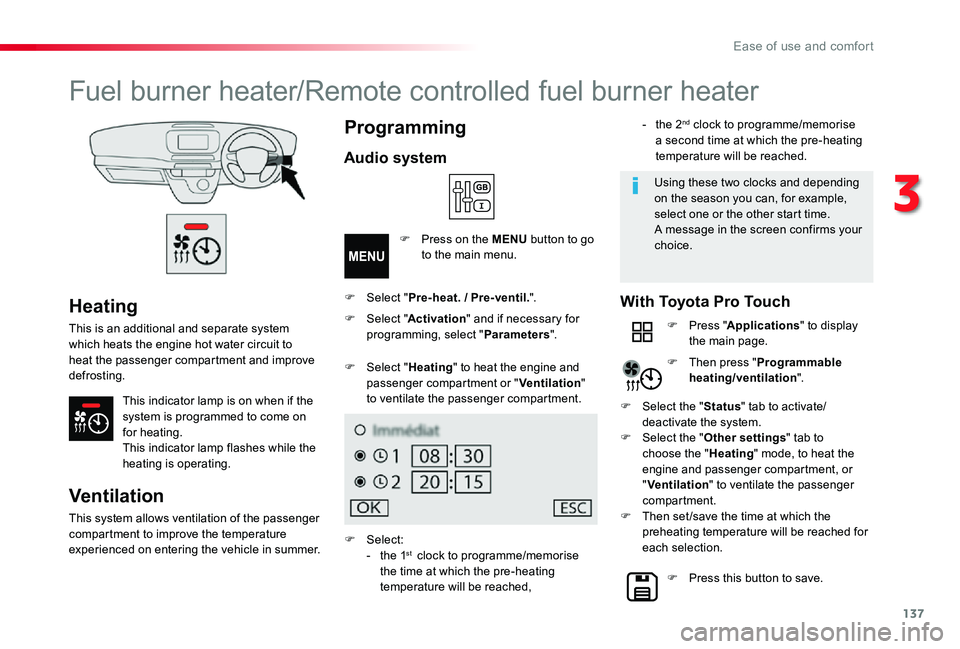
Heating
This is an additional and separate system which heats the engine hot water circuit to heat the passenger compartment and improve defrosting.
This indicator lamp is on when if the system is programmed to come on for heating.This indicator lamp flashes while the heating is operating.
Fuel burner heater/Remote controlled fuel burner heater
Ventilation
This system allows ventilation of the passenger compartment to improve the temperature
experienced on entering the vehicle in summer.
Programming
Audio system
F Press on the MENU button to go to the main menu.
F Select "Pre-heat. / Pre-ventil.".
F Select "Heating" to heat the engine and passenger compartment or "Ventilation" to ventilate the passenger compartment.
F Select:- the 1st clock to programme/memorise the time at which the pre-heating temperature will be reached,
Using these two clocks and depending on the season you can, for example, select one or the other start time.A message in the screen confirms your choice.
F Select "Activation" and if necessary for programming, select "Parameters".
- the 2nd clock to programme/memorise a second time at which the pre-heating temperature will be reached.
With Toyota Pro Touch
F Press "Applications" to display the main page.
F Press this button to save.
F Select the "Status" tab to activate/deactivate the system.F Select the "Other settings" tab to choose the "Heating" mode, to heat the engine and passenger compartment, or "Ventilation" to ventilate the passenger compartment.F Then set /save the time at which the preheating temperature will be reached for
each selection.
F Then press "Programmable heating/ventilation".
3
Ease of use and comfort
Page 138 of 418

138
F Press and hold this button to stop the heating immediately.
F Press and hold this button to start the heating immediately.
The indicator lamp in the remote control comes
on in red for about 2 seconds to confirm that the signal has been received by the vehicle.
The indicator lamp in the remote control comes on in green for about 2 seconds to confirm that the signal has been received by the vehicle.
Switching off
Switching on
Long range remote control
The range of the remote control is about 0.6 miles (1 km), in open country.
The indicator lamp in the remote control flashes for about 2 seconds if the vehicle has not received the signal.You should then move to a different location and repeat the command.
Changing the battery
If the indicator lamp in the remote control becomes orange, the state of charge of the battery is low.If the indicator lamp is not on, the battery is discharged.
F Use a coin to unscrew the cap and replace the bulb.
With Toyota Pro Touch with navigation system
F Press the "Applications" menu.
F Press "Temperature programming".
F Press the "Vehicle Apps" tab.
F Press the "Status" tab to activate/deactivate the system.F Press the "Parameters" tab to select "Heating" mode to heat the engine and passenger compartment or "Ventilation" mode to ventilate the passenger compartment.F Then set /save the activation time for each selection.F Press "OK" to confirm.
Ease of use and comfort
Page 139 of 418

139
Always switch off the programmable heating while refuelling to avoid any risk of fire or explosion.To avoid the risk of intoxication and asphyxiation, the programmable heating must not be used, even for short periods, in an enclosed area such as a garage or workshop not equipped with exhaust gas extraction.Do not park the vehicle on an inflammable sur face (dry grass, dead leaves, paper…), there is a risk of fire.Glazed sur faces such as the rear screen or windscreen can become very hot in places.Take care not to place objects in contact with these sur faces, nor touch them with your hands or any other part of your body.
The heating is activated provided that:- the battery is sufficiently charged,- the fuel level is adequate,- the engine has been started since the previous heating cycle.
The programmable heating system is supplied by the vehicle's fuel tank.Before use, ensure that there is enough fuel in the tank.If the tank is on reser ve, it is recommended that the system is not used.
The ventilation is activated provided that the battery is sufficiently charged.During heating
This indicator lamp flashes while the heating is in operation.This indicator lamp goes off at the end of the heating cycle or when the heating is stopped using the remote control.
The maximum heating period is about 45 minutes depending on the ambient conditions.
Do not throw the remote control batteries away, they contain metals which are harmful to the environment.Take them to an approved collection point.
3
Ease of use and comfort
Page 144 of 418

144
Model without AUTO lighting
Model with AUTO lighting
Main lighting selection ringLighting off (ignition off) / Front daytime running lamps (engine running).
Automatic illumination of headlamps.
Sidelamps only.
Dipped or main beam headlamps.
Dipping the headlamps
In the lighting off and sidelamps modes, the driver can switch on the main beam headlamps temporarily ("headlamp flash") by maintaining a pull on the stalk.
Operation of the selected lighting is confirmed by the illumination of the corresponding indicator lamp.
Pull the stalk to switch between dipped and main beam headlamps.
Lighting control stalk
In some weather conditions (e.g. low temperature or humidity), the presence of misting on the internal sur face of the glass of the headlamps and rear lamps is normal; it disappears after the lamps
have been on for a few minutes.
Turn the ring to align the desired symbol with the marking.
Lighting and visibility
Page 147 of 418

147
Front daytime running
lamps
(light-emitting diodes)
If fitted to your vehicle, they come on automatically when the engine is started, when the lighting control stalk is in position "0" or "AUTO".
Automatic illumination of
headlamps
Activation
When a low level of ambient light is detected by a sunshine sensor, the number plate lamps, sidelamps and dipped beam headlamps are switched on automatically, without any action on the part of the driver. They can also come on if rain is detected, at the same time as automatic operation of the windscreen wipers.As soon as the brightness returns to a
sufficient level or after the windscreen wipers are switched off, the lamps are switched off automatically.
Deactivation
F Turn the ring to another position. Deactivation of the function is accompanied by the display of a message.
Operating fault
In the event of a malfunction of the sunshine sensor, the lighting comes on; this warning lamp is displayed
Contact an authorized Toyota dealer or repairer, or another duly qualified and equipped professional.
in the instrument panel accompanied by an
audible signal and/or a message.
In fog or snow, the sunshine sensor may detect sufficient light. In this case, the lighting will not come on automatically.Do not cover the sunshine sensor, coupled with the rain sensor and located in the top of the windscreen behind the rear view mirror; the
associated functions would no longer be controlled.
F Turn the ring to the "AUTO" position. The
activation of the function is accompanied by the display of a message.
4
Lighting and visibility
Page 157 of 418
157
* Depending on the country of sale.
Heated windscreen and
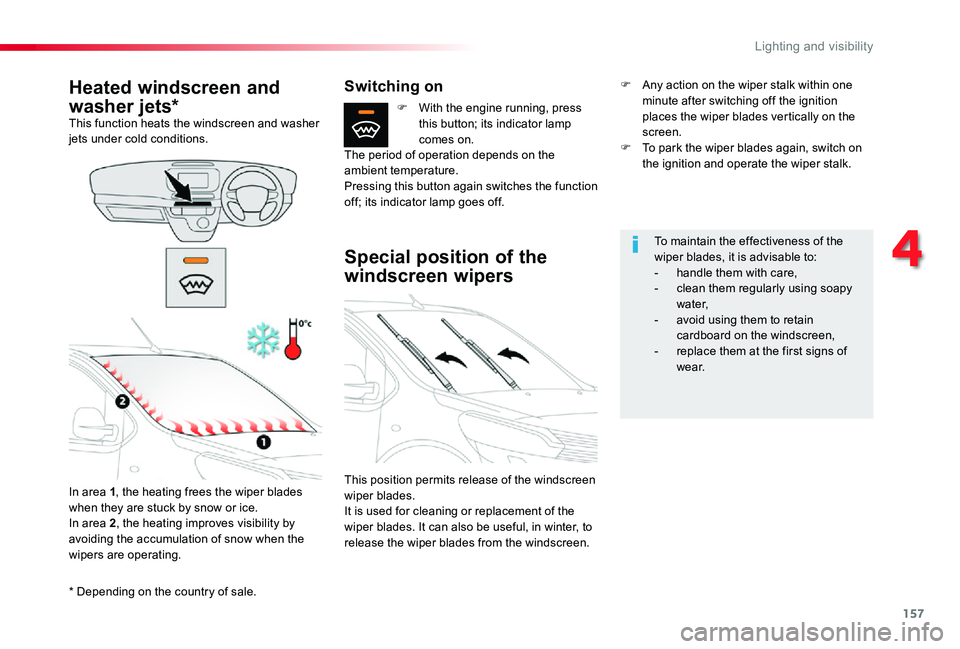
washer jets*This function heats the windscreen and washer jets under cold conditions.
In area 1, the heating frees the wiper blades when they are stuck by snow or ice.In area 2, the heating improves visibility by avoiding the accumulation of snow when the
wipers are operating.
Switching on
F With the engine running, press this button; its indicator lamp comes on.The period of operation depends on the ambient temperature.Pressing this button again switches the function off; its indicator lamp goes off.
Special position of the
windscreen wipers
This position permits release of the windscreen wiper blades.It is used for cleaning or replacement of the wiper blades. It can also be useful, in winter, to release the wiper blades from the windscreen.
To maintain the effectiveness of the wiper blades, it is advisable to:- handle them with care,- clean them regularly using soapy water,- avoid using them to retain cardboard on the windscreen,- replace them at the first signs of w e a r.
F Any action on the wiper stalk within one minute after switching off the ignition places the wiper blades vertically on the screen.F To park the wiper blades again, switch on the ignition and operate the wiper stalk.
4
Lighting and visibility