2020 TOYOTA PROACE VERSO engine
[x] Cancel search: enginePage 278 of 418
278
AdBlue® and SCR system
for Diesel engines
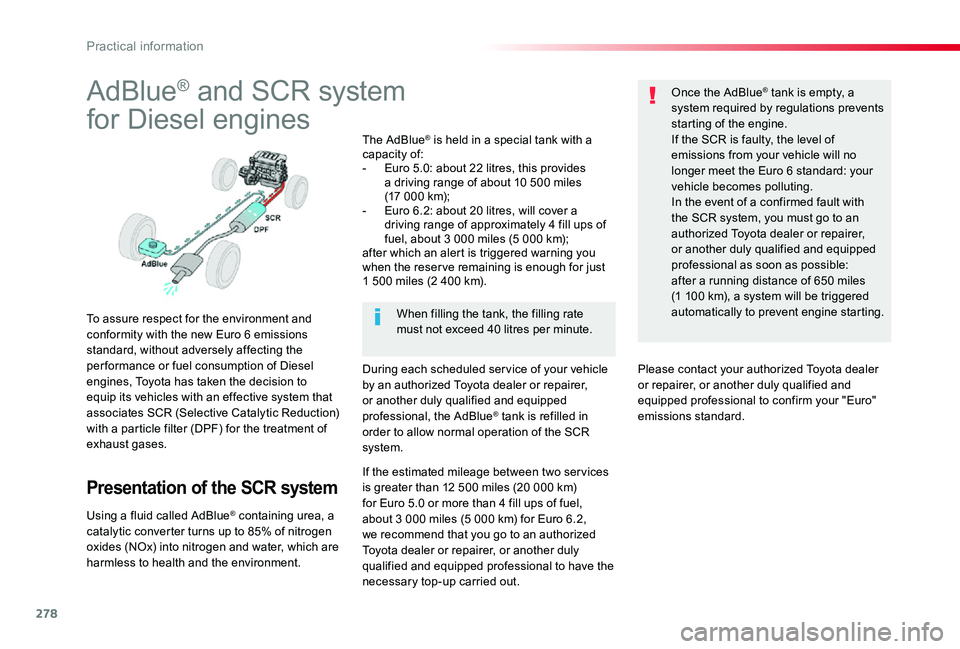
To assure respect for the environment and conformity with the new Euro 6 emissions standard, without adversely affecting the per formance or fuel consumption of Diesel engines, Toyota has taken the decision to equip its vehicles with an effective system that associates SCR (Selective Catalytic Reduction) with a particle filter (DPF) for the treatment of exhaust gases.
Presentation of the SCR system
Using a fluid called AdBlue® containing urea, a catalytic converter turns up to 85% of nitrogen oxides (NOx) into nitrogen and water, which are harmless to health and the environment.
The AdBlue® is held in a special tank with a capacity of: - Euro 5.0: about 22 litres, this provides a driving range of about 10 500 miles (17 000 km); - Euro 6.2: about 20 litres, will cover a driving range of approximately 4 fill ups of fuel, about 3 000 miles (5 000 km); after which an alert is triggered warning you when the reser ve remaining is enough for just 1 500 miles (2 400 km).
During each scheduled ser vice of your vehicle by an authorized Toyota dealer or repairer, or another duly qualified and equipped professional, the AdBlue® tank is refilled in order to allow normal operation of the SCR system.
Once the AdBlue® tank is empty, a system required by regulations prevents starting of the engine.If the SCR is faulty, the level of emissions from your vehicle will no longer meet the Euro 6 standard: your vehicle becomes polluting.In the event of a confirmed fault with the SCR system, you must go to an authorized Toyota dealer or repairer, or another duly qualified and equipped professional as soon as possible: after a running distance of 650 miles (1 100 km), a system will be triggered automatically to prevent engine starting.When filling the tank, the filling rate must not exceed 40 litres per minute.
If the estimated mileage between two ser vices is greater than 12 500 miles (20 000 km) for Euro 5.0 or more than 4 fill ups of fuel, about 3 000 miles (5 000 km) for Euro 6.2, we recommend that you go to an authorized Toyota dealer or repairer, or another duly qualified and equipped professional to have the necessary top-up carried out.
Please contact your authorized Toyota dealer or repairer, or another duly qualified and equipped professional to confirm your "Euro" emissions standard.
Practical information
Page 279 of 418
279
Topping-up the AdBlue®
Filling the AdBlue® tank is an operation included in every routine ser vice on your vehicle by an authorized Toyota dealer or repairer, or another duly qualified and equipped professional.Nevertheless, given the capacity of the tank, it may be necessary to top-up the fluid between ser vices, more particularly if an alert (warning lamps and a message) signals the requirement.You can go to an authorized Toyota dealer or repairer, or another duly qualified and equipped professional.If you envisage topping-up yourself, please read the following warnings carefully.
Precautions in use
Keep AdBlue® out of the reach of children, in its original bottle.Never transfer AdBlue® to another container: it would lose its purity.
Use only AdBlue® fluid that meets the ISO 22241 standard.
Never dilute AdBlue® with water.Never pour AdBlue® into the Diesel fuel tank.
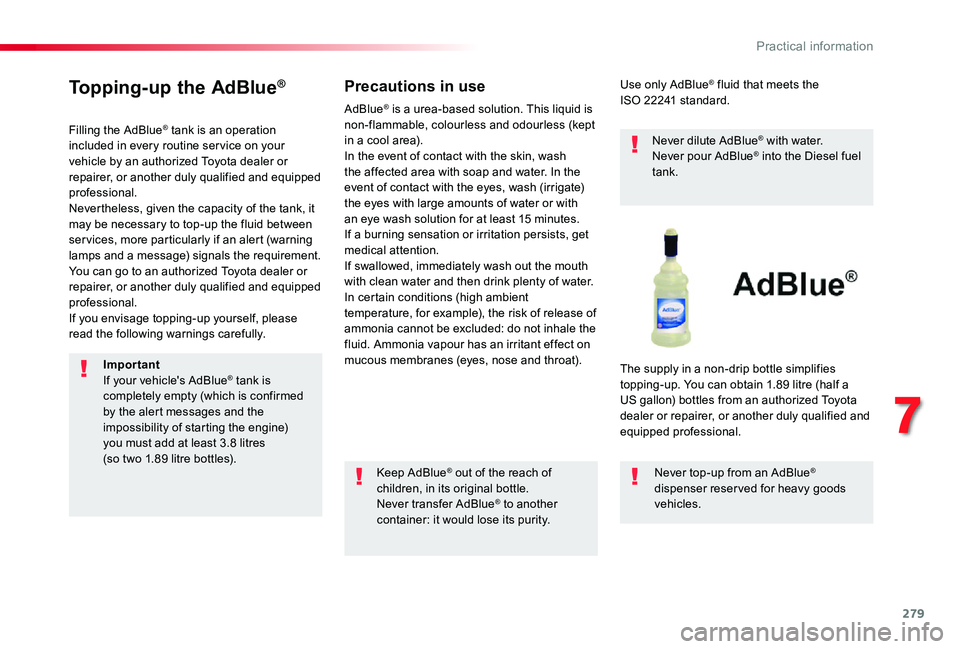
The supply in a non-drip bottle simplifies topping-up. You can obtain 1.89 litre (half a US gallon) bottles from an authorized Toyota dealer or repairer, or another duly qualified and equipped professional.
Never top-up from an AdBlue® dispenser reser ved for heavy goods vehicles.
AdBlue® is a urea-based solution. This liquid is non-flammable, colourless and odourless (kept in a cool area).In the event of contact with the skin, wash the affected area with soap and water. In the event of contact with the eyes, wash (irrigate) the eyes with large amounts of water or with an eye wash solution for at least 15 minutes. If a burning sensation or irritation persists, get
medical attention.If swallowed, immediately wash out the mouth with clean water and then drink plenty of water.In certain conditions (high ambient temperature, for example), the risk of release of ammonia cannot be excluded: do not inhale the fluid. Ammonia vapour has an irritant effect on mucous membranes (eyes, nose and throat).ImportantIf your vehicle's AdBlue® tank is completely empty (which is confirmed by the alert messages and the impossibility of starting the engine) you must add at least 3.8 litres (so two 1.89 litre bottles).
7
Practical information
Page 280 of 418

280
Recommendations on storage
Never store bottles of AdBlue® in your vehicle.
AdBlue® freezes at about -11°C and deteriorates above 25°C. It is recommended that bottles be stored in a cool area and protected from direct sunlight.Under these conditions, the fluid can be kept for at least a year.If the additive has frozen, it can be used once it has completely thawed out.
Procedure
Before starting the top-up procedure, ensure that the vehicle is parked on a flat and level sur face.
F Switch off the ignition and remove the key, or if your vehicle has one, press the START/STOP button to switch off the engine.
F For access to the AdBlue® tank, open the left-hand front door.F From below, pull the black cover.
F Turn the blue cap a 6th of a turn anti-clockwise.F Lift off the cap.
Do not dispose of AdBlue® bottles in the household waste. Place them in a container provided for this purpose or take them to your dealer.
In wintry conditions, ensure that the temperature of the vehicle is above -11°C. Other wise the AdBlue® may be frozen and so cannot be poured into its tank. Park your vehicle in a warmer area for a few hours to allow the top-up to be carried out.
Practical information
Page 281 of 418

281
F After emptying the bottle, wipe away any spillage around the tank filler using a damp cloth.
If any additive is split or splashed, wash immediately with cold water or wipe with a damp cloth.If the additive has crystallised, clean it off using a sponge and hot water.
F Refit the blue cap to the tank and turn it a 6th of a turn clockwise, to its stop.
Important: when topping-up after running out of additive, signalled by the message "Top up emissions additive: Starting prevented", you must wait for about 5 minutes before switching on the ignition, without opening the driver's door, unlocking the vehicle, introducing the key into the ignition switch, or placing the key of the "Smar t Entr y & Star t System" inside the vehicle.Switch on the ignition, then wait for 10 seconds before starting the engine.
F Obtain a bottle of AdBlue®. After first checking the use-by date, read carefully the instructions on use on the label before pouring the contents of the bottle into your
vehicle's AdBlue® tank.
Freezing of the AdBlue®
AdBlue® freezes at temperatures below around -11°C.The SCR system includes a heater for the AdBlue® tank, allowing you to continue driving in very cold conditions.F Refit the black cover, starting at the top.F Close the door.
7
Practical information
Page 287 of 418
287
Repair procedure
1. Sealing
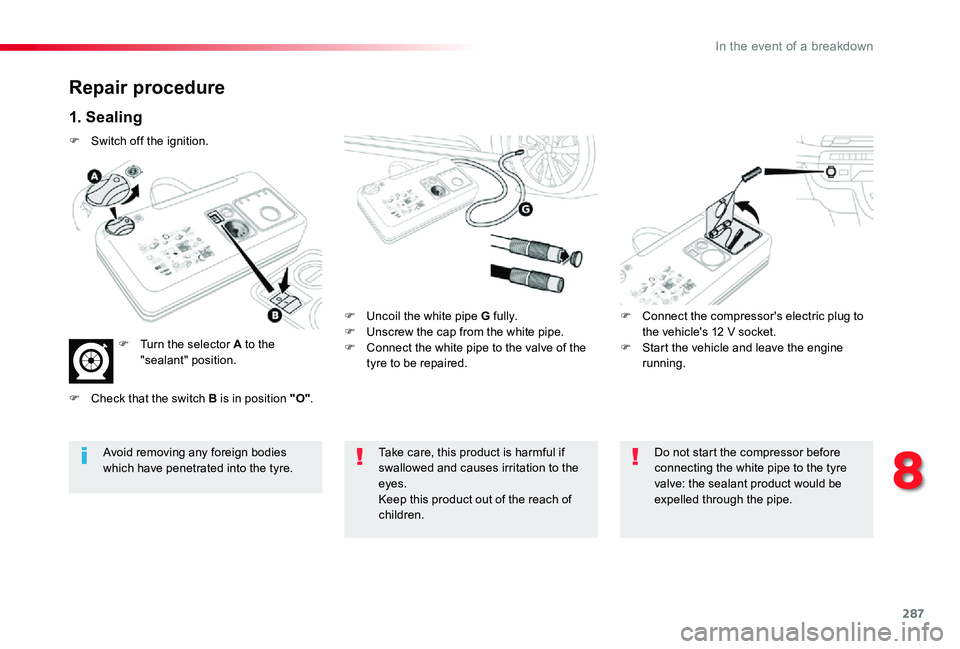
F Uncoil the white pipe G fully.F Unscrew the cap from the white pipe.F Connect the white pipe to the valve of the tyre to be repaired.
F Connect the compressor's electric plug to the vehicle's 12 V socket.F Start the vehicle and leave the engine running.
Take care, this product is harmful if swallowed and causes irritation to the eyes.Keep this product out of the reach of children.
Avoid removing any foreign bodies which have penetrated into the tyre.
Do not start the compressor before connecting the white pipe to the tyre valve: the sealant product would be expelled through the pipe.
F Switch off the ignition.
F Turn the selector A to the "sealant" position.
F Check that the switch B is in position "O".
8
In the event of a breakdown
Page 289 of 418
289
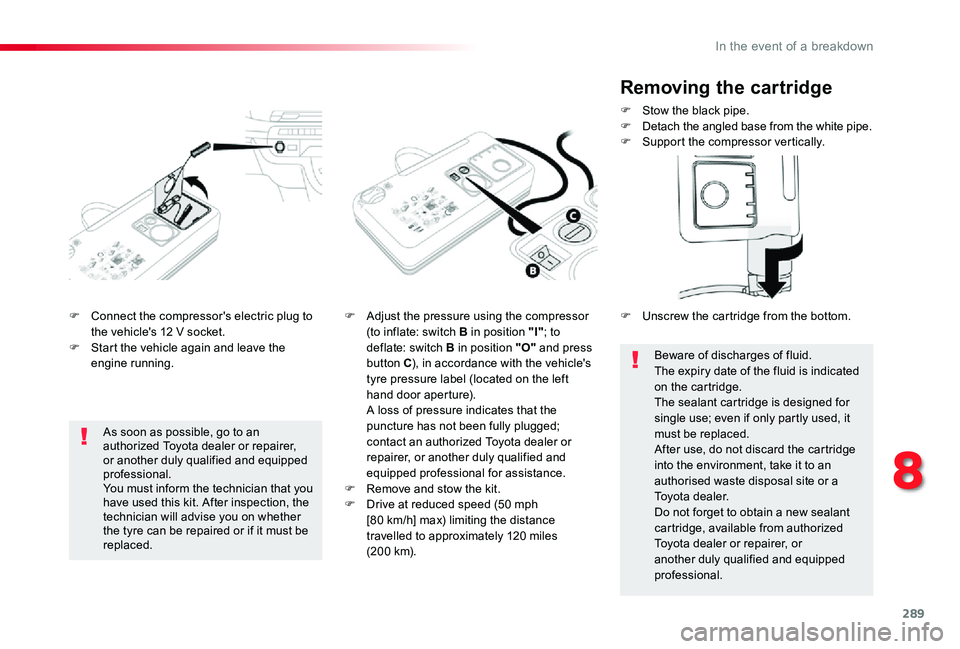
F Connect the compressor's electric plug to the vehicle's 12 V socket.F Start the vehicle again and leave the engine running.
F Adjust the pressure using the compressor (to inflate: switch B in position "I"; to deflate: switch B in position "O" and press button C), in accordance with the vehicle's tyre pressure label (located on the left hand door aperture). A loss of pressure indicates that the puncture has not been fully plugged; contact an authorized Toyota dealer or repairer, or another duly qualified and equipped professional for assistance.F Remove and stow the kit.F Drive at reduced speed (50 mph [80 km/h] max) limiting the distance travelled to approximately 120 miles (200 km).
As soon as possible, go to an authorized Toyota dealer or repairer, or another duly qualified and equipped professional.You must inform the technician that you have used this kit. After inspection, the technician will advise you on whether the tyre can be repaired or if it must be replaced.
Removing the cartridge
F Stow the black pipe.F Detach the angled base from the white pipe.F Support the compressor vertically.
Beware of discharges of fluid.The expiry date of the fluid is indicated on the cartridge.The sealant cartridge is designed for single use; even if only partly used, it must be replaced.After use, do not discard the cartridge into the environment, take it to an authorised waste disposal site or a Toyota dealer.Do not forget to obtain a new sealant cartridge, available from authorized Toyota dealer or repairer, or another duly qualified and equipped professional.
F Unscrew the cartridge from the bottom.
8
In the event of a breakdown
Page 290 of 418
290
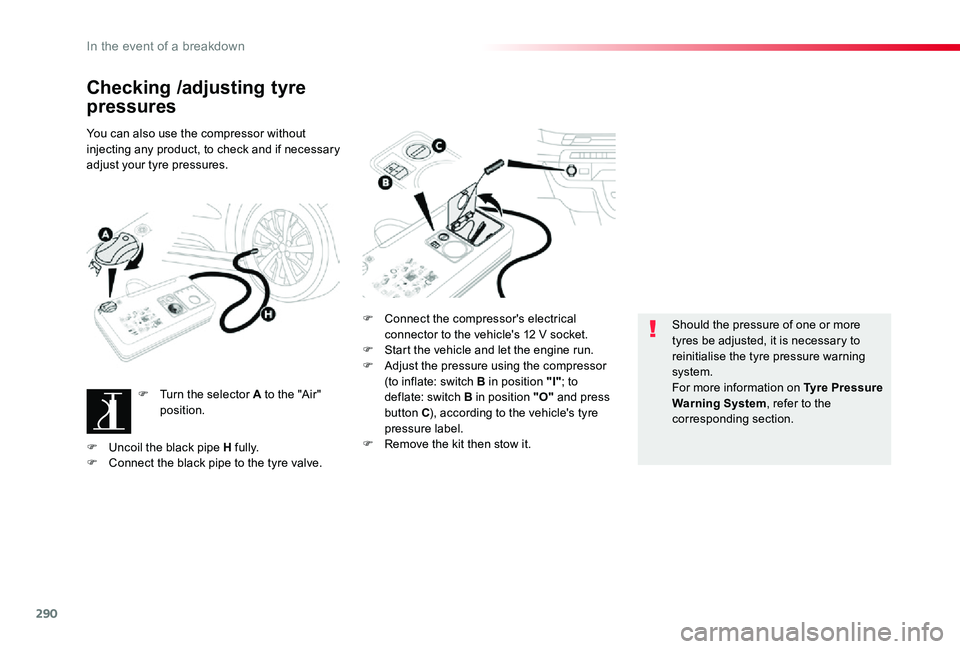
Checking /adjusting tyre
pressures
You can also use the compressor without injecting any product, to check and if necessary adjust your tyre pressures.
F Turn the selector A to the "Air" position.
F Connect the compressor's electrical connector to the vehicle's 12 V socket.F Start the vehicle and let the engine run.F Adjust the pressure using the compressor (to inflate: switch B in position "I"; to deflate: switch B in position "O" and press button C), according to the vehicle's tyre pressure label.F Remove the kit then stow it.
Should the pressure of one or more tyres be adjusted, it is necessary to reinitialise the tyre pressure warning system.For more information on Tyre Pressure Warning System, refer to the corresponding section.
F Uncoil the black pipe H fully.F Connect the black pipe to the tyre valve.
In the event of a breakdown
Page 315 of 418

315
Engine compartment fuses
F Release the two latches A.F Remove the cover.F Change the fuse.F When you have finished, close the cover carefully then engage the two latches A, to ensure correct sealing of the fusebox.
FuseN°Rating(A)Functions
F125Heated washer jets.
F1425Front and rear screenwash pump.
F155Front radar and emergency braking, electric power steering.
F1710Built-in systems inter face.
F1930Front wiper motor.
F2015Front and rear screenwash pump.
F2120Headlamp wash pump.
F2215Horn.
F2315Right hand main beam headlamp.
F2415Left hand main beam headlamp.
The fusebox is located in the engine compartment near the battery.
The fuses described hereafter vary according to the equipment in your vehicle.
Access to the fuses
8
In the event of a breakdown