Page 406 of 532

406 5-2. Steps to take in an emergency
WARNING
■Maintenance of the tires
Each tire, including the spare (if provided), should be checked monthly
when cold and inflated to the inflation pressure recommended by the
vehicle manufacturer on the vehicle placard or tire inflation p ressure
label (tire and load information label). (If your vehicle has tires of a differ-
ent size than the size indicated on the vehicle placard or tire inflation
pressure label [tire and load information label], you should de termine the
proper tire inflation pressure for those tires.)
As an added safety feature, your vehicle has been equipped with a tire
pressure monitoring system (TPMS -tire pressure warning system) that
illuminates a low tire pressure telltale (tire pressure warning light) when
one or more of your tires is significantly under-inflated. Acco rdingly,
when the low tire pressure telltale (tire pressure warning ligh t) illumi-
nates, you should stop and check your tires as soon as possible , and
inflate them to the proper pressure. Driving on a significantly under-
inflated tire causes the tire to overheat and can lead to tire failure.
Under-inflation also reduces fuel efficiency and tire tread lif e, and may
affect the vehicle's han dling and stopping ability.
Please note that the TPMS (tire pressure warning system) is not a sub-
stitute for proper tire maintenance, and it is the driver's res ponsibility to
maintain correct tire pressure, even if under-inflation has not reached the
level to trigger illumination of the TPMS low tire pressure telltale (tire
pressure warning light).
Your vehicle has also been equipped with a TPMS (tire pressure warning
system) malfunction indicator to indicate when the system is no t operat-
ing properly. The TPMS (tire pressure warning system) malfuncti on indi-
cator is combined with the low tire pressure telltale (tire pre ssure
warning light). When the system detects a malfunction, the tell tale will
flash for approximately one minut e and then remain continuously illumi-
nated. This sequence will continue upon subsequent vehicle star t-ups as
long as the malfunction exists. When the malfunction indicator is illumi-
nated, the system may not be able to detect or signal low tire pressure
as intended.
Page 407 of 532
5
When trouble arises
407
5-2. Steps to take in an emergency
WARNING
TPMS (tire pressure warning system) malfunctions may occur for
a vari-
ety of reasons, including the installation of replacement or al ternate tires
or wheels on the vehicle that prevent the TPMS (tire pressure w arning
system) from functioning properl y. Always check the TPMS (tire pres-
sure warning system) malfunctio n telltale after replacing one or more
tires or wheels on your vehicle to ensure that the replacement or alter-
nate tires and wheels allow the TPMS (tire pressure warning sys tem) to
continue to function properly.
NOTICE
■To ensure the tire pressure warning system operates properly
Do not install tires with different specifications or makers, as the tire
pressure warning system may not operate properly.
Page 408 of 532
408
5-2. Steps to take in an emergency
If a warning message is displayed (vehicles with a color multi-information display)
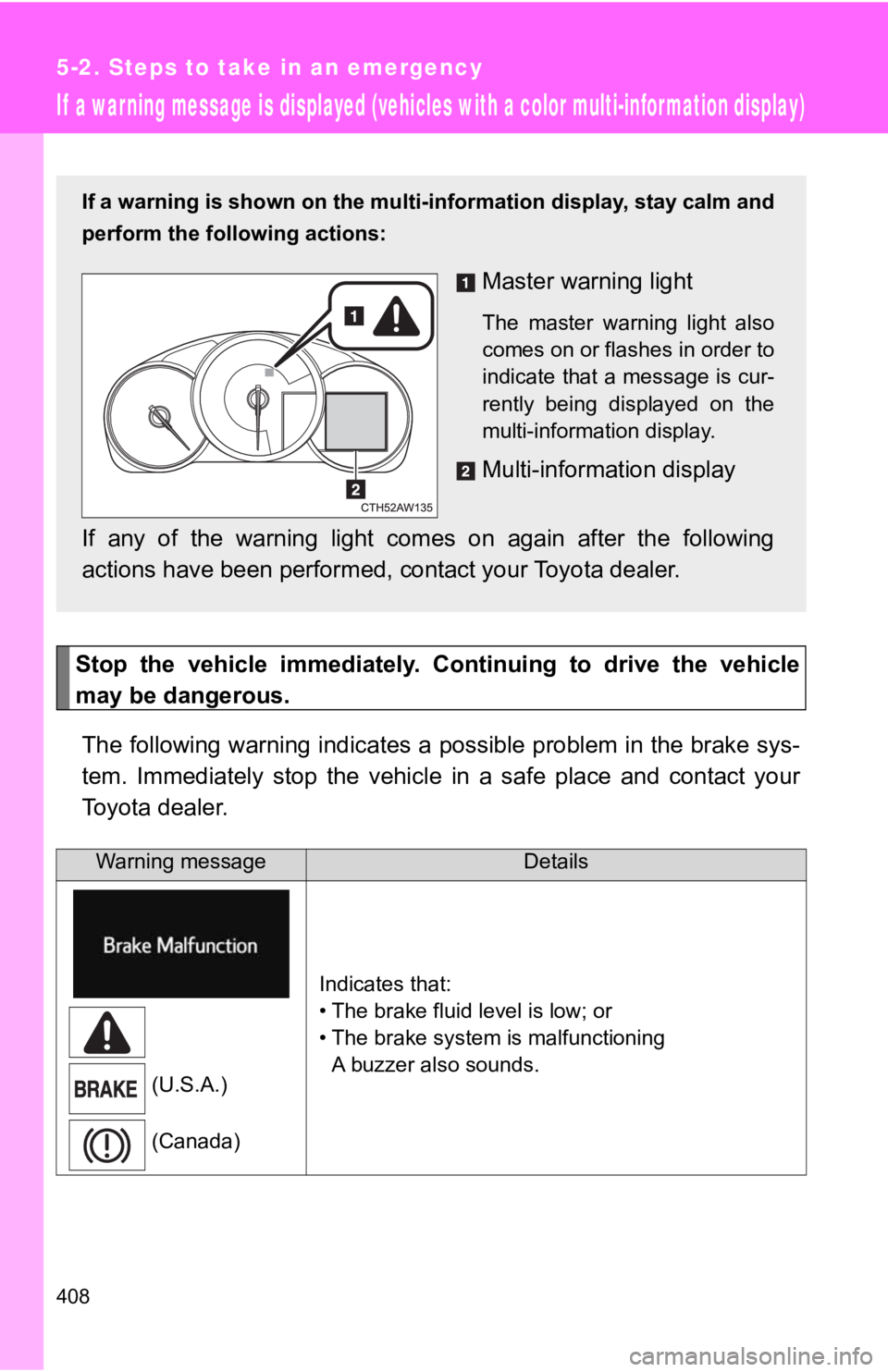
Stop the vehicle immediately. Continuing to drive the vehicle
may be dangerous.
The following warning indicates a possible problem in the brake sys-
tem. Immediately stop the vehicl e in a safe place and contact your
Toyota dealer.
Warning messageDetails
(U.S.A.)
(Canada) Indicates that:
• The brake fluid level is low; or
• The brake system is malfunctioning
A buzzer also sounds.
If a warning is shown on the mult i-information display, stay calm and
perform the following actions:
Master warning light
The master warning light also
comes on or flashes in order to
indicate that a message is cur-
rently being displayed on the
multi-information display.
Multi-information display
If any of the warning light comes on again after the following
actions have been performed, contact yo ur Toyota dealer.
Page 409 of 532
5
When trouble arises
409
5-2. Steps to take in an emergency
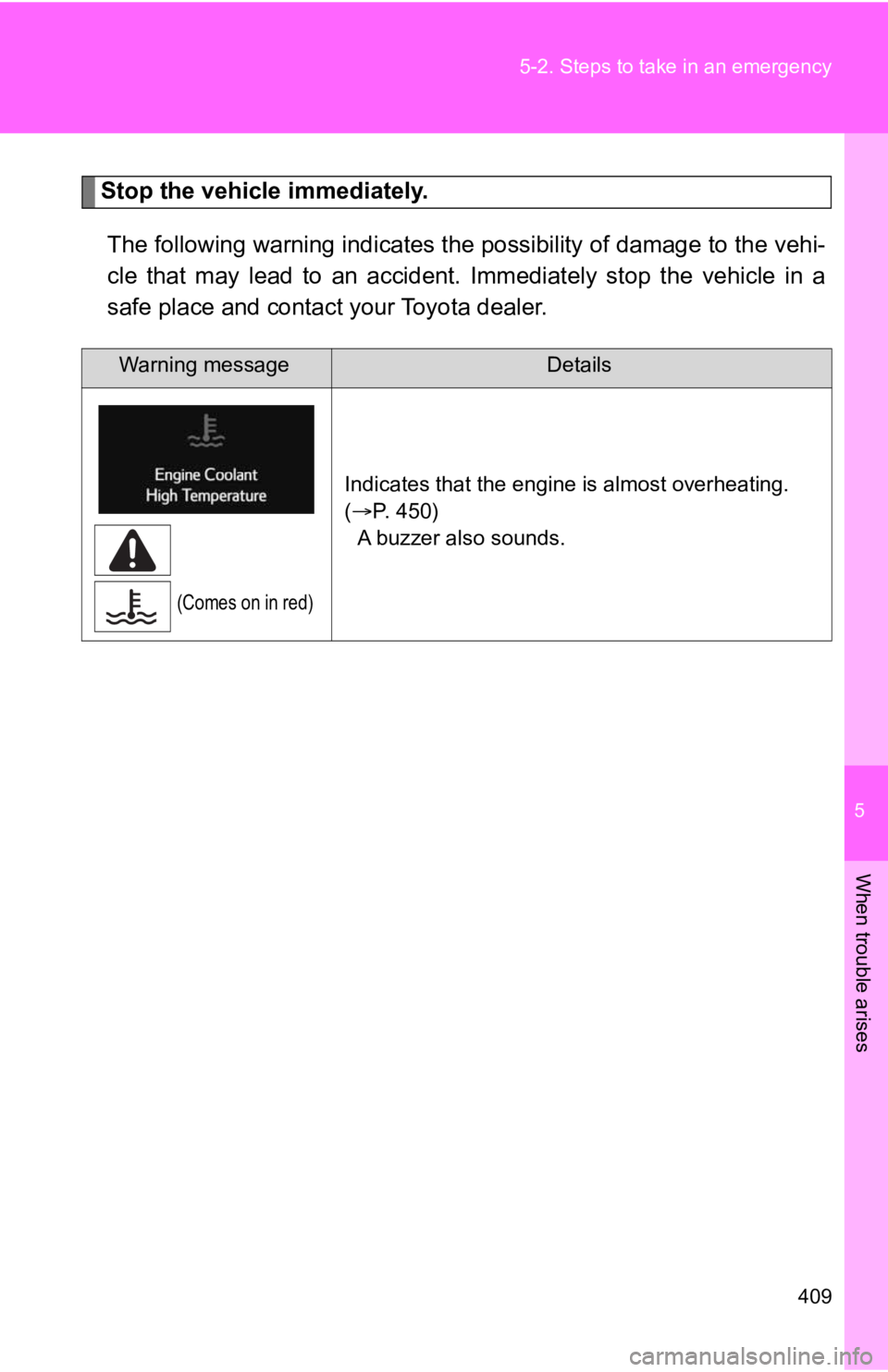
Stop the vehicle immediately.
The following warning indicates the possibility of damage to th e vehi-
cle that may lead to an acciden t. Immediately stop the vehicle in a
safe place and contact your Toyota dealer.
Warning messageDetails
(Comes on in red)
Indicates that the engine is almost overheating.
( P. 450)
A buzzer also sounds.
Page 410 of 532
410 5-2. Steps to take in an emergency
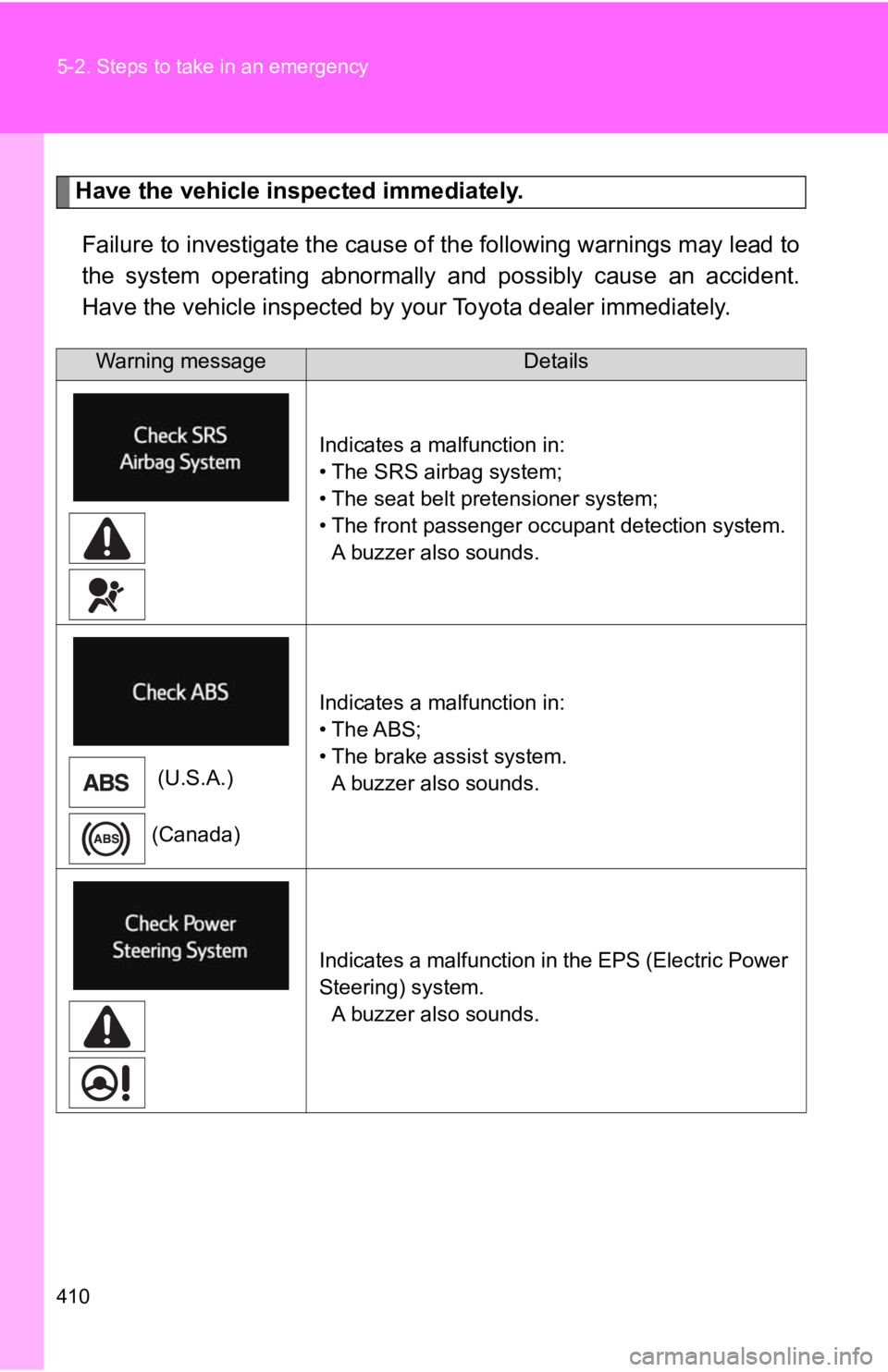
Have the vehicle inspected immediately.
Failure to investigate the cause of the following warnings may lead to
the system operating abnormally and possibly cause an accident.
Have the vehicle ins pected by your Toyota dealer immediately.
Warning messageDetails
Indicates a malfunction in:
• The SRS airbag system;
• The seat belt pretensioner system;
• The front passenger occupant detection system. A buzzer also sounds.
(U.S.A.)
(Canada) Indicates a malfunction in:
• The ABS;
• The brake assist system.
A buzzer also sounds.
Indicates a malfunction in the EPS (Electric Power
Steering) system. A buzzer also sounds.
Page 411 of 532
5
When trouble arises
411
5-2. Steps to take in an emergency
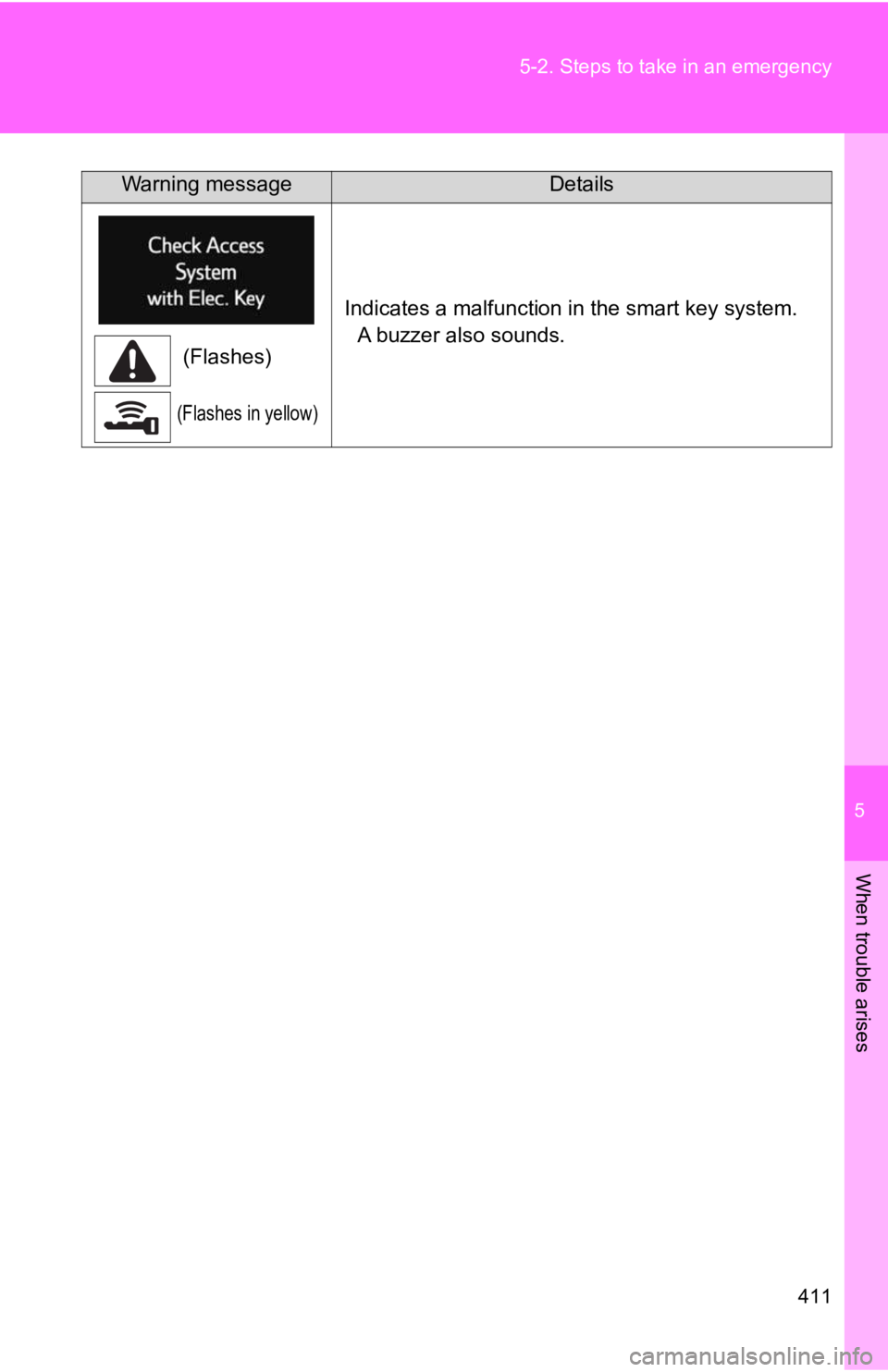
(Flashes)
(Flashes in yellow)
Indicates a malfunction in the smart key system.
A buzzer also sounds.
Warning messageDetails
Page 412 of 532
412 5-2. Steps to take in an emergency
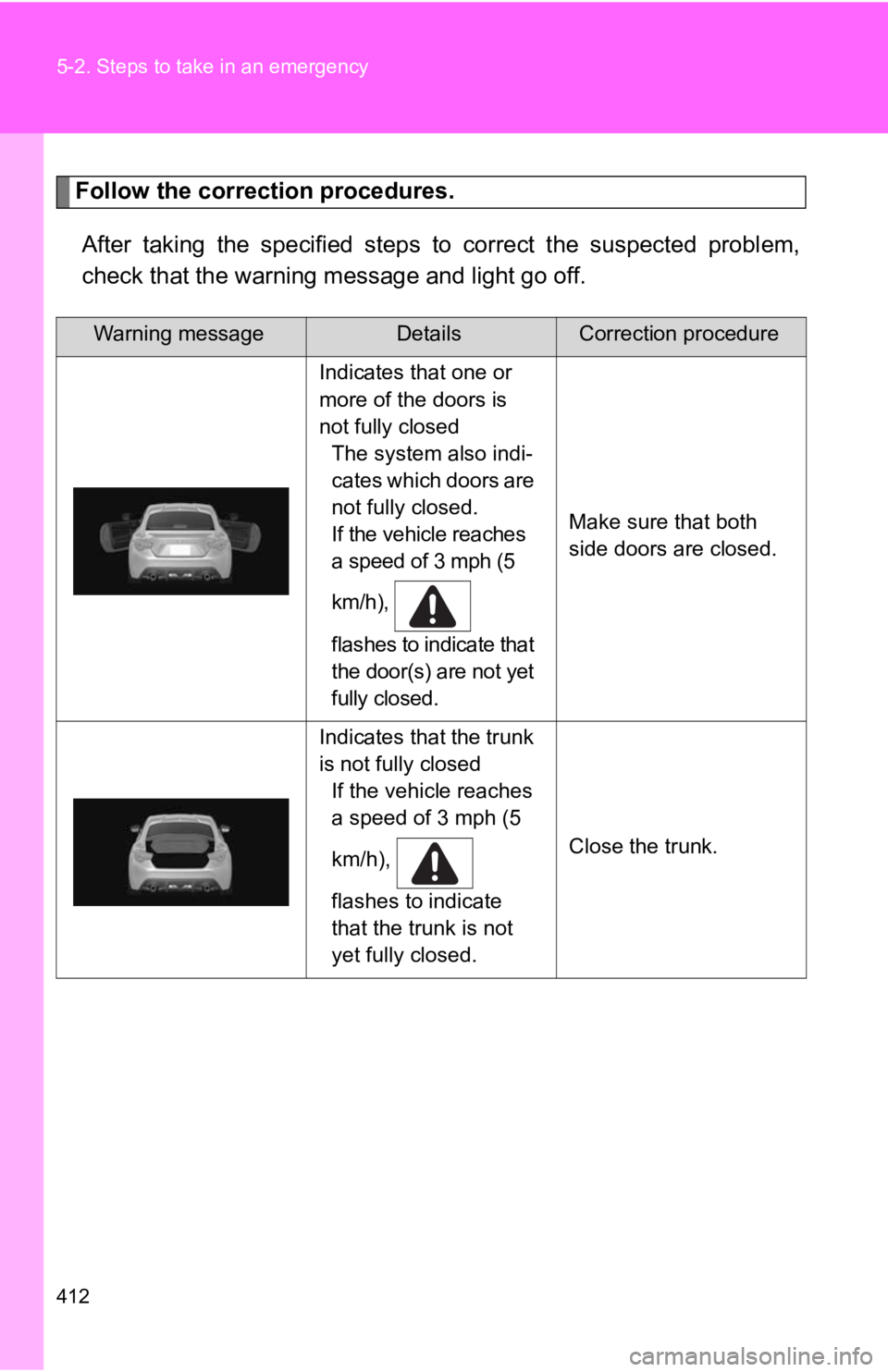
Follow the correction procedures.After taking the specified steps to correct the suspected probl em,
check that the warning me ssage and light go off.
Warning messageDetailsCorrection procedure
Indicates that one or
more of the doors is
not fully closed The system also indi-
cates which doors are
not fully closed.
If the vehicle reaches
a speed of 3 mph (5
km/h),
flashes to indicate that
the door(s) are not yet
fully closed. Make sure that both
side doors are closed.
Indicates that the trunk
is not fully closed If the vehicle reaches
a speed of 3 mph (5
km/h),
flashes to indicate
that the trunk is not
yet fully closed. Close the trunk.
Page 413 of 532
5
When trouble arises
413
5-2. Steps to take in an emergency
*: This distance is computed based on your average fuel consumption. As a
result, the actual distance that can be driven may differ from that displayed.
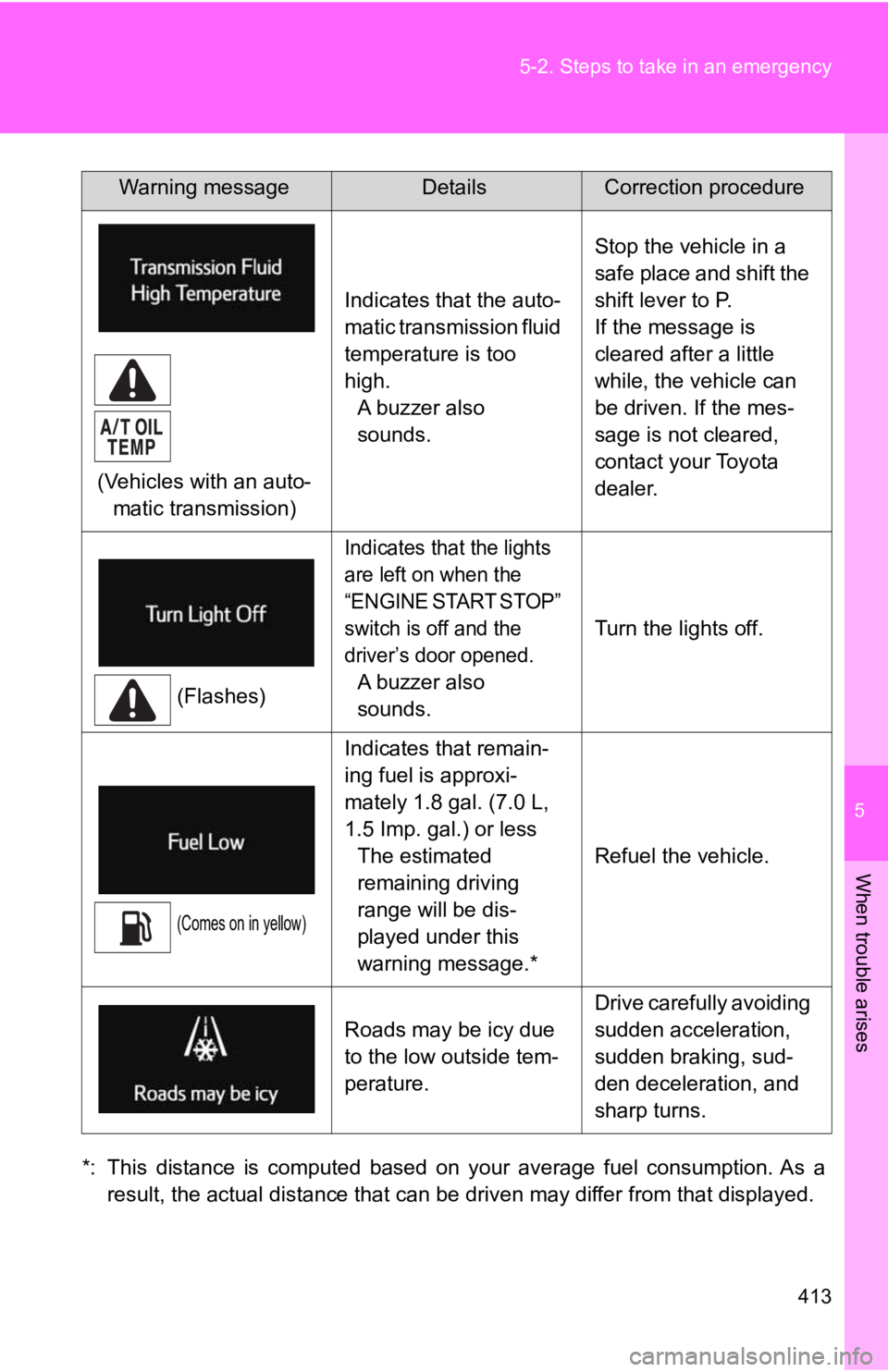
(Vehicles with an auto-
matic transmission) Indicates that the auto-
matic transmission fluid
temperature is too
high.
A buzzer also
sounds. Stop the vehicle in a
safe place and shift the
shift lever to P.
If the message is
cleared after a little
while, the vehicle can
be driven. If the mes-
sage is not cleared,
contact your Toyota
dealer.
(Flashes)
Indicates that the lights
are left on when the
“ENGINE START STOP”
switch is off and the
driver’s door opened.
A buzzer also
sounds. Turn the lights off.
(Comes on in yellow)
Indicates that remain-
ing fuel is approxi-
mately 1.8 gal. (7.0 L,
1.5 Imp. gal.) or less
The estimated
remaining driving
range will be dis-
played under this
warning message.* Refuel the vehicle.
Roads may be icy due
to the low outside tem-
perature. Drive carefully avoiding
sudden acceleration,
sudden braking, sud-
den deceleration, and
sharp turns.
Warning messageDetailsCorrection procedure