Page 422 of 532
422 5-2. Steps to take in an emergency
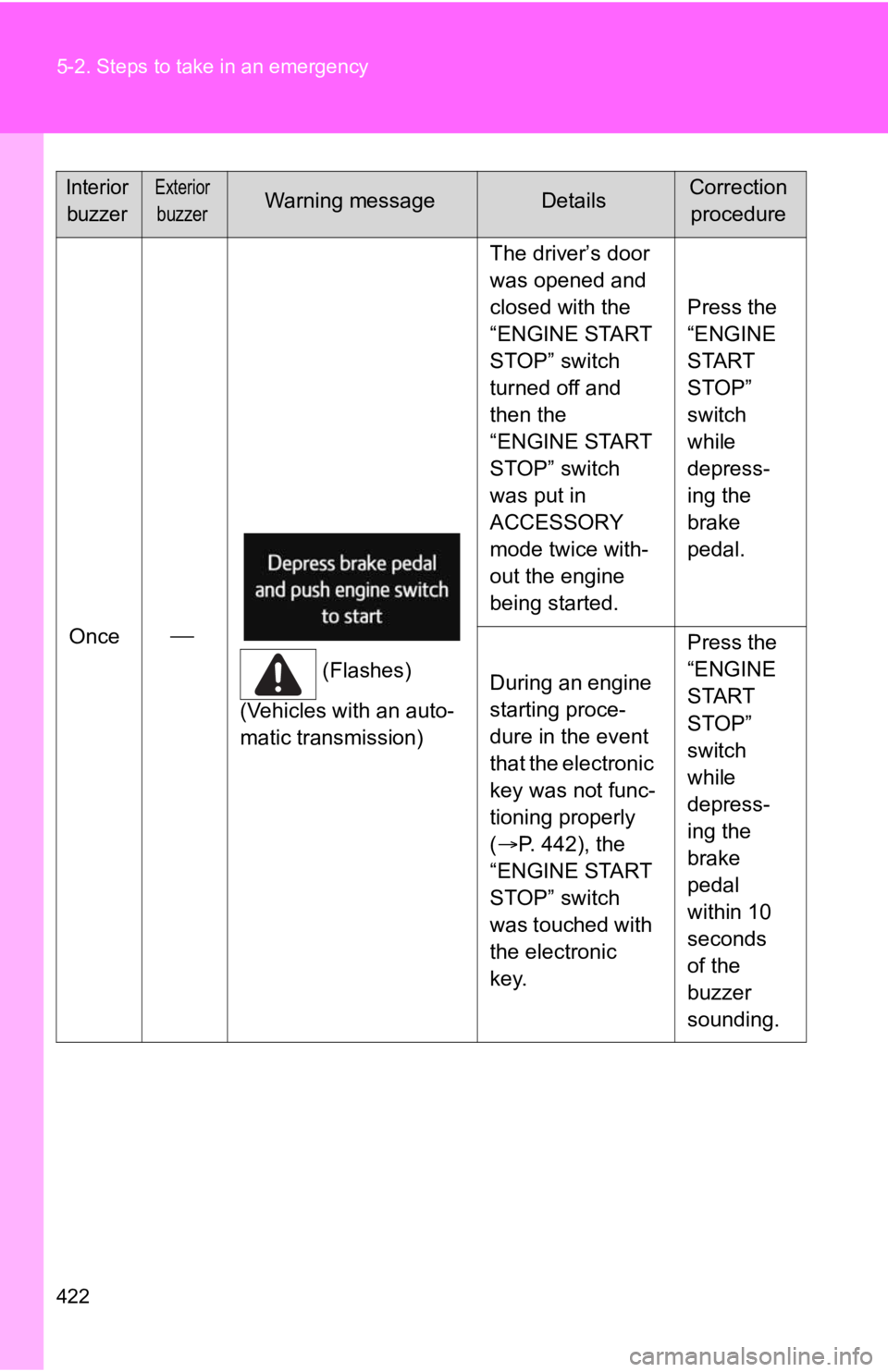
Once
(Flashes)
(Vehicles with an auto-
matic transmission) The driver’s door
was opened and
closed with the
“ENGINE START
STOP” switch
turned off and
then the
“ENGINE START
STOP” switch
was put in
ACCESSORY
mode twice with-
out the engine
being started.
Press the
“ENGINE
START
STOP”
switch
while
depress-
ing the
brake
pedal.
During an engine
starting proce-
dure in the event
that the electronic
key was not func-
tioning properly
( P. 442), the
“ENGINE START
STOP” switch
was touched with
the electronic
key. Press the
“ENGINE
START
STOP”
switch
while
depress-
ing the
brake
pedal
within 10
seconds
of the
buzzer
sounding.
Interior
buzzerExterior
buzzerWarning messageDetailsCorrection procedure
Page 423 of 532
5
When trouble arises
423
5-2. Steps to take in an emergency
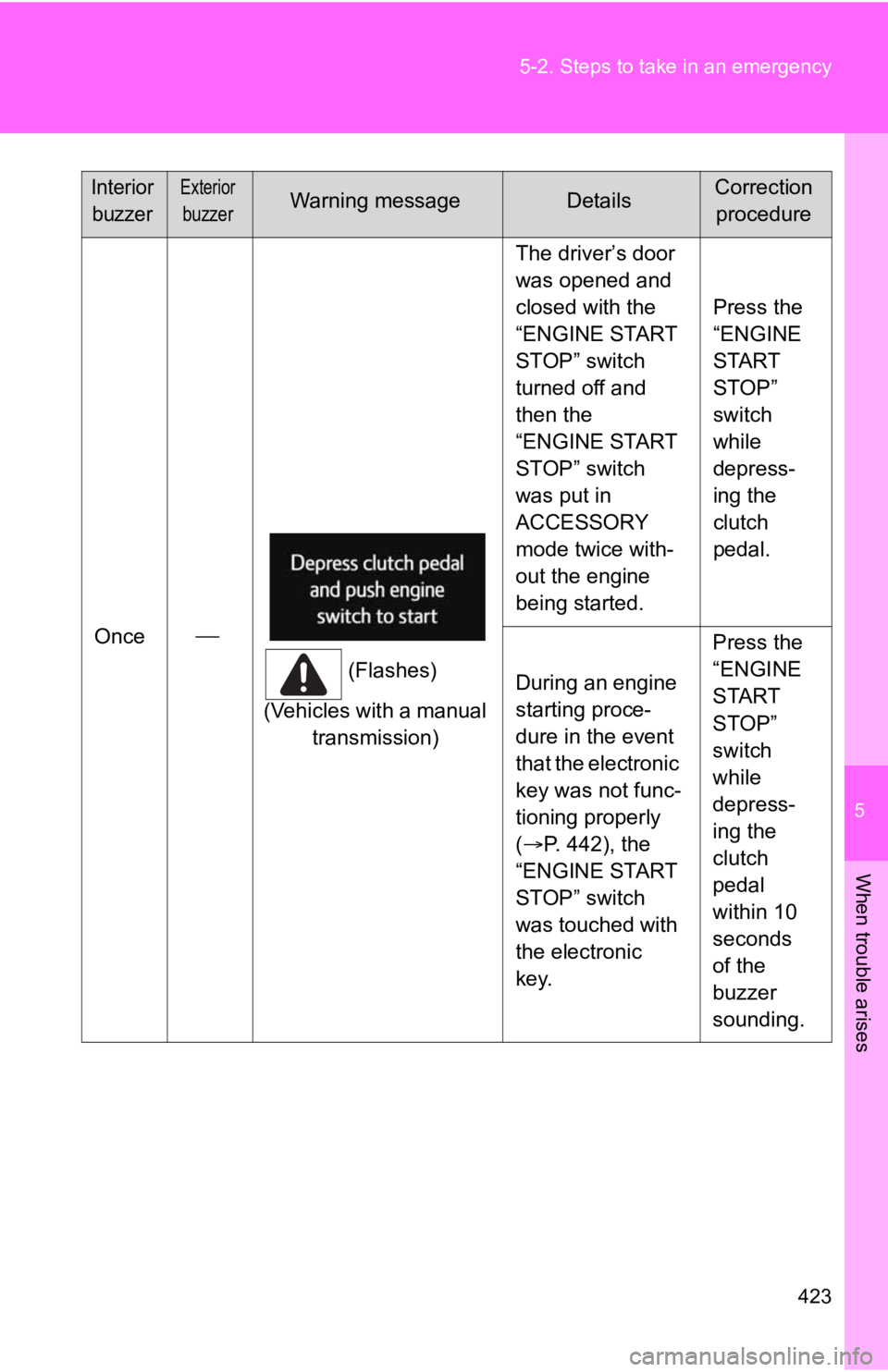
Once
(Flashes)
(Vehicles with a manual transmission) The driver’s door
was opened and
closed with the
“ENGINE START
STOP” switch
turned off and
then the
“ENGINE START
STOP” switch
was put in
ACCESSORY
mode twice with-
out the engine
being started.
Press the
“ENGINE
START
STOP”
switch
while
depress-
ing the
clutch
pedal.
During an engine
starting proce-
dure in the event
that the electronic
key was not func-
tioning properly
( P. 442), the
“ENGINE START
STOP” switch
was touched with
the electronic
key. Press the
“ENGINE
START
STOP”
switch
while
depress-
ing the
clutch
pedal
within 10
seconds
of the
buzzer
sounding.
Interior
buzzerExterior
buzzerWarning messageDetailsCorrection procedure
Page 424 of 532
424 5-2. Steps to take in an emergency
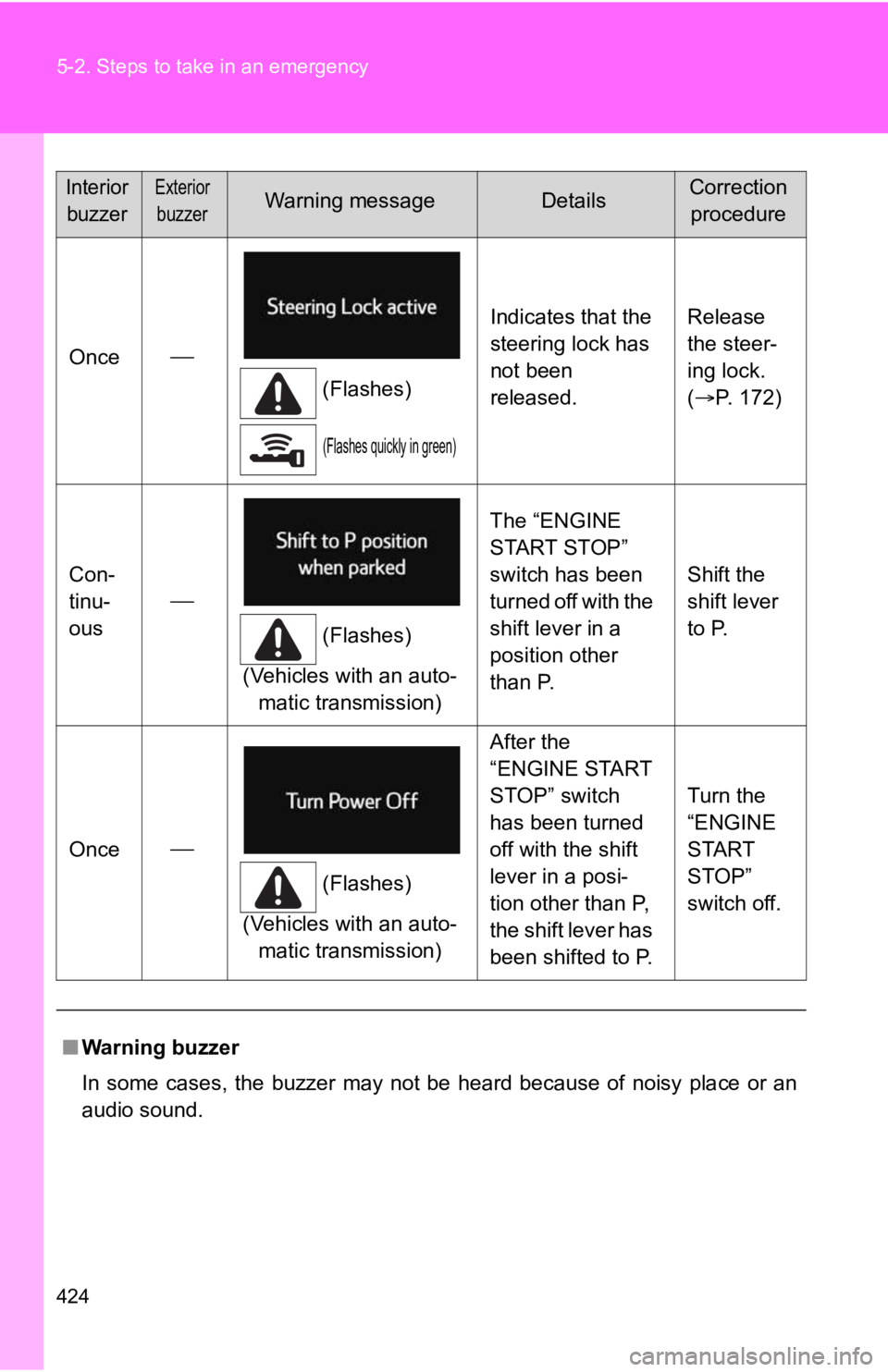
Once
(Flashes)
(Flashes quickly in green)
Indicates that the
steering lock has
not been
released. Release
the steer-
ing lock.
(
P. 172)
Con-
tinu-
ous
(Flashes)
(Vehicles with an auto- matic transmission) The “ENGINE
START STOP”
switch has been
turned off with the
shift lever in a
position other
than P.
Shift the
shift lever
to P.
Once
(Flashes)
(Vehicles with an auto- matic transmission) After the
“ENGINE START
STOP” switch
has been turned
off with the shift
lever in a posi-
tion other than P,
the shift lever has
been shifted to P.
Turn the
“ENGINE
START
STOP”
switch off.
■ Warning buzzer
In some cases, the buzzer may not be heard because of noisy pla ce or an
audio sound.
Interior buzzerExterior
buzzerWarning messageDetailsCorrection procedure
Page 430 of 532
430 5-2. Steps to take in an emergency
Stow the flat tire, tire jack and all tools. (P. 431)
■The compact spare tire
●The compact spare tire is identified by the label “TEMPORARY US E
ONLY” on the tire sidewall.
Use the compact spare tire tem porarily only in an emergency.
●Make sure to check the tire pressure of the compact spare tire.
( P. 468)
■When using the compact spare tire
As the compact spare tire is not equipped with the tire pressure warning
valve and transmitter, low inflation pressure of the spare tire will not be
warned. Also, if you replace the compact spare tire after the t ire pressure
warning light comes on, the light remains on.
■If you have a flat rear tire
Install the compact spare tire on the front of the vehicle. Per form the fol-
lowing steps.
Replace a front tire with the compact spare tire.
Replace the flat rear tire with the tire removed from the front of
the vehicle.
■After completing the tire change
The tire pressure warning system must be reset. (P. 3 4 6 )
STEP 5
STEP 1
STEP 2
Page 432 of 532

432 5-2. Steps to take in an emergency
WARNING
■Using the tire jack
Improper use of the tire jack may lead to death or serious injuries due to
the vehicle suddenly falling off the jack.
●Do not use the tire jack for any purpose other than replacing t ires or
installing and removing tire chains.
●Only use the tire jack that comes with this vehicle for replacing a flat
tire.
Do not use it on other vehicles, and do not use other tire jack s for
replacing tires on this vehicle.
●Always check that the tire jack is securely set to the jack point.
●Do not put any part of your body under the vehicle supported by a jack.
●Do not start or run the engine while your vehicle is supported by the
jack.
●When raising the vehicle, make sure that no one is in the vehic le and
unload all luggage from the vehicle.
●When raising the vehicle, do not put an object on or under the jack.
●Do not raise the vehicle to a height greater than that required to
replace the tire.
●Use a jack stand if it is neces sary to get under the vehicle.
Take particular care when lowering the vehicle to ensure that n o one
working on or near the v ehicle may be injured.
Page 433 of 532

5
When trouble arises
433
5-2. Steps to take in an emergency
WARNING
■Replacing a flat tire
●Do not touch the disc wheels or the area around the brakes imme
di-
ately after the vehicle has been driven.
After the vehicle has been driven the disc wheels and the area around
the brakes will be extremely hot . Touching these areas with han ds, feet
or other body parts w hile changing a tire, etc. may result in b urns.
●Do not attach a heavily damaged wheel ornament, as it may fly o ff the
wheel while the ve hicle is moving.
●Failure to follow these precautions could cause the wheel nuts to
loosen and the tire to fall off, resulting in death or serious injury.
• Have the wheel nuts tightened with a torque wrench to 89 ft•lb f (120
N•m, 12.2 kgf•m) as soon as possible after changing wheels.
• When installing a tire, only use wheel nuts that have been spe cifi-
cally designed for that wheel.
• If there are any cracks or deformations in the bolt screws, nu t
threads or bolt holes of the wh eel, have the vehicle inspected by
your Toyota dealer.
• When installing the wheel nuts, be sure to install them with t he
tapered ends facing inward. ( P. 358)
Page 434 of 532

434 5-2. Steps to take in an emergency
WARNING
■When using the compact spare tire
●Remember that your compact spare tire is specifically designed for
use with your vehicle. Do not use your compact spare tire on an other
vehicle.
●Do not use two compact spa re tires simultaneously.
●Replace the compact spare tire with a standard tire as soon as possi-
ble.
●Avoid sudden acceleration, abrupt steering, sudden braking and shift-
ing operations that cause sudden engine braking.
●Install the compact spare tire on a front wheel.
■When storing the compact spare tire
Be careful not to catch fingers or other body parts between the compact
spare tire and the body of the vehicle.
■Speed limit when using the compact spare tire
Do not drive at speeds in excess of 50 mph (80 km/h) when a compact
spare tire is installed on the vehicle.
The compact spare tire is not designed for driving at high spee ds. Failing
to observe this precaution may lead to an accident causing deat h or seri-
ous injury.
■When the compact spare tire is attached
The vehicle speed may not be correctly detected, and the follow ing sys-
tems may not ope rate correctly:
●ABS & brake assist
●VSC
●TRAC
●EPS
●Cruise control
Page 435 of 532

5
When trouble arises
435
5-2. Steps to take in an emergency
NOTICE
■Do not drive the vehic
le with a flat tire.
Do not continue driving with a flat tire.
Driving even a short distance wi th a flat tire can damage the tire and the
wheel beyond repair.
■Be careful when driving over bumps with the compact spare tire
installed on the vehicle.
The vehicle becomes lower when d riving with the compact spare tire
compared to when driving with standard tires. Be careful when d riving
over uneven road surfaces.
■Driving with tire chains and the compact spare tire
Do not fit tire chains to the compact spare tire.
Tire chains may damage the vehicle body and adversely affect dr iving
performance.
■When replacing the tires
When removing or fitting the wheels, tires or the tire pressure warning
valve and transmitter, contact yo ur Toyota dealer as the tire pressure
warning valve and transmitter may be damaged if n ot handled correctly.
■To avoid damage to the tire pressure warning valves and transmi t-
ters
When a tire is repaired with liquid sealants, the tire pressure warning
valve and transmitter may not operate properly. If a liquid sea lant is
used, contact your Toyota dealer or other qualified service shop as soon
as possible. Make sure to replace the tire pressure warning val ve and
transmitter when replacing the tire. ( P. 3 4 6 )
■Stowing the jack
When stowing the jack in the jack holder, make sure that the pa rt that the
jack handle attaches to is pointing towards the inside of the t runk. Failure
to do so may damage the vehicle body.
■Replacing a flat tire
Do not hit and bend the disc rotor backing plate when removing and
installing the tire. A bent backi ng plate may scrape against th e disc rotor
and cause noise while the vehicle is in motion.