2020 MERCEDES-BENZ METRIS maintenance
[x] Cancel search: maintenancePage 269 of 320

agent, e.g. car shampoo, or with cleaning
cloths.
Cleaning the sensors !
Do not use dry, coarse or hard cloths and
do not scrub. You will otherwise scratch or
damage the sensors.
If you clean the sensors with a power
washer or steam cleaner, observe the infor-
mation provided by the manufacturer
regarding the distance to be maintained
between the vehicle and the nozzle of the
power washer. X
Clean drive system sensors : with water,
car shampoo and a soft cloth.
Cleaning the rear view camera !
Do not use dry, coarse or hard cloths and
do not scrub. You could otherwise scratch
or damage the lens of the rear view camera.
When cleaning the vehicle with a high-pres-
sure or steam cleaner, observe a minimum
distance of 1.6 ft
(50 cm) to the rear view
camera. Do not aim directly at the rear view
camera. You could otherwise damage the
rear view camera.
Make sure that you do not apply any wax to
camera lens when waxing the vehicle. If neces-
sary, remove the wax using water, shampoo
and a soft cloth. Vehicles with rear-end doors
X Clean camera lens : with clean water and
a soft cloth. Vehicles with a tailgate
X Make sure that the engine is switched off
and the key is in position 2 in the ignition
lock.
X Engage reverse gear or shift the transmis-
sion to position k.
The rear view camera flap opens.
X Clean camera lens : with clean water and
a soft cloth.
Cleaning the sliding door The care instructions do not apply to electric
sliding doors. Care
267
Maintenance and care Z
Page 270 of 320

X
Remove foreign objects from the vicinity of
contact surfaces ; and contact pins : of
the sliding door.
X Clean contact surfaces ; and contact
pins : with a mild cleaning agent and a
soft cloth.
Do not oil or grease contact plates ; or
contact pins :.
Cleaning the trailer tow hitch H
Environmental note
Dispose of rags soaked in oil and grease in
an environmentally responsible manner.
! Do not clean the ball coupling with a
power washer. Do not use solvents.
! Observe the notes on additional care for
the trailer tow hitch (see the manufacturer's
operating instructions).
You can also have the maintenance work on
the ball coupling and the trailer tow hitch car-
ried out by a qualified specialist workshop. Interior
Cleaning the interior !
When using liquids to clean the vehicle
interior, observe the following points:
R Under no circumstances use power wash-
ers.
R Make sure that no fluids enter or remain
in gaps and cavities.
R Ensure sufficient ventilation when clean-
ing.
R Make sure that the vehicle interior is com-
pletely dry after cleaning. Cleaning the display !
For cleaning, do not use any of the follow-
ing:
R alcohol-based thinner or gasoline
R abrasive cleaning agents
R commercially-available household clean-
ing agents
These may damage the display surface. Do
not put pressure on the display surface
when cleaning. This could lead to irreparable
damage to the display.
X Switch off the display and let it cool down.
X Clean the display surface with a commer-
cially available microfiber cloth and cleaner
for TFT/LCD displays.
X Dry the display surface using a dry micro-
fiber cloth.
Cleaning the plastic trim G
WARNING
Care products and cleaning agents contain-
ing solvents cause surfaces in the cockpit to
become porous. As a result, plastic parts
may come loose in the event of air bag
deployment. There is a risk of injury.
Do not use any care products and cleaning
agents to clean the cockpit.
! Never attach the following to plastic surfa-
ces:
R stickers
R films
R perfume oil container or similar
You could otherwise damage the plastic.
! Do not allow cosmetics, insect repellent or
sunscreen to come into contact with the
plastic trim. This maintains the high-quality
look of the surfaces.
X Wipe the plastic trim and the cockpit with a
damp, lint-free cloth, e.g. a microfiber cloth.
X Heavy soiling: use mild soapy water or care
products and cleaning agents recommended
and approved by Mercedes-Benz. 268
CareMaintenance and care
Page 271 of 320

Cleaning the steering wheel and selec-
tor lever
X
Thoroughly wipe with a damp cloth.
X Vehicles with leather upholstery: after
cleaning, use leather care agents that have
been recommended and approved by
Mercedes-Benz.
Cleaning the trim elements !
Do not use solvent-based cleaning agents
such as tar remover, wheel cleaners, pol-
ishes or waxes. There is otherwise a risk of
damaging the surface.
X Wipe the trim elements with a damp, lint-
free cloth, e.g. a microfiber cloth.
X Heavy soiling: use care products and
cleaning agents recommended and
approved by Mercedes-Benz.
Cleaning the seat covers !
Do not use microfiber cloths to clean gen-
uine leather or artificial leather covers. If
used often, a microfiber cloth can damage
the cover.
! Clean:
R artificial leather covers with a cloth mois-
tened with a solution containing 1% deter-
gent, e.g. dish washing liquid.
R cloth covers with a microfiber cloth mois-
tened with a solution containing 1% deter-
gent, e.g. dish washing liquid. Wipe entire
seat sections carefully to avoid leaving
visible lines. Leave the seat to dry after-
wards. Cleaning results depend on the
type of dirt and how long it has been
there.
R genuine leather covers carefully with a
damp cloth, then wipe the covers down
with a dry cloth. Make sure that the
leather does not become soaked. Other-
wise, the leather could become rough or
cracked. Only use leather care agents
that have been tested and approved by
Mercedes-Benz. You can obtain these
from a qualified specialist workshop.
i Please keep in mind that:
R leather covers are a natural product and,
as such, are subject to a natural aging process. Leather may react differently,
e.g. increased wrinkling, to certain envi-
ronmental influences (such as high
humidity or intense heat).
R regular care is essential to make sure that
the appearance and comfort of the covers
are retained over time.
To clean genuine leather covers: X Remove any dust, crumbs etc. If necessary,
carefully vacuum-clean the seat covers.
X Carefully wipe the leather seat covers with a
damp cloth.
X Wipe over again with a dry cloth.
Make sure that the leather does not become
soaked, especially perforated parts.
X Then treat the leather seats with a leather
care foam.
Only use leather care agents that have been
tested and approved by Mercedes-Benz.
Observe the manufacturer's instructions.
Cleaning the seat belts G
WARNING
Seat belts can become severely weakened if
bleached or dyed. This could cause the seat
belts to tear or fail, for instance, in the event
of an accident. This poses an increased risk
of injury or fatal injury.
Never bleach or dye the seat belts.
! Do not clean the seat belts using chemical
cleaning agents. Do not dry the seat belts
by heating at temperatures above
176 ‡
(80 †) or in direct sunlight.
Remove any stains or dirt immediately. This
will avoid residue or damage. X Use clean, lukewarm water and soap solu-
tion.
Cleaning the headliner and carpets X
Headliner: if it is very dirty, use a soft brush
or dry shampoo.
X Carpets: use the carpet and textile cleaning
agents recommended and approved by
Mercedes-Benz. Care
269
Maintenance and care Z
Page 272 of 320
Useful information
This Operator's Manual describes all models
as well as standard and optional equipment of
your vehicle that were available at the time of
going to print. Country-specific variations are
possible. Note that your vehicle may not be
equipped with all of the described functions.
This also applies to systems and functions rel-
evant to safety.
Read the information on qualified specialist
workshops (Y page
32).Where will I find...?
Vehicle tool kit
General notes Depending on the equipment version of the
vehicle, the vehicle tool kit is:
R in the seat base of the left front seat
R in the rear compartment stowage compart-
ment
R in the tool holder in the cargo compartment
Apart from some country-specific variants,
vehicles without a spare wheel are not equip-
ped with tire-changing tools. If your vehicle is
equipped with tire-changing tools, these are in
the vehicle tool kit. If the vehicle tool kit is
stowed in the driver's seat base, the jack is in
a separate holder in the cargo compartment
on the right-hand side of the vehicle next to
the tailgate/rear-end door
(Y page 272).
Some tools for changing a wheel are specific
to the vehicle. For more information on which
tools are required and approved to perform a
wheel change on your vehicle, consult a quali-
fied specialist workshop.
Necessary tire-changing tools can include, for
example:
R Jack
R Lug wrench
R Ratchet wrench
i The jack has a maximum weight of 7.5 kg
depending on the vehicle's equipment.
The maximum payload of the jack can be
found on the sticker on the jack itself. The jack is maintenance-free. In the event of
a malfunction, please contact a qualified
specialist workshop.
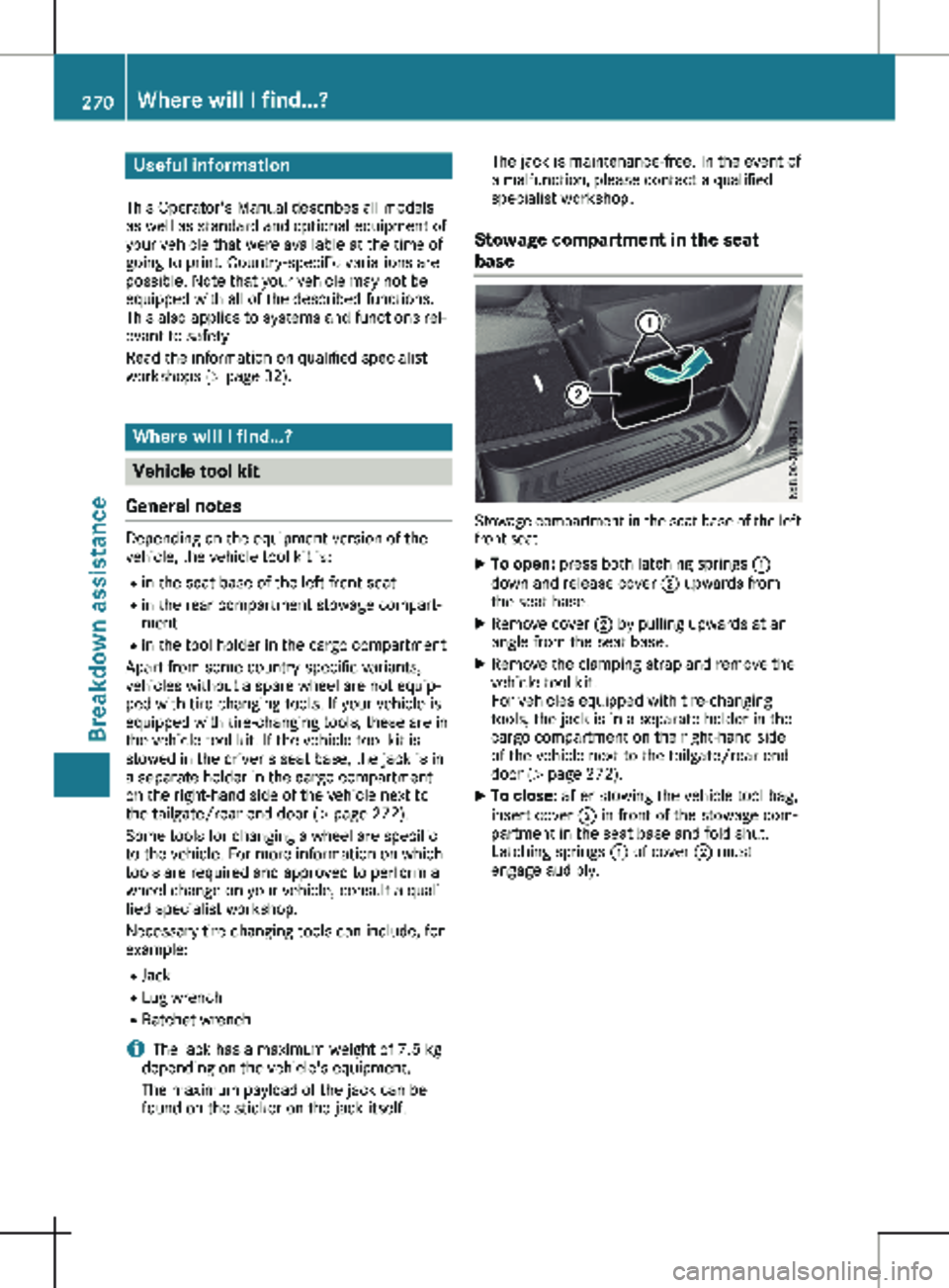
Stowage compartment in the seat
base Stowage compartment in the seat base of the left
front seat
X To open: press both latching springs :
down and release cover ; upwards from
the seat base.
X Remove cover ; by pulling upwards at an
angle from the seat base.
X Remove the clamping strap and remove the
vehicle tool kit.
For vehicles equipped with tire-changing
tools, the jack is in a separate holder in the
cargo compartment on the right-hand side
of the vehicle next to the tailgate/rear-end
door (Y page
272).
X To close: after stowing the vehicle tool bag,
insert cover ; in front of the stowage com-
partment in the seat base and fold shut.
Latching springs : of cover ; must
engage audibly. 270
Where will I find...?
Breakdown assistance
Page 288 of 320

For further information on displaying the cur-
rent tire pressures, refer to "Checking the tire
pressure electronically"
(Y page 287).
Important safety notes G
WARNING
Risk of accident due to incorrect tire
pressure
Each tire, including the spare (if provided),
should be checked monthly when cold and
inflated to the inflation pressure recommen-
ded by the vehicle manufacturer on the vehi-
cle placard or tire inflation pressure label. (If
your vehicle has tires of a different size than
the size indicated on the vehicle placard or
the tire inflation pressure label, you should
determine the proper tire inflation pressure
for those tires.)
As an added safety feature, your vehicle has
been equipped with a tire pressure monitor-
ing system (TPMS) that illuminates a low tire
pressure telltale when one or more of your
tires is significantly under-inflated. Accord-
ingly, when the low tire pressure telltale illu-
minates, you should stop and check your
tires as soon as possible, and inflate them to
the proper pressure. Driving on a signifi-
cantly under-inflated tire causes the tire to
overheat and can lead to tire failure. Under-
inflation also reduces fuel efficiency and tire
tread life, and may affect the vehicle's han-
dling and stopping ability.
Please note that the TPMS is not a substi-
tute for proper tire maintenance, and it is
the driver's responsibility to maintain cor-
rect tire pressure, even if under-inflation has
not reached the level to trigger illumination
of the TPMS low tire pressure telltale.
Your vehicle has also been equipped with a
TPMS malfunction indicator to indicate
when the system is not operating properly.
The TPMS malfunction indicator is combined
with the low tire pressure telltale. When the
system detects a malfunction, the telltale
will flash for approximately one minute and
then remain continuously illuminated. This sequence will continue upon subsequent
vehicle start-ups as long as the malfunction
exists.
When the malfunction indicator is illumina-
ted, the system may not be able to detect or
signal low tire pressure as intended. TPMS
malfunctions may occur for a variety of rea-
sons, including the installation of replace-
ment or alternate tires or wheels on the
vehicle that prevent the TPMS from func-
tioning properly.
Always check the TPMS malfunction telltale
after replacing one or more tires or wheels
on your vehicle to ensure that the replace-
ment or alternate tires and wheels allow the
TPMS to continue to function properly.
It is the driver's responsibility to set the tire
pressure to the recommended cold tire pres-
sure suitable for the operating conditions
(Y page
282).
Note that the correct tire pressure for the cur-
rent operating conditions must first be pro-
gramed into the tire pressure monitor. If a sub-
stantial pressure loss occurs, the warning
threshold for the warning message is aligned
to the taught-in reference values. Restart the
tire pressure monitor after adjusting the cold
tire pressure ( Y page 288). The current pres-
sures are saved as new reference values. This
will ensure that a warning message will only
appear if the tire pressure drops significantly.
The tire pressure monitor does not warn you if
a tire pressure is incorrect. Observe the notes
on the recommended tire pressure
(Y page 282).
The tire pressure monitor is not able to warn
you of a sudden loss of pressure, e.g. following
penetration by a foreign object. In this event,
brake the vehicle until it comes to a standstill.
Avoid sudden steering movements.
The tire pressure monitor has a yellow h
warning lamp in the instrument cluster for indi-
cating pressure loss/malfunctions (USA) or
pressure loss (Canada). Depending on how the
warning lamp flashes or lights up, an underin-
flated tire or a malfunction in the tire pressure
monitor is displayed:
R if the h warning lamp is lit continuously,
the tire pressure on one or more tires is sig- 286
Tire pressure
Wheels and tires
Page 309 of 320

!
Filter the fuel before transferring it to the
vehicle if you are refueling the vehicle from
barrels or containers.
This will prevent malfunctions in the fuel
system due to contaminated fuel.
i E10 fuel contains an admixture of up to
10% bioethanol. Your vehicle is E10 compat-
ible. You can refuel your vehicle with E10
fuel.
i You can obtain information on fuel grades
at a qualified specialist workshop or at a gas
station. If there is no identification on the
filling pump, consult a gas station attendant.
For more information about refueling
(Y page
136).
Fuel additives
! Operating the engine with subsequently
added fuel additives can cause engine dam-
age. Do not mix fuel additives with fuel. This
does not include additives for the removal
and prevention of deposits. Gasoline can
only be mixed with additives recommended
by Mercedes-Benz. Follow the instructions
in the product description. You can find fur-
ther information on recommended additives
in any Mercedes-Benz Commercial Van Cen-
ter.
Mercedes-Benz recommends using brand-
name fuels with additives.
If you use fuels without these additives for a
long period of time, deposits can form. This
primarily forms on the inlet valve and in the
combustion chamber.
In some countries, the available fuel grade
may be inadequate. Residue could build up in
the fuel injection system as a result. In this
case, in consultation with a Mercedes-Benz
Commercial Van Center, the fuel should be
mixed with the cleaning additive recommen-
ded by Mercedes-Benz. You must observe the
notes and mixing ratios indicated on the con-
tainer.
Do not add other fuel additives to the fuel.
This results in unnecessary costs and can
damage the engine. Information on fuel consumption H
Environmental note
CO 2 (carbon dioxide) is the gas that accord-
ing to the current state of knowledge is
mainly responsible for the heating of the
earth's atmosphere (greenhouse effect). The
CO 2 emissions of your vehicle vary in direct
correspondence with the fuel consumption
and is therefore dependent on:
R the efficient utilization of the fuel by the
engine
R the respective style of driving
R other non-technical factors, such as envi-
ronmental influences, condition of the
road or traffic flow, for example
You can help to minimize CO 2 emissions
with a conservative driving style and regular
maintenance of your vehicle .
Only for certain countries: the respective cur-
rent consumption and emission values of your
vehicle can be found in the COC papers (EC
CERTIFICATE OF CONFORMITY). These docu-
ments are supplied when the vehicle is deliv-
ered.
Consumption figures were found in the cur-
rently valid respective version: R for vehicles with exhaust gas standard Euro
6 as per directive (EC) no. 715/2007
R for vehicles with exhaust gas standard
EURO VI as per directive (EC) no. 595/2009
Fuel consumption depends on:
R the vehicle version
R the style of driving
R the operating conditions
R the fuel type and fuel grade used
The vehicle will use more fuel than usual in the
following situations:
R at very low outside temperatures
R in city traffic
R during short journeys
R on mountainous terrain
R when towing a trailer
Observe the advice in the "Protection of the
environment" section to keep fuel consump-
tion low
(Y page 29). Service products and capacities
307
Technical data Z
Page 311 of 320

Capacities
!
Do not add too much oil. adding too much
engine oil can result in damage to the
engine or to the catalytic converter. Have
excess engine oil siphoned off.
Oil change including oil filter Engine oil
Approx. 2 US gal
(7.75 l )Additives
!
Do not use any additives in the engine oil.
This could damage the engine.
Engine oil viscosity !
If the SAE class of the engine oil used does
not cover the outside temperature range in
which your vehicle is traveling, you must
change the engine oil in good time, in partic-
ular before the cold season commences.
Using an engine oil that does not have ade-
quate temperature characteristics can lead
to engine damage.
The temperature range information of the
SAE classification always refers to that of
fresh oil. The temperature characteristics of
the engine oil may deteriorate significantly
as a result of aging during vehicle operation,
especially at low outside temperatures.
Therefore, have the engine oil changed
before the cold season commences. Use an
approved engine oil of the specified SAE
class. Engine oil SAE classification
Viscosity indicates the flow characteristics of a
fluid. If an engine oil has a high viscosity, this
means that it is thick; a low viscosity means
that it is thin. Depending on the respective outside tempera-
tures, select an engine oil according to SAE
classification (viscosity). The viscosity class of
the engine oil can have an influence on the
fuel consumption. The table displays the SAE
classification to be used. The low temperature
characteristics of engine oils can noticeably
deteriorate during operation, e.g. from aging,
soot and fuel accretion. For this reason, regu-
lar oil changes using an approved engine oil
from the suitable SAE classification are
urgently recommended.
Oil change Oil change intervals depend on the vehicle's
operating conditions and the quality of the
engine oil used. The on-board computer auto-
matically shows the date for the next oil
change as an event message in the display.
Mercedes-Benz recommends having the oil
changed at a qualified specialist workshop.
Information about oil consumption Depending on the driving style, the vehicle
consumes a maximum of 1.0 US qt
(1.0 l) of
engine oil over a distance of 620 miles
(1,000 km).
Oil consumption may be higher if:
R The vehicle is new.
R You mainly operate the vehicle under ardu-
ous operating conditions.
R You frequently drive at high engine speeds.
Regular maintenance is one of the precondi-
tions for moderate rates of consumption.
You can only estimate the oil consumption
after you have driven a considerable distance.
Check the engine oil level on a regular basis,
e.g. weekly or each time you refuel
( Y page 252). Service products and capacities
309
Technical data Z
Page 312 of 320

Transmission oil
Automatic transmission Operating fluid: automatic transmission
fluid Product name/number Maintenance
interval Mobil ATF 134 FE
Valvoline ATF Pro 236.15
MB Sheet No. 236.15 —
More information can be obtained at any quali-
fied specialist workshop.
Rear axle Operating fluid: transmission oil
Product name/number Maintenance
interval Mobilube FE 75W-85
Mobilube FE Plus NG
75W-85
MB Sheet No. 235.7 —
More information can be obtained at any quali-
fied specialist workshop.
Brake fluid
G
WARNING
The brake fluid constantly absorbs moisture
from the air. This lowers the boiling point of
the brake fluid. If the boiling point of the
brake fluid is too low, vapor pockets may
form in the brake system when the brakes
are applied hard. This would impair braking
efficiency. There is a risk of an accident.
You should have the brake fluid renewed at
the specified intervals.
! Brake fluid corrodes paint, plastic and rub-
ber. If paint, plastic or rubber has come into
contact with brake fluid, rinse with water
immediately.
When handling, storing and disposing of brake
fluid, please observe the relevant regulations and the important safety notes for service
products (Y page
305).
Over a period of time, the brake fluid absorbs
moisture from the air. This reduces its boiling
point.
Have the brake fluid replaced at specified
intervals by a qualified specialist workshop.
i There is usually a notice in the engine
compartment to remind you when the next
brake fluid change is due.
Use only approved brake fluids that comply
with the Mercedes-Benz Specifications for Ser-
vice Products. Always check for the identifica-
tion DOT 4 plus.
Information about approved brake fluids can
be obtained:
R on the Internet at
http://bevo.mercedes-benz.com. Coolant
Important safety notes G
WARNING
If antifreeze comes into contact with hot
components in the engine compartment, it
may ignite. There is a risk of fire and injury.
Let the engine cool down before you add
antifreeze. Make sure that antifreeze is not
spilled next to the filler neck. Thoroughly
clean the antifreeze from components
before starting the engine.
! Take care not to spill any coolant on pain-
ted surfaces. You could otherwise damage
the paintwork.
When handling, storing and disposing of cool-
ant and antifreeze, please observe the relevant
regulations and the important safety notes for
operating fluids
(Y page 305).
Coolant additive with corrosion and
antifreeze protection !
Use only approved antifreeze/corrosion
inhibitor that complies with MB Specifica-
tion for Service Products, Sheet Number
325. Using other, non-approved antifreeze/
corrosion inhibitors may cause damage to 310
Service products and capacities
Technical data