Page 337 of 637
5-20
Driving your vehicle
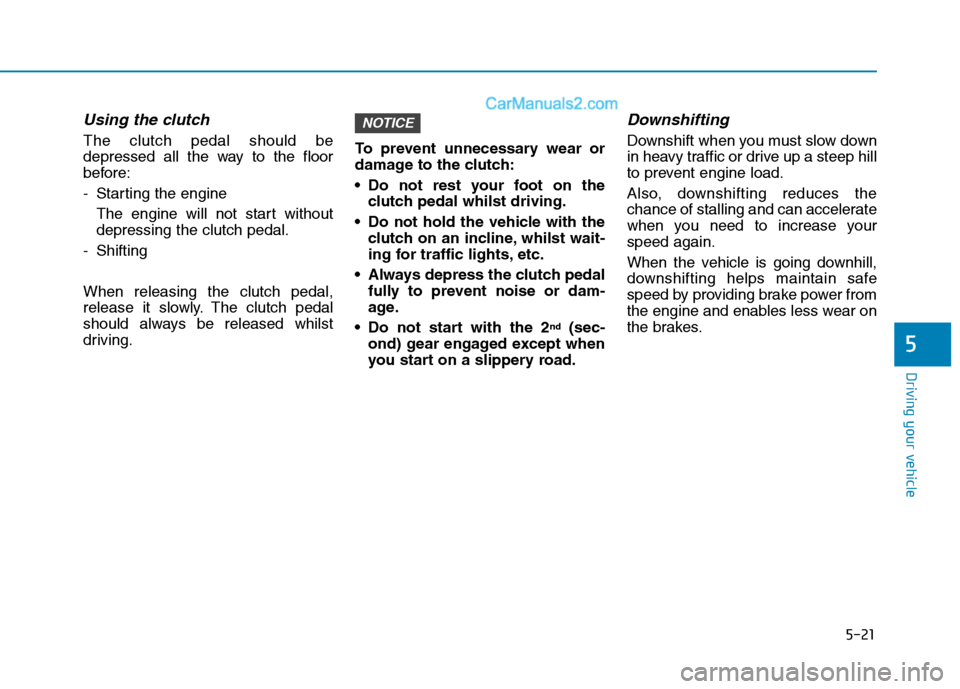
Manual transmission opera-
tion
The manual transmission has 6 for-
ward gears. The transmission is fully
synchronized in all forward gears so
shifting to either a higher or a lower
gear is easily accomplished.To shift to R (Reverse), make sure
the vehicle has completely stopped,
and then move the shift lever to neu-
tral before moving into R (Reverse).
When you've come to a complete
stop and it's hard to shift into 1
stgear
or R (Reverse):
1. Put the shift lever in neutral and
release the clutch pedal.
2. Depress the clutch pedal, and
then shift into first or R (Reverse)
gear.
Information
During cold weather, shifting may be
difficult until the transmission lubri-
cant has warmed up.
i
M MA
AN
NU
UA
AL
L
T
TR
RA
AN
NS
SM
MI
IS
SS
SI
IO
ON
N
(
(I
IF
F
E
EQ
QU
UI
IP
PP
PE
ED
D)
)
Before leaving the driver’s seat,
always make sure the shift lever
is in 1
stgear when the vehicle is
parked uphill and in R
(Reverse) downhill, set the park-
ing brake, and place the ignition
switch in the LOCK/OFF posi-
tion. Unexpected vehicle move-
ment may occur if these precau-
tions are not followed.
WARNING
OTLE058005
The shift lever can be moved without
pressing the button (1).
The button (1) must be pressed
whilst moving the shift lever.
Page 338 of 637
5-21
Driving your vehicle
5
Using the clutch
The clutch pedal should be
depressed all the way to the floor
before:
- Starting the engine
The engine will not start without
depressing the clutch pedal.
- Shifting
When releasing the clutch pedal,
release it slowly. The clutch pedal
should always be released whilst
driving.To prevent unnecessary wear or
damage to the clutch:
Do not rest your foot on the
clutch pedal whilst driving.
Do not hold the vehicle with the
clutch on an incline, whilst wait-
ing for traffic lights, etc.
Always depress the clutch pedal
fully to prevent noise or dam-
age.
Do not start with the 2
nd(sec-
ond) gear engaged except when
you start on a slippery road.
Downshifting
Downshift when you must slow down
in heavy traffic or drive up a steep hill
to prevent engine load.
Also, downshifting reduces the
chance of stalling and can accelerate
when you need to increase your
speed again.
When the vehicle is going downhill,
downshifting helps maintain safe
speed by providing brake power from
the engine and enables less wear on
the brakes.
NOTICE
Page 339 of 637
5-22
Driving your vehicle
To prevent damage to the engine,
clutch and transmission:
When downshifting from 5th
gear to 4th gear, be careful not
to inadvertently push the shift
lever sideways engaging 2nd
gear. The drastic downshift may
cause the engine speed to
increase to the point that the
tachometer will enter the red-
zone.
Do not downshift more than two
gears at a time or downshift the
gears when the engine is run-
ning at high speed (5,000 RPM
or higher). Such downshifting
may damage the engine, clutch
and the transmission.
Good driving practices
Never take the vehicle out of gear
and coast down a hill. This is
extremely dangerous.
Don't "ride" the brakes. This can
cause the brakes and related parts
to overheat and malfunction.
When you are driving down a long
hill, slow down and shift to a lower
gear. Engine braking will help slow
down the vehicle.
Slow down before shifting to a
lower gear. This will help avoid
over-revving the engine, which can
cause damage.
Slow down when you encounter
cross winds. This gives you much
better control of your vehicle.
Be sure the vehicle is completely
stopped before you shift into R
(Reverse) to prevent damage to
the transmission. Exercise extreme caution when
driving on a slippery surface. Be
especially careful when braking,
accelerating or shifting gears. On a
slippery surface, an abrupt change
in vehicle speed can cause the
drive wheels to lose traction and
may cause loss of vehicle control
resulting in an accident.
NOTICE
Do not use the engine brake
(shifting from a higher gear to
lower gear) rapidly on slippery
roads. The vehicle may slip
causing an accident.
WARNING
Page 348 of 637
5-31
Driving your vehicle
Dual clutch transmission oper-
ation
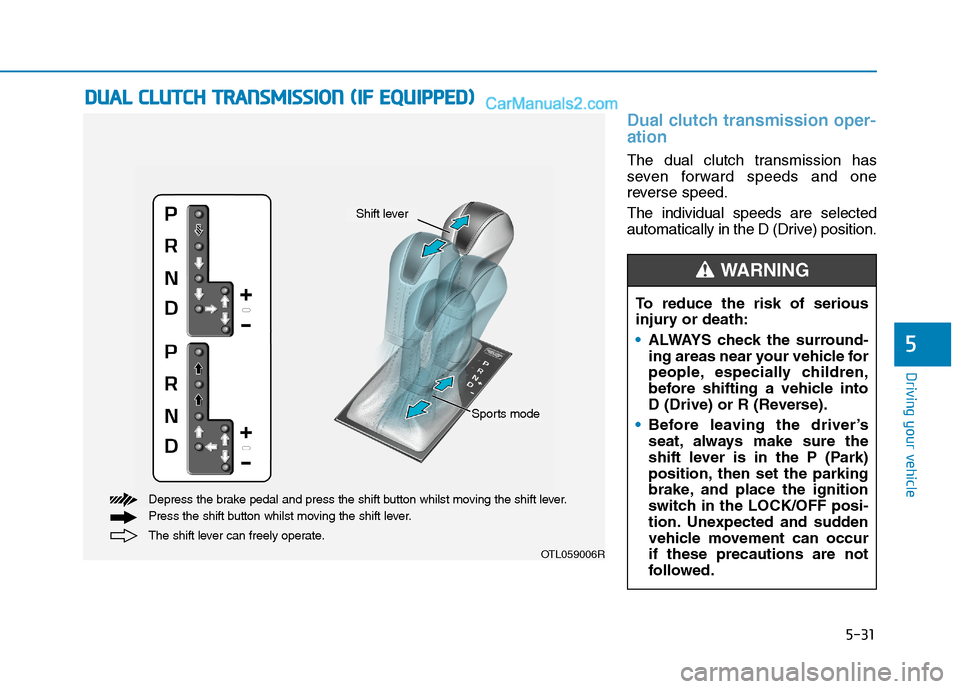
The dual clutch transmission has
seven forward speeds and one
reverse speed.
The individual speeds are selected
automatically in the D (Drive) position.
D DU
UA
AL
L
C
CL
LU
UT
TC
CH
H
T
TR
RA
AN
NS
SM
MI
IS
SS
SI
IO
ON
N
(
(I
IF
F
E
EQ
QU
UI
IP
PP
PE
ED
D)
)
5
OTL059006R
The shift lever can freely operate. Depress the brake pedal and press the shift button whilst moving the shift lever.
Press the shift button whilst moving the shift lever.
Shift lever
To reduce the risk of serious
injury or death:
ALWAYS check the surround-
ing areas near your vehicle for
people, especially children,
before shifting a vehicle into
D (Drive) or R (Reverse).
Before leaving the driver’s
seat, always make sure the
shift lever is in the P (Park)
position, then set the parking
brake, and place the ignition
switch in the LOCK/OFF posi-
tion. Unexpected and sudden
vehicle movement can occur
if these precautions are not
followed.
WARNING
Sports mode
Page 349 of 637
5-32
The indicator in the instrument clus-
ter displays the shift lever position
when the ignition switch is in the ON
position.
The dual clutch transmission gives
the driving feel of a manual trans-
mission, yet provides the ease of a
fully automatic transmission. Unlike
a traditional automatic transmis-
sion, the gear shifting can be felt
(and heard) on the dual clutch
transmission
- Think of it as an automatically
shifting manual transmission.
- Shift into Drive range and get fully
automatic shifting, similar to a
conventional automatic transmis-
sion.
Dual clutch transmission adopts a
dry-type dual clutch, which is dif-
ferent from torque converter of
automatic transmission, and
shows better acceleration perform-
ance during driving. But, initial
launch might be little bit slower
than Automatic Transmission. Gear shifts are sometimes more
noticeable than a conventional
automatic transmission and a light
vibration during launching can be
felt as the transmission speed is
matched with the engine speed.
This is a normal condition of the
dual clutch transmission.
The dry-type clutch transfers
torque and provides a direct driv-
ing feeling which may feel different
from a conventional automatic
transmission with a torque convert-
er. This may be more noticeable
when starting from a stop or low
vehicle speed.
When rapidly accelerating at low
vehicle speed, the engine could
rev at high rpm depending on vehi-
cle drive condition.
For smooth launch uphill, press
down the accelerator pedal
smoothly depending on the current
conditions.
If you release your foot from the
accelerator pedal at low vehicle
speed, you may feel strong engine
brake, which is similar to manual
transmission.
Driving your vehicle
Do not use the engine brake
(shifting from a high gear to
lower gear) rapidly on slip-
pery roads. The vehicle may
slip causing an accident.
To avoid damage to your
transmission, do not try to
accelerate in R (Reverse) or
any forward gear position with
the brakes on.
When stopped on slope, do
not hold the vehicle with
accelerator pedal. Use the
service brake or the parking
brake.
Page 350 of 637
5-33
Driving your vehicle
When driving downhill, you may
use Sports Mode and press the
paddle shifters to downshift to a
lower gear in order to control your
speed without using the brake
pedal excessively.
When you turn the engine on and
off, you may hear clicking sounds
as the system goes through a self
test. This is a normal sound for the
Dual clutch transmission.LCD display for transmission
temperature and warning mes-
sage
Transmission temperature
gauge
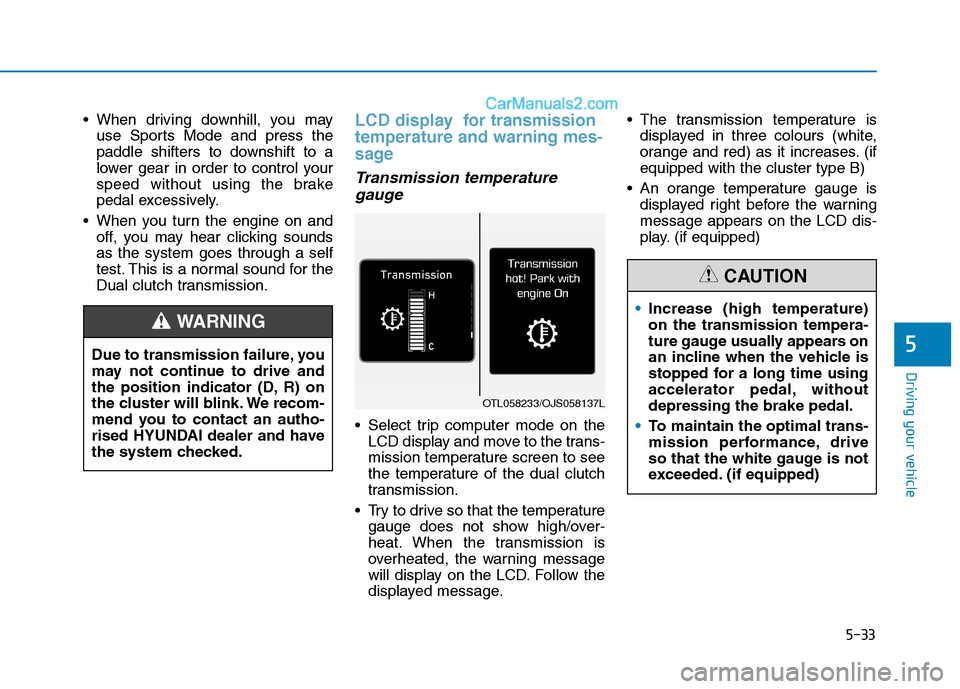
Select trip computer mode on the
LCD display and move to the trans-
mission temperature screen to see
the temperature of the dual clutch
transmission.
Try to drive so that the temperature
gauge does not show high/over-
heat. When the transmission is
overheated, the warning message
will display on the LCD. Follow the
displayed message. The transmission temperature is
displayed in three colours (white,
orange and red) as it increases. (if
equipped with the cluster type B)
An orange temperature gauge is
displayed right before the warning
message appears on the LCD dis-
play. (if equipped)
5Due to transmission failure, you
may not continue to drive and
the position indicator (D, R) on
the cluster will blink. We recom-
mend you to contact an autho-
rised HYUNDAI dealer and have
the system checked.
WARNING Increase (high temperature)
on the transmission tempera-
ture gauge usually appears on
an incline when the vehicle is
stopped for a long time using
accelerator pedal, without
depressing the brake pedal.
To maintain the optimal trans-
mission performance, drive
so that the white gauge is not
exceeded. (if equipped)
CAUTION
OTL058233/OJS058137L
Page 351 of 637
5-34
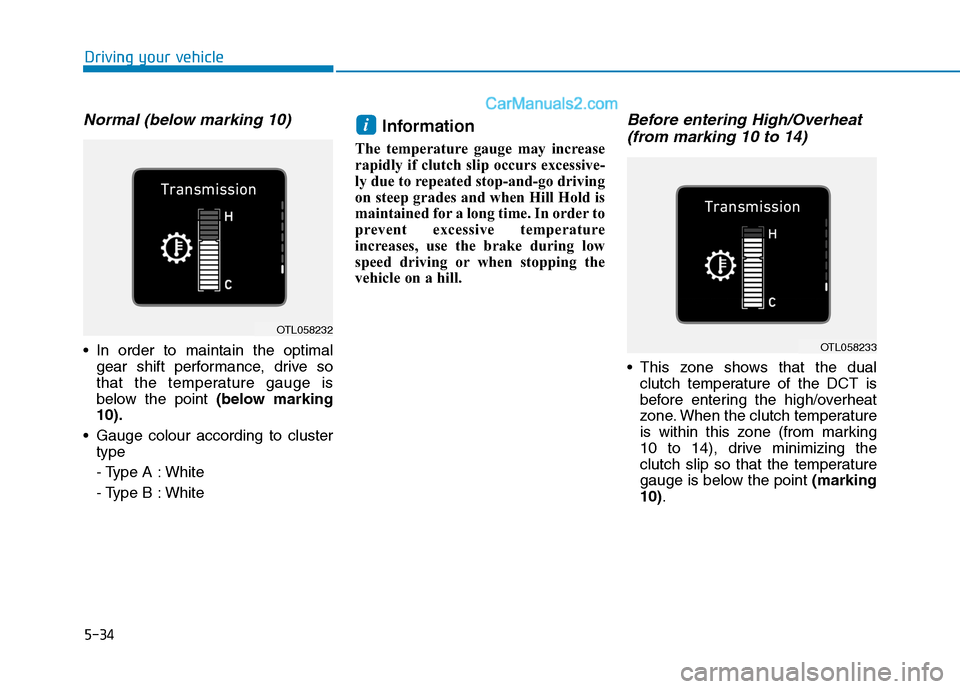
Normal (below marking 10)
In order to maintain the optimal
gear shift performance, drive so
that the temperature gauge is
below the point (below marking
10).
Gauge colour according to cluster
type
- Type A : White
- Type B : White
Information
The temperature gauge may increase
rapidly if clutch slip occurs excessive-
ly due to repeated stop-and-go driving
on steep grades and when Hill Hold is
maintained for a long time. In order to
prevent excessive temperature
increases, use the brake during low
speed driving or when stopping the
vehicle on a hill.
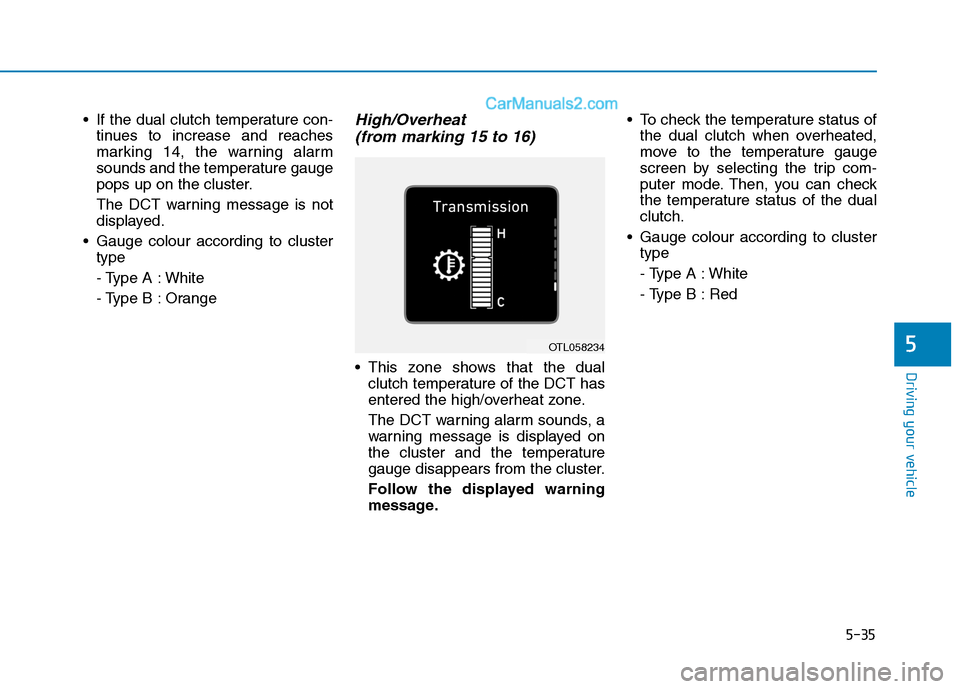
Before entering High/Overheat
(from marking 10 to 14)
This zone shows that the dual
clutch temperature of the DCT is
before entering the high/overheat
zone. When the clutch temperature
is within this zone (from marking
10 to 14), drive minimizing the
clutch slip so that the temperature
gauge is below the point (marking
10).
i
Driving your vehicle
OTL058232
OTL058233
Page 352 of 637
5-35
Driving your vehicle
If the dual clutch temperature con-
tinues to increase and reaches
marking 14, the warning alarm
sounds and the temperature gauge
pops up on the cluster.
The DCT warning message is not
displayed.
Gauge colour according to cluster
type
- Type A : White
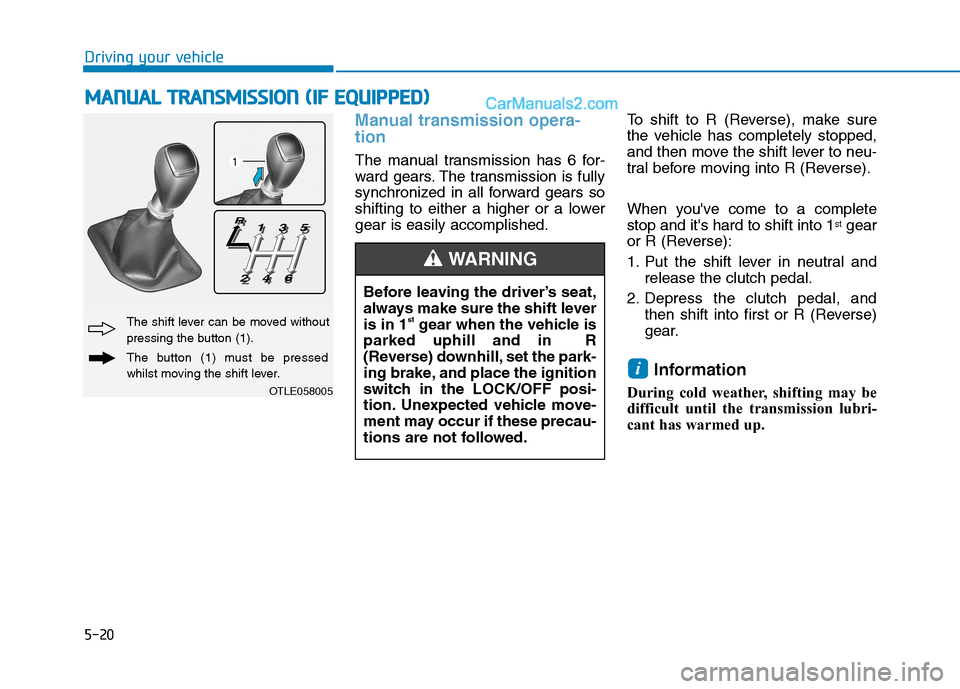
- Type B : OrangeHigh/Overheat
(from marking 15 to 16)
This zone shows that the dual
clutch temperature of the DCT has
entered the high/overheat zone.
The DCT warning alarm sounds, a
warning message is displayed on
the cluster and the temperature
gauge disappears from the cluster.
Follow the displayed warning
message. To check the temperature status of
the dual clutch when overheated,
move to the temperature gauge
screen by selecting the trip com-
puter mode. Then, you can check
the temperature status of the dual
clutch.
Gauge colour according to cluster
type
- Type A : White
- Type B : Red
5OTL058234