2019 VOLVO XC90 TWIN ENGINE warning
[x] Cancel search: warningPage 77 of 697

SAFETY
75
To access the anchors
1. Put the child restraint in position.
2. Kneel on the child restraint to press downthe seat cushion and locate the anchors by
feel.
3. Fasten the attachment on the child restraint's lower straps to the ISOFIX/LATCH
lower anchors.
4. Firmly tension the lower child seat straps according to the manufacturer's instructions.
WARNING Volvo's ISOFIX/LATCH anchors conform to
FMVSS/CMVSS standards. Always refer to
the child restraint system's manual for weight
and size ratings.
NOTE
The rear center seat is not equipped with
ISOFIX/LATCH lower tether anchors. If a
child restraint is used in this seat, attach
the restraint's upper anchor strap (if
equipped with these) to the top tether
anchor point for this strap and secure the
child restraint with the vehicle's center
seat belt.
Always follow your child seat manufactur-
er's installation instructions, and use both
ISOFIX/LATCH lower anchors and top
tethers whenever possible. Fasten the attachment correctly to the ISOFIX/LATCH
lower anchors.WARNING
Be sure to fasten the attachment cor-
rectly to the anchor (see the illustration).
If the attachment is not correctly fas-
tened, the child restraint may not be
properly secured in the event of a colli-
sion.
The ISOFIX/LATCH lower child restraint
anchors are only intended for use with
child seats positioned in the outboard
seating positions. These anchors are not
certified for use with any child restraint
that is positioned in the center seating
position. When securing a child restraint
in the center seating position, use only
the vehicle's center seat belt.
Related information
Child restraints (p. 65)
Top tether anchors (p. 72)
ISOFIX/LATCH lower anchors (p. 74)
Page 78 of 697

SAFETY
* Option/accessory.
76 Integrated booster cushion*
1
The integrated booster cushion in the second
row center seating position helps ensure that a
child can sit comfortably and safely.
The integrated booster cushion has been spe-
cially designed to help safeguard children in the
rear seat when used with the vehicle's seat belts.
If using a booster cushion does not result in
proper positioning of the shoulder strap, then the
child should be placed in a properly secured child
restraint. The shoulder belt must never be placed
behind the child's back or under the arm.
Only used for children in the weight range
15-36 kg (33-80 lbs) and height range
97-137 cm (38-54 inches).
In Canada: 18 kg (40 lbs) is the minimum
weight requirement for a child using booster
cushions according to the Canadian regulation
CMVSS 213.4 Correct seating position: the seat belt is positioned
across the collarbone.
Before driving, make sure that:
the booster cushion is locked into position
the head restraint is set to the same height
as the child's head, so that, if possible, the
entire back of the child's head is covered
the seat belt is taut, in contact with the
child's body and not twisted
the seat belt is not positioned across the
child's throat or below the shoulder
the lap section of the seat belt is placed low
over the child's hips to provide the best pro-
tection.
WARNING DEATH or SERIOUS INJURY can
occur
Follow all instructions on this
child restraint and in the vehicle's
owner's manual.
Make sure the booster cushion is
securely locked before the child
is seated.
Only use for children who weigh between
15-36 kg (33-80 lbs) and who are
between 97-137 cm (38-54 tum) in
height. In Canada: 18 kg (40 lbs) is the
minimum weight requirement for a child
using booster cushions according to the
Canadian regulation CMVSS 213.4
Use only the vehicle's lap and shoulder
belt system when restraining the child in
this booster cushion.
In the event of a collision while the inte-
grated booster cushion was occupied, the
entire booster cushion and seat belt must
be replaced. The booster cushion should
also be replaced if it is badly worn or
damaged in any way. This work should be
performed by a trained and qualified
Volvo service technician only. 1
Canada only: This cushion may be referred to as a built-in booster cushi\
on.
Page 80 of 697

||SAFETY
* Option/accessory.
78
WARNING DEATH or SERIOUS INJURY can
occur
Follow all instructions on this
child restraint and in the vehicle's
owner's manual.
Make sure the booster cushion is
securely locked before the child
is seated.
Only use for children who weigh between
15-36 kg (33-80 lbs) and who are
between 97-137 cm (38-54 tum) in
height. In Canada: 18 kg (40 lbs) is the
minimum weight requirement for a child
using booster cushions according to the
Canadian regulation CMVSS 213.4
Use only the vehicle's lap and shoulder
belt system when restraining the child in
this booster cushion.
In the event of a collision while the inte-
grated booster cushion was occupied, the
entire booster cushion and seat belt must
be replaced. The booster cushion should
also be replaced if it is badly worn or
damaged in any way. This work should be
performed by a trained and qualified
Volvo service technician only.Related information
Integrated booster cushion* (p. 76)
Folding down the integrated booster cush-
ion* (p. 78) Folding down the integrated
booster cushion*
When the integrated booster cushion in the rear
seat is not in use, it should be stowed (folded
down). Pull the handle forward to release the
booster cushion.
Page 81 of 697

SAFETY
* Option/accessory.79Press down on the center of the booster
cushion to lock it into position.
CAUTION
Make sure that there are no objects (e.g. toys)
on the seat under the integrated booster
cushion before folding it down.
NOTE
The integrated booster cushion must be
stowed (folded down) before folding down
the seat backrest.
WARNING DEATH or SERIOUS INJURY can
occur
Follow all instructions on this
child restraint and in the vehicle's
owner's manual.
Make sure the booster cushion is
securely locked before the child
is seated.
Only use for children who weigh between
15-36 kg (33-80 lbs) and who are
between 97-137 cm (38-54 tum) in
height. In Canada: 18 kg (40 lbs) is the
minimum weight requirement for a child
using booster cushions according to the
Canadian regulation CMVSS 213.4
Use only the vehicle's lap and shoulder
belt system when restraining the child in
this booster cushion.
In the event of a collision while the inte-
grated booster cushion was occupied, the
entire booster cushion and seat belt must
be replaced. The booster cushion should
also be replaced if it is badly worn or
damaged in any way. This work should be
performed by a trained and qualified
Volvo service technician only.Related information
Integrated booster cushion* (p. 76)
Folding up the integrated booster cushion*
(p. 77)
Page 84 of 697

DISPLAYS AND VOICE CONTROL
* Option/accessory.
82 Instruments and controls in left-
hand drive vehicles
The overviews show the location of the vehicle's
displays and controls.
Steering wheel and dashboard Parking lights, daytime running lights, low
beams, high beams, turn signals, rear fog
light, trip computer reset
Steering wheel paddles for manual shifting*
Head-up display*
Instrument panel
Wipers and washers, rain sensor*
Right-side steering wheel keypad
Steering wheel adjustment Horn
Left-side steering wheel keypad
Hood open
Display lighting, tailgate unlock/open*/
close*, halogen headlight height adjustment
Ceiling console Front reading lights and courtesy lighting
Panoramic roof*
Ceiling console display ON CALL button
HomeLink
®
*
Center and tunnel console Center display
Hazard warning flashers, defrosting, media,
glove compartment open
Gear selector
Start knob
Drive modes
Parking brake
Auto-hold brakes
Driver's door
Page 86 of 697

DISPLAYS AND VOICE CONTROL
* Option/accessory.
84 Instrument panel
The instrument panel displays information rela-
ted to the vehicle and driving.
The instrument panel contains gauges, indicators
and monitoring and warning symbols. What is
shown in the instrument panel varies depending
on the equipment, settings and functions cur-
rently active.
The instrument panel is activated as soon as a
door is opened, i.e. in ignition mode 0. The panel
will power down after a short period of time if it is
not used. To reactivate it, do one of the following:
Depress the brake pedal.
Activate ignition mode I.
Open one of the doors.
WARNING If the instrument panel turns off, does not
activate when the ignition is switched on, or
part/all of the panel cannot be read, do not
drive the vehicle. Consult a workshop immedi-
ately. Volvo recommends an authorized Volvo
workshop.
WARNING
If the instrument panel is not functioning
properly, information about brakes, airbags or
other safety-related systems may not be dis-
played. The driver will then not be able to
check the status of the vehicle systems or
receive relevant warnings and information.
Location in the instrument panel:
Left side
In the centerRight side
Speedometer
Indicator and warning symbols Tachometer/Hybrid gaugeA
Trip odometer Ambient temperature sensorGear indicator
Odometer B
Clock Drive Mode
(Hybrid, Off Road, Pure, Power or AWD)
Cruise control/speed limiter information Message (also graphics in some cases) Fuel gauge
Road sign information* Door and seat belt status
Hybrid gauge
– Hybrid battery's charge levelDistance to empty tank
Page 87 of 697

DISPLAYS AND VOICE CONTROL
85Left side
In the centerRight side
– Media player
Distance to discharged battery
– Navigation system mapCurrent fuel consumption
– PhoneApp menu (activated using steering wheel keypad)
– Voice Control–
– CompassA
–A
Depends on selected drive mode.
B Total distance.
Dynamic symbolDynamic symbol in basic mode. In the center of the instrument panel is a dynamic
symbol that changes appearance according to
the type of message displayed. The severity of
the control or warning symbol is indicated by an
amber or red marking around the symbol. An ani-
mation may be used to change the symbol into a
larger image in order to graphically depict the
location of a problem or to clarify information.
Example with indicator symbol.
Related information
Instrument panel settings (p. 86)
Warning symbols in the instrument panel
(p. 97)
Indicator symbols in the instrument panel
(p. 94)
Trip computer (p. 89)
Messages in the instrument panel (p. 105)
Handling the App menu in the instrument
panel (p. 104)
Page 96 of 697
DISPLAYS AND VOICE CONTROL
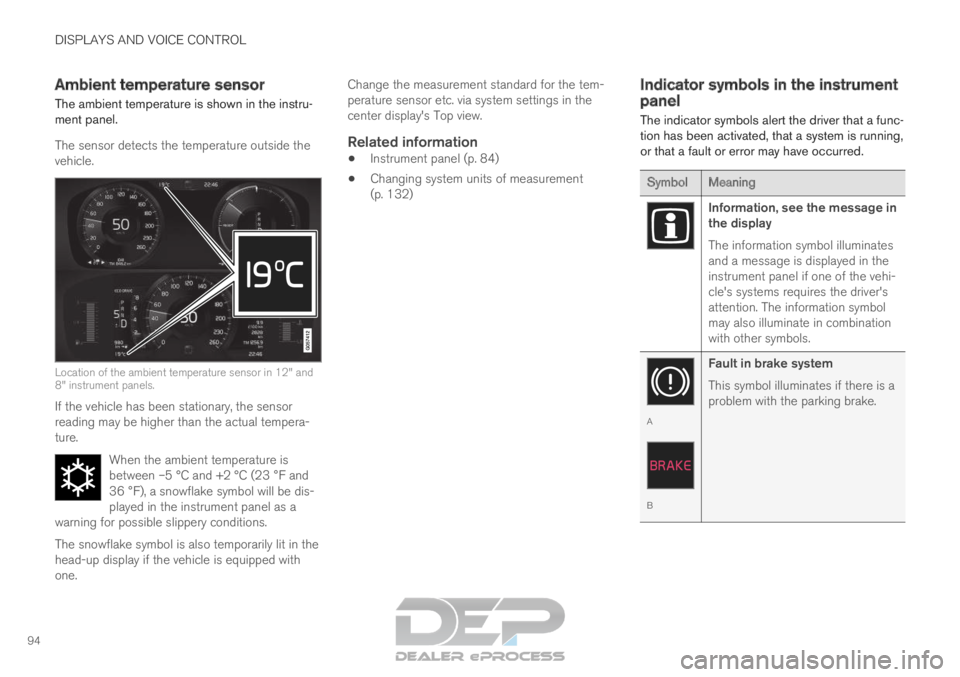
94Ambient temperature sensor
The ambient temperature is shown in the instru-
ment panel.
The sensor detects the temperature outside the
vehicle. Location of the ambient temperature sensor in 12" and
8" instrument panels.
If the vehicle has been stationary, the sensor
reading may be higher than the actual tempera-
ture.
When the ambient temperature is
between –5 °C and +2 °C (23 °F and
36 °F), a snowflake symbol will be dis-
played in the instrument panel as a
warning for possible slippery conditions. The snowflake symbol is also temporarily lit in the
head-up display if the vehicle is equipped with
one. Change the measurement standard for the tem-
perature sensor etc. via system settings in the
center display's Top view.
Related information
Instrument panel (p. 84)
Changing system units of measurement
(p. 132) Indicator symbols in the instrument
panel
The indicator symbols alert the driver that a func-
tion has been activated, that a system is running,
or that a fault or error may have occurred. Symbol
Meaning Information, see the message in
the display
The information symbol illuminates
and a message is displayed in the
instrument panel if one of the vehi-
cle's systems requires the driver's
attention. The information symbol
may also illuminate in combination
with other symbols.
A
B
Fault in brake system
This symbol illuminates if there is a
problem with the parking brake.