2019 VOLVO XC90 TWIN ENGINE light
[x] Cancel search: lightPage 581 of 697

WHEELS AND TIRES
}}
* Option/accessory. 579
1.
Clean the contact surfaces between the
wheel and the wheel hub.
2. Lift the wheel into place. Tighten the wheel bolts securely.
Do not grease the wheel bolt threads.
3. Lower the vehicle so that the wheel cannot rotate.
4. Tighten the wheel bolts in a crisscross pat- tern (as shown in illustration). It is important
that the wheel bolts are securely tightened.
Tighten to a torque of 140 Nm (103 ft.lbs.).
Use a torque wrench to check torque. 5. Press the plastic covers onto the wheel bolts.
WARNING The wheel bolts may need to be tightened
again several days after a wheel change.
Temperature fluctuations and vibrations can
cause them to loosen slightly.
NOTE
After inflating a tire, always replace the
valve cap to help prevent valve damage
caused by gravel, dirt, etc.
Use plastic valve caps only. Metal caps
could corrode and become difficult to
remove.
Related information
Leveling control settings* (p. 464)
When changing wheels (p. 574)
Hoisting the vehicle (p. 618)
Jack* (p. 575)
Tool kit (p. 574)
Removing a wheel (p. 576) Spare wheel
15
The spare wheel is a Temporary Spare and can
be used to temporarily replace a punctured tire
on one of the vehicle's regular wheels.
The spare tire is only intended for temporary use.
Replace it with a normal wheel as soon as possi-
ble.
The driving characteristics of the vehicle change
and ground clearance reduces when the spare
wheel is used. Do not wash the vehicle in an
automatic car wash while using the Temporary
Spare.
The recommended tire pressure must be main-
tained regardless of at which position the tempo-
rary spare wheel is used on the vehicle.
If the spare wheel is damaged, a new one can be
purchased from a Volvo retailer.
WARNING Current legislation prohibits the use of the
"Temporary Spare" tire other than as a tem-
porary replacement for a punctured tire. It
must be replaced as soon as possible by a
standard tire. Road holding and handling may
be affected with the "Temporary Spare" in
use. Do not drive faster than 80 km/h
(50 mph).
15
Not available on all models.
Page 596 of 697
LOADING, STORAGE AND PASSENGER COMPARTMENT
* Option/accessory.
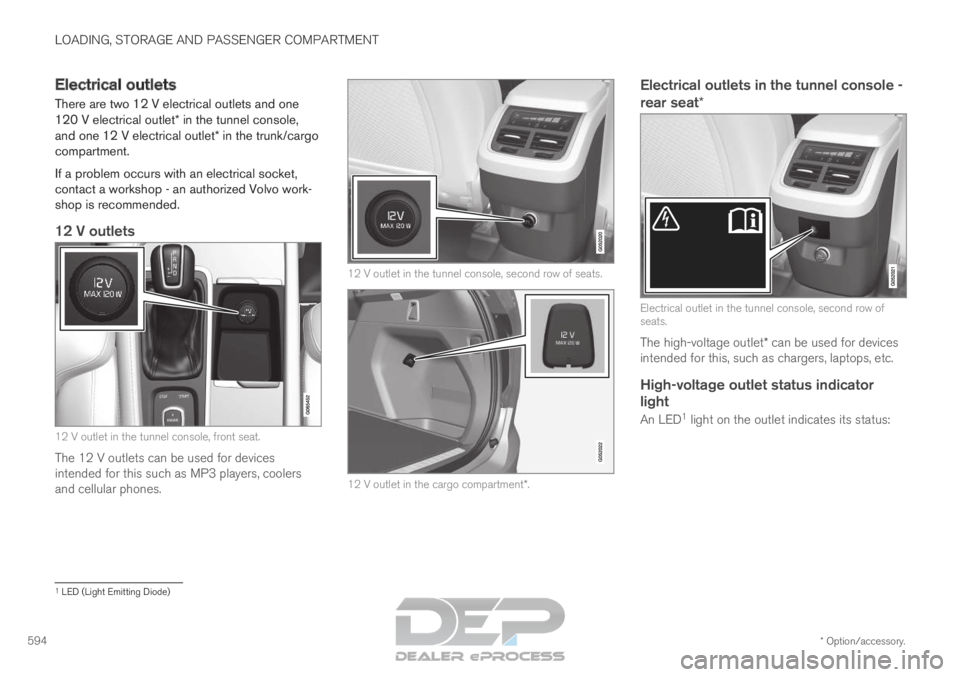
594 Electrical outlets
There are two 12 V electrical outlets and one
120 V electrical outlet* in the tunnel console,
and one 12 V electrical outlet* in the trunk/cargo
compartment.
If a problem occurs with an electrical socket,
contact a workshop - an authorized Volvo work-
shop is recommended.
12 V outlets 12 V outlet in the tunnel console, front seat.
The 12 V outlets can be used for devices
intended for this such as MP3 players, coolers
and cellular phones. 12 V outlet in the tunnel console, second row of seats.
12 V outlet in the cargo compartment*.
Electrical outlets in the tunnel console -
rear seat* Electrical outlet in the tunnel console, second row of
seats.
The high-voltage outlet* can be used for devices
intended for this, such as chargers, laptops, etc.
High-voltage outlet status indicator
light
An LED 1
light on the outlet indicates its status: 1
LED (Light Emitting Diode)
Page 597 of 697

LOADING, STORAGE AND PASSENGER COMPARTMENT
595Status indicator light
Cause Action
Steady green light
The outlet is providing electrical current to a connected device. None.
Flashing orange light The outlet's voltage converter is too hot (e.g. if the device draws \
too much cur- rent or if the temperature in the passenger compartment is very high). Unplug the device, let the voltage converter cool
down and plug in the device again.
The connected device is drawing too much current (at the moment or con-\
stantly) or is not functioning properly. None. The device cannot be used in the outlet.
Indicator light off The outlet has not detected a device plugged into the outlet. Make sure the device is correctly plugged into
the outlet.
The outlet is not active. Make sure the vehicle's ignition is in at least
mode I.
The outlet has been active but has been deactivated. Start the engine and/or charge the start battery.
Related information
Passenger compartment interior (p. 592)
Using the electrical outlets (p. 596)
Page 598 of 697

LOADING, STORAGE AND PASSENGER COMPARTMENT
* Option/accessory.
596 Using the electrical outlets
The 12 V outlet can be used for devices
intended for this such as MP3 players, coolers
and cellular phones.
The high-voltage outlet* can be used for devices
intended for this, such as chargers, laptops, etc.
The ignition must be in at least mode I for the
outlets to supply current. The outlets will then be
active as long as there is sufficient charge in the
start battery.
If the engine is turned off and the vehicle is
locked, the outlets will be deactivated. If the
engine is turned off and the vehicle remains
unlocked, the sockets will remain active for up to
7 minutes.
NOTE Bear in mind that using the electrical outlets
when the engine is off could cause the starter
battery to have too low of a charge level,
which could limit other functionality.
Accessories connected to the electrical out-
lets can be activated even when the vehicle
electrical system is off or if preconditioning is
used. For this reason, disconnect plugs when
they are not in use to prevent the starter bat-
tery from becoming discharged.
WARNING
Do not use accessories with large or
heavy plugs – they could damage the out-
let or come loose while you are driving.
Do not use accessories that could cause
disruptions to e.g. the vehicle's radio
receiver or electrical system.
Position the accessory so that there is no
risk of it injuring the driver or passengers
in the event of heavy braking or a colli-
sion.
Pay attention to connected accessories
as they can generate heat that could burn
passengers or the interior.
Using 12 V outlets1. Remove the stopper (tunnel console) or fold
down the cover (trunk/cargo compartment)
over the socket and plug in the device.
2. Unplug the device and put the stopper back in (tunnel console) or fold up the cover
(trunk/cargo compartment) when the socket
is not in use or left unattended.
CAUTION The maximum power is 120 W (10 A) per
outlet.
Using high-voltage outletsThe ignition must be in at least mode I for outlets
to supply current. The outlets will then be active
as long as there is sufficient charge in the start
battery.
1. Slide down the cover over the outlet and plug
in the device.
>
The LED 2
light on the outlet will indicate
its status.
2. The outlet is supplying electrical current when the light is glowing steadily green.
3. Disconnect the device by pulling out the plug (do not pull on the cord).
Pull up the cover when the outlet is not in
use or is left unattended.
CAUTION The maximum power is 150 W.
WARNING
Do not attempt to alter or repair the high-volt-
age outlet on your own. Volvo recommends
contacting an authorized Volvo workshop.
2
LED (Light Emitting Diode)
Page 600 of 697

LOADING, STORAGE AND PASSENGER COMPARTMENT
* Option/accessory.
598 Sun visors
In the ceiling in front of the driver and front pas-
senger, there are sun visors that can be lowered
and angled to the side as necessary.
The illustration is generic – the design may vary.
The mirror lighting* comes on automatically when
the cover is lifted up.
The mirror frame has a holder for e.g. cards or
tickets.
Related information
Passenger compartment interior (p. 592) Cargo compartment
The vehicle has a flexible cargo compartment
that makes it possible to carry and secure large
objects.
The cargo compartment capacity can be consid-
erably increased by folding down the backrests in
the second and third rows* of seats. To make
loading and unloading easier, the rear section of
the vehicle can be raised and lowered using the
level control function*. Use the load anchoring
eyelets or grocery bag holders to help secure
objects in place, and the retractable cargo com-
partment cover* to help conceal objects in the
cargo compartment.
If the vehicle is equipped with a temporary spare
tire, this is secured to the cargo compartment
floor under the cover. The towing eyelet and tire
sealing system are located under the cargo com-
partment floor.
Related information
Loading recommendations (p. 598)
Grocery bag holders (p. 600)
Load anchoring eyelets (p. 601)
Installing and removing the cargo compart-
ment cover* (p. 601) Loading recommendations
There are a number of things to consider when
carrying loads in or on the vehicle.
Load-carrying capacity is determined by the vehi-
cle's curb weight. The total weight of all passen-
gers and any installed accessories reduces the
vehicle's load-carrying capacity by the corres-
ponding amount.
WARNING The vehicle's driving characteristics change
depending on the weight and position of the
load.
Loading the cargo compartment/trunk
Position objects so they are pressing against
the rear seat backrests.
Distribute the load evenly.
Heavy objects should be positioned as low
as possible. Avoid placing heavy objects on
folded-down seat backrests.
Cover sharp corners with a soft cloth or simi-
lar to help prevent damage to the upholstery.
Use the load anchoring eyelets and tension-
ing straps or similar to secure all objects.
Page 604 of 697

||LOADING, STORAGE AND PASSENGER COMPARTMENT
* Option/accessory.
602 Push the end piece down on both sides, one
at a time.
>
When a click is heard and the red marks
on each end piece are no longer visible,
the cover is in place. Check that it is
secure.
Removing the cargo compartment
cover
In retracted position:
1. Press the button on one of the cover's ends and lift out that end.
For 7-seat models - remove the third row
seat belt latches from the hooks above the
side panels.
2. Carefully lift the cover up and out. > The other end will release automaticallyand the cover can then be lifted out of the
cargo compartment.
Related information
Operating the cargo compartment cover*
(p. 602)
Loading recommendations (p. 598) Operating the cargo compartment
cover*
The cover can be used in two positions: fully
open to completely cover the cargo compart-
ment or partially retracted to make it easier to
reach further into the cargo compartment.
Fully open
7-seat models
1. Hang the third-row seat belt latches in the
hooks provided in the side panels. Grasp the handle and pull the cover out and
above the side panels in the cargo compart-
ment. Pull the cover to its end position.
With the cover completely open (covering the
cargo compartment), press the attaching
pins at the end of the cover into the grooves
on the side panels and release the cover
slightly while pressing the handle lightly
downward to hook the pins into the grooves.
>
The cover will be secured in the fully open
position.
5-seat models
Page 605 of 697

LOADING, STORAGE AND PASSENGER COMPARTMENT
}}
603 Grasp the handle and pull the cover out and
above the side panels in the cargo compart-
ment. Pull the cover to its end position.
With the cover completely open (covering the
cargo compartment), press the attaching
pins at the end of the cover into the grooves
on the side panels and release the cover
slightly while pressing the handle lightly
downward to hook the pins into the grooves.
>
The cover will be secured in the fully open
position.
CAUTION Do not place objects on top of the cargo
compartment cover.
WARNING
In 7-seat models - never have a cargo com-
partment cover mounted when there are pas-
sengers in the rear seats. This could lead to
serious injury in the event of a collision.
Loading mode From the fully retracted position - grasp the
handle and pull the cover up and over the
side panels in the cargo compartment. Pull to
the end position and press the attaching pins
at the end of the cover into the grooves in
the side panels of the vehicle. (If the cover is
already fully open, see next section.)
From the fully open position - grasp the han-
dle and press the cover's attaching pins
down into the grooves in the side panels and
then release.
>
Retract the cover until it stops in the parti-
ally retracted position. If your hands are full: In the fully open position, push the cover's
handle slightly upward with e.g. your elbow.
>
The cover will retract until it stops in
the partially retracted position.
To fully open the cover from the partially retrac-
ted position:
1.
Grasp the handle and pull the cover out as
far as possible.
2. Let the cover retract slightly and press the handle slightly downward.
> The cover will be secured in the fully openposition.
Page 609 of 697

LOADING, STORAGE AND PASSENGER COMPARTMENT
607
4.
Rear mounting.
For rear mounting:
With the cargo net hooked into the rear ceil-
ing mounting points, attach the net's straps
into the front floor eyelets in the cargo com-
partment. Front mounting.
For front mounting:
With the cargo net mounted in the front ceil-
ing mounting points, hook the straps into the
outer eyelets on the front seat rails behind
the seats. Attaching the net is easier if the
seat backrests are upright and the seats are
moved slightly forward.
Move the seat or backrest only until it
touches the net. Moving it with too much
force or applying too much pressure to the
net could lead to damage.
CAUTION If a seat or backrest is pressed with too much
force back against the cargo net, the net and
its ceiling brackets could be damaged. 5. Pull the straps until the cargo net is taut.
Removing the cargo netThe cargo net can be easily removed and folded
up.
1. Loosen the cargo net by pressing the button
on the strap locks on each side and pulling
to allow some slack.
2. Press in the catches and release both of the strap hooks.
3. Unhook the upper hooks and remove the net from the ceiling mounting points.
4. Press the red button on the rod so that it can be folded. Fold and roll up the net. Store the
net in its case.
Related information
Loading recommendations (p. 598)
Load anchoring eyelets (p. 601)