2019 VOLVO XC60 TWIN ENGINE spare tire
[x] Cancel search: spare tirePage 577 of 695
WHEELS AND TIRES
}}
* Option/accessory.575
1.Clean the contact surfaces between thewheel and the wheel hub.
2. Lift the wheel into place. Tighten the wheelbolts securely.
Do not grease the wheel bolt threads.
3. Lower the vehicle so that the wheel cannotrotate.
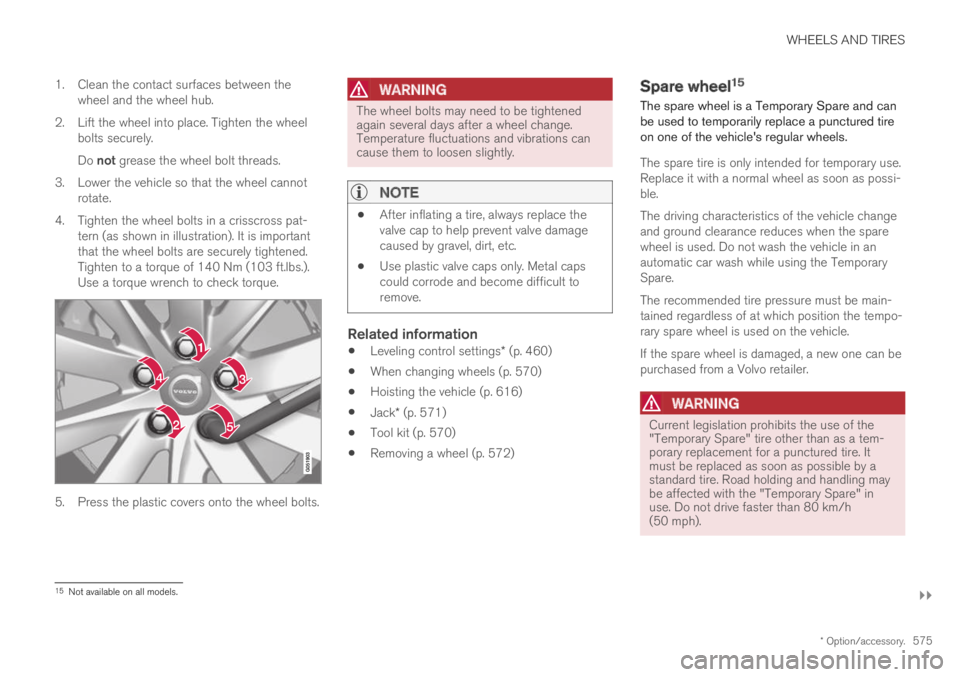
4. Tighten the wheel bolts in a crisscross pat-tern (as shown in illustration). It is importantthat the wheel bolts are securely tightened.Tighten to a torque of 140 Nm (103 ft.lbs.).Use a torque wrench to check torque.
5. Press the plastic covers onto the wheel bolts.
WARNING
The wheel bolts may need to be tightenedagain several days after a wheel change.Temperature fluctuations and vibrations cancause them to loosen slightly.
NOTE
After inflating a tire, always replace thevalve cap to help prevent valve damagecaused by gravel, dirt, etc.
Use plastic valve caps only. Metal capscould corrode and become difficult toremove.
Related information
Leveling control settings* (p. 460)
When changing wheels (p. 570)
Hoisting the vehicle (p. 616)
Jack* (p. 571)
Tool kit (p. 570)
Removing a wheel (p. 572)
Spare wheel15
The spare wheel is a Temporary Spare and canbe used to temporarily replace a punctured tireon one of the vehicle's regular wheels.
The spare tire is only intended for temporary use.Replace it with a normal wheel as soon as possi-ble.
The driving characteristics of the vehicle changeand ground clearance reduces when the sparewheel is used. Do not wash the vehicle in anautomatic car wash while using the TemporarySpare.
The recommended tire pressure must be main-tained regardless of at which position the tempo-rary spare wheel is used on the vehicle.
If the spare wheel is damaged, a new one can bepurchased from a Volvo retailer.
WARNING
Current legislation prohibits the use of the"Temporary Spare" tire other than as a tem-porary replacement for a punctured tire. Itmust be replaced as soon as possible by astandard tire. Road holding and handling maybe affected with the "Temporary Spare" inuse. Do not drive faster than 80 km/h(50 mph).
15Not available on all models.
Page 578 of 695

||
WHEELS AND TIRES
576
WARNING
The vehicle must never be driven withmore than one "Temporary Spare" tiremounted.
Driving with a spare wheel may alter thedriving characteristics of the vehicle.Replace the spare wheel with a normalwheel as soon as possible.
The spare wheel is smaller than the nor-mal wheel, which affects the vehicle'sground clearance. Watch for high curbsand do not wash the vehicle in an auto-matic car wash when a spare wheel ismounted.
Follow the manufacturer's recommendedtire inflation pressure for the spare wheel.
On all-wheel drive vehicles, the drive onthe rear axle can be disconnected.
If the spare wheel is mounted on thefront axle, snow chains must not be used.
The spare wheel must not be repaired.
CAUTION
The vehicle must not be driven with wheels ofdifferent dimensions or with a spare tire otherthan the one that came with the vehicle. Theuse of different size wheels can seriouslydamage your vehicle's transmission.
Related information
When changing wheels (p. 570)
Recommended tire pressure (p. 565)
Accessing the spare wheel
Follow these instructions regarding handling thespare wheel.
The spare wheel is stored in a bag and should besecured with two straps onto the floor of thetrunk/cargo compartment when the vehicle isbeing driven. The straps should be strappeddown crosswise over the wheel, attached to theload anchoring eyelets and pulled taut.
Wheel changing tools are located under thecargo compartment floor.
Related information
Spare wheel (p. 575)
Page 580 of 695

||
WHEELS AND TIRES
578
CAUTION
Snow chains can be used on the vehicle, withthe following restrictions:
Volvo recommends not using snowchains on wheel dimensions larger than18 inches.
Always follow the manufacturer's installa-tion instructions carefully. Install chainsas tightly as possible and retighten peri-odically.
Only put snow chains on the front wheels(also applies to all-wheel drive vehicles).
If accessory, aftermarket or "custom"tires and wheels with different dimen-sions than the original tires and wheelsare used, snow chains in some casesmay NOT be used. Sufficient distancebetween the chains and brakes, suspen-sion and body components must bemaintained.
Check local regulations regarding the useof snow chains before installing.
Never exceed the snow chain manufac-turer's specified maximum speed limit.Under no circumstances should youexceed 50 km/h (30 mph).
Avoid bumps, holes or sharp turns whendriving with snow chains.
Avoid driving on surfaces without snow asthis wears out both the snow chains andthe tires.
The handling of the vehicle can beadversely affected when driving withchains. Avoid fast or sharp turns as wellas locked wheel braking.
Some types of strap-on chains affectbrake components and therefore mustNOT be used.
Consult a Volvo retailer for more informationabout snow chains.
Related information
Winter driving (p. 468)
Tire sealing system16
The temporary tire sealing system can be usedto seal a puncture in a tire or to check andadjust the pressure in the tire.
Models equipped with a spare wheel17 do nothave the tire sealing system.
WARNING
California Proposition 65
Operating, servicing and maintaining a pas-senger vehicle can expose you to chemicalsincluding engine exhaust, carbon monoxide,phthalates, and lead, which are known to theState of California to cause cancer and birthdefects or other reproductive harm. To mini-mize exposure, avoid breathing exhaust, donot idle the engine except as necessary, serv-ice your vehicle in a well ventilated area andwear gloves or wash your hands frequentlywhen servicing your vehicle. For more infor-mation go to www.P65Warnings.ca.gov/passenger-vehicle.
The tire sealing system consists of a compressorand a bottle containing sealing compound. Thesealing functions as a temporary repair.
Page 597 of 695

LOADING, STORAGE AND PASSENGER COMPARTMENT
}}
* Option/accessory.595
Cargo compartment
The vehicle has a flexible cargo compartmentthat makes it possible to carry and secure largeobjects.
The cargo capacity of the vehicle can be consid-erably increased by folding down the rear seatbackrests. To make loading and unloading easier,the rear section of the vehicle can be raised andlowered using the level control function*. Use theload anchoring eyelets or grocery bag holders tohelp secure objects in place, and the retractablecargo compartment cover* to help concealobjects in the cargo compartment.
If the vehicle is equipped with a temporary sparetire, this is secured to the cargo compartmentfloor under the cover. The towing eyelet and tiresealing system are located under the cargo com-partment floor.
Related information
Loading recommendations (p. 595)
Grocery bag holders (p. 597)
Load anchoring eyelets (p. 598)
Installing and removing the cargo compart-ment cover* (p. 598)
Loading recommendations
There are a number of things to consider whencarrying loads in or on the vehicle.
Load-carrying capacity is determined by the vehi-cle's curb weight. The total weight of all passen-gers and any installed accessories reduces thevehicle's load-carrying capacity by the corres-ponding amount.
WARNING
The vehicle's driving characteristics changedepending on the weight and position of theload.
Loading the cargo compartment/trunk
Position objects so they are pressing againstthe rear seat backrests.
Distribute the load evenly.
Heavy objects should be positioned as lowas possible. Avoid placing heavy objects onfolded-down seat backrests.
Cover sharp corners with a soft cloth or simi-lar to help prevent damage to the upholstery.
Use the load anchoring eyelets and tension-ing straps or similar to secure all objects.
WARNING
In a head-on collision at a speed of 50 km/h(30 mph), an unsecured object weighing 20kg (44 pounds) can reach a projectile weightequivalent to 1000 kg (2200 pounds).
WARNING
If objects are loaded higher than the upperedge of the side windows, leave a 10 cm (4in.) space between the objects and the win-dow. Objects placed closer to this couldimpede the function of the inflatable curtainconcealed inside the headlining.
WARNING
Always secure the load. Otherwise, it may shiftduring heavy braking and injure people in thevehicle.
Cover sharp edges and sharp corners withsomething soft.
Turn off the engine and apply the parkingbrake when loading/unloading long objects.Otherwise, it is possible for the load to reachthe gear lever or gear selector and move it toa drive position – which could cause the vehi-cle to begin rolling.
Page 675 of 695

SPECIFICATIONS
673
Approved tire pressure
The following tire pressures are recommendedby Volvo for your vehicle. Refer to the tire infla-
tion placard for information specific to the tiresinstalled on your vehicle at the factory.
Tire dimensionsCold tire pressure for up to five persons
Front
psi (kPa)
Rear
psi (kPa)
235/60 R18
235/55 R19
255/45 R20
35 (240)35 (240)
255/40 R21
265/35 R22
38 (260)38 (260)
Temporary spare tireN/AN/A
Related information
Type designations (p. 662)
Checking tire pressure (p. 563)
Recommended tire pressure (p. 565)
Page 688 of 695

INDEX
686
Sound experience 493
Sound settings 492, 535
phone 536
playing media 514, 516
text message 535
Spare tire 575, 576
Speed camera 363
Speed Limiter 277, 280, 281, 285
getting started 278
shut down 280
temporary deactivation 279
Speed symbols, tires 560
Spin control 273
Stability and traction control system 273, 276
operation 275
Stability system 273
Stains 643, 645, 646, 647, 648
Start and lock system
type designations 251
Start battery 477, 625
overload 476
Start engine 430
Starting the engine
after a collision 62
Start the vehicle 430
Steel cargo grid 602
Steering assistance at risk of colli-
sion375, 376, 377, 378, 379, 380, 381,
382, 384
Steering assistance at risk of rear-end col-
lision381, 382
Steering power level, see Steering wheel
resistance272
Steering resistance at risk of head-on colli-
sion378, 379, 380
Steering wheel197, 198
heating215, 216
keypad197
paddle197
steering wheel adjustment198
Steering wheel keypad197
Steering wheel paddles447
Steering wheel resistance, speed-depend-
ent272
Stone chips and scratches 655, 656
Storage compartments588
center console589
glove compartment593
sun visor594
Sunroof
pinch protection166
Sun shade
panoramic roof172, 175
pinch protection166
Sun visor 594
mirror lighting 163
Symbols
indicator symbols 94
warning symbols 97
Symbols and messages
Adaptive Cruise Control 308
center display's status bar 124
Collision warner with auto-brake 348
hybrid-related 426
parking climate 231
Symbols and messages for Assistance at
risk of collision 384
system updates 611
T
Tailgate
locking/unlocking241, 255
open/close with foot movement 264
power260
unlocking from inside258
Technician certification 38
Page 689 of 695

INDEX
687
Temperature
adjusting 222, 223
perceived 201
Temperature monitoring 418
Temporary spare
spare tire 575
Temporary tire sealing system
execution, checking 579
Inflating tires 583
location 578
overview 578
sealing compound 578
Terms and conditions
services 35
users 544
Tire dimensions 560, 570
Tire pressure monitoring
calibrating 567
Tires 556
direction of rotation 558
glossary of terms 559
inflation pressure table 673
mounting 574
pressure 673
removal 572
rotation 557
specifications 560, 673
storage 556
tire pressure monitoring 565
tire sealing578
Tread depth577
tread wear indicator 559
winter tires 577
Tire sealing system 579
Tire tread 559
Tools 570
Top tether anchors (child restraint sys-
tems)72
Top view 132
Total airing function 237
Towbar 478
removable, attaching, installing, mount-
ing 478
removable, removing, detaching 478
Towing 483
Towing capacity and towball load 668
Towing eyelet 484
TPMS - Tire Pressure Monitoring System 565
Traction control 273
Traffic information 500
Trailer 481
driving with a trailer 479
Lamps 482
swaying 481
Trailer Stability Assist481
trailer481
Trailer stabilizer 274
Trailer towing
trailer hitch 478
Transmission 444
automatic 445
Transmission fluid
grade 671
Travel Link 508
Fuel 512
Notifications 511
Sports 513
weather 510
Tread depth 559, 577
Tread wear indicator 559
Trip computer 89, 91
Trip odometer 89
Trip odometer resetting 92
Trip statistics 92
Troubleshooting
Adaptive Cruise Control 306
Troubleshooting the camera sensor 332, 335
TSA - Trailer Stability Assist 274, 481
Tunnel detection 155
Turn off engine 432