2019 VOLKSWAGEN T-ROC brakes
[x] Cancel search: brakesPage 280 of 502

wheels can spin even when brake support systems are active, and this can lead to a loss of control of
the vehicle.
WARNING
The effectiveness of ESC can be reduced considerably if other components and systems which affect
driving dynamics are not serviced properly or are not functioning properly. This also applies, but not
exclusively, to the brakes, tyres and other named systems.
Please always bear in mind that modifications and changes to the vehicle can affect the way brake
support systems operate.
Alterations to the suspension or the use of non-approved wheel and tyre combinations can affect
the function of brake support systems and reduce their effectiveness.
Suitable tyres support the effectiveness of ESC.
WARNING
Driving without the brake servo can considerably increase the braking distance and thus cause
accidents and serious injuries.
Never switch the engine or ignition off while the vehicle is in motion.
If the brake servo does not function or the vehicle is being towed, the brake pedal will have to be
depressed more forcefully as the braking distance will be increased due to the lack of assistance for
the brake system.
Switching the TCS on and off
Switch off the traction control system (TCS) if the vehicle does not have sufficient traction:
When driving in deep snow or on loose surfaces.
When rocking the vehicle free if it is stuck.
Then switch on TCS again.
Switching TCS on and off
TCS can be switched off and on in the Infotainment system Infotainment system controls and
displays
When the TCS is switched off, the yellow indicator lamp lights up on the instrument cluster
display.
As soon as the TCS starts regulating, the indicator lamp flashes yellow.
Troubleshooting
Page 281 of 502

Warning lamp lights up red.
Seek expert assistance immediately.
ABS failure or fault.
Warning lamp lights up yellow.
Go to a qualified workshop. The vehicle can be braked without the anti-lock brake system.
TCS regulating to prevent the wheels from spinning.
Indicator lamp flashes yellow.
ESC switched off for system-related reasons.
Indicator lamp lights up yellow.
Switch the ignition on and off.
Drive a short distance at a speed of 15 20 km/h (9 12 mph) if necessary.
If is still lit up, seek expert assistance.
The brake support systems make noises
Noises may be heard when the brake support systems are performing control interventions.
Unexpected reduction in engine power
Faults can occur in the ESC and TCS systems if the four wheels have different types of tyres.
Any differences in the rolling radius of the tyres can cause the system to reduce engine power
unexpectedly.
WARNING
If the brake system warning lamp lights up together with the ABS indicator lamp , the ABS
control function may have failed. This can cause the rear wheels to lock quickly when you brake.
Locked rear wheels can lead to a loss of control of the vehicle. If possible, reduce your speed and
drive carefully at low speed to the nearest qualified workshop in order to have the brake system
tested. Avoid sudden braking and driving manoeuvres on the way.
If the ABS indicator lamp does not go out or comes on while the vehicle is in motion, ABS is not
working properly. The vehicle can be stopped using the normal brakes only (without the anti-lock
brake system). The protection provided by the anti-lock brake system is no longer available. Go to a
qualified workshop as soon as possible.
Practical equipment
Stowage areas
Page 318 of 502

Tyre pressure
Follow the trailer manufacturer's recommendations concerning the tyre pressure for the trailer
tyres.
When towing a trailer, inflate the wheels on the towing vehicle with the maximum permitted tyre
pressure Tyre pressure
WARNING
Accidents and serious injuries can occur if you exceed the vehicle's maximum permitted gross axle
weight rating, drawbar load, gross vehicle weight rating or gross combination weight rating.
exceed the permissible gross vehicle weight for the vehicle with weight at the front and rear of the
vehicle.
WARNING
Loads that may slide can severely impair stability and driving safety, which can cause accidents and
severe injuries.
secure loads using suitable and undamaged lashing, retaining or securing straps.
Driving with a trailer
First read and observe the introductoryinformation and safety warnings
Headlight adjustment
Towing a trailer can raise the front end of the vehicle enough for the dipped beam to dazzle other
road users. Use the headlight range control to lower the light cone as required. Vehicles with
dynamic headlight range control are adjusted automatically.
Things to note when driving with a trailer
If the trailer has an overrun brake, apply the brakes gently at first and then firmly. This will
prevent the jerking that can be caused by the trailer wheels locking.
Page 382 of 502
Refill only with distilled water. All other types of water can cause corrosion in the engine due to
the chemical components contained in the water. This can also lead to engine failure. If any other
type of water apart from distilled water has been refilled, the fluid in the cooling system should be
completely replaced immediately by a qualified workshop.
Fig. 188
be forced out of the cooling system when the engine is hot and could cause damage.
completely. Heavy coolant loss is an indication of leaks in the cooling system. The cooling system
should be checked by a qualified workshop as soon as possible. Failure to do so can result in engine
damage.
have entered the cooling system. Do not drive on! Seek expert assistance. Failure to do so can result
in engine damage.
correct openings. The use of incorrect service fluids could result in serious malfunctions and engine
damage.
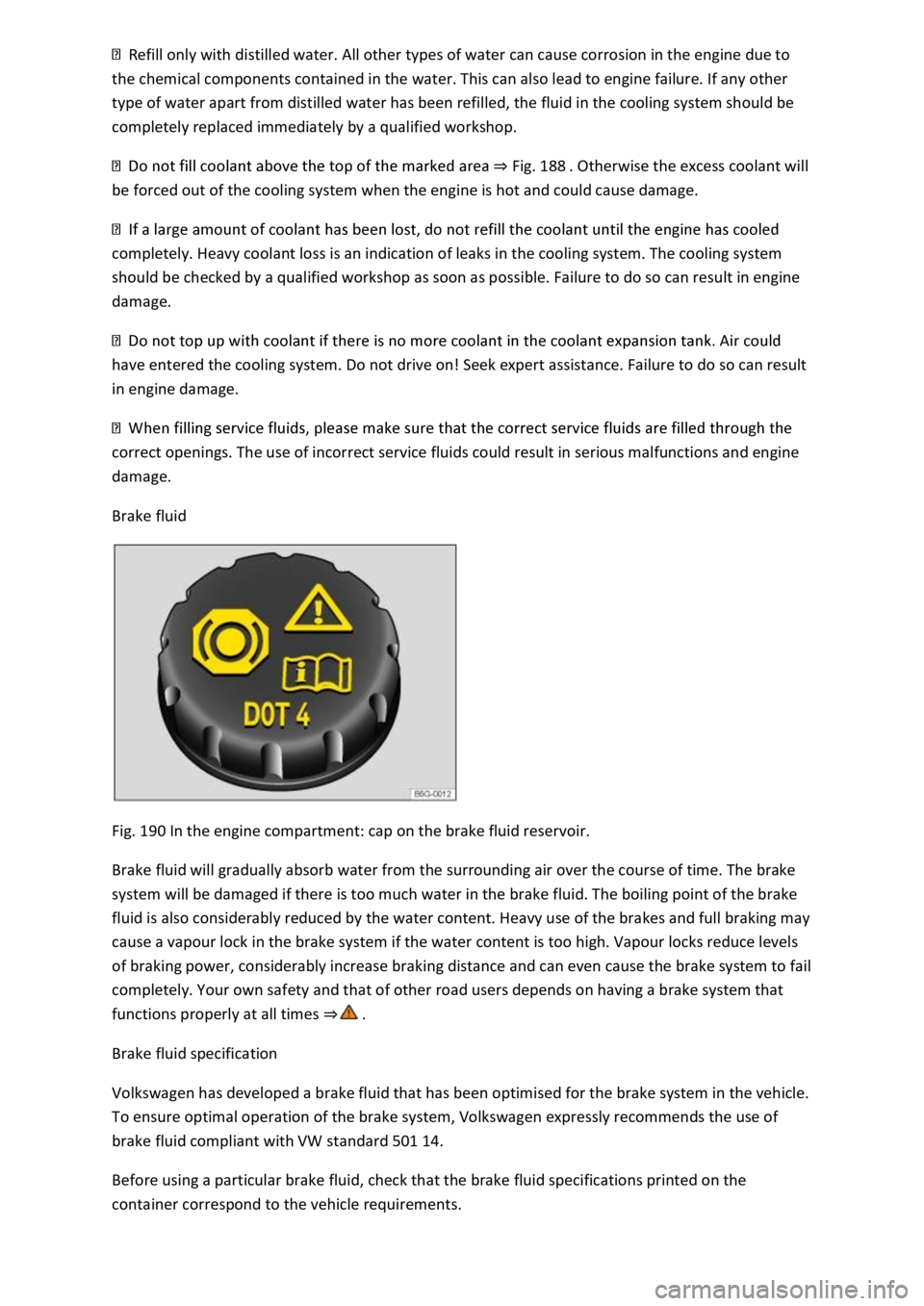
Brake fluid
Fig. 190 In the engine compartment: cap on the brake fluid reservoir.
Brake fluid will gradually absorb water from the surrounding air over the course of time. The brake
system will be damaged if there is too much water in the brake fluid. The boiling point of the brake
fluid is also considerably reduced by the water content. Heavy use of the brakes and full braking may
cause a vapour lock in the brake system if the water content is too high. Vapour locks reduce levels
of braking power, considerably increase braking distance and can even cause the brake system to fail
completely. Your own safety and that of other road users depends on having a brake system that
functions properly at all times
Brake fluid specification
Volkswagen has developed a brake fluid that has been optimised for the brake system in the vehicle.
To ensure optimal operation of the brake system, Volkswagen expressly recommends the use of
brake fluid compliant with VW standard 501 14.
Before using a particular brake fluid, check that the brake fluid specifications printed on the
container correspond to the vehicle requirements.
Page 383 of 502

standard 501 14 is available from Volkswagen dealerships.
If this brake fluid is not available and it is necessary to use another high-quality brake fluid instead,
brake fluid that is compliant with DIN ISO 4925 CLASS 4 or US standard FMVSS 116 DOT 4 can be
used.
Not all brake fluids that are compliant with DIN ISO 4925 CLASS 4 or US standard FMVSS 116 DOT 4
have the same chemical composition. Some of these brake fluids may contain chemicals that can
damage or destroy brake system components over time.
Volkswagen therefore recommends the use of brake fluid that is compliant with VW standard 501 14
to ensure sustained proper operation of the brake system.
Brake fluid that is compliant with VW standard 501 14 fulfils the requirements of DIN ISO 4925
CLASS 4 or US standard FMVSS 116 DOT 4.
Brake fluid level
The brake fluid level must always be between the MIN and MAX marking on the brake fluid reservoir
or above the MIN marking
The brake fluid level cannot be checked accurately in all models as engine components may partially
conceal the fluid level in the brake fluid reservoir. If the brake fluid level cannot be read exactly,
please go to a qualified workshop.
The brake fluid level drops slightly during vehicle operation as the brake pads wear and the brakes
are automatically adjusted.
Brake fluid level
The indicator lamp lights up red.
Brake fluid level is too low.
Do not drive on! Check the brake fluid level.
If the brake fluid level is too low, inform a qualified workshop. Have the brake system checked.
Changing the brake fluid
The brake fluid should be changed by a qualified workshop. Volkswagen recommends using a
Volkswagen dealership for this purpose. Only brake fluid that conforms with the required
specification should be used.
WARNING
Brake failure or reduced braking efficiency can be caused by the brake fluid level being too low or by
brake fluid that is too old or unsuitable.
Page 384 of 502

king efficiency, considerably increase braking distance and can cause the brake system to
fail completely.
with VW standard 501 14.
fluid or low-quality brake fluid can affect the functioning of the brakes and reduce
their effectiveness.
501 14 is not available, use a high-quality brake fluid
compliant with DIN ISO 4925 CLASS 4 or the US standard FMVSS 116 DOT 4, but only in exceptional
circumstances.
WARNING
Brake fluid is toxic.
brake fluid. There is always a risk of someone drinking from such containers, even if they are labelled
appropriately.
children.
NOTICE
Brake fluid that has leaked or been spilt can damage the vehicle paintwork, plastic parts and tyres.
Immediately wipe off brake fluid that has leaked or been spilt from all parts of the vehicle.
Brake fluid can pollute the environment. Any service fluids that have escaped or been spilt must be
collected and disposed of properly.
12-volt vehicle battery
Introduction
This chapter contains information on the followingsubjects:
Checking the electrolyte level of the 12-volt vehicle battery
Charging, replacing, disconnecting and connecting the 12-volt vehicle battery
Troubleshooting
The 12-volt vehicle battery is a component of the electrical system and serves to supply power in the
vehicle.
Page 414 of 502
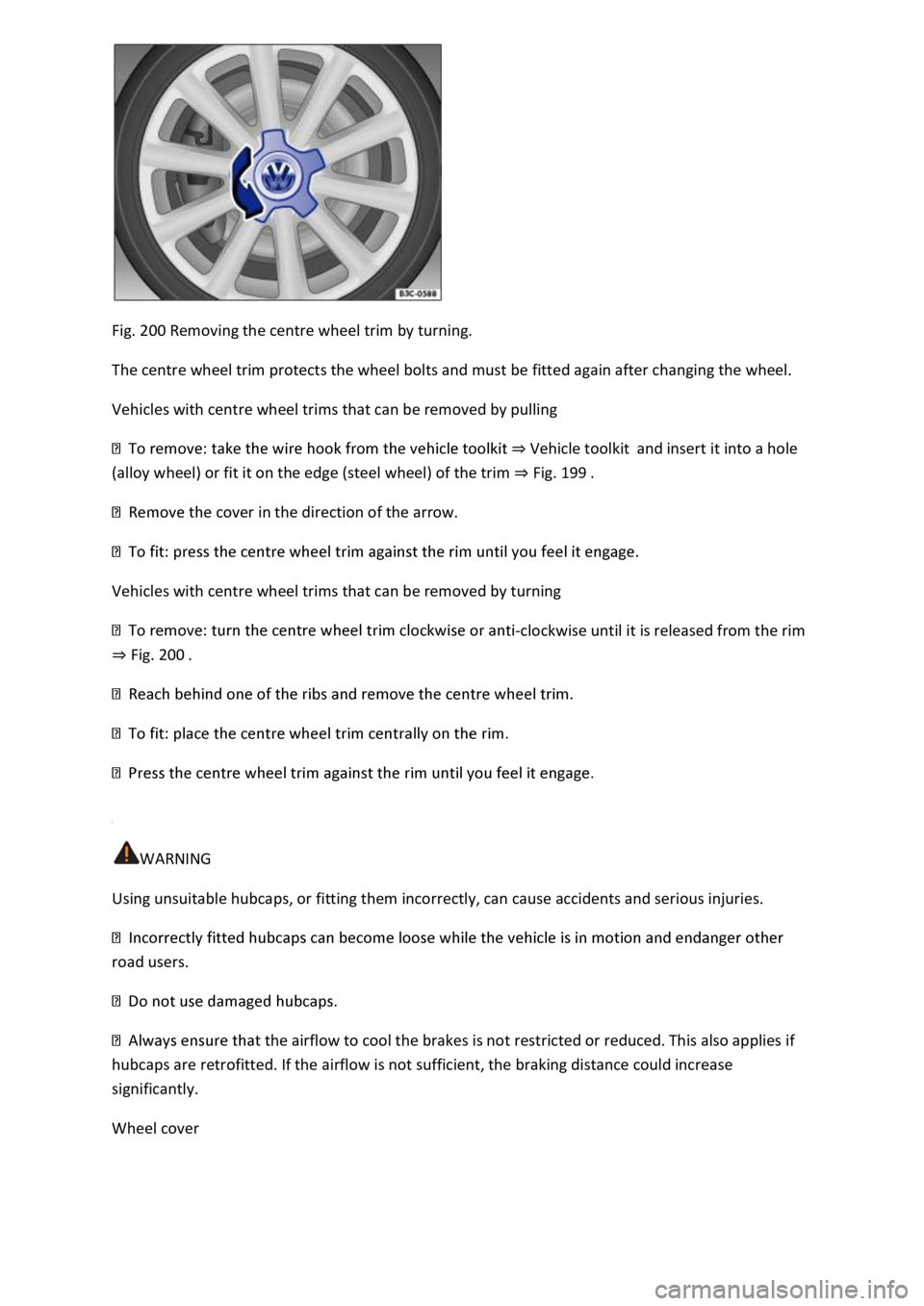
Fig. 200 Removing the centre wheel trim by turning.
The centre wheel trim protects the wheel bolts and must be fitted again after changing the wheel.
Vehicles with centre wheel trims that can be removed by pulling
Vehicle toolkitand insert it into a hole
(alloy wheel) or fit it on the edge (steel wheel) of the trim Fig. 199
cover in the direction of the arrow.
Vehicles with centre wheel trims that can be removed by turning
-clockwise until it is released from the rim
Fig. 200
WARNING
Using unsuitable hubcaps, or fitting them incorrectly, can cause accidents and serious injuries.
road users.
the airflow to cool the brakes is not restricted or reduced. This also applies if
hubcaps are retrofitted. If the airflow is not sufficient, the braking distance could increase
significantly.
Wheel cover
Page 440 of 502
be
increased as the brake discs and pads will be wet, or possibly iced up in winter.
-ice the brakes by performing careful braking manoeuvres. Do not endanger any other
road users when doing this.
NOTICE
Serious vehicle damage can be caused if the vehicle is not washed correctly.
could freeze up.
NOTICE
Painted parts and surfaces with a matt finish, unpainted plastic parts, headlight lenses and tail light
clusters can be damaged if the vehicle is not washed correctly.
-painted vehicle only in a textile car wash.
-painted surfaces with hot wax.
-painted surfaces.
Wash the vehicle only in specially designated washing areas. This prevents any waste water
contaminated with oil from entering the sewerage system.
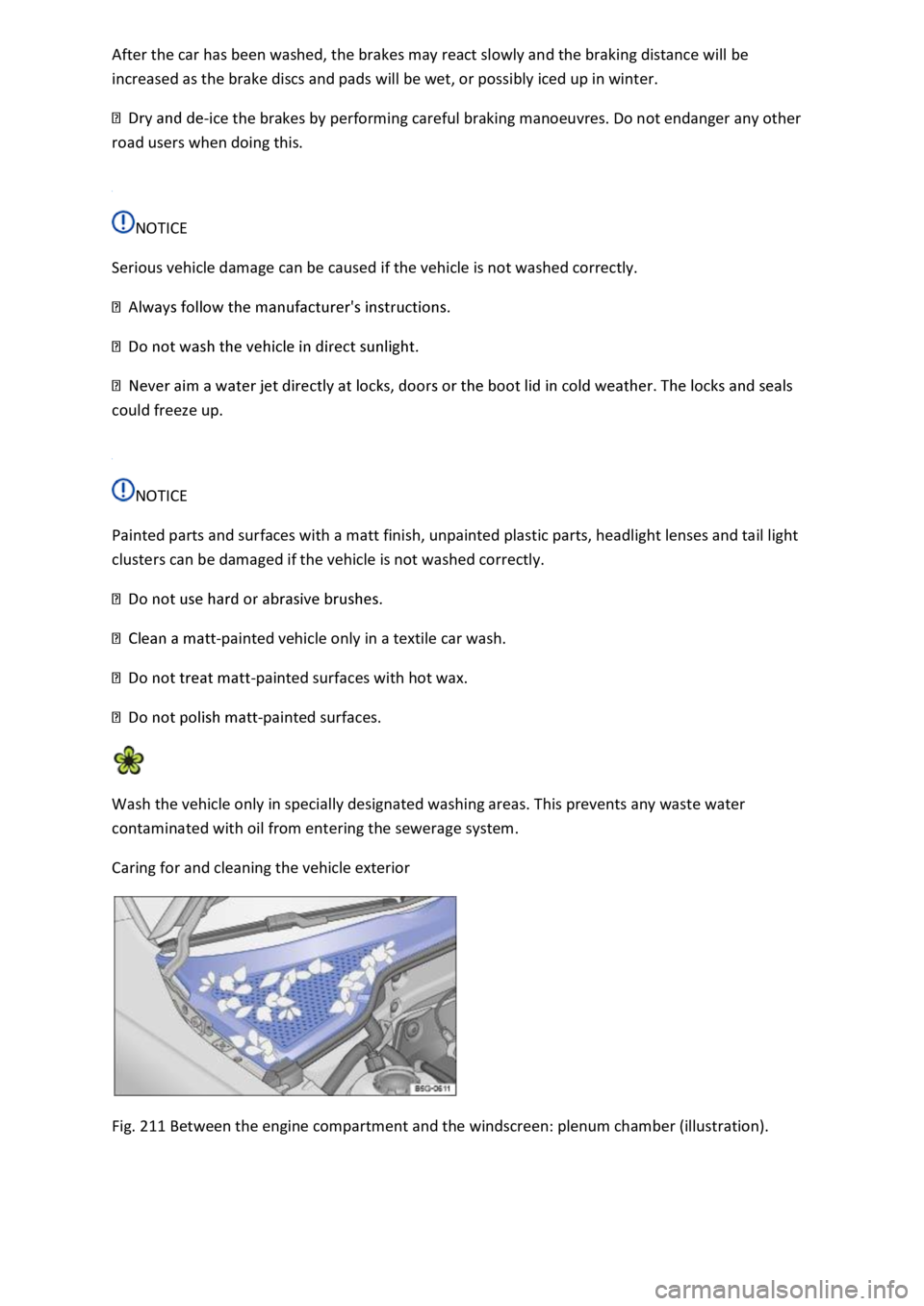
Caring for and cleaning the vehicle exterior
Fig. 211 Between the engine compartment and the windscreen: plenum chamber (illustration).