2019 TOYOTA SUPRA boot
[x] Cancel search: bootPage 245 of 456
245
3
Supra Owner's Manual3-1. CONTROLS
CONTROLS
one turning circle line is displayed.
■Parking with the help of driv-
ing path and turning circle
lines
1Position the vehicle so that the
red turning circle line is within
the boundaries of the parking
space.
2Turn the steering wheel so that
the green driving path line cov-
ers the corresponding turning
circle line.
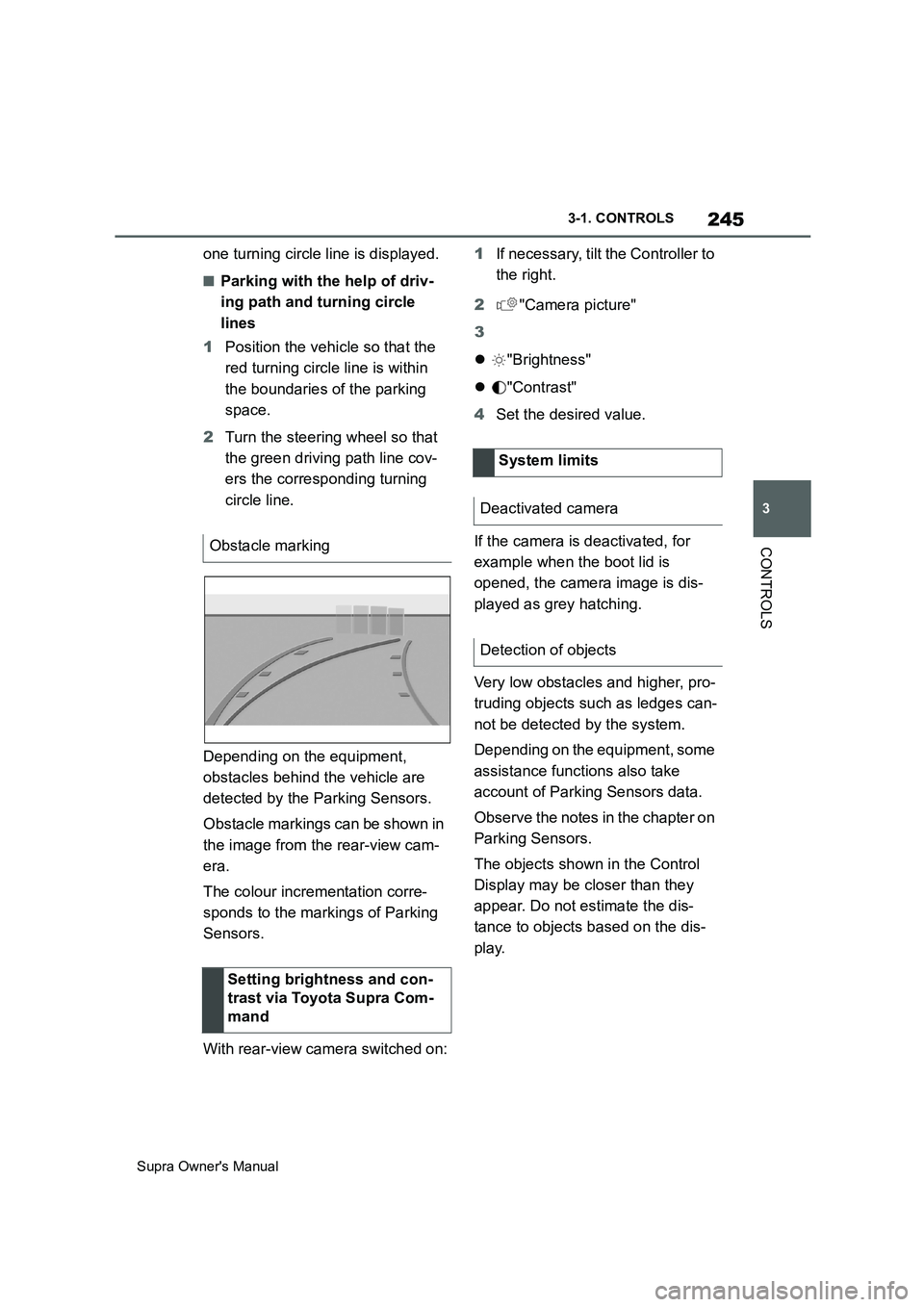
Depending on the equipment,
obstacles behind the vehicle are
detected by the Parking Sensors.
Obstacle markings can be shown in
the image from the rear-view cam-
era.
The colour incrementation corre-
sponds to the markings of Parking
Sensors.
With rear-view camera switched on:1If necessary, tilt the Controller to
the right.
2"Camera picture"
3
"Brightness"
"Contrast"
4Set the desired value.
If the camera is deactivated, for
example when the boot lid is
opened, the camera image is dis-
played as grey hatching.
Very low obstacles and higher, pro-
truding objects such as ledges can-
not be detected by the system.
Depending on the equipment, some
assistance functions also take
account of Parking Sensors data.
Observe the notes in the chapter on
Parking Sensors.
The objects shown in the Control
Display may be closer than they
appear. Do not estimate the dis-
tance to objects based on the dis-
play. Obstacle marking
Setting brightness and con-
trast via Toyota Supra Com-
mand
System limits
Deactivated camera
Detection of objects
Page 258 of 456
258
Supra Owner's Manual3-1. CONTROLS
cal devices when standby state or
drive-ready state is switched on.
The total load of all sockets must
not exceed 140 watt at 12 volts.
To avoid damage to the socket, do
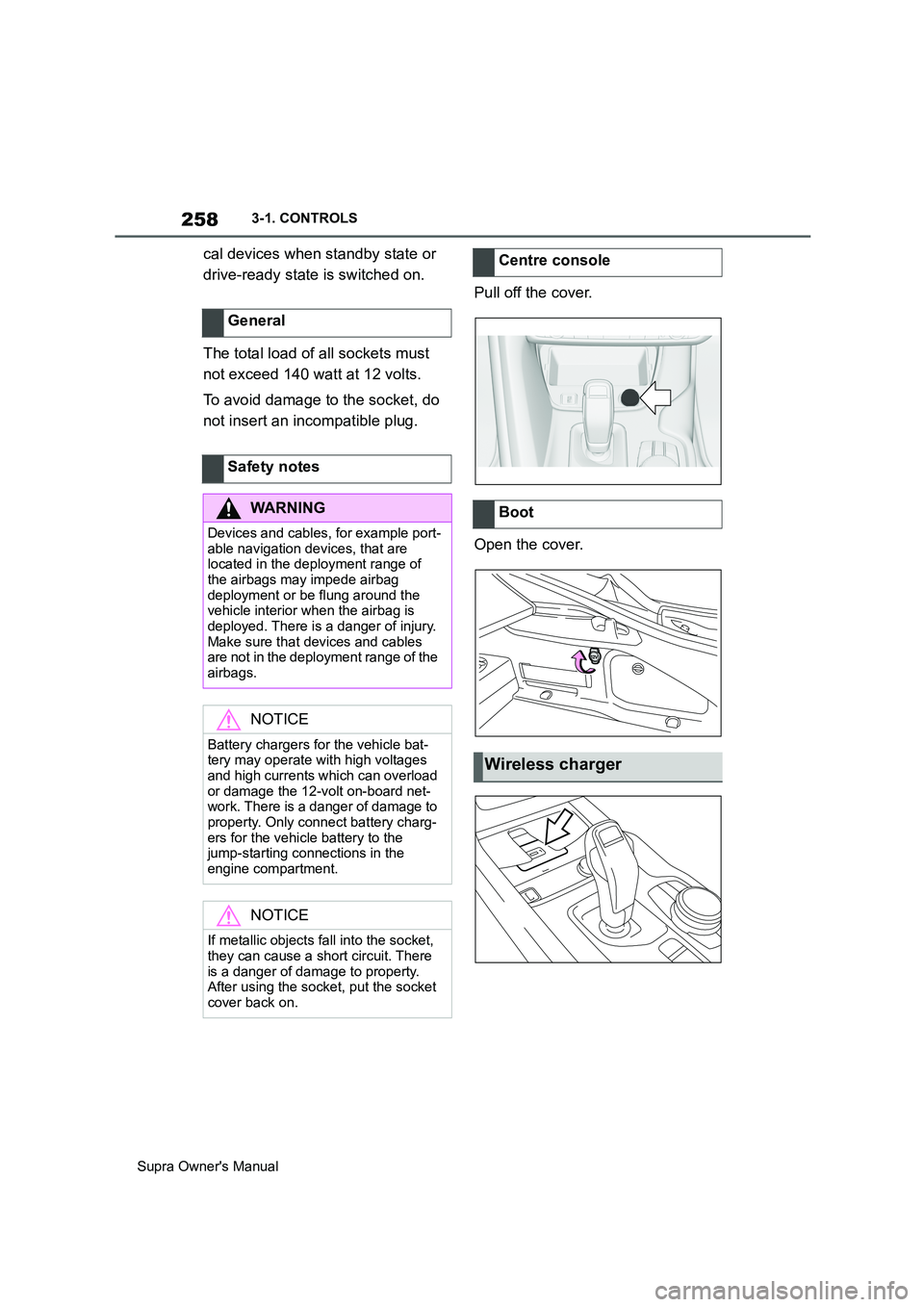
not insert an incompatible plug.Pull off the cover.
Open the cover. General
Safety notes
WARNING
Devices and cables, for example port-
able navigation devices, that are
located in the deployment range of
the airbags may impede airbag
deployment or be flung around the
vehicle interior when the airbag is
deployed. There is a danger of injury.
Make sure that devices and cables
are not in the deployment range of the
airbags.
NOTICE
Battery chargers for the vehicle bat-
tery may operate with high voltages
and high currents which can overload
or damage the 12-volt on-board net-
work. There is a danger of damage to
property. Only connect battery charg-
ers for the vehicle battery to the
jump-starting connections in the
engine compartment.
NOTICE
If metallic objects fall into the socket,
they can cause a short circuit. There
is a danger of damage to property.
After using the socket, put the socket
cover back on.
Centre console
Boot
Wireless charger
Page 261 of 456
261
3
Supra Owner's Manual3-1. CONTROLS
CONTROLS
This chapter describes all standard,
country-specific and special equip-
ment available for the model series.
It may therefore describe equip-
ment and functions which are not
installed in your vehicle, for exam-
ple on account of the optional
equipment selected or the country
specification. This also applies to
safety-relevant functions and sys-
tems. Please comply with the rele-
vant laws and regulations when
using the corresponding functions
and systems. Safety note
WARNING
Fragile objects, for example glass
bottles or glasses, can break in the
event of an accident. Shards may
scatter throughout the interior. There
is a danger of injury or damage to
property. Do not use any fragile
objects while driving. Only stow fragile
objects in closed storage compart-
ments.
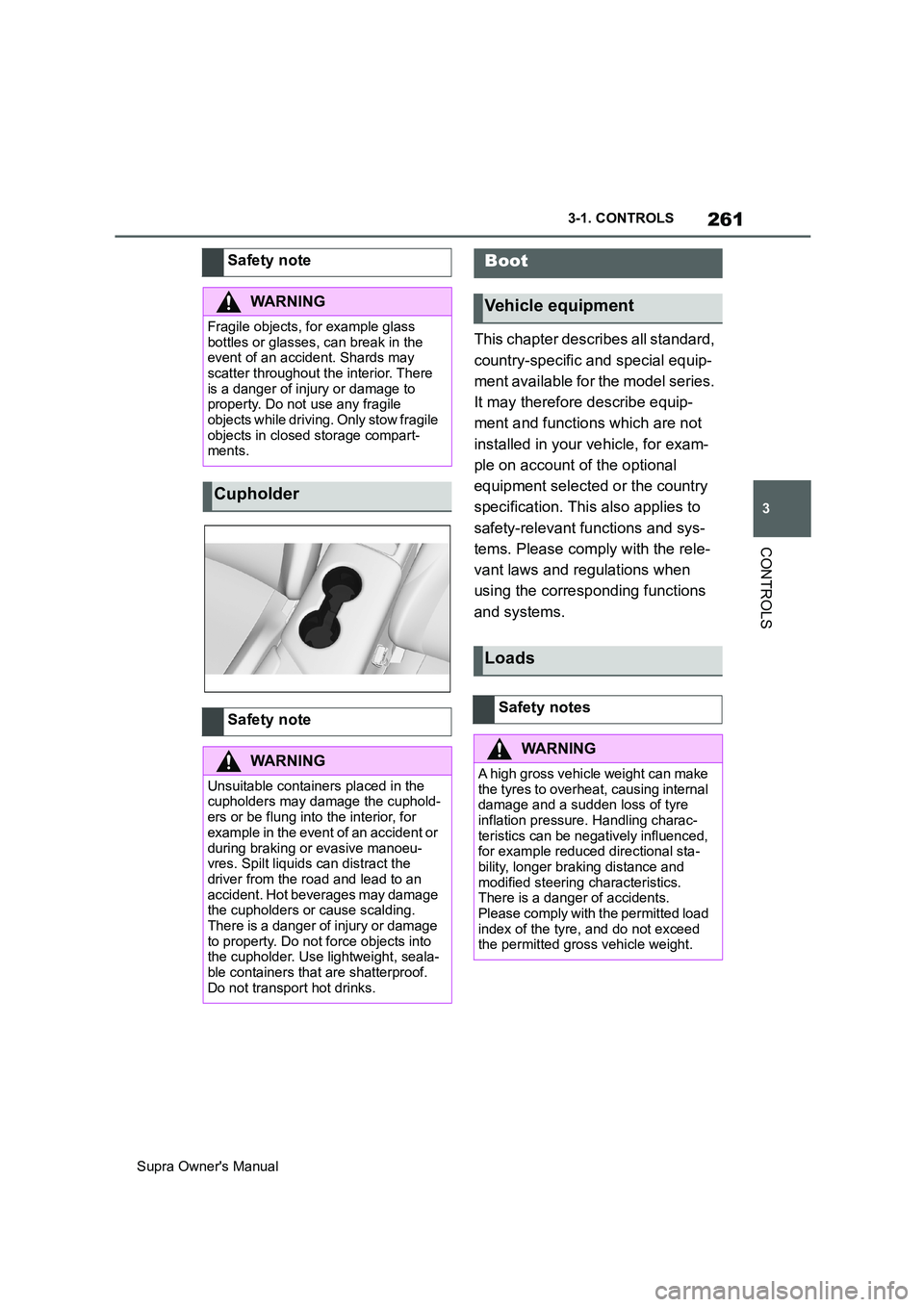
Cupholder
Safety note
WARNING
Unsuitable containers placed in the
cupholders may damage the cuphold-
ers or be flung into the interior, for
example in the event of an accident or
during braking or evasive manoeu-
vres. Spilt liquids can distract the
driver from the road and lead to an
accident. Hot beverages may damage
the cupholders or cause scalding.
There is a danger of injury or damage
to property. Do not force objects into
the cupholder. Use lightweight, seala-
ble containers that are shatterproof.
Do not transport hot drinks.
Boot
Vehicle equipment
Loads
Safety notes
WARNING
A high gross vehicle weight can make
the tyres to overheat, causing internal
damage and a sudden loss of tyre
inflation pressure. Handling charac-
teristics can be negatively influenced,
for example reduced directional sta-
bility, longer braking distance and
modified steering characteristics.
There is a danger of accidents.
Please comply with the permitted load
index of the tyre, and do not exceed
the permitted gross vehicle weight.
Page 262 of 456
262
Supra Owner's Manual3-1. CONTROLS
Wrap protective material around
any sharp corners and edges on
the load.
Heavy transported loads: stow
as far forward and as low down as possible, ideally directly
behind the boot partition.
Small and lightweight trans-
ported loads: can be secured
with retaining straps, a luggage
net or other suitable straps.
Large and heavy transported
loads: secure with lashing straps.
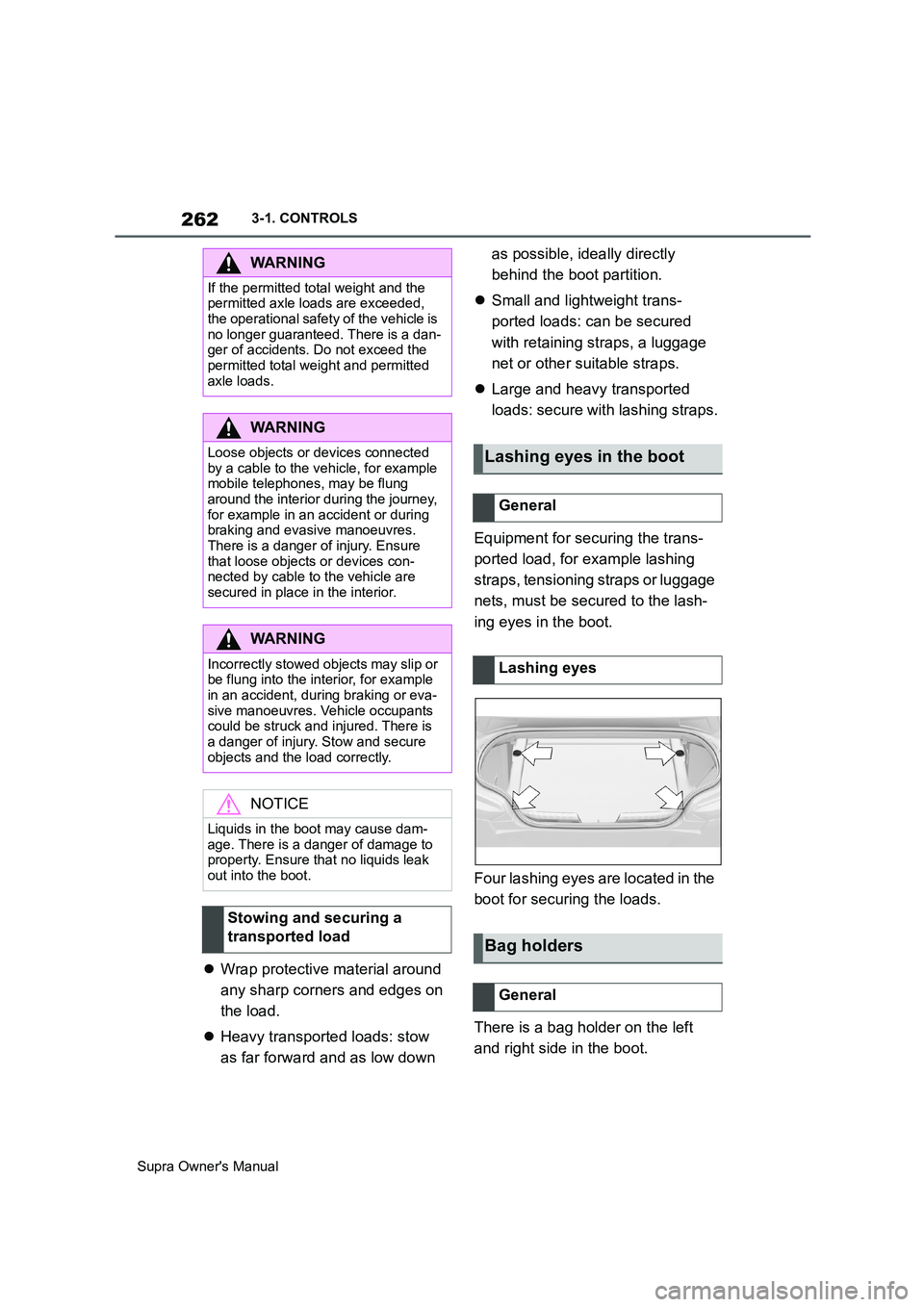
Equipment for securing the trans-
ported load, for example lashing
straps, tensioning straps or luggage
nets, must be secured to the lash-
ing eyes in the boot.
Four lashing eyes are located in the
boot for securing the loads.
There is a bag holder on the left
and right side in the boot.
WARNING
If the permitted total weight and the
permitted axle loads are exceeded,
the operational safety of the vehicle is
no longer guaranteed. There is a dan-
ger of accidents. Do not exceed the
permitted total weight and permitted
axle loads.
WARNING
Loose objects or devices connected
by a cable to the vehicle, for example
mobile telephones, may be flung
around the interior during the journey,
for example in an accident or during
braking and evasive manoeuvres.
There is a danger of injury. Ensure
that loose objects or devices con-
nected by cable to the vehicle are
secured in place in the interior.
WARNING
Incorrectly stowed objects may slip or
be flung into the interior, for example
in an accident, during braking or eva-
sive manoeuvres. Vehicle occupants
could be struck and injured. There is
a danger of injury. Stow and secure
objects and the load correctly.
NOTICE
Liquids in the boot may cause dam-
age. There is a danger of damage to
property. Ensure that no liquids leak
out into the boot.
Stowing and securing a
transported load
Lashing eyes in the boot
General
Lashing eyes
Bag holders
General
Page 263 of 456
263
3
Supra Owner's Manual3-1. CONTROLS
CONTROLSThere is a tensioning strap on the
right-hand trim panel for securing
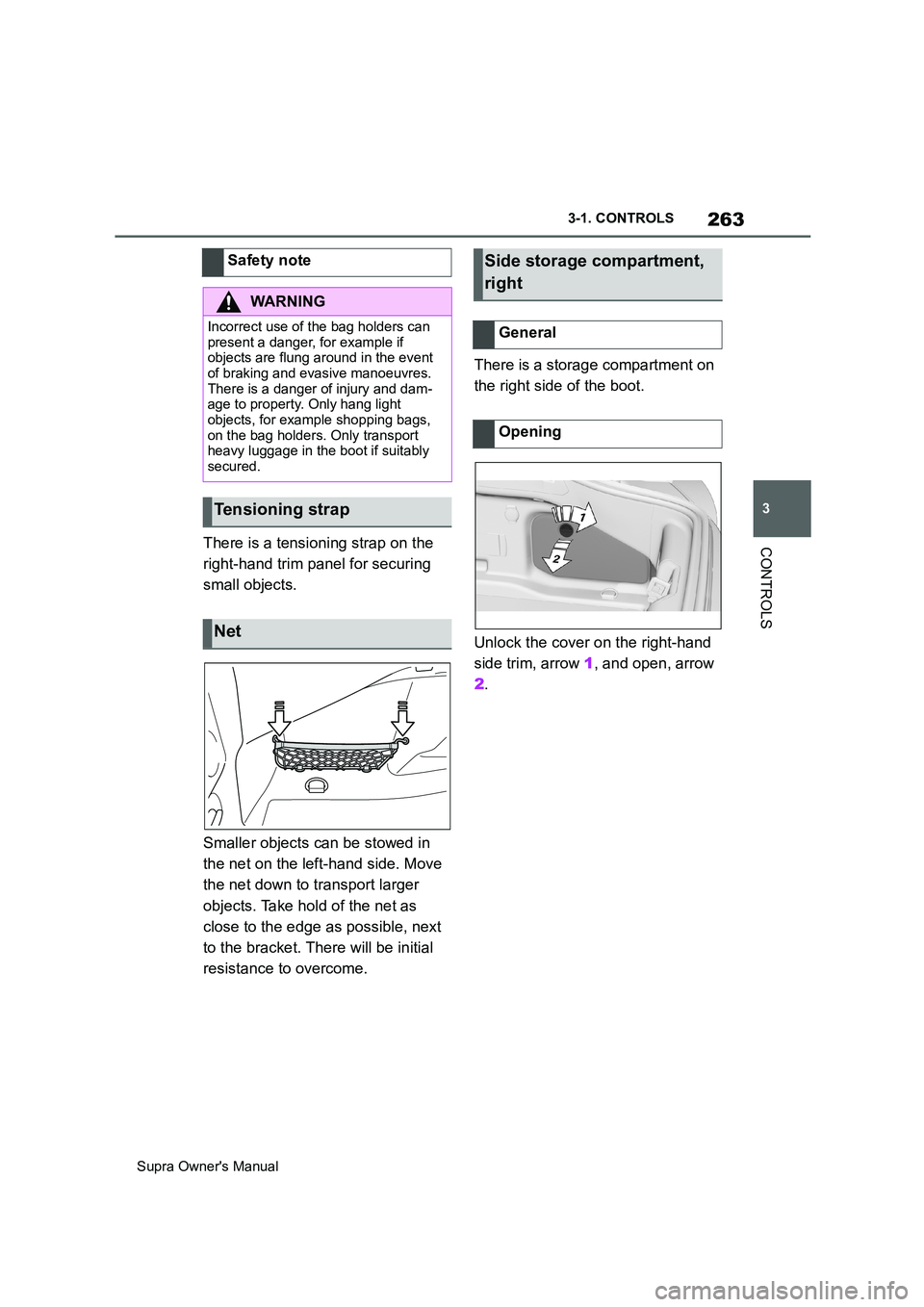
small objects.
Smaller objects can be stowed in
the net on the left-hand side. Move
the net down to transport larger
objects. Take hold of the net as
close to the edge as possible, next
to the bracket. There will be initial
resistance to overcome.There is a storage compartment on
the right side of the boot.
Unlock the cover on the right-hand
side trim, arrow 1, and open, arrow
2. Safety note
WARNING
Incorrect use of the bag holders can
present a danger, for example if
objects are flung around in the event
of braking and evasive manoeuvres.
There is a danger of injury and dam-
age to property. Only hang light
objects, for example shopping bags,
on the bag holders. Only transport
heavy luggage in the boot if suitably
secured.
Tensioning strap
Net
Side storage compartment,
right
General
Opening
Page 267 of 456
267
4
Supra Owner's Manual4-1. DRIVING HINTS
DRIVING HINTS
Brake discs and pads only achieve
their full effectiveness after approxi-
mately 500 km, 300 miles. Drive
moderately during this running-in
period.
Please comply with the running-in
procedures again if the compo-
nents previously referred to are
renewed.
The exhaust gas particle filter col-
lects soot particles. The soot parti-
cles are burned at high
temperatures to clean the exhaust
gas particle filter as necessary.
The cleaning process takes a few
minutes, during which the following
may occur:
Engine temporarily runs a bit
roughly.
A slightly higher engine speed is
required to achieve the usual
power output.
A small amount of smoke from
the exhaust, even after stopping
the engine. Brake system
After fitting new parts
General driving information
Closing the boot lid
Safety note
WARNING
When open, the boot lid protrudes
above the vehicle, and in the event of
an accident, braking or evasive
manoeuvres, it can endanger vehicle
occupants and other road users, or
damage the vehicle. Exhaust fumes
may also enter the passenger com-
partment. There is a danger of injury
or damage to property. Do not drive
with the boot lid open.
Hot exhaust system
WARNING
During vehicle operation, high tem-
peratures may occur under the vehi-
cle body, for example due to the
exhaust system. If flammable materi-
als, for example leaves or grass,
come into contact with hot parts of the
exhaust system, these materials can
catch fire. There is a danger of injury
or damage to property. Never remove
the heat shields fitted here or apply
under seal to them. Make sure that
when driving, idling or parking, no
flammable materials can come into
contact with hot vehicle parts. Do not
touch the hot exhaust system.
Exhaust gas particle filter
Principle
General
Page 279 of 456
279
5
Supra Owner's Manual5-1. MOBILITY
MOBILITY
for the respective load conditions
will apply, in accordance with the
vehicle's actual load condition.
Example: for a partially loaded
vehicle, the optimum tyre inflation
pressure is the one stated for a par-
tially loaded vehicle.
More information regarding wheels
and tyres can be obtained from any
authorized Toyota retailer or Toyota
authorized repairer, or any reliable
repairer.
The current tire pressure of each
installed wheel can be displayed on
the control display.
To ensure that they are displayed
correctly, the tyre sizes must be
stored in the system and must have
been set, see page 290, for the
mounted tyres.
The current tyre inflation pressure
value is shown on each tyre.Tyres heat up while driving. The
tyre inflation pressure increases
with the temperature of the tyre.
Tyres have a natural, uniform loss
of tyre inflation pressure.
Inflating devices can display a pres-
sure that may be up to 0.1 bar too
low.
The tyre inflation pressure inscrip-
tions on the tyre inflation pressure
sign on the door pillar only relate to
cold tyres or tyres at the same tem-
perature as the ambient tempera-
ture.
Only check the tyre inflation pres-
sures when the tyres are cold, i.e.:
• A driving distance of max. 2 km,
1.25 miles has not been
exceeded.
• If the vehicle has not moved
again for at least 2 hours after a
journey.
Regularly check the tyre inflation
pressure of the emergency wheel in
the boot and correct the pressure if
necessary.
1Determine the specified tyre
inflation pressures for the tyres For Australia/New Zealand
WARNING
The inflation pressures on the tyre
label are applicable only for tyres
explicitly mentioned on the label.
Inflation pressures for tyres that may
be covered by the label – by size,
speed category and load rating/load
index – but not explicitly mentioned
on the label may be different. Please
obtain adequate inflation pressures in
accordance with the tyre manufac-
turer's specifications from your tyre
dealer.
On the Control Display
Checking the tyre inflation
pressure
General
Checking using tyre inflation pres-
sure inscriptions on the door pillar
Page 285 of 456
285
5
Supra Owner's Manual5-1. MOBILITY
MOBILITY
With the Mobility System, minor
tyre damage can be quickly sealed,
to allow you to drive on. For this
purpose, liquid sealant is pumped
into the tyres which encloses the
damage from the inside when it
hardens.
• Please observe the notes on the
application of the Mobility Sys-
tem which are on the compres-
sor and the sealant container.
• Applying the Mobility System can
be ineffective for tyre damage
larger than approximately 4 mm.
• Contact any authorized Toyota
retailer or Toyota authorized
repairer, or any reliable repairer if
you are unable to put the tyre
back in operation.
• If possible, foreign matter that
has penetrated the tyre should
remain inside the tyre. Only
remove foreign objects if they
are visibly protruding from the
tyre.
• Remove the speed limit sticker
from the sealant container and
attach to the steering wheel.
• Using sealants can damage the
TPM wheel electronics. In this
case, have the electronics
replaced at the next opportunity.• The compressor can be used to
check the tyre inflation pressure.
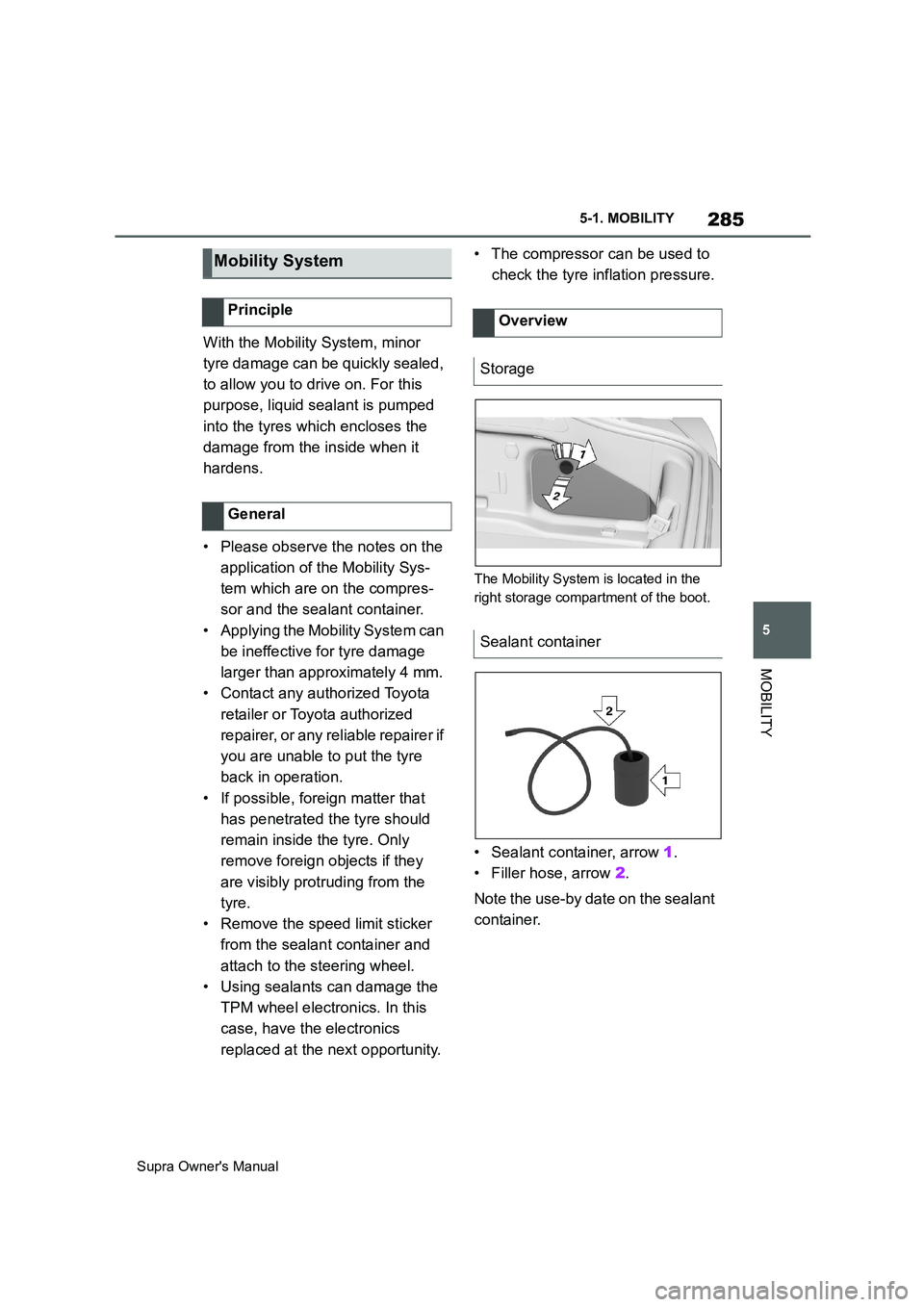
The Mobility System is located in the
right storage compartment of the boot.
• Sealant container, arrow 1.
• Filler hose, arrow 2.
Note the use-by date on the sealant
container.
Mobility System
Principle
GeneralOverview
Storage
Sealant container