2019 MERCEDES-BENZ SPRINTER brake pads
[x] Cancel search: brake padsPage 129 of 354

#
Remo vekey1 from your keyring. #
Inse rtkey1 into the slot.
The vehicle is star ted af ter a brief time. #
Leavetheke y inser ted during the entire jour‐
ne y. #
Ifyo u pull key1 out of the slot, the engine
continues torun. #
Have key1 checked at a qualified specialist
wo rkshop.
If th eve hicle does not star t: #
Leavekey1 inthe slot. #
Press the brake pedal. #
Start theve hicle with thest art/ stop button.
% Yo
u can also swit chon the po wer supp lyor
th e ignition with thest art/ stop button. Breaking-in no
tes Pr
otect the engine during thefirs t1, 000 miles
(1,500 km) by:
R driving at varying road and engine speeds.
R shifting tothe next gear up when or before
th etac home ter needle is 00C3ofthewa yto the
re d area.
R avoiding stre ss on theve hicle such as driving
at full thro ttle.
R not shi fting manually toa lo werge ar to brake.
R afte r1, 000 miles (1,500 km), gradually
increasing the engine speed and accelerate
th eve hicle up tofull speed.
R vehicles with automatic transmission: not
depressing the accelera tor pedal be yond the
pressure point (kickdown). This also applies if
the engine or parts of the driv‐
et ra in ha vebeen replaced.
Also obser vethefo llowing breaking-in no tes:
R The sensors of the ESP ®
driving saf ety sy stem
adjust automatically while a cer tain di stance
is being driven af terth eve hicle has been
delivered or af terre pairs. Full sy stem ef fec‐
tiveness is not reached until the end of this
te ach-in process.
R New or exch anged brakepads, brake discs
and tires only pr ovide optimal braking and
bonding af ter se veral hundred kilom eters.
Un tilthen, compensate forth ere duced brak‐
ing ef fect by applying greater pressure tothe
brake pedal. Driving tips
Note
s on driving &
WARNING Risk of accident due to
objects in the driver's foot we ll
Objects in the driver's foot we ll may impede
pedal tr avel or block a depressed pedal.
This jeopardizes the operating and road
saf ety of theve hicle. #
Stow all objects in theve hicle securely
so that they cannot getinto the driver's
fo ot we ll. #
Ensure floor mats and carpets cannot
slip and pr ovide suf ficient room forthe
pedals. #
Do not lay multiple floor mats or carpets
on top of one ano ther. &
WARNING Risk of accident due to
unsuitable foot we ar
Operation of the pedals may be restricted due
to unsuitable foot we ar such as:
R Shoes with plat form soles
R Shoes with high heels
R Slippers #
When driving alw ayswe ar suitable
shoes in order tobe able tooperate the
pedals safel y. Driving and pa
rking 105
Page 132 of 354

Information about transport
byrail
Tr ansporting your vehicle byrail may be subject
to cer tain restrictions or requ ire special meas‐
ures tobe take n in some countries due tovarying
tunnel heights and loading standards.
Yo u can obtain information about this from any
authorized Mercedes-Benz Center.
Note s on brakes &
WARNING Risk of skidding and of an
accident due toshifting down on slippery
ro ad sur faces
If yo u shift down on slippery road sur faces to
inc rease the engine braking ef fect, the drive
wheels may lose traction. #
Do not shift down on slippery road sur‐
fa ces toinc rease the engine braking
ef fect. &
WARNING Risk of accident due tothe
brake sy stem overheating
If yo u lea veyour foot on the brake pedal
when driving, the brake sy stem may overheat.
This increases the braking dis tance and the
brake sy stem may evenfa il. #
Never use the brake pedal as a foot re st. #
Do not depress the brake pedal and the
accelerator pedal at the same time
while driving. Downhill
gradients
On long and steep downhill gradients you should
obse rveth efo llowing instructions:
R invehicles with an automatic transmission,
shift down toshift ranges 2or 1in good time
so that the engine is running at a medium to
high engine speed (/ page117).
% Cha
nge the shift range in good time when
cruise control is acti vated. Obser vethe driv‐
ing tips (/ page105).
Yo uth ereby make use of the braking ef fect of the
engine and do not ha vetobrake as of tento main‐
tai nth e speed. This relie vesth e load on the
service brake and pr events the brakes from over‐
heating and wearing tooqu ickl y. Heavy and light loads &
WARNING Risk of accident due tothe
brake sy stem overheating
If yo u lea veyour foot on the brake pedal
when driving, the brake sy stem may overheat.
This increases the braking dis tance and the
brake sy stem may evenfa il. #
Never use the brake pedal as a foot re st. #
Do not depress the brake pedal and the
accelerator pedal at the same time
while driving. If
th e brakes ha vebeen subjected toa heavy
load, do not stop theve hicle immediately. Drive
on for a short while. The brakes cool down more
qu ickly in the air flow.
If th e brakes ha vebeen used only moderatel y,
yo u should occasionally test their ef fectiveness.
To do this, brake more firm lyfrom a higher speed
while paying attention tothe tra ffic conditions.
The brakes will grip better as a result.
We tro ad sur faces
If yo u ha vebeen driving for a long time in heavy
ra in without braking, there may be a dela yed
re sponse when youfirs t apply the brakes. This
may also occur af ter driving thro ugh a car wash
or deep water.Yo u must depress the brake pedal
more firm ly. Main tain a longer di stance tothe
ve hicle in front.
While paying attention tothe tra ffic conditions,
yo u should brake theve hicle firm ly af ter driving
on a wetro ad sur face or thro ugh a car wash. This
heats the brake discs so that they dry more
qu ickl y,which pr otects them against cor rosion.
Limited braking ef fect on salt-trea tedro ads:
R a layer of salt on the brake discs or brakepads
can increase braking dis tances conside rably,
or braking may happen on only one side
R maintain an especially lar gesafe dis tance to
th eve hicle in front
To remo vethe la yer of salt:
R apply the brakes from time totime, paying
attention totraf fic conditions
R carefully dep ress the brake pedal at the end
of a journey and af terth est art of a new jour‐
ney
Checking the brakepad thickness
In addition tomonitoring using the brakepad wear
sensor, regular lymonitor and check all of the 108
Driving and pa rking
Page 133 of 354

brakepads
byper form ing a visual inspection to
look for pad material wear.
If yo u are unable tocheck the brakepad wear on
th e inside of the wheels, remo vethe wheels if
yo u possess there qu ired skills, or visit a qualified
specialist workshop.
If th e brakepad material thickness is less than
0. 12 in (3 mm), ha vethe brakepads checked and
re placed at a qualified specialist workshop, if
necessar y.
Do not solely rely on the brakepad wear sensor.
It is also strongly recommended that you ha ve
th e brakepads checked at a qualified specialist
wo rkshop, not only at everyservice displa yedby
th e maintenance inter val displa y,but also prior to
long journe ysand when ever the wheels are
re mo ved.
Ne w brake discs and brakepads
New brakepads and brake discs on lyreach their
optimal braking ef fect af ter appro ximately
10 0 miles (100 kilome ters).
Unti lth en, compensate forth ere duced braking
ef fect by applying greater pressure tothe brake
pedal. For saf etyre asons, Mercedes-Benz recom‐
mends that you only ha vebrakepads and brake
discs which are appr ovedby Mercedes-Benz
ins talled on your vehicle.
Other brake discs or brakepads may compromise
th e saf ety of your vehicle.
Alw aysre place all brake discs and brakepads on
an axle at the same time. Alw ays ins tall new
brakepads when replacing brake discs.
Pa rking brake &
WARNING Risk of skidding or an acci‐
dent bybraking with the parking brake
If yo u ha vetobrake your vehicle with the
parking brake, the braking dis tance is consid‐
erab lylonger and the wheels may loc k.There
is an increased risk of skidding and/or acci‐
dent. #
Only brake theve hicle with the parking
brake if the service brake has failed. #
Inthis case, do not apply the parking
brake with too much forc e. #
Ifth e wheels loc k,immediately release
th e parking brake as much as required
fo rth e wheels toturn again. Ve
hicles with a manual parking brake
When driving on wetro ads or dirt-co vered sur fa‐
ces, road salt or dirt may getinto the parking
brake. This causes cor rosion and a reduction of
braking forc e.
In order topreve ntthis, drive with the parking
brake lightly applied from time totime.
When doing so, drive for a dis tance of appr ox‐
imately 300 ftat a maximum speed of 13mph
(20 km/h).
The brake lights do not light up when you brake
th eve hicle with the parking brake.
Information about driving on wetroads
Hydroplaning &
WARNING Risk of aquaplaning because
tire tread is too low
Depending on the dep thofthewate r onthe
ro adw ay, aquaplaning can occur despite suf fi‐
cient tire tread dep thand low speed. #
Avoid tire ruts and brake carefully. The
refore , in heavy rain or other conditions in
which hydroplaning can occur, drive as follo ws:
R Reduce your speed.
R Avoid tire ruts.
R Brake carefully.
Driving on flooded roads
Bear in mind that vehicles tr aveling in front or in
th e opposite direction create waves. This may
cause the maximum permissible dep thofwa ter
to be exc eeded. These no tes must be obser ved
under all circum stances. Otherwise, you can
damage the engine, electrics and transmission.
If yo u ha vetodrive on stre tches of road on which
wa ter has collected, please bear in mind thefo l‐
lowing:
R The wate r level of standing water may not be
abo vethe lo wer edge of the front bumper.
R You may drive no faster than walking pace.
Obser vethe no tes on ford ing while off- road for
all-wheel drive vehicles (/ page110). Driving and parking
109
Page 137 of 354
This increases
road adhesion, especially on
we tro adw ays.
R Check the wheels and tires and wheel wells
fo r trapped fore ign objects and remo vethem.
Tr apped fore ign objects can damage the
wheels and tires or may be flung out from the
ve hicle when continuing the journe y.
R Check the underbody for trapped branches or
ot her parts of plants and remo vethem.
R Clean the brake discs, brakepads and axle
joints, particularly af ter operation in sand,
mud, grit and gr avel,wa ter or similar lydirty
conditions.
R Check the entire floor assembly, the tires,
wheels, bodywork stru cture, brakes, steering,
suspension and exhaust sy stem for any dam‐
age.
R Check the service brake for operating saf ety,
e.g. car ryout a brake test.
R Ifyo u notice strong vib rations af ter driving
off-road, check the wheels and driv etra in for
fo re ign objects again. Remo veany fore ign
objects which can lead toimbalances and
th us cause vibrations. In theeve nt of damage
to the wheels and the drive train, visit a quali‐
fi ed specialist workshop immediately. ECO display function
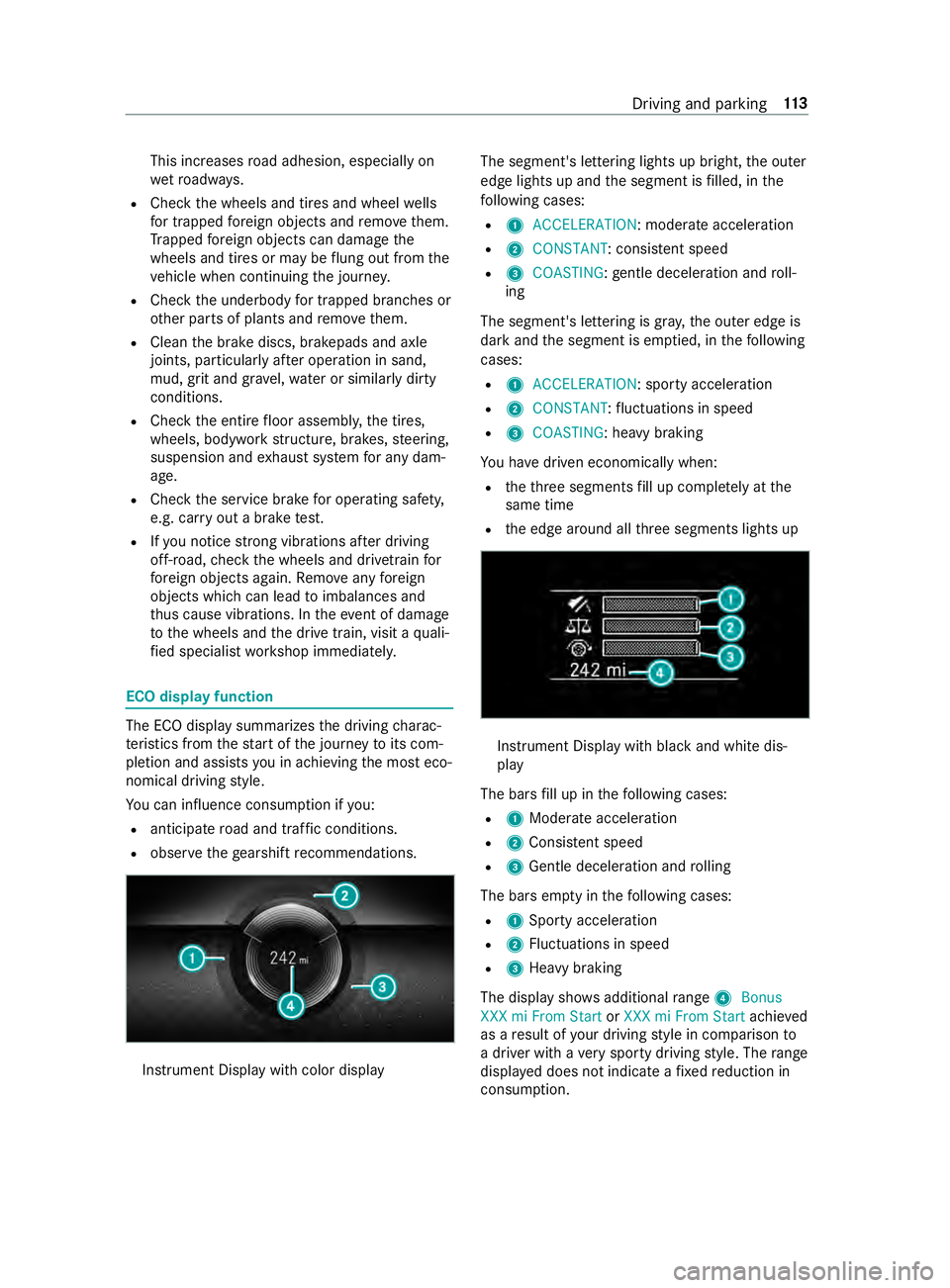
The ECO display summarizes
the driving charac‐
te rist ics from thest art of the journey toits com‐
pletion and assists you in achieving the most eco‐
nomical driving style.
Yo u can influence consum ption if you:
R anticipate road and traf fic conditions.
R obser vethege arshift recommendations. Instrument Display wi
thcolor display The segment's lettering lights up bright,
the outer
edge lights up and the segment is filled, in the
fo llowing cases:
R 1 ACCELERATION : moderate acceleration
R 2 CONSTANT: consis tent speed
R 3 COASTING: gentle deceleration and roll‐
ing
The segment's lettering is gray ,th e outer edge is
dark and the segment is em ptied, in thefo llowing
cases:
R 1 ACCELERATION: sporty acceleration
R 2 CONSTANT :fl uctuations in speed
R 3 COASTING: heavy braking
Yo u ha vedriven economically when:
R theth re e segments fill up comple tely at the
same time
R the edge around all thre e segments lights up Instrument Display with black and white dis‐
play
The bars fill up in thefo llowing cases:
R 1Moderate acceleration
R 2Consis tent speed
R 3Gentle deceleration and rolling
The bars em pty in thefo llowing cases:
R 1Sporty acceleration
R 2Fluctuations in speed
R 3Heavy braking
The display sho wsadditional range 4Bonus
XXX mi From Start orXXX mi From Start achieved
as a result of your driving style in comparison to
a driver with a very sporty driving style. The range
displ ayed does not indicate a fixe dre duction in
consum ption. Driving and parking
11 3
Page 237 of 354

Obser
vethefo llowing no tes: Note
s on cleaning and car ePreve nting damage totheve hicle
Wheels/rims Usewate r and acid-free wheel cleaner. R
Do not use acidic wheel cleaners to
re mo vebrake dust. Otherwise, wheel
bolts and brake components may be
damaged.
R Toavo id cor rosion of brake discs and
brakepads, drive for a few minutes
af te r cleaning before parking the
ve hicle. The brake discs and brake‐
pads warm up and dry out.
Wi ndo ws
Clean wind owsinside and outside with a
damp clo thand with a cleaning agent
re commended for Mercedes-Benz . Do not use dry clo
ths or abrasive or sol‐
ve nt-based cleaning agents toclean the
inside of windo ws.
Wi per blades
Carefully clean thefo lded-a way wiper
blades with a damp clo th.Do not clean
the wiper blades too of ten.
Ex terior
lighting Clean
the lenses with a wet sponge and
mild cleaning agent, e.g. car sha mpoo. Only use cleaning agents or clo
ths suita‐
ble for plast ic lenses.
Sensors Cleanthe sensors in the front and rear
bumper and in thera diator grill with a
soft clo thand car shampoo. When using a po
werwa sher, keep a min‐
imum dis tance of 11.8 in (30 cm).
Re ar view
camera and
360° Cam‐
era Use clean
water and a soft clo thtoclean
th e camera lens. Do not use a po
werwa sher.
Tr ailer hitch
R
Remo vetraces of rust on the ball,
e.g. with a wire brush.
R Remo vedirt with a lint-free clo th.
R After cleaning, lightly oil or grease
th e ball head.
R Obser vethe no tes on care in the
trailer hitch manufactu rer's operat‐
ing instructions. Do not clean
the ball neck with a po wer
wa sher or sol vent.
Sliding door R
Remo vefore ign objects from the
vicinity of the contact plates and
contact pins of the sliding door.
R Clean the contact plates and contact
pins with a mild cleaning agent and a
soft clo th. Do not oil or grease
the contact plates
and the contact pins. Maintenance and care
213
Page 303 of 354
Display messages
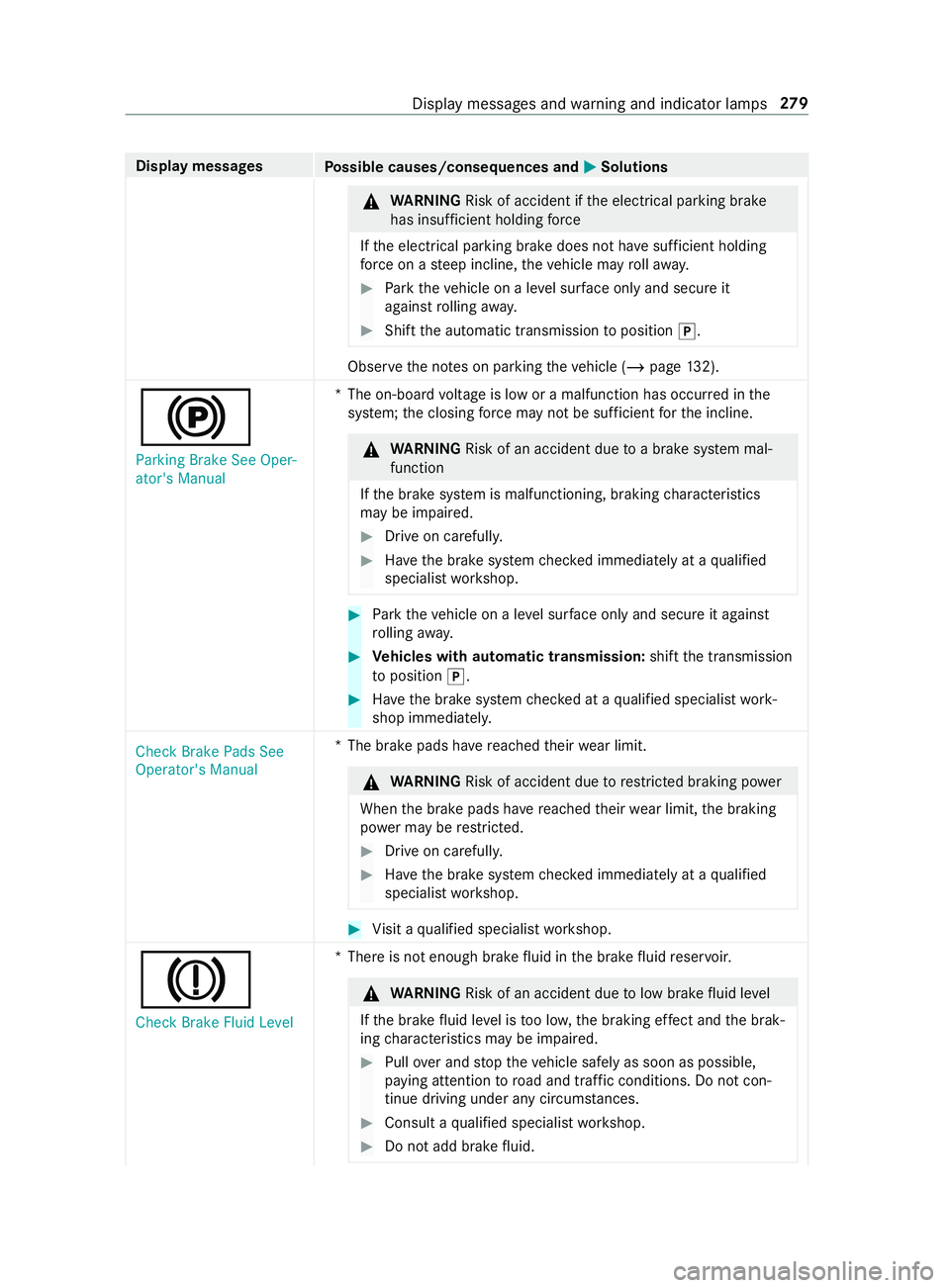
Possible causes/consequences and 0050 0050Solutions &
WARNING Risk of accident if the electrical parking brake
has insuf ficient holding force
If th e electrical parking brake does not ha vesuf ficient holding
fo rc e on a steep incline, theve hicle may rollaw ay. #
Park theve hicle on a le vel sur face only and secu reit
against rolling away. #
Shift the automatic transmission toposition 005D. Obser
vethe no tes on parking theve hicle (/ page132).
0024
Parking Brake See Oper-
ator's Manual *T
he on-board voltage is low or a malfunction has occur red in the
sy stem; the closing forc e may not be suf ficient forth e incline. &
WARNING Risk of an accident due toa brake sy stem mal‐
function
If th e brake sy stem is malfunctioning, braking characteristics
may be impaired. #
Drive on carefull y. #
Have the brake sy stem checked immediately at a qualified
specialist workshop. #
Park theve hicle on a le vel sur face only and secu reit against
ro lling away. #
Vehicles with automatic transmission: shiftthe transmission
to position 005D. #
Have the brake sy stem checked at a qualified specialist work‐
shop immediatel y.
Check Brake Pads See
Operator's Manual *T
he brake pads ha vereached their wear limit. &
WARNING Risk of accident due torestricted braking po wer
When the brake pads ha vereached their wear limit, the braking
po we r may be restricted. #
Drive on carefully. #
Have the brake sy stem checked immediately at a qualified
specialist workshop. #
Visit a qualified specialist workshop.
004D
Check Brake Fluid Level *T
here is not enough brake fluid in the brake fluid reser voir. &
WARNING Risk of an accident due tolow brake fluid le vel
If th e brake fluid le vel is too lo w,the braking ef fect and the brak‐
ing characteristics may be impaired. #
Pull over and stop theve hicle safely as soon as possible,
paying attention toroad and traf fic conditions. Do not con‐
tinue driving under any circums tances. #
Consult a qualified specialist workshop. #
Do not add brake fluid. Display messages and
warning and indicator lamps 279
Page 332 of 354
Braking wi
thparking brake: .............. 108
Breaking-in no tes ............................. 105
Downhill gradient ............................. 108
Driving tips ....................................... 105
EBD (electronic brake forc e distri‐
bution) ..............................................1 39
Heavy and light loads ....................... 108
HOLD function .................................. 14 5
New brake discs and brake pads/
linings ............................................... 108
Re stricted braking ef fect (salt-trea‐
te dro ads) ........................................ .105
We tro ad sur faces ............................ 108
Brake Assi stSystem
see BAS (Brake Assi stSystem)
Brake Assistance see BAS (Brake Assi stSystem)
Brake fluid
No tes ............................................... 269
Brake forc e distribution
EBD (electronic brake forc e distri‐
bution) ..............................................1 39
Brakes New/replaced brakepads/brake
discs ................................................. 105
Breakdown Assi stance overview .......................... .16
Changing a wheel ............................ .251
Ro adside Assis tance ........................... 21
To w starting .................................... .228
To wing away ..................................... 225
Tr ansporting theve hicle ...................2 27
Breakdown see Flat tire
Breaking-in no tes ................................. 105
Bulbs Reversing light .................................... 87
Buttons Steering wheel ..................................1 64C
Call list Making a call .................................... 186
Overview .......................................... 185
Selecting options .............................. 186
Calls ...................................................... .184
Ac cepting ......................................... 184
Ac tivating functions du ring a call ...... 184
Calls with se veral participants .......... 184
Declining .......................................... 184
Ending a call .................................... .184 Incoming call during an
existing
call .................................................. .184
Making ............................................. 184
Camera see 360° Camera
see Rear view camera
Car wash
see Care
Car wash (care) .....................................2 10
Care ........................................................ 214
Car wash ...........................................2 10
Carpet .............................................. .214
Displ ay.............................................. 214
Exterior lighting ................................ 212
Headliner .......................................... 214
Matte finish ....................................... 211
Pa int ................................................ .211
Plastic trim ....................................... 214
Po we rwa sher ................................... 210
Re alwo od/trim elements ................. 214
Re ar view camera/360° Camera ...... 212
Seat belt ........................................... 214
Seat co ver ........................................ 214
Senso rs............................................ 212
Ta ilpipes ............................................ 212
Tr ailer hit ch....................................... 212
Wa shing byhand ...............................2 11
Wheels/rims .....................................2 12
Wi ndo ws ........................................... 212
Wi per blades .....................................2 12
Cargo compa rtment lighting
Motion de tector .................................. 83
Cargo co mpartment ventilation
Deactivating .....................................1 02
Setting .............................................. 102
Cargo tie-down point ............................197
Cargo tie-down points Info rm ation ...................................... .275
Carpet (care) ........................................ .214
Change bulbs Additional turn signal light (all-
wheel drive vehicles) .......................... 85
Changing a bulb see Changing bulbs
Changing a wheel Lowe ring theve hicle ........................ 254
Preparing .......................................... 251
Ra ising theve hicle ............................2 51
Re moving a wheel ............................ 253
Changing address ................................... 21308
Index
Page 335 of 354

Ad
aptive Highbeam Assist Cur‐
re ntly Una vailable See Opera tor's
Manual ............................................. 296
Ad aptive Highbeam Assist Inopera‐
tive .................................................. .296
0099 Additive Sy stem Fault Emer‐
ge ncy Op.: XXX mph See Opera‐
to r's Manual .................................... .290
0099 Additive Sy stem Fault See
Operator's Manual ...........................289
0099 Additive Sy stem Fault Starts
until Emerg. Op.: XXX See Opera‐
to r's Manual .................................... .289
Air Conditioning Malfunction See
Operator's Manual ............................ 294
Apply Brake toShift from 'P' ............ 295
00AD ATTENTION ASSIST Inopera‐
tive ................................................... 285
00AD ATTENTION ASSIS T:Take a
Break! ............................................... 285
0049 AutoLamp Function Inopera‐
tive ................................................... 296
Au xilia ryBattery Malfunction ........... 294
Blind Spot Assi stCur rently
Un available See Operator's Manual
.......................................................... 284
Blind Spot Assist Inoperative ............ 284
Blind Spot Assist Trailer NotMoni‐
to re d ................................................ 284
004D Check Brake Fluid Le vel.......... 279
Check Brake Pads See Operator's
Manual .............................................2 79
00AC CheckCoolant Le vel See
Opera tor's Manual ........................... 288
00B2 Check Engine Oil AtNext
Re fueling .......................................... 287
00B2Che ckEngine Oil Le vel (Add 1
Liter) ................................................ 286
003ACheck Fuel Filter ......................2 86
0049Che ckLeft Low Beam (e xam‐
ple) .................................................. .296
0077Che ckTire s .............................. 291
00B2 Check Washer Fluid ................2 9200AC
Coolant Too Hot Stop Vehicle
Tu rn Engine Off ................................ 288
Cruise Control Inoperati ve............... 283
00CE Currently Un available Cam‐
era Dirty .......................................... .283
Curr ently Un available Radar Sen‐
sors Dirty .........................................2 84
0025 Currently Una vailable See
Opera tor's Manual ........................... 282
00E5Curr ently Unavailable See
Operator's Manual ............................ 281
00AFDon't Forget Your Key.............. .291
Driver's Door Open & Transmission
Not in P Risk of Vehicle Rolling
Aw ay ................................................ 295
00B3Engine Oil Le vel Cann otBe
Measured ......................................... 286
00B2 Engine Oil Le vel Low Stop
Ve hicle Turn Engine Off .................... 286
00B2Engine Oil Pressure Stop
Switch Off Engine ............................. 286
00B2 Engine Oil Reduce Oil Le vel.... .2 86
0075Fr ont Left Malfunction
Service Required (e xample).............. 277
00D4 Fuel Le vel Low ........................ .285
0024Incline TooSt eep See Opera‐
to r's Manual ..................................... 278
003B Inoperative Battery Low ...........293
003B Inoperative Refuel Vehicle .......2 93
0025 Inoperative See Operator's
Manual ............................................. 282
00E5Inope rative See Operator's
Manual ............................................ .281
007A Inoperative See Operator's
Manual .............................................2 81
003B Inoperative See Operator ’s
Manual ............................................. 293
00AFKe yNot De tected (red dis‐
pl ay messa ge)...................................2 91
00AF KeyNot De tected (white dis‐
pl ay messa ge).................................. 292 Index
311