2019 MERCEDES-BENZ SPRINTER warning light
[x] Cancel search: warning lightPage 233 of 354

#
Neverto uch the danger zone sur round‐
ing moving component parts, e.g. the
ro tation area of thefa n. #
Remo vejewe lry and watches. #
Keep items of clo thing and hair away
from moving parts. &
WARNING Risk of bu rns from hot com‐
ponent parts in the engine compartment
Cer tain components in the engine compart‐
ment can be very hot, e.g. the engine, the
ra diator and parts of theex haust sy stem. #
Allow the engine tocool down and only
to uch component parts desc ribed in the
fo llowing. If
yo u ha vetocar ryout any workinthe engine
compartment, touch only thefo llowing compo‐
nents:
R Hood
R Engine oil filler opening cap
R Washer fluid reser voir cap
R Coolant expansion reser voir cap #
Open the hood (/ page 202). #
Remo vedirt from water drain valve 2 of air
intake box 1. Draining
the fuel filter &
WARNING Danger of fire and explosion
due tofuel
Fu els are highly flammable. #
It is essential toavoid fire , open flames,
smoking and creating spar ks. #
Before filling up, switch off the engine,
and, if applicable, the auxiliary heating. &
WARNING Risk offire and explosion due
to fuel
Fu els are highly flammable. There is a risk of
fi re and explosion due tocontact wi thhot
component parts. #
Allow the engine and theex haust sys‐
te m to cool down. *
NO
TEEngine damage due todela yed
drainage of the fuel filter Ve
hicles with a diesel engine: delayed
drainage of the fuel filter can lead toengine
damage.
If th e003A indicator lamp lights up, drain the
fuel filter immediately. +
ENVIRONMENTAL
NOTEEnvironmental
pollution due todisposal in a non-envi‐
ro nmental ly-friendly manner #
Dispose of thewate r/fuel mixture in an
environmentally-friendly manner. Mo
tor OM642 #
Park theve hicle in a safe location and secure
it against rolling away. #
Switch off the auxiliary heating
(/ page 100). #
Switch off the engine. #
Open the hood (/ page 202). Maintenance and care
209
Page 236 of 354
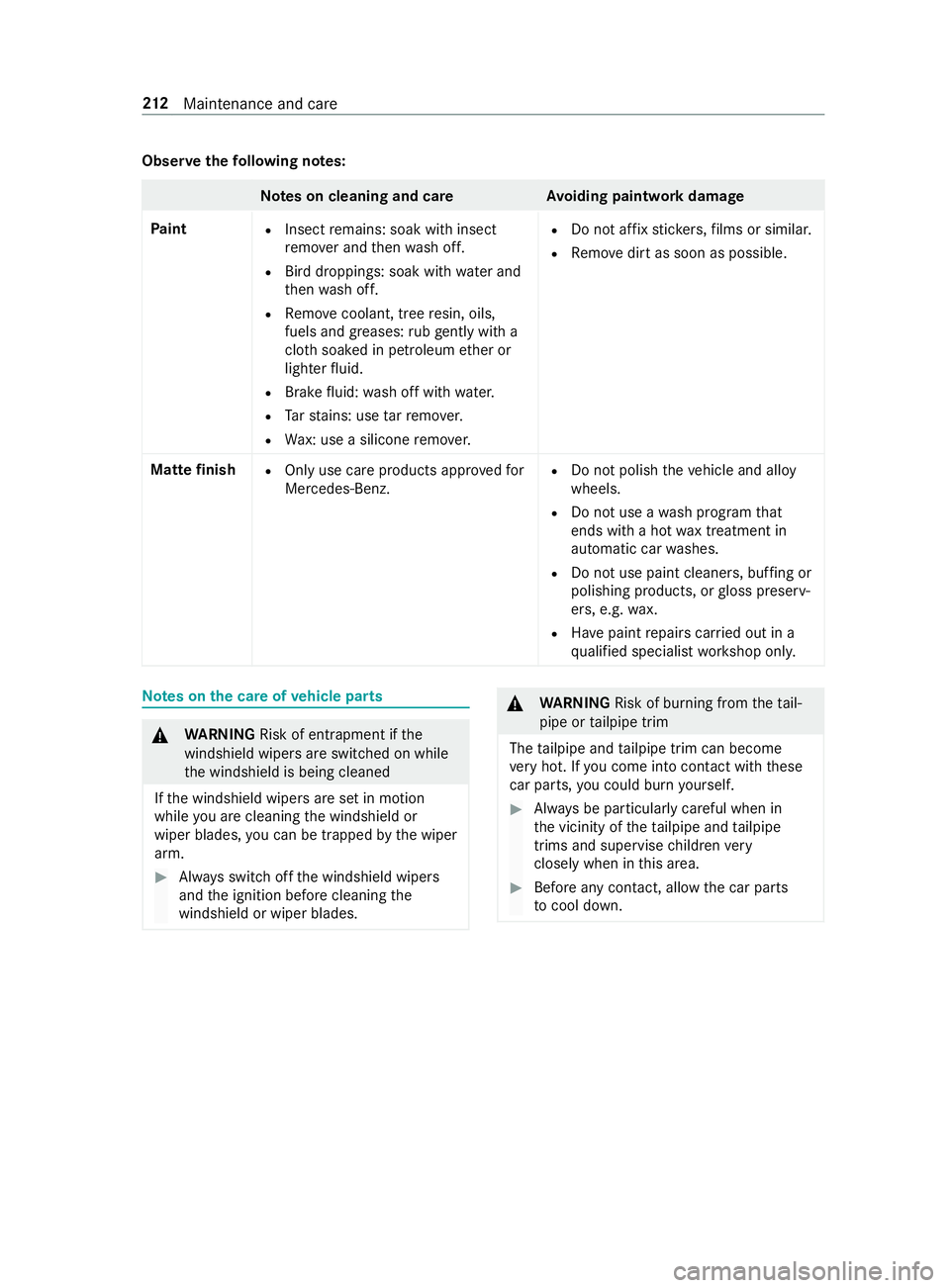
Obser
vethefo llowing no tes: Note
s on cleaning and car eAvoiding paintwork damage
Pa int
R
Insect remains: soak with insect
re mo ver and then wash off.
R Bird droppings: soak with water and
th en wash off.
R Remo vecoolant, tree resin, oils,
fuels and greases: rubge ntly wi th a
clo thsoaked in petroleum ether or
lighter fluid.
R Brake fluid: wash off with water.
R Tarst ains: use tarre mo ver.
R Wax: use a silicone remo ver. R
Do not af fix st icke rs,fi lms or similar.
R Remo vedirt as soon as possible.
Mat tefinish
R
Only use care products appr ovedfor
Mercedes-Benz. R
Do not polish theve hicle and alloy
wheels.
R Do not use a wash program that
ends with a hot wax treatment in
au tomatic car washes.
R Do not use paint cleaners, buf fing or
polishing products, or gloss preserv‐
ers, e.g. wax.
R Have paint repairs car ried out in a
qu alified specialist workshop onl y. Note
s onthe care of vehicle parts &
WARNING Risk of entrapment if the
windshield wipers are swit ched on while
th e windshield is being cleaned
If th e windshield wipers are set in motion
while you are cleaning the windshield or
wiper blades, you can be trapped bythe wiper
arm. #
Always switch off the windshield wipers
and the ignition before cleaning the
windshield or wiper blades. &
WARNING Risk of bu rning from theta il‐
pipe or tailpipe trim
The tailpipe and tailpipe trim can become
ve ry hot. If you come into con tact wi th these
car parts, you could burn yourself. #
Always be particularly careful when in
th e vicinity of theta ilpipe and tailpipe
trims and supervise children very
closely when in this area. #
Before any con tact, allow the car parts
to cool down. 212
Maintenance and care
Page 238 of 354
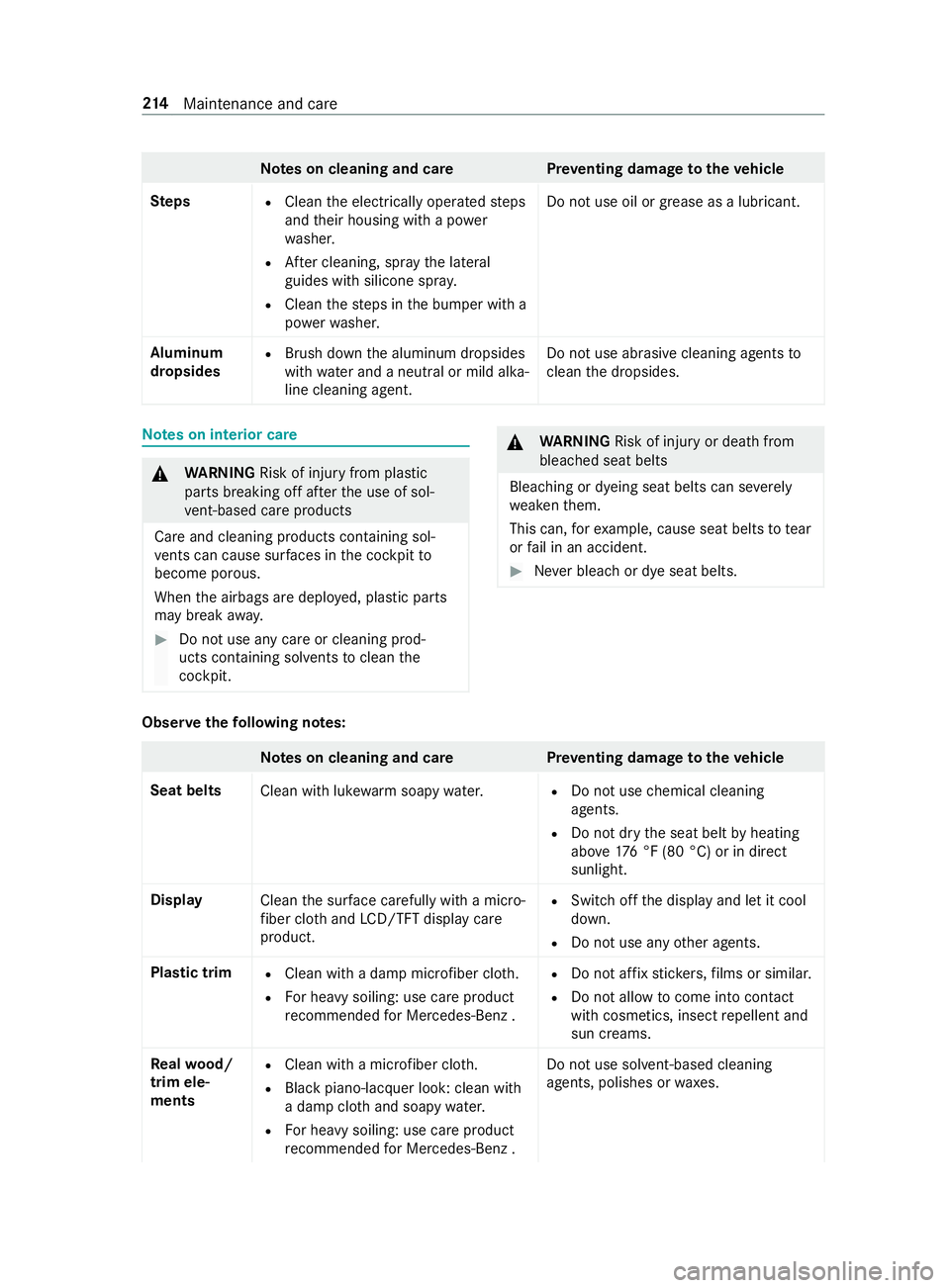
Note
s on cleaning and car ePreve nting damage totheve hicle
Ste ps
R
Clean the electrically operated steps
and their housing with a po wer
wa sher.
R After cleaning, spr aythe lateral
guides with silicone spr ay.
R Clean thesteps in the bumper with a
po we rwa sher. Do not use oil or grease as a lubricant.
Aluminum
dropsides R
Brush down the aluminum dropsides
with water and a neutral or mild alka‐
line cleaning agent. Do not use abrasive cleaning agents
to
clean the dropsides. Note
s on interior care &
WARNING Risk of inju ryfrom pla stic
parts breaking off af terth e use of sol‐
ve nt-based care products
Ca reand cleaning products con taining sol‐
ve nts can cause su rfaces in the cockpit to
become porous.
When the airbags are deplo yed, plastic parts
may break away. #
Do not use any care or cleaning prod‐
ucts containing sol vents toclean the
cockpit. &
WARNING Risk of inju ryor death from
bleached seat belts
Bleaching or dyeing seat belts can se verely
we aken them.
This can, forex ample, cause seat belts totear
or fail in an accident. #
Never blea chor dye seat belts. Obser
vethefo llowing no tes: Note
s on cleaning and car ePreve nting damage totheve hicle
Seat belts Clean with lukewarmsoapy water. R
Do not use chemical cleaning
agents.
R Do not dry the seat belt byheating
abo ve176 °F (80 °C) or in direct
sunlight.
Display Cleanthe sur face carefully wi tha mic ro‐
fi ber clo thand LCD/TFT displ aycare
product. R
Switch off the display and let it cool
down.
R Do not use any other agents.
Plastic trim R
Clean with a damp microfiber clo th.
R For heavy soiling: use care product
re commended for Mercedes-Benz . R
Do not af fix st icke rs,fi lms or similar.
R Do not allow tocome into contact
wi th cosmetics, insect repellent and
sun creams.
Re alwo od/
trim ele‐
ments R
Clean with a mic rofiber clo th.
R Blackpiano-lacquer look: clean with
a damp clo thand soapy water.
R For heavy soiling: use care product
re commended for Mercedes-Benz . Do not use sol
vent-based cleaning
agents, polishes or waxes. 214
Maintenance and care
Page 242 of 354
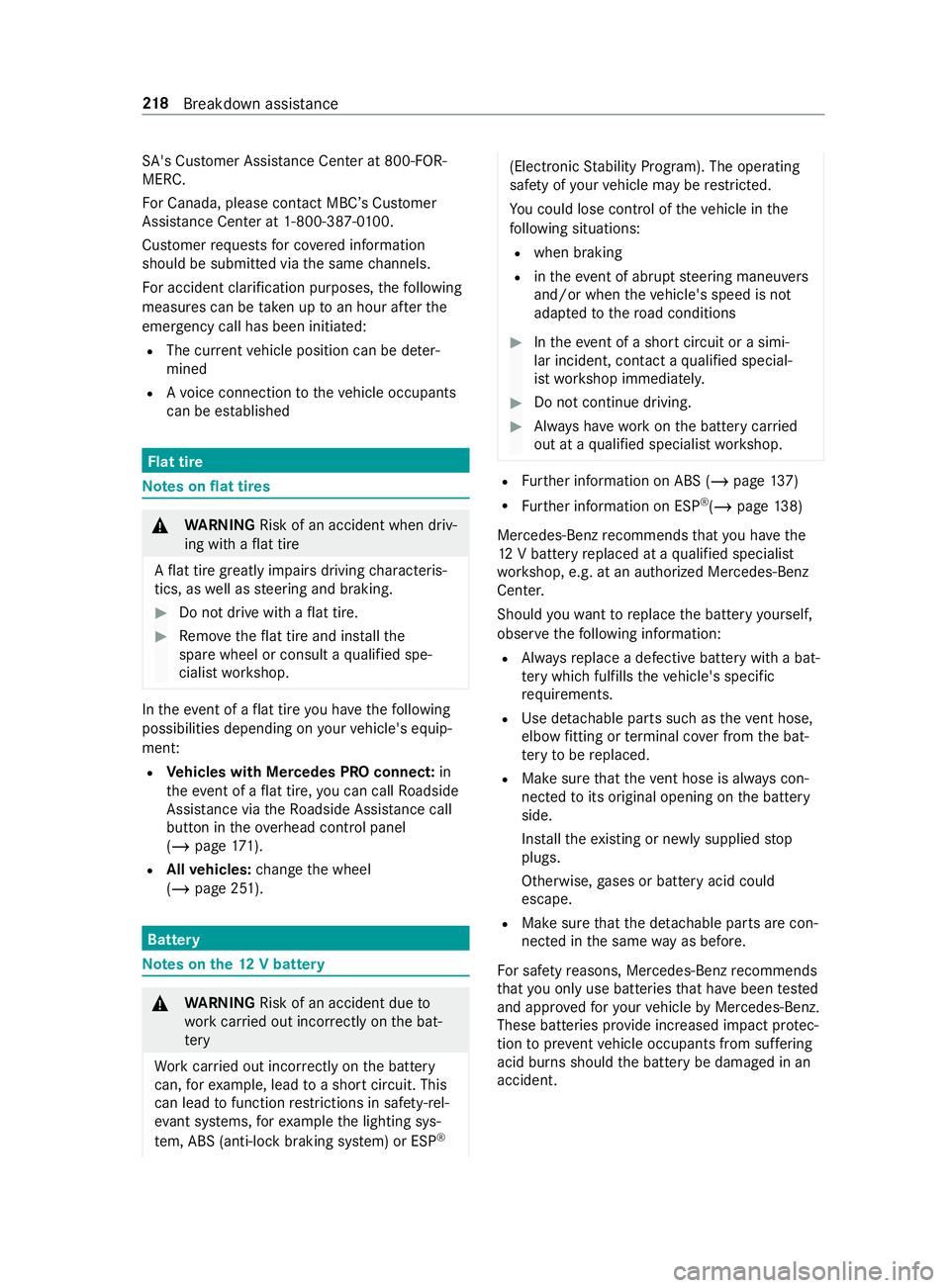
SA
's Cus tomer Assis tance Center at 800-FOR-
MERC.
Fo r Canada, please contact MBC’s Cust omer
Assis tance Center at 1-800-387-0 100.
Cust omer requ ests for co vered information
should be submitted via the same channels.
Fo r accident clarification purposes, thefo llowing
measures can be take n up toan hour af terthe
emer gency call has been initia ted:
R The cur rent vehicle position can be de ter‐
mined
R Avo ice connection totheve hicle occupants
can be es tablished Flat tire
Note
s onflat tires &
WARNING Risk of an accident when driv‐
ing wi thaflat tire
A flat tire greatly impairs driving characteris‐
tics, as well as steering and braking. #
Do not drive with a flat tire. #
Remo vetheflat tire and ins tallthe
spare wheel or consult a qualified spe‐
cialist workshop. In
theeve nt of a flat tire you ha vethefo llowing
possibilities depending on your vehicle's equip‐
ment:
R Vehicles with Mercedes PRO connec t:in
th eeve nt of a flat tire, you can call Roadside
Assis tance via theRo adside Assis tance call
button in theov erhead cont rol panel
(/ page 171).
R Allvehicles: change the wheel
(/ page 251). Batte
ry Note
s onthe12 V battery &
WARNING Risk of an accident due to
wo rkcar ried out incor rectly on the bat‐
te ry
Wo rkcar ried out incor rectly on the battery
can, forex ample, lead toa short circuit. This
can lead tofunction restrictions in saf ety-re l‐
eva nt sy stems, forex ample the lighting sys‐
te m, ABS (anti-lock braking sy stem) or ESP ® (Elect
ronic Stability Prog ram). The operating
saf ety of your vehicle may be restricted.
Yo u could lose control of theve hicle in the
fo llowing situations:
R when braking
R intheeve nt of ab rupt steering maneuvers
and/or when theve hicle's speed is not
adap tedto thero ad conditions #
Intheeve nt of a sho rtcircuit or a simi‐
lar incident, contact a qualified special‐
ist workshop immediately. #
Do not continue driving. #
Always ha vewo rkon the battery car ried
out at a qualified specialist workshop. R
Further information on ABS (/ page137)
R Further information on ESP ®
(/ page 138)
Me rcedes-Benz recommends that you ha vethe
12 V battery replaced at a qualified specialist
wo rkshop, e.g. at an authorized Mercedes-Benz
Center.
Should youwa nttoreplace the battery yourself,
obse rveth efo llowing information:
R Alwaysre place a defective battery with a bat‐
te ry which fulfills theve hicle's specific
re qu irements.
R Use de tach able parts such as theve nt hose,
elbow fitting or term inal co ver from the bat‐
te ry to be replaced.
R Make sure that theve nt hose is al ways con‐
nected toits original opening on the battery
side.
Ins tallth eex isting or newly supplied stop
plugs.
Otherwise, gases or battery acid could
escape.
R Make sure that the de tach able parts are con‐
nec ted in the same way as before.
Fo r saf etyre asons, Mercedes-Benz recommends
th at you only use bat teries that ha vebeen tested
and appr ovedfo ryo ur vehicle byMercedes-Benz.
These batteries pr ovide inc reased impact pr otec‐
tion topreve ntvehicle occupants from suf fering
acid bu rns should the battery be damaged in an
accident. 218
Breakdown assis tance
Page 244 of 354

&
WARNING Risk ofexplosion from hydro‐
ge nga s igniting
A battery generates hydrogen gas during the
ch arging process. If there is a short circuit or
spar ksstart toform ,th ere is a danger of the
hy drogen gas igniting. #
Make sure that the positive term inal of
th e connected battery does not come
into contact with vehicle parts. #
Never place me tal objects or tools on a
batter y. #
When connecting and disconnecting the
batter y,yo u must obse rveth e described
order forth e battery clamps. #
When giving starting assistance, alw ays
make sure that you on lyconnect battery
te rm inals with identical polarity. #
During starting assis tance, you must
obse rveth e described order for con‐
necting and disconnecting the jumper
cables. #
Do not connect or disconnect the bat‐
te ry cla mp s while the engine is running. &
WARNING Risk ofexplosion during
ch arging process and starting assis tance
During thech arging process and starting
assis tance, the battery may release an explo‐
sive gas mixture. #
Avoid fire , open flames, creating spar ks
and smoking. #
Make sure that there is suf ficient venti‐
lation du ring thech arging process and
during starting assis tance. #
Do not lean over a batter y. &
WARNING Risk ofexplosion from a fro‐
zen battery
A dischar ged battery may freeze at temp era‐
tures slightly abo veor below freezing point.
During starting assis tance or battery charg‐
ing, battery gas may be released. #
Alwaysth aw a frozen battery out first
before charging it or per form ing starting
assis tance. If
th ewa rning/indicator lamps do not light up in
th e instrument display around or below freezing point, it is
very likely that the discharged battery
has frozen.
In this case, obser vethefo llowing points:
R do not give theve hicle starting assis tance or
ch arge the battery
R the service life of a battery that has been
th awe d may be reduced drastically
R thest art-up behavior may de teriorate, partic‐
ularly at low temp eratures
R it is recommended that you ha veath awed
battery checked at a qualified specialist work‐
shop
* NO
TEDama gecaused bynume rous or
ex tended attempts tostart the engine Nume
rous or extended attempts tostart the
engine may damage the catalytic con verter
due tonon-combu sted fuel. #
Avoid numerous and extended attem pts
to start the engine. Obser
vethefo llowing points during starting
assis tance and when charging the battery:
R only use undamaged jumper cables/charging
cables with a suf ficient cross-section and
insula tedte rm inal clamps
R non-insulated parts of thete rm inal clamps
must not come into con tact wi thother me tal
parts while the jumper cables/charging
cables are connected tothe battery/jump-
st art connection point
R the jumper cables/charging cable must not
come into contact with any parts which may
mo vewhen the engine is running
R alwa ys make sure that nei ther you nor the
battery is electros tatically charged
R alwayske ep away from fire and open flames
R do not lean over a battery
R when charging: only use a battery charger
th at has been tested and appr ovedby
Mercedes-Benz and read the operating
instructions foryo ur charge r before charging
th e batter y.
Obser vethe additional following points during
st arting assis tance:
R starting assis tance may only be pr ovided
using batteries with a nominal voltage of 12 V
R theve hicles must not touch each other 220
Breakdown assis tance
Page 245 of 354

R
vehicles with a gasoline engine: only per‐
fo rm starting assis tance when the engine and
ex haust sy stem are cold #
Vehicles with a battery main switch: check
whe ther the battery main switch is switched
on (/ page114). #
Secu retheve hicle using the parking brake. #
Vehicles with automatic transmission:
shift the transmission toposition 005D. #
Switch off the ignition and all electrical con‐
sumers. #
Open the hood (/ page 202). Example: jump-s
tart connection point
% Right-hand-drive
vehicles: the jump-s tart
connection points may be on the opposite
side. #
Remo vethe co ver from the positive term inal
on the donor batter y. #
First, connect the positive term inal clamp of
th e jumper cables/charging cables tothe
positive term inal of theot her vehicle's bat‐
te ry. #
With positive term inal clamp 2ofthe
jumper cable, slide there d pr otective cap on
jump-s tart connection point 1back with a
clockwise turn. #
Connect the positive term inal clamp tothe
positive term inal of jump-s tart connection
point 1. #
During starting assistance: start the engine
of the donor vehicle and let it run at idle
speed. #
Connect the negative term inal of the donor
battery tothe ground point of your ow nve hi‐ cle with
the jumper cable/charging cable.
Begin with the donor batter y. #
During starting assistance: start the engine
on your ow nve hicle. #
When charging: start thech arging process. #
During starting assistance: letthe engine
ru nfo r a few minutes. #
During starting assistance: before discon‐
necting the jumper cable, switch on an elec‐
trical consumer on your ow nve hicle, e.g. the
re ar wind owheater or lighting.
When thest arting assis tance/charging process is
comple te: #
First,re mo vethe jumper cables/charging
cables from the ground point and negative
te rm inal of theot her vehicle's batter y,then
from the positive term inal of jump-s tart con‐
nection point 1and the positive term inal of
th eot her vehicle's batter y.Each time, begin
at the contacts on your ow nve hicle.
The red pr otective cap springs back toits ini‐
tial position when positive term inal clamp 2
is disconnected from jump-s tart connection
point 1.
Fu rther information can be obtained at a qualified
specialist workshop. Installing/removing
thefloor co vering (vehi‐
cles with rear wheel drive) &
WARNING Risk of accident due to
objects in the driver's foot we ll
Objects in the driver's foot we ll may impede
pedal tr avel or block a depressed pedal.
This jeopardizes the operating and road
saf ety of theve hicle. #
Stow all objects in theve hicle securely
so that they cannot getinto the driver's
fo ot we ll. #
Ensure floor mats and carpets cannot
slip and pr ovide suf ficient room forthe
pedals. #
Do not lay multiple floor mats or carpets
on top of one ano ther. Breakdown assis
tance 221
Page 259 of 354
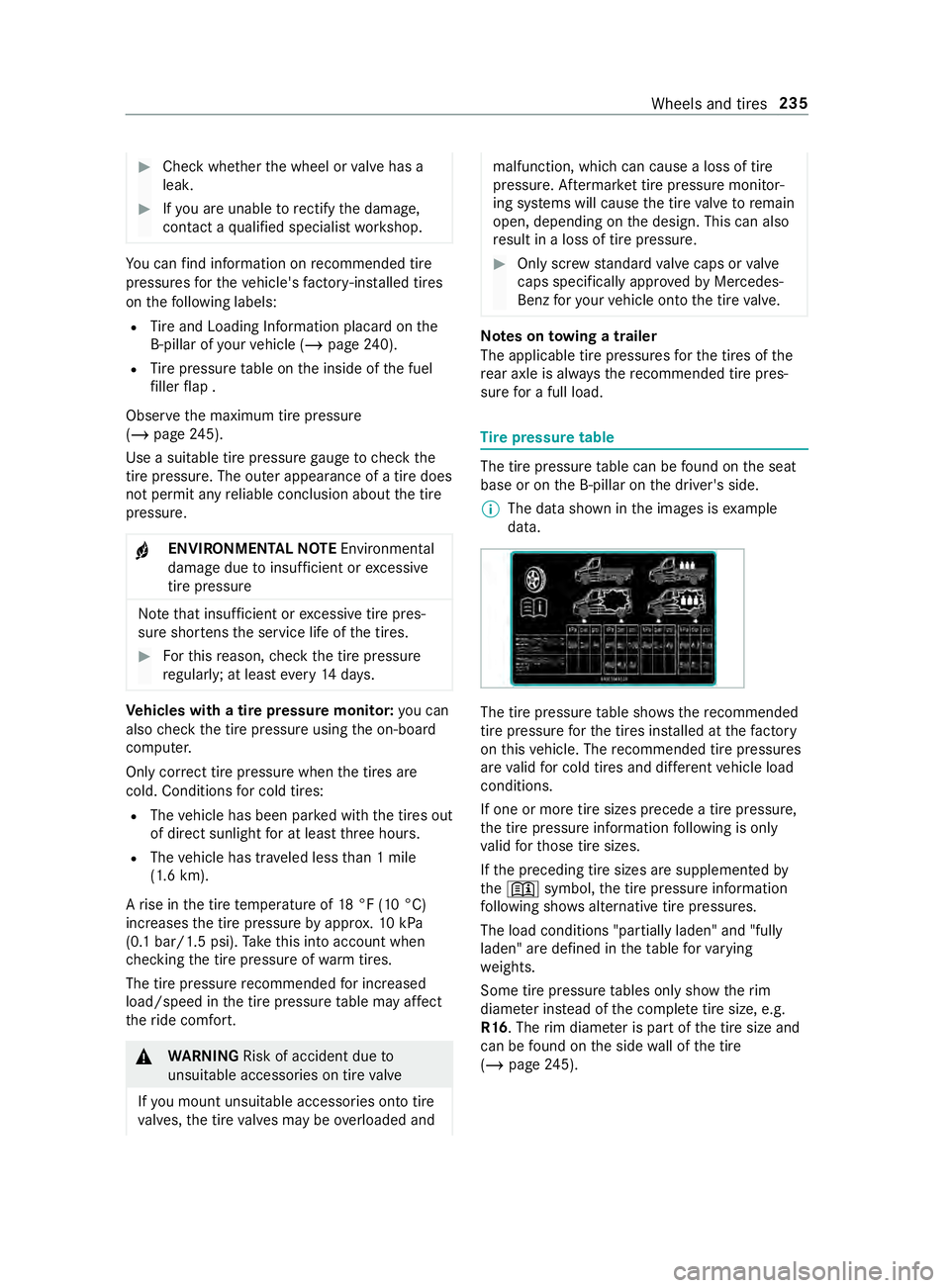
#
Check whe ther the wheel or valve has a
leak. #
Ifyo u are unable torectify the damage,
contact a qualified specialist workshop. Yo
u can find information on recommended tire
pressures forth eve hicle's factor y-ins talled tires
on thefo llowing labels:
R Tire and Loading In form ation placard on the
B‑pillar of your vehicle (/ page240).
R Tire pressure table on the inside of the fuel
fi ller flap .
Obse rveth e maximum tire pressure
(/ page 245).
Use a sui table tire pressure gauge tocheck the
tire pressure. The ou ter appearance of a tire does
not permit any reliable conclusion about the tire
pressure.
+ ENVIRONMEN
TALNO TEEnvironmental
damage due toinsuf ficient or excessive
tire pressure No
tethat insuf ficient or excessive tire pres‐
sure shor tens the service life of the tires. #
Forth is reason, check the tire pressure
re gularly; at least every14 days. Ve
hicles with a tire pressure monitor: you can
also check the tire pressure using the on-board
computer.
Only cor rect tire pressure when the tires are
cold. Conditions for cold tires:
R The vehicle has been par ked with the tires out
of direct sunlight for at least thre e hours.
R The vehicle has tr aveled less than 1 mile
(1.6 km).
A rise in the tire temp erature of 18°F (10 °C)
increases the tire pressure byappr ox.10 kPa
(0.1 bar/1.5 psi). Take this into account when
ch ecking the tire pressure of warm tires.
The tire pressure recommended for increased
load/speed in the tire pressure table may af fect
th eride comfort. &
WARNING Risk of accident due to
unsuitable accesso ries on tire valve
If yo u mount unsuitable accesso ries onto tire
va lves, the tire valves may be overloaded and malfunction, which can cause a loss of tire
pressure. Af term arke t tire pressure moni tor‐
ing sy stems will cause the tire valve toremain
open, depending on the design. This can also
re sult in a loss of tire pressure. #
Only scr ewstandard valve caps or valve
caps specifically appr ovedby Mercedes-
Benz foryo ur vehicle onto the tire valve. Note
s ontowing a trailer
The applicable tire pressures forth e tires of the
re ar axle is alw aysth ere commended tire pres‐
sure for a full load. Ti
re pressure table The tire pressure
table can be found on the seat
base or on the B‑pillar on the driver's side.
% The data shown in
the images is example
data. The tire pressure
table sho ws there commended
tire pressu reforth e tires ins talled at thefa ctory
on this vehicle. The recommended tire pressures
are valid for cold tires and dif fere nt vehicle load
conditions.
If one or more tire sizes precede a tire pressure,
th e tire pressure information following is only
va lid forth ose tire sizes.
If th e preceding tire sizes are supplemented by
th e0091 symbol, the tire pressure information
fo llowing sho wsalternative tire pressures.
The load conditions "partially laden" and "fully
laden" are defined in theta ble forva rying
we ights.
Some tire pressure tables only show therim
diame ter ins tead of the comple tetire size, e.g.
R16. The rim diame ter is part of the tire size and
can be found on the side wall of the tire
(/ page 245). Wheels and tires
235
Page 269 of 354
Information on maximum tire pressu
re%
The data shown in
the illustration is sample
data.
Maximum permitted tire pressure 1, which is
permitted forth e tires must not be exceeded.
Exception: when using the 225/ 75R16C
12 1/120R (122L) tires as a spa rewheel on the
re ar axle of Super Sin gle ve hicles with a dis tance
limit of 62 mi (100 km) and speed limit of 34 mph
(55 km/h). Information on tire
characteristics %
The data shown in
the illustration is sample
data.
This information describes the type of tire cord
and the number of la yers in side wall1 and
under tire tread 2. Ti
re size designation, load-bearing capacity,
speed rating and load index &
WARNING Risk of inju rythro ugh exceed‐
ing the specified tire load rating or the
permissible speed rating
Exceeding the specified tire load rating or the
permissible speed rating may lead totire
dama geand tothe tires bur sting. #
Therefore, only use tire types and sizes
appr ovedfo ryo ur vehicle model. #
Obser vethe tire load rating and speed
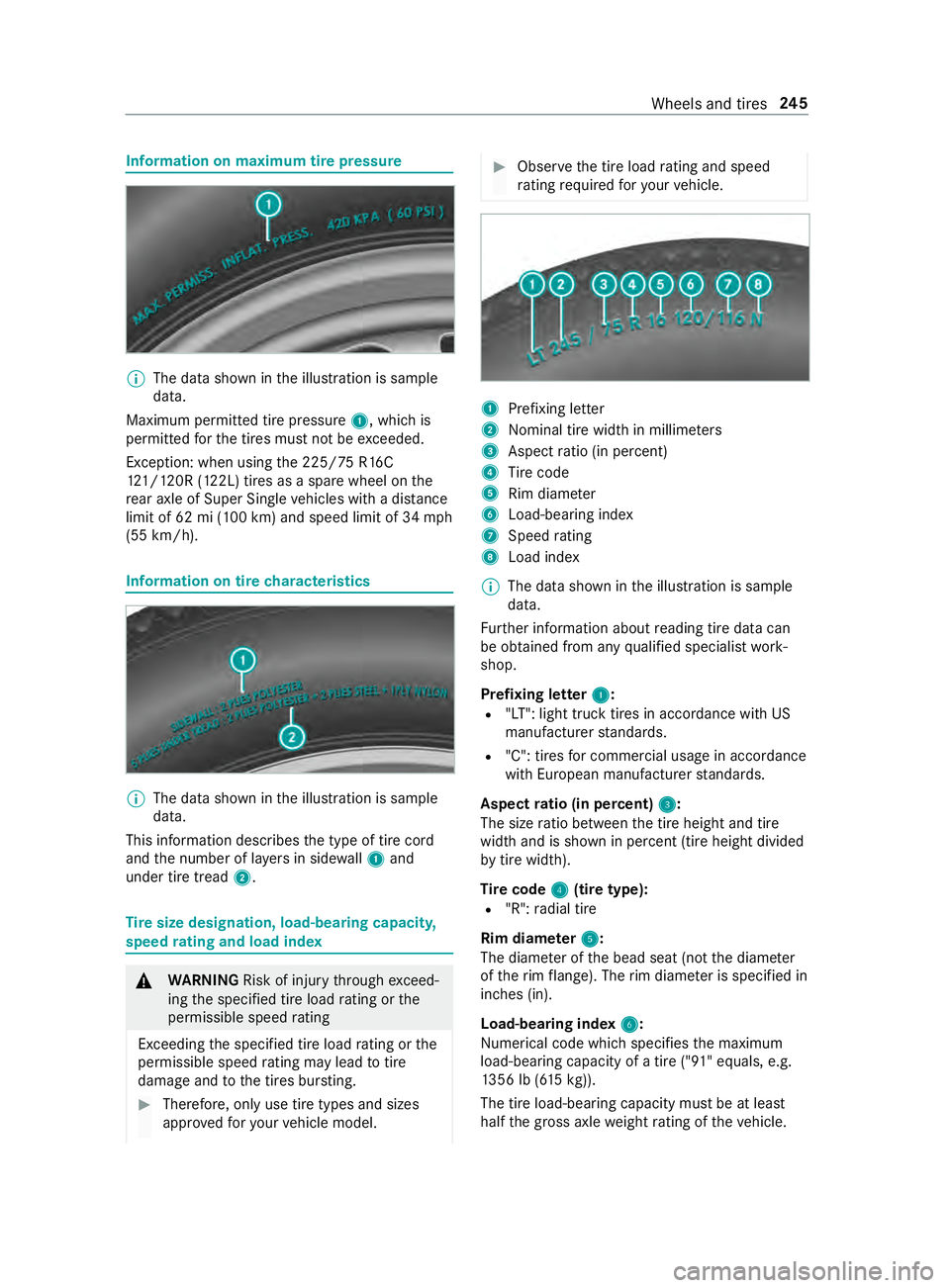
ra ting requ ired foryo ur vehicle. 1
Prefixing letter
2 Nominal tire width in millime ters
3 Aspect ratio (in pe rcent)
4 Tire code
5 Rim diame ter
6 Load-bearing index
7 Speed rating
8 Load ind ex
% The data shown in
the illustration is sample
data.
Fu rther information about reading tire data can
be obtained from any qualified specialist work‐
shop.
Prefixing letter 1 1:
R "LT": light truck tires in accordance with US
manufacturer standards.
R "C": tires for commercial usage in accordance
with European manufacturer standards.
Aspect ratio (in percent) 3 3:
The size ratio between the tire height and tire
width and is shown in percent (tire height divided
by tire width).
Ti re code 4 4(tire type):
R "R": radial tire
Rim diam eter 5
5:
The diame ter of the bead seat (not the diame ter
of therim flange). The rim diame ter is specified in
inches (in).
Load-bearing index 6
6:
Numerical code which specifies the maximum
load-bearing capacity of a tire ("91" equals, e.g.
13 56 lb (6 15kg)).
The tire load-bearing capacity must be at least
half the gross axle weight rating of theve hicle. Wheels and tires
245